We are developing the social individualist meta-context for the future. From the very serious to the extremely frivolous... lets see what is on the mind of the Samizdata people.
Samizdata, derived from Samizdat /n. - a system of clandestine publication of banned literature in the USSR [Russ.,= self-publishing house]
|
Never mind San Francisco or Hampstead, Brussels is the true home of the radical student left. Still as committed as ever to the anti-ismism crusades of the 1980’s, they continue to dig away at the foundations of our ‘bourgeois values’.
Seems they have just struck another seam:
The Commission is in the final stages of drawing up a directive to ban sex discrimination, with implications for the media, advertising and insurance industries.
The draft directive, revealed in Tuesday’s Financial Times, would leave it to the courts to decide whether programmes or advertisements were sexist or “did not respect human dignity”. An explanatory note says: “The purpose of this provision is to avoid throughout all forms of mass media all stereotypical portrayals of women and men, as well as any projection of unacceptable images of men and women affecting human dignity and decency in advertisements.”
The law could have profound implications for institutions such as Britain’s topless Page Three girls in The Sun newspaper and vast swathes of Italian television. Advertisers using sex to sell could also be affected.
If it wasn’t so offensive and inappropriate, I’d say that they’ve just discovered a motherlode.
The real devil in this detail lies with the apparently reasonable proposition to ‘leave it to the Courts’ thereby providing a fig-leaf of objective justice. Actually, though, this is a charter and blessing for looney-left activists to drag any number of advertising agencies and media companies through any number of Courts on pretty much any pretext they damn well please (as these things are usually drafted in the widest and vaguest possible terms).
However, in practice, this will only need to be done once or twice for the wicked capitalists to get the message and, in order to avoid the risk of a ruinous lawsuit, start censoring themselves. That is the ideal solution because why bother with all that messy and troublesome enforcement business when life is so much easier for the ruling elite if everyone just internalises their own repression.
The European Union: if it didn’t exist, we would not have to invent it.
One of the more feeble but less important things about the euro is the actual design of the banknotes. It was decided early on that the notes would show pictures of bridges, supposedly to symbolise “the close cooperation between Europe and the rest of the world”. However, due to the fact that there were not going to be enough notes to show a picture of a bridge from each Euro-zone country, the notes were instead designed with pictures of bridges that don’t actually exist, but which resemble (in terms of style) bridges that do exist somewhere in Europe. (To my eye, a remarkably large number of them resemble real bridges that are actually in France, but that might be just me). So, rather than drawing attention to the great cultural treasures that do in fact exist in the euro-zone, European money instead gives us a sort of homogenised blandless.
(Euro coins have one common side and one side that the country that would issues the particular coin into circulation can do what it likes with. Just as with the state quarters in the US, which the states got to design, the quality of the designs is variable).
In any event, it was nice to see on the front page of this morning’s Times (which Samizdata does not link to) that the people who design British coins do not go for such blandness. From 2004 to 2007 Britain (assuming it does not join the euro) is going to release a series of four new pound coins showing great British bridges.
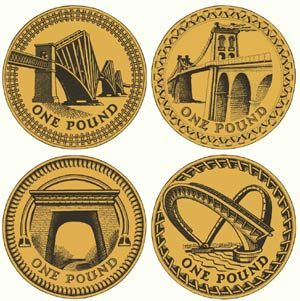
Of course, issues of everyone getting their turn come into this, too. As England, Scotland, Wales, and Northern Ireland all use the same coins, one of the four coins has to feature a bridge from each of the four constituent countries of the United Kingdom. (Curiously, the situation with the pound is the precise reverse of that with the euro. All of the UK uses the same coins, but England, Scotland, and Northern Ireland all have different banknotes).
This is where we get to the interesting part, which is the choice of bridges on the coins. Choosing for Scotland and Wales was undoubtedly very easy. Benjamin Baker’s Forth Bridge and Thomas Telford’s Menai Strait Bridge are so famous that it can’t have taken more than a moment to choose them. As for Northern Ireland, we have the rather more obscure Egyptian Arch from the Belfast-Dublin railway. Sadly, there are no really famous bridges in Northern Ireland, so we have to make do with what we have. I would rather a more famous bridge from somewhere else in the UK on the coin, but I guess Northern Ireland has to get a coin.
As for England, we have the very new Gateshead Millennium Bridge. This choice doesn’t impress me greatly, as I think the new bridge is more a piece of urban decoration than a piece of important infrastructure. (It illustrates that with modern super-strong materials, engineers and architects designing urban footbridges suddenly have immense freedom to be playful with the design of such bridges, as almost anything they can imagine has suddenly become technically possible and affordable. This is an interesting story, I am all for urban decoration, and I think the bridge is a very good example, but am not sure that this bridge is the right choice for a series of coins that celebrates great bridge building.
So what would my choice for the “England” bridge be? → Continue reading: Euro notes, British coins, and a tour of Britain’s finest bridges
Here is a quote from an opinion piece by David Heathcoat-Amory MP, the Tory party representative on the convention, published in the Telegraph:
No one in the convention doubts the scale of the undertaking or the huge implications for the way Europe is governed – except, apparently, the British Government, which is completely isolated in maintaining that the new constitution is just a “tidying-up exercise”. In the convention, this caused bafflement and then some hilarity. Peter Hain, the government representative, belatedly declared a number of “red lines” on proposals that he wants removed, such as majority voting on foreign policy, social security harmonisation, and interference in criminal justice procedures. But if these issues are so important to the Government, how can it just be a “tidying-up exercise”?
The truth is that the European Constitution founds a new union, with a single unified structure and legal personality. The existing structure, which secures the rights of member states to make their own decisions and collective arrangements about foreign policy and criminal justice matters, will disappear. The EU will have “exclusive competence” over trade, competition rules, common commercial policy, fisheries conservation and the signing of all international agreements.
Please read the whole article, it’s terrifying in its clarity. To be honest, I don’t know which bit I find more scary. The one about the changes to the UK legal system:
The EU’s proposed criminal justice powers are particularly striking because they allow for harmonisation of national laws and procedures by majority voting. This obviously goes to the heart of domestic policy, particularly for a country such as Britain with a distinctive common law tradition, including jury trials, habeas corpus and rules of evidence that differ from those in most other EU countries.
Or the one about foreign policy:
Foreign policy, which is at present decided between national governments, will change completely. The new foreign minister will “conduct the Union’s foreign policy”. There is provision for majority voting on policies recommended by the foreign minister.
None of the above is new and has been bemoaned on Samizdata.net many times, but it gets more frightening as the process of EU imposition on the UK progresses…

The proposed EU regulation of blogs and other forms of Internet speech being suggested by the Council of Europe (a quasi-governmental think-tank whose views have inordinate sway with the EU’s policy making elite) is very revealing about what lies at the heart of The Great European Project.
Steven Den Beste has written a rather good article on why the press is treated differently than broadcast media which use the finite resource of the electromagnetic spectrum. One can argue that as the EM spectrum is finite, it is reasonable to share out its use and as clearly not everyone can set up a radio or TV station, some rules to prevent the use of the media from becoming over mighty are justified. This is not quite how I see that issue myself but the contention is far from absurd.
One can even make the far less supportable assertion that because in reality setting up a newspaper is far beyond the means of most people simply because it is so expensive, the state should regulate the press, at least to some extent. Not surprisingly I flatly reject this notion and think the only defence individuals need against the established press are laws against libel. However the thinking behind this sort of regulation is at least easy to understand and can, if you accept the state as an essentially benevolent neutral institution (which I certainly do not), be seen as a way to prevent abuses of power by an over-mighty media corporation given the vast asymmetry of access to public opinion between a newspaper and an individual.
But when the Council of Europe start urging the EU to regulate blogs like this one, it should be clear that none of the arguments which can be applied to broadcast media and or the press apply here. As I mentioned in my previous article on this issue, if you have a cheap computer and a crummy modem, it still only takes about five minutes and no money whatsoever beyond your dial-up or broadband connection charges to set up a blog. There is no asymmetry of access to the public involved here. Granted, setting up an effective blog is another issue entirely, but simply getting viewable grievances in front of blogosphere eyeballs is simplicity itself.
So if anyone can set up a blog, and there is no finite resource in need of being allocated ‘fairly’ and there are no de facto capital related barriers to ‘market’ entry, what are we to make of this Council of Europe proposal to regulate us? → Continue reading: What is really going on in Europe?
People in the US, who take notions of Freedom of Expression and Private Property for granted, will be astonished by the latest steaming pile of wisdom to emerge from the clenched cheeks of our European would-be masters. Declan McCullagh reports:
The all-but-final proposal draft says that Internet news organizations, individual Web sites, moderated mailing lists and even Web logs (or “blogs”), must offer a “right of reply” to those who have been criticized by a person or organization.
With clinical precision, the council’s bureaucracy had decided exactly what would be required. Some excerpts from its proposal:
- “The reply should be made publicly available in a prominent place for a period of time (that) is at least equal to the period of time during which the contested information was publicly available, but, in any case, no less than for 24 hours.”
- Hyperlinking to a reply is acceptable. “It may be considered sufficient to publish (the reply) or make available a link to it” from the spot of the original mention.
- “So long as the contested information is available online, the reply should be attached to it, for example through a clearly visible link.”
- Long replies are fine. “There should be flexibility regarding the length of the reply, since there are (fewer) capacity limits for content than (there are) in off-line media.”
It’s pretty zany to imagine that just about every form of online publishing, from full-time news organizations to occasional bloggers to moderated chat rooms, would be covered. But it’s no accident. A January 2003 draft envisioned regulating only “professional on-line media.” Two months later, a March 2003 draft dropped the word “professional” and intentionally covered all “online media” of any type.
Read the whole article.
So what is the message to the EU I mentioned in the title? Simple:
We will not comply
We have a comments section on samizdata.net in which people can and do comment about what we write, but access to that comment section is at our capricious discretion. If we decide we want to IP ban someone or want to delete their remarks from our comments section because we think they are offensive, or even if they are not offensive but we just bloody well feel like doing it because we have a headache, then we bloody well will. This is our private property.
We are already hosted on a server in the USA and I am quite confident our hosters would tell the EU where they can stick any demands to yank us off the net because we decline to submit to political moderation of the form our free speech takes on our private property (i.e. the server space we rent from them). If we have to go entirely pseudonymous and log onto Samizdata.net in order to post via ‘dead drop’ servers rather than submit to EU regulation of how we manage the information on our blog, then that is exactly what those of us who post from within the rapidly emerging EU tyranny will do. We utterly reject political moderation of free speech in civil society. This is not about giving people a voice but rather about replacing social interaction (which is what true free speech is), with political interaction mediated and mandated by the state.
If these regulations become the law of the EU (as seems likely), we will not obey, we will not cooperate, we will not accept that anyone has a ‘right’ to reply on our blog. Do you think we have said nasty things about you and want to reply regardless of our unwillingness to let you use our comment section? Fine…go to blogger.com, sign up (for free), click on ‘create a new blog’ and voila… you have your own blog on which you can scream about how those mean old Samizdatistas ‘done you wrong’ to your heart’s content.
And if the EU says we have to let you comment… tough shit, it ain’t gonna happen. The people who write for Samizdata.net all now live next door to Samizdata Illuminatus, in Arkham, Massachusetts.
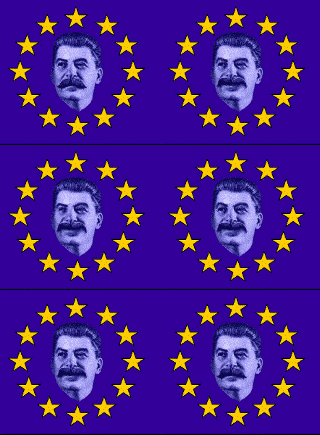
 
Having been involved in British libertarian circles since I was in my late teens about 18 years ago – god that makes me feel old – I have gotten used to the charge that the likes of us are crazed dogmatists. In Britain’s notoriously anti-intellectual culture, being interested in ideas, and worse, ideas which question the need for most of what governments do, is to be branded as a dangerous nutter. (Mind you, having read abusive comments directed at yours truly by various LewRockwell.com types, I feel almost quite moderate and middle-of-the-road these days.)
Step forward Aidan Rankin, who in The Spectator magazine, charges that eurosceptics within the Tory Party and among libertarian circles are the “new Trotskyists,” every bit as militant and dogmatic as the old left. In a way, that is a backhanded compliment of sorts because it shows that folk like Rankin are at least becoming aware of our existence, even though they prefer to construct straw men for the purpose of easy knock-down pieces rather than describe us more accurately. Anyway, let us fisk:
On Europeans and other issues the Tories are still impeded – not by indecision as in the recent past, but by an insidious ideological rigidity, a right-wing version of political correctness.
Huh? Really? Has the Tory Party, in recent years, called for, say, total withdrawal by this country from the EU? No. But to read Rankin you would assume that to be the case.
Public scepticism about the single currency is matched by the lack of public support for Eurosceptic campaigns. This is because even to sympathetic observers such campaigns appear so often to be bitter and bigoted.
He has half a point. I think the eurosceptic lobby would do better to focus on the essentially illiberal nature of the EU rather than on the fact that is being run by vile Frogs, etc. → Continue reading: Straw men
Here are extracts from a letter by Geoff Bean, an English dairy farmer, addressed to Steve Williamson, a “Special Enforcement Officer” of the agency in York. The York farmer bought builder’s rubble to make repairs round his farm, but received a letter stating that since his land did not have the benefit of a Waste Management Licence, this depositing of “waste” was in clear breach of the law and requesting that Mr Bean submit to a formal interview under the Police and Criminal Evidence Act (PACE) to “establish” his involvement in this unlicensed waste management operation.
I am in receipt of your pompous and ill-informed letter. How dare you write to me in such terms, as if you were addressing a common criminal.
The “waste” for which he had paid good money was about to be put to valuable use replacing the floor of a barn and resurfacing his farm tracks.
Were I a one-legged homosexual Afghan refugee/terrorist living on the welfare state, you and your ilk would not dare write in such a manner for fear of having all the human rights lawyers in creation round your necks, but as you are speaking to an honest, hard-working and overstressed Englishman, you appear to think you can behave like all too many of the vast and ever-increasing army of totally useless, non-productive, arrogant and bloody-minded officialdom, who are now only too successfully doing more damage to this once great and free nation than was ever achieved by Adolf Hitler.
Mr Williamson repeated that Mr Bean must submit to interview “under caution”. Mr Bean agreed to spare some of his valuable time to assist Mr Williamson in his “futile attempt” to justify his “bureaucratic red tape”, but reminded him that, since slavery in this country had been abolished, he would expect reimbursement at “£150 an hour or part thereof, plus VAT”.
That’s the spirit!
But rejoice ye not, since whether Mr Bean will face criminal charges for his breach of EU law, the agency cannot yet comment…
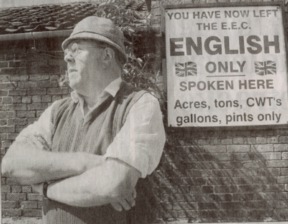
From Sunday Telegraph’s Christopher Booker’s Notebook
Update: If you think this is outrageous, you might want to share your thoughts with Mr Steve Williamson himself. And while you are at it, why not to cc his boss, the regional director Mr Andrew Wood. We have done a bit of research and think these email addresses will work, given the format of the Environmental Agency emails.
I don’t know whether we have just signed up to a new EU Constitution or not. Strange as it sounds, I truly have no idea. Judging from the opening paragraphs of this Telegraph report, it’s already a done deal:
To the strains of Beethoven’s Ode To Joy, the Convention on the Future of Europe proclaimed agreement yesterday on a written constitution for a vast European Union of 450 million citizens bringing together East and West.
Valery Giscard d’Estaing, the chair of the 105-strong body, held up a text that he said could be offered proudly to prime ministers next week as a permanent settlement for a free and democratic family of nations.
So is that it then? Are we now all Euro-serfs? Has the knot been tied, the deal been struck and all the irons shoved deeply into the fire? If so, well that was pretty sneaky of them, wasn’t it.
On the other hand, further down in the same article, there is room for doubt:
EU governments will have their chance to chip away at the 224-page text in an intergovernmental conference running from October to next spring, although Mr Hain said the essential architecture is now written in stone.
That sounds like there’s still room for an argument, doesn’t it? Though perhaps not much argument. More like wiggle room.
Well, I must confess I’m stumped. Like every other Euro-project it’s all camouflaged in double-speak and drenched in high-concept gobbledegook. Maybe salvation lies in the hope that possibly the EUnuchs don’t understand it either.
And of course I am sure he does not particularly care what I think either. In an article titled Europe and Liberalism, he notes that Ramesh Ponnuru has praised him for changing his mind about the European Union.
Sullivan now thinks the European Union is not such a good thing as he once thought and both he and Ponnuru have finally noticed that having the EU completely swallow Britain is also not in the national interests of the USA. In fact that Americentric utilitarian observation seems to be the entire basis for their opposition to The Great European Project. Massive regulatory statism? Dramatic erosion of due process? Ever higher taxes? ‘Fortress Europe’ trade barriers with the rest of the world? Spectacular corruption? Higher unemployment? No… the reason to finally start glaring at the EU across the Atlantic is to preserve the UK’s ability to support the US in foreign policy matters and to work for US interests from within the bastions of Fortress Europe.
This narrow utilitarian argument seems to be what has brought Sullivan to stop being a cheerleader for the EU without much of a nod to the idea that maybe the EU is bad for Britain. So whilst I am happy to see a fairly influential commentator like Sullivan stop arguing Britain should embrace the EU even more deeply, he has nothing whatsoever to contribute to the British domestic debate on the subject. In fact, the stated views of Sullivan play to anti-American sentiments within Britain so harmoniously that I really wish he would just shut the f**k up.
To argue that the reason Britain should not allow its national sovereignty and identity to be submerged by Europe is because it does not suit the United States, is to put many of the people who dislike the EU in Britain in rather a quandary. Many such folks dislike the EU because British interests matter far more to them that those of the EU… and for exactly the same reason they are also highly suspicious of the USA, seeing it as subordinating ‘our’ interests to ‘their’ interests. For an example of anti-EU sentiments allied to deep and festering suspicion of the USA, you need look no further than Air Strip One. I see little value in Sullivan actively kicking the none-too-tight lid off latent anti-Americanism with statements like:
Keeping Britain both in the [United States of Europe] and outside of it militarily, diplomatically, and monetarily should become a prime U.S. objective in foreign policy. Without it, the United States could lose its most valuable military and diplomatic ally.
But the fact is almost no one who actually (in theory) gets a vote on the subject, not even Atlanticist enthusiasts like myself, think US interests are more than passingly germane when trying to argue against Britain sleepwalking to the gaping maw of that half-dead and half-mad leviathan called the European Union.
It seems Sullivan is no fan of the social/cultural Anglosphere meme. What with him being a party political right-statist (a Republican) and only a passing commentator on things like objective rights and moral philosophy, I suppose it is not all that surprising to read him taking a highly collectivist ‘American national interests’ view of pretty much everything, but then this is precisely why his views are of little value in any positive way to people outside his American national collective.
I would argue that the Anglosphere does exist as a cultural vibe, but it is something that can be made a great deal weaker precisely by attitudes like Sullivan’s. The underlying cultural basis for UK political support for US actions in Iraq sprang from these very real Anglosphere notions. Yet if I thought the United States government was working to keep Britain inside a United States of Europe (just not too far inside) for its own interests and at our expense, which is to say working against people like me who are calling for the UK’s complete withdrawal from the EU, then I would be bulk purchasing US flags to burn in demonstrations in central London… and if a relentlessly Atlanticist Anglosphere person such as me thinks that, one can only speculate what less pro-American segments of popular opinion might think.
If the US government wants Britain as an ally, fine. But if it wants to sacrifice individual British people as political cannon fodder to mitigate the effects of EU power? Want to know where you can stick that? I will continue to regard US civil society as having many admirable qualities and still feel an Atlanticist affinity to it regardless… but at that point the US government loses its ‘lesser evil’ status for me and becomes just another enemy on every level as the last basis for having incidental common goals vanishes.
I am sick to death of the BBC, I really am. How anybody can even try to suggest that it is an objective news source is beyond me. The paranoid, ranting, ‘Little Englander’, anti-EU, xenophobic mentality is clear for all to see:
The 12-nation eurozone is in even worse economic trouble than previously thought.
How can this be anything but complete garbage? It is high time that the BBC was exposed as the extreme right-wing, capitalistic, Bushista, warmongering propoganda tool that it really is!
HMG is being high-handed, undemocratic and arrogant. That is the view of the British tabloid newspaper The Daily Mail on the refusal by the government to put the issues of the EU constitution and joining the single currency to the British public in a referendum.
In response, they have been running a campaign in the form of a ‘People’s Referendum’ which gives members of the public an opportunity to let HMG know how they feel and demand a formal, legally-binding referendum of these issues. The campaign ends at midnight tonight.
Whilst I can wholly sympathise with the sense of outrage and injustice that has driven this ‘voxpop’ campaign, I have chosen not to participate because, strange as it may sound, I do not want a referendum.
I do not wish to be too harsh on the organisers of this campaign or the proprietors of the Daily Mail. They are being far more proactive in advancing the debate in this country than just about any other organ of the fourth estate and, to the extent that the eventual result provides a bellweather of public opinion, it may prove useful in terms of boosting moral. But, tactically, to demand a referendum on these issues is to play right into the hands of the enemy.
I say this because with a government which is committed to the EU project, coupled with the ability to write out a blank cheque to enable them to realise their vision, a referendum is anything but the level playing-field that too many people fondly imagine it to be. There are loads of ways that the result can be pre-determined and HMG is almost certain to employ every single one them.
First off, the ‘yes’ campaign will have access to unlimited tax-payer funds while the ‘no’ campaign will have to rely on voluntary donations from their supporters. The (state-owned) BBC propoganda machine will be put into overdrive and current sceptical non-state media sources will be bought off or bullied into switching sides. Organised indepenence campaigns will be infiltrated with people who will start making nazi-type noises to the press at the right moment, thus giving the impression that the ‘no’ campaign is merely a fig-leaf for a scarey national socialist movement and, every day of the campaign will see dark, ominous op-eds in various established media outlets warning of the ‘dire economic consequences’ of a ‘no’ vote.
Added to all this, of course, is the distinct possibility that the actual voting figures themselves will be diddled. I wouldn’t put it past them. Even if that were not the case and, by some miracle, the ‘no’ campaign won a slim majority, we all know what happens next. Yes, that’s right, just as in Denmark and Ireland, we would have to endure another referendum in order to get the ‘right’ result.
In short, the referendum on the Euro and the Constitution will be as rigged as an 18th Century tea clipper. If the independence movement has put all its eggs in the referendum basket, then where does it go from there? The answer is nowhere. Having been spiked by the appearance of a ‘democratic consensus’ we will have no choice but to watch helplessly while Mr.Blair abolishes our country with a flourish of moral authority.
That is why I will not join in the voices calling for a referendum. I choose, intead, to demand complete British withdrawal from the EU and not to settle for any less. It is the only position which cannot be bargained away, compromised or outflanked.
Neither this nor any other government has the right to sign away the sovereignty of the British people and I do not accept as legitimate any show of hands which purports to provide it with the authority to do so. I demand independence and I will accept no substitutes.
A new EU directive, that goes into effect on July 1, will require all Internet firms to account for value added tax, or VAT, on “digital sales.” Computerworld reports how overseas Internet retailers may see their European profit push derailed by one of the oldest drags on business: tax.
The effect of the law will be an additional 15 to 25 percent levy on Internet transactions such as software and music downloads, monthly subscriptions to an Internet service provider and on any product purchased through an online auction anywhere in the EU.
The VAT tax is not new burden for European dot-coms that have been charging customers VAT since their inception. Their overseas rivals though have been exempt, making foreign firms an obvious choice for the bargain-hunting consumer. David Melville, general counsel of UK ISP Freeserve, a division of French ISP Wanadoo, rejoices:
It’s a massive competitive disadvantage. It’s good to see at last it being eroded.
Freeserve has lobbied furiously for the past two years to get the loophole closed, saying its chief rival AOL UK, the Internet unit of AOL Time Warner, saved 150 million pounds ($249.7 million) in tax payments over the years.
Shock, horror! How about lobbying the EU comissariat to abolish the internet sales VAT in the EU instead?! I thought not.
For example, on eBay, a UK seller will pay six pounds to list an automobile and 35 pounds for real estate, both 20 percent increases that include the UK’s 17.5 percent VAT charge. Some analysts predict that the new tax will decreases sales in the short term, which will hurt American dot-coms such as eBay and Amazon, given their expectations of higher growth in their overseas business.
But European firms feel justice have been done.:
The old way certainly gave non-EU companies a leg up during a very crucial stage in the development of the market.
Please note the assumption that it is acceptable for governments to meddle with competitive markets and ‘equalise the race’. The EU businesses behave in a way that is not surprising, they are happy to see their overseas competitors weakened, however, I fear their victory is rather Pyrrhic.

|
Who Are We? The Samizdata people are a bunch of sinister and heavily armed globalist illuminati who seek to infect the entire world with the values of personal liberty and several property. Amongst our many crimes is a sense of humour and the intermittent use of British spelling.
We are also a varied group made up of social individualists, classical liberals, whigs, libertarians, extropians, futurists, ‘Porcupines’, Karl Popper fetishists, recovering neo-conservatives, crazed Ayn Rand worshipers, over-caffeinated Virginia Postrel devotees, witty Frédéric Bastiat wannabes, cypherpunks, minarchists, kritarchists and wild-eyed anarcho-capitalists from Britain, North America, Australia and Europe.
|




