We are developing the social individualist meta-context for the future. From the very serious to the extremely frivolous... lets see what is on the mind of the Samizdata people.
Samizdata, derived from Samizdat /n. - a system of clandestine publication of banned literature in the USSR [Russ.,= self-publishing house]
|
David Holcberg of the Ayn Rand Institute makes some good points about the FCC’s proposed fines against CBS. If a Danish newspaper can establish that freedom of expression does indeed mean the right to do things that will offend some people, should that notion not also apply in the ‘Land of the Free’?
The $3.6 million in ‘indecency’ fines proposed by the FCC against CBS are an ominous attack on the freedom of speech protected by the First Amendment.
Just as the government does not fine newspapers that publish cartoons that Muslims deem indecent, it should not fine broadcasters that air shows that viewers deem indecent. Viewers are free to change the channel or turn off their TV set if they do not like what they see. They can not be forced to patronize a station they find indecent.
Moreover, it is the parents – not the government – who should be responsible for determining what their children are allowed to watch on TV.
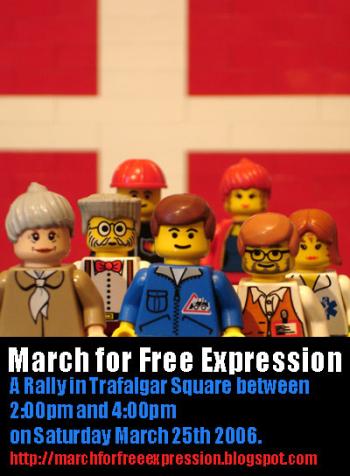
There is a rally going to be held in Trafalgar Square between 2:00pm and 4:00pm on Saturday March 25th 2006, in support of freedom of expression. Be there and show your support! There is also going to be a similar rally in Berlin on the same day and hopefully others organised in various cities if a critical mass of interest can be attracted.
A few weeks ago during a talk hosted at the Institute for Economic Affairs, I picked up a pamphlet written by Lawrence W. Reed of the Mackinac Centre about the life of Thomas Clarkson, a man who, in the late 18th Century, campaigned in print to ban the slave trade. While characters such as William Wilberforce or T.B. Macaulay may be more widely recognised for their role in outlawing this vile business, it was Clarkson who in many ways provided much of the intellectual ammunition. (His name is probably not greatly known and the first thing that sprung to my mind was whether he was the ancestor of British motoring journalist and TV personality Jeremy Clarkson.)
Clarkson wrote an essay for a prize at Cambridge University, and chose to write on the subject of slavery — then a booming industry enriching many a Briton. For the remainder of his life, he campaigned tirelessly, sometimes even to the point where his own life was put in physical danger. But as we know, victory was eventually secured.
Why do I mention this tale? I do so because it is fashionable amongst a certain type of person to decry the importance of ideas, of individual campaigners against injustice and oppression, and to claim — with the benefit of 20/20 hindsight, of course — that slavery, and other monstrosities, only declined because of economic or other forces. But even though there is some truth in ascribing changes to these things, as this Wikipedia entry accepts, it still requires the energy and commitment of actual people to force the pace of change. We do not know, for instance, how long slavery might have persisted under the British Empire had people like Clarkson not bothered to campaign against it. It is fair to assume, however, that it ended a good deal sooner than otherwise and hence millions of people probably owed what freedoms they had to people such as this fellow.
It is sometimes a bit depressing to be a libertarian in a country where freedoms are being stamped on as they are at present but frankly I have no time for self-pity, and stories like that of Thomas Clarkson are an inspiring example of how good people with ideas in their heads and fire in the belly can make a difference. Clarkson is a great British hero.
The British pub chain JD Wetherspoon has decided to postpone a ban on smoking in all its pubs, although a nation-wide ban will come into force at the start of 2007, due to the government’s new law. A rather ironic tale.
How odd. In many ways, JDW was a good example of how, in a free market, people who wanted a quiet pint without breathing cigarette smoke or listening to loud music could do so. In my own area of Westminister, there is a large chain called the Willow Walk which I and a number of friends use from time to time. Everyone is happy, smokers and non-smokers alike. Considering that the majority of the adult population do not smoke, one would expect plenty of entrepreneurial pub and restaurant owners to cater to the tastes of said public, and indeed many such businesses have developed.
But of course, markets are messy and full of tradeoffs. And for our tidyminded masters, that is unacceptable.
The Guardian’s Jenni Russell points out that the attitude of British officialdom is changing subtly.
I find this change truly frightening because I spent the first few years of my life in apartheid South Africa. My parents were political activists, and we lived in an atmosphere of fear. My mother’s relations distanced themselves from her, fearing that they too would be targeted if they associated with us. My earliest memories are of police raiding the house at night, emptying out dolls’ cots and sweeping books off shelves. People would simply disappear. A black friend left our house to travel to his family in Zululand, and vanished.
After a month of inquiries, someone found a witness who had seen him being picked up by the police. He was being held without charge under the 90-days legislation – the same policy that the government is trying to introduce here. The relief when we came to England was incalculable. This country, these policemen and this government were benign, reasonable and trustworthy. As my father never ceased to point out, a Britain that had fought fascism had a deep-rooted commitment to protecting the individual from the state.
That is no longer true. ID cards are one danger, but there are other measures which are already a reality. […]
I fear that many of us are failing to see the danger we are now in, precisely because we have grown up in a largely benign state. We still trust in the good sense and reasonableness of its agents, and the rest of officialdom.
However, I think she is wrong about the cause:
This change in the relationship between people and officials can only be explained as a result of the new illiberal atmosphere in which we are living.
That’s back to front. An illiberal attitude is insufficient for oppression or we would be living under the dictatorship of the Free Church of Scotland. It is actually about power. Unchecked power will be abused. Not may, will.
You cannot change the culture of the law – Blair minor – without affecting the culture of the land. British police were once famous for courtesy. But then as little as twenty years ago they had few powers not available to the ordinary citizen. They relied on voluntary cooperation for much of their authority, and the reasonable exercise of that authority yielded general cooperation.
Before the merger of the agencies, the Inland Revenue was proverbially gentlemanly and reasonable compared to HM Customs and Excise, though the taxation functions were very similar. The difference in culture wasn’t accidental. Customs had vastly greater powers and found it easier to rely on fear to do the job.
ASBO-land is a different place from England. And this is why: as they gain more capacity to order us about, those in office will order us about more. What else?
The PM implies he wishes us to ‘respect’ one another and social norms. He claims he has given powers to officials to make it so. But respec’ on the streets will mean something else. It will mean respec’ (in the sense of fawning obedience) towards the same officials who have the powers to make it so. And as we have ever fewer rights – perhaps not even existence – without their say-so, truculence, swagger and oppression by officials will become the norm.
Perry de Havilland wrote in this post that
all insulting behaviour (short of actual incitement to violence), blasphemy and ‘holocaust denial’ laws are an intolerable abridgement of freedom of expression and must be abolished, now!
Why is incitement to violence an exception? When a violent act is committed, why should a citizen capable of standing trial be able to claim that they were incited as some kind of mitigating circumstance? Is there not a legal expectation in nations respecting the rule of law that an adult capable of standing trial is a thinking, responsible individual? And thus, if said individual claims to have been ‘incited’ to violence, surely the point is that at some stage that person has decided to physically remove the rights of another. Grandma’s favourite scold – “if someone told you to jump off a cliff…” – applies in spades.
I cannot see how an ‘incitement to violence’ is any different to racist ‘hate speech’ – something that is censured but not censored by most supporters of liberal values. Surely a liberal believes that personal responsibility is central pillar of liberty. Criminalising incitement to violence further divorces personal responsibility from individuals, thus further justifying the existence of an overmighty State.
Incidentally, I am sure I am not the only one who would like to know further details of Perry’s run-in with David Irving.
At the same time Jyllands-Posten in Denmark is valiantly establishing that freedom of expression is a core western value and that the right to say what you will does indeed include the right to say what some people may find offensive… a court in Austria has in effect sided with Islamic extremists by sentencing ‘historian’ and fantasist David Irving to three years in jail for upsetting Jewish sensibilities by making preposterous claims about the Nazi Holocaust.
Am I the only one who sees the sickening irony of protecting Jewish feelings ending up giving aid and comfort of Islamic bigots who want to prevent the publishing of anything they find offensive? I can just hear them now: “Oh, so upsetting the Jews gets you thrown in jail but anyone can upset the Muslims…”
Dr Romain, rabbi of Maidenhead Synagogue, said: “I welcome yet another public rebuff for David Irving’s pseudo-historical views, although personally I prefer to treat him with disdain than with imprisonment.”
And that, Rabbi, is the sign of a mature and freedom loving disposition. What a pity that more Muslim clerics do not take such a view when their sensibilities are offended and their community starts howling for the state to ban offensive remarks as Austria has done in the case of David Irving. Had Jyllands-Posten been an Austrian rather than Danish newspaper, it would be hard to make the argument that there was clearly a legal right to offensive (and therefore free) expression.
And before people in the USA get too smug, this is not just a European issue. Let me ask you this: do you support making burning the US flag illegal? If so, then clearly you agree with the Muslims that free speech does not include the right to offend people.
Time to clean house: all insulting behaviour (short of actual incitement to violence), blasphemy and ‘holocaust denial’ laws are an intolerable abridgement of freedom of expression and must be abolished, now!
Update: Stephen Pollard and Oliver Kamm have broadly similar views.
Look, I have got a cold coming on. I do not really want to post about this. But, for the record (and because this is Samizdata, dammit! We may not be able to stop the passing of liberty but we of all people should toll the bell) David Irving should not be jailed. Historical opinions, however deluded and malevolent, should not be criminalised.
Reuters reports that the hunting with hounds is more popular than ever despite the move by parliament last year to outlaw the hunting of foxes with hounds. (Incidentally, foxes are increasingly a problem in the cities as they scavenge for food. I used to live in Clapham and the place was full of them).
It makes me wonder about whether the vote by MPs this week to ban smoking in public places, including private members’ clubs, will be easily enforced. Let’s hope it meets the same fate as the anti-foxhunting measure. I say this as someone who does not smoke or hunt on horseback (despite being a Suffolk farmer’s son, hunting with hounds never appealed, although I have shot the odd bunny rabbit from time to time).
MPs have just voted in favour of making it compulsory for Britons to have an ID card when they apply for a passport. Bastards.
Our home grown authoritarians plan to inflict yet more absurd measures which have nothing to do with defending ourselves against terrorism. ID cards would not have stopped a single terrorist attack in the UK: they are a control measure designed to make taxing and regulating people’s economic activities easier, nothing more. Yet because there is a genuine threat from Islamic terrorists, the government keeps trying to conflate ID cards with ‘doing something about terrorism’. As it is so obviously untrue, this issue makes a rather good quick and easy litmus test to detect people who are either complete idiots or barefaced liars (or both).
Moreover the intend to make ‘glorifying terrorism’ illegal is not just bound to backfire, it is a terrible idea on every level. You would think people in the dismal halls of Westminster would have learned to leave well enough alone given the comical absurdity of past attempts to ban terrorists saying things in the UK, which lead to such farcical situations as having Sinn Fein/IRA’s Gerry Adams’ voice being dubbed by other people’s voices to get around attempts to stop him airing his views. We need people to actually say what they think and the more vile they are, the more important it is to hear what motivates them.
Moreover does anyone seriously think people are attracted to actively support terrorism because of what they read in a mainstream newspaper rather than opinions closer to their every day life? It is a bit more complex than that and again you would think the experience of Ulster would have shown that when terrorists gain the support of a section of a society, all stoping their spokesmen from talking in the media does is prevent everyone else from understanding what they really think.
The BBC and mainstream media generally has followed the government line that there is a large pool of moderate Muslim opinion which does not support or sympathise with radical and intolerant Islamic views. I too have assumed this to be the case, at least in some measure, and yet as time goes by the theory is starting to look rather threadbare as if there really is a majority of moderates out there, they are more than just silent, they are almost invisible. The organisers of the demonstration yesterday in Trafalgar Square carefully choreographed the event to show the world a moderate face of muslim opinion standing hand in hand with a few dhimmis like Ken Livingston and select useful idiots such as Pax Christi and former KGB front man Bruce Kent. Yet it took less than 24 hours for one of the people behind the demo to reveal his true colours.
But any attempt to shut these people up with the law will not stop them saying whatever they want amongst their own community, unless the government plans to have multi-lingual spies reporting on what gets said in every single mosque and Arabic/Turkish/Kurdish/Pakistani social club in Britain. The only people who will no longer know what these guys really think will be the rest of us. And given that anyone who trusts the what the state says to decide who is and is not ‘the bad guys’ is a credulous fool, that is not a good idea to say the least. Yet again we see why freedom of expression is not just important, it is essential if we are to know our enemies as well as our friends.
Muslim Action Committee are calling for changes to the law in Britain to implement an aspect of sharia law and they want the British state to do it for them. What they want is to legally ban people from displaying pictures of Mohammed, the seventh century warlord who founded their religion, because it annoys them. Never mind that showing images of this historical figure does not threaten them with violence or prevent their exercise of religion, they want to make it illegal to annoy them.
They are planning to stage a protest march in London on 18 February, expecting to attract 20,000 to 50,000 people. I hope the number is considerably larger because I am sure as hell going to be there expressing my views as well.
If they get their way, we will undoubtedly be prosecuted as Samizdata’s response to this islamo-fascist proposal will be a “Mohammed Picture of the Day”, each day and every day until hell freezes over or we run out of server space. Intolerant Islam does not like being annoyed? Well guys, you ain’t seen nothing yet, I promise you that. Our Dutch friends at The Amazing Retecool are a fairly good place to start for interesting interpretations of Mohammed’s image.
If this ever becomes law and I personally get dragged into court over what Samizdata will most certainly do, rest assured that as we are hosted in the USA we will remain on-line and ‘expressive’ regardless, even if I have to ‘host’ myself in the USA a few years earlier that I expected. So to all your intolerant Islamic fascists out there who think it is within your power to silence all the voices you dislike, with all due respect (i.e. none), you are very much mistaken.
|
Who Are We? The Samizdata people are a bunch of sinister and heavily armed globalist illuminati who seek to infect the entire world with the values of personal liberty and several property. Amongst our many crimes is a sense of humour and the intermittent use of British spelling.
We are also a varied group made up of social individualists, classical liberals, whigs, libertarians, extropians, futurists, ‘Porcupines’, Karl Popper fetishists, recovering neo-conservatives, crazed Ayn Rand worshipers, over-caffeinated Virginia Postrel devotees, witty Frédéric Bastiat wannabes, cypherpunks, minarchists, kritarchists and wild-eyed anarcho-capitalists from Britain, North America, Australia and Europe.
|