We are developing the social individualist meta-context for the future. From the very serious to the extremely frivolous... lets see what is on the mind of the Samizdata people.
Samizdata, derived from Samizdat /n. - a system of clandestine publication of banned literature in the USSR [Russ.,= self-publishing house]
|
A very small silver lining to the very large dark cloud that overshadows these violent times is that the war on drugs – that is to say the “war” on a particular form of unhealthy behaviour – no longer gets the prestige it once did. I think someone is feeling left out.
Police have claimed new successes in the war on drugs in central Scotland.
Officers have swooped on nearly 20 homes in the Falkirk, Stirling and Clackmannanshire areas in the past week as part of Operation Overlord.
They called it Operation Overlord?
In today’s Times Daniel Finkelstein reminisces.
There used to be a free-market libertarian bookshop in Covent Garden. It sold pamphlets on things such as how to cut crime by giving criminals tradeable vouchers. Or you could buy a T-shirt with a Warhol-style print of Friedrich von Hayek. You should have gone while you still could. It has closed down now — supply exceeded demand.
Little does he know where a new supply can be found, bwa-ha-ha-ha….
What’s wrong with tradeable vouchers for criminals anyway? Works for Ankh-Morpork.
“Whom do I lobby to if I want to change international law? Whom do I vote for? If anyone knocks on your door between now and Thursday, ask ’em that. If they can come up with anything remotely within their jurusdiction, vote for ’em.”
– a Biased BBC commenter known as ‘Alton Benes’
A review written by Keith Windschuttle has appeared in National Review. The book reviewed is The Anglosphere Challenge by James C. Bennett. (N.B. updated link allows access to US, British or Canadian Amazon and lets you read some of the book content.) I liked the book and liked the review and want to talk about them.
Let me start with a disclosure: I have biffed many an email to and fro with Jim Bennett, and have had the pleasure of meeting him once at one of Perry’s blogger parties. The ease with which that came to pass is of interest in itself. I cannot exactly remember how I went from hearing my husband say, ‘some bloke on the radio was talking about something called the “Anglosphere”‘, to talking to said bloke at a party. But it was not difficult and the internet was involved at all stages. There is nothing new about an interlocking network of informal communities (sustained by the exchange of letters) that include authors and people interested in their ideas, and whose existence is enlivened by the odd party. However what is new is that the ease of formation of such micro-communities has vastly increased. Their transaction costs have decreased.
People exchanging their writings (including but not limited to blogging) and ending up at the same parties are found at one end of an axis against which are plotted possible meanings of the word “community.” The quantity changing as one moves along the axis could be informality, size, fluidity, non-exclusiveness (in the sense that you can belong to many of them) or voluntariness: for any of these variables the resulting spectrum would still show the same types of community appearing in the same order. Libertarians by definition like the fact that email-swapping, partygoing micro-communities are voluntary, and they also tend to have a preference of taste for the fact that they are small, fluid, and non-exclusive. → Continue reading: Evolving political forms and common culture: the Anglosphere
John Quiggin of Crooked Timber has posted about a fascinating legal case. Two Chinese players of an online game acquired a valuable virtual sword. What happened next?
One of them borrowed it and sold it for about $1000. The other player went to the police without result, and eventually confronted his partner, and in the ensuing argument, pulled a knife and stabbed him to death. It’s sad that this happened, but the most interesting aspect for those not directly involved is the question of whether the seller had committed a crime, and if so what.
Perhaps some Samizdata readers who are lawyers or gamers or both can help him out. (Although F. Gregory Lastowka and Dan Hunter already have written a paper.)
Even more interesting than the legal question is the evolution of the game worlds in ways, good and bad, that the designers don’t anticipate or want. A commenter to John Quiggin’s post, Keith M Ellis, says:
But it strikes me that the game designers have some oddly familiar problems on their hands: they want a particular outcome, but people self-organize in ways that make it very hard to simply engineer that particular outcome.
The libertarian angle on that is obvious. Is the Hobbesian outcome that some (apparently rather a high proportion) of the players seem to go all out to make others have a bad playing experience a challenge to our worldview?
Yet another aspect is the interaction between the game world and the real world. Another commenter, “asg” says:
In World of Warcraft, there are two factions (the Horde and the Alliance). Players from the two factions aren’t allowed to communicate across faction lines—they can’t talk to each other, mail each other, group with each other, etc. Some enterprising players discovered that, while the game garbled their speech for players on the opposite side, it didn’t garble digits or punctuation, so someone developed a code to allow cross-faction communication. The latest patch put an end to that.
For some reason I thought of this from the point of view of the fictional game characters, not the players. The thought of the characters in the game world, forbidden to speak to their enemies, yet finding a way to communicate by going outside the bounds of their own reality, would make a story worthy of Philip K Dick.
I had intended to make the following excerpt from an essay by George Reisman, Education and the Racist Road to Barbarism, a Samizdata Quote of the Day:
Today, the critics of “Eurocentrism” rightly refuse to accept any form of condemnation for their racial membership. They claim to hold that race is irrelevant to morality and that therefore people of every race are as good as people of every other race. But then they assume that if people of all races are equally good, all civilizations and cultures must be equally good. They derive civilization and culture from race, just as the European racists did. And this is why they too must be called racists. They differ from the European racists only in that while the latter started with the judgment of an inferior civilization or culture and proceeded backwards to the conclusion of an inferior race, the former begin with the judgment of an equally good race and proceed forwards to the conclusion of an equally good civilization or culture. The error of both sets of racists is the same: the belief that civilization and culture are racially determined.
However I have changed my mind. Partly this is because Adriana has got in first with a quote of the day from the estimable Terry Pratchett, but also it is because Reisman’s essay is sucking great quotes out from my typing fingers like an unstoppable brain-eating science fiction monster, with the difference that my brain seems actually enhanced by the process. A single QotD is not enough to fulfil my compulsion.
Here is another memorable passage:
For the case of a Westernized individual, I must think of myself. I am not of West European descent. All four of my grandparents came to the United States from Russia, about a century ago. Modern Western civilization did not originate in Russia and hardly touched it. The only connection my more remote ancestors had with the civilization of Greece and Rome was probably to help in looting and plundering it. Nevertheless, I am thoroughly a Westerner. I am a Westerner because of the ideas and values I hold. I have thoroughly internalized all of the leading features of Western civilization. They are now my ideas and my values. Holding these ideas and values as I do, I would be a Westerner wherever I lived and whenever I was born.
Food for thought here:
I believe that the decline in education is probably responsible for the widespread use of drugs. To live in the midst of a civilized society with a level of knowledge closer perhaps to that of primitive man than to what a civilized adult requires (which, regrettably, is the intellectual state of many of today’s students and graduates) must be a terrifying experience, urgently calling for some kind of relief, and drugs may appear to many to be the solution.
I believe that this also accounts for the relatively recent phenomenon of the public’s fear of science and technology. Science and technology are increasingly viewed in reality as they used to be humorously depicted in Boris Karloff or Bela Lugosi movies, namely, as frightening “experiments” going on in Frankenstein’s castle, with large numbers of present-day American citizens casting themselves in a real-life role of terrified and angry Transylvanian peasants seeking to smash whatever emerges from such laboratories. This attitude is the result not only of lack of education in science, but more fundamentally, loss of the ability to think critically–an ability which contemporary education provides little or no basis for developing. Because of their growing lack of knowledge and ability to think, people are becoming increasingly credulous and quick to panic.
I found the essay via Abode of Amritas.
Though the pictures seem pretty, as a Christian, I probably would not care for the new book by Gerhard Haderer, an Austrian cartoonist. He depicts Christ as a “binge-drinking friend of Jimi Hendrix and naked surfer high on cannabis.” What daring iconoclasm! In 1905, maybe. In 2005, apart from six nonagerian nuns living in enclosed orders and a few hobby-protesters, nobody gives a monkeys.
Yesterday if anyone had made the slightest suggestion that the furore that results from writing such a book qualified a man to be regarded as some sort of martyr for free speech, I’d have retorted that the “furore” had probably been budgeted for to the last euro by the publishers. “Regrettably, Herr Haderer, the market for Christian outrage is not what it was, and we cannot agree to your suggested advance.” Or I’d have suggested that if he wants to play martyr he could try it with the Muslims, who are more likely to enter into the spirit of the game.
But by the holy bowels of Jimi Hendrix, the poor little poseur really is in danger of arrest. And do you know why? Because of the European arrest warrant, that’s why. An Austrian cartoonist and writer faces extradition to Greece (Greece: why does that not surprise me?) for something he wrote in Austria. I assume that Austria has no law, or dead-letter law, against blasphemy. So he wrote something that was legal in Austria but not in Greece, and now he faces extradition to Greece. He did not even know his wretched book had been published in Greece.
I found this via Public Interest. Peter Briffa points out that when this law was introduced much was said by its sponsors about extraditing foreign criminals to Britain … and very little about the extradition of British people to foreign countries for “crimes” that might well not be crimes at all in Britain.
Perhaps some legally knowledgeable reader can tell me if there is anything at all to stop this happening to, for instance, a British Samizdata contributor, if the authorities in some foreign capital should take a dislike to something he or she had written.
If you don’t like what the label on your clothes says – the size or the brand name – cut it off.
(From a beauty book or a women’s magazine, I forget which. Sublime wisdom, whatever the source.)
In a detailed post about about the Identity Cards Bill Chris Lightfoot makes this point:
…Hilariously, they haven’t even fixed s.12(4) in which
The things that an individual may be required to do under subsection (3) are–
(a) to attend at a specified place and time; […]
— this is the same as in the draft, and they haven’t even bothered to add `reasonable’ as many responses to the consultation suggested. Presumably if some bored Crapita employee does send out a notice of the form,
You are required to attend the summit of Mt. Snowdon at 0300h tomorrow morning so that we can take your fingerprints; failure to attend will be punished by a civil penalty of £1,000. Do not pass `go’.
the courts will eventually tell him to go fuck himself, but we have to wait to find out.
I am happy and relieved by the result of the US election. I thank those who campaigned, volunteered or just plain voted to keep the right man at the helm.
All the same, I take literally the statement that democracy is the least worst form of government.
Many here argue that we do not need any government at all. It is not going away any time soon, though. Most anarchists and minarchists will concede that modern liberal democracy is fertile ground compared to the despotic wasteland that makes up most of history, even if it is not yet a garden of libertarian delights.
I figured out as a child that the least wonderful aspect of a modern liberal democracy is that it lets the majority decide: the tyranny of the majority is to be feared. Votes are a mechanism to deal with the fact that some administrative variables affecting many people (speed limits, for instance, or surrenders) must be set at a predictable value for a recognisable group, or bad stuff happens.
I also figured out as a child that the good soul of a liberal democracy, the thing that has made us the most fortunate human beings in history, is the idea that every individual matters. None of us can be made to stop mattering because we look wrong or do wrong. That’s why every individual has certain rights that cannot be…
…OK, OK, I had better stop myself before I re-hash the Declaration of Independence in much inferior prose. You know all this. You can probably cite references. Please do!
It is a pity it ever has to come to voting. Votes by definition make some people sad. Yet we go on and on about majorities and mandates and elections and other things to do with the regrettable majoritarian aspects of our system. We talk much less about how the only reason that counting people matters is that people count. And, as we on this blog know, it is a constant struggle to defend individual rights against the majority.
I just wondered, is the reason that we so exalt the rule of the majority over the more fundamental principle of equality before the law simply because we picked the wrong ruddy name for our system of government? Everybody knows that we don’t mean by democracy what the Greeks meant by it. We don’t have ostracism. We don’t have slavery. These prohibitions are not mere differences of custom but integral to the system. The difference between our ‘democracy’ and theirs is precisely that we believe in inalienable rights and equality under the law. So whose bleedin’ stupid idea was it to call our system the Greek word for “people-rule?” It was sure to give folk the wrong idea. If we had just called it isonomy instead we would all be a lot better off.
A series of posts on Crooked Timber criticise pro-Iraq war libertarians, mentioning this blog in particular. The posts (and still more the comments) differ in their degree of charitability to our position but the general thrust is ‘… can we think of a new name for libertarians who think it’s a good idea to invade other countries and overthrow their governments, like maybe “shmibertarians”?’
Apologies to those who have heard me saying this before.
It is all much simpler than you think.
When I see my house burning down I do not wait for the evolution of private fire brigades.
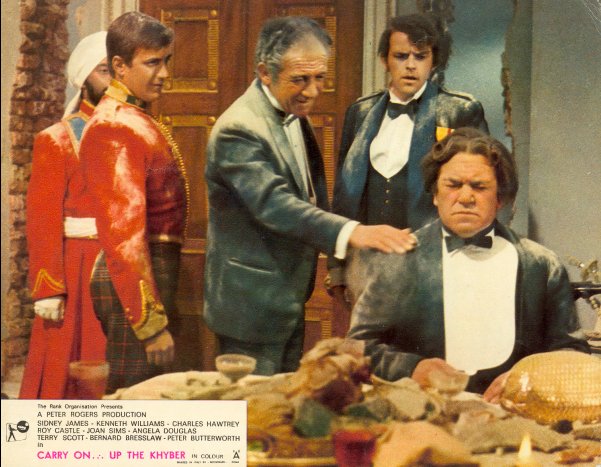
One of my favourite scenes from the funniest ever Carry On film, Carry On Up The Khyber, comes right at the end when the villanous Khazi of Khalabar (Kenneth Williams) discourteously attacks the Residence while Sir Sidney Ruff-Diamond (Sid James, of course) and his good lady wife (Joan Sims) are having a formal dinner.
In a gloriously demented show of stiff-upper-lippery the assembled diners refuse to admit that anything is happening. The musicians play on even while the ceiling falls in and the walls crumble. Change our ways because some dashed foreigners are set to slaughter us? By Gad, Sir, next you’ll be asking us to pass the port to the right!
Robert Fisk and the other staff of the Independent probably do not often think of themselves as Sons of the Empire. But I was rather struck by the headline an unknown sub-editor gave Fisk’s front-page Independent article yesterday. The article commemorated the third anniversary of the terrorist attacks of September 11 2001 – when the crumbling walls and the slaughter were, alas, real rather than part of a movie. The headline said: “We should not have allowed 19 murderers to change our world.”*
* = full story archives here.
|
Who Are We? The Samizdata people are a bunch of sinister and heavily armed globalist illuminati who seek to infect the entire world with the values of personal liberty and several property. Amongst our many crimes is a sense of humour and the intermittent use of British spelling.
We are also a varied group made up of social individualists, classical liberals, whigs, libertarians, extropians, futurists, ‘Porcupines’, Karl Popper fetishists, recovering neo-conservatives, crazed Ayn Rand worshipers, over-caffeinated Virginia Postrel devotees, witty Frédéric Bastiat wannabes, cypherpunks, minarchists, kritarchists and wild-eyed anarcho-capitalists from Britain, North America, Australia and Europe.
|






Recent Comments