We are developing the social individualist meta-context for the future. From the very serious to the extremely frivolous... lets see what is on the mind of the Samizdata people.
Samizdata, derived from Samizdat /n. - a system of clandestine publication of banned literature in the USSR [Russ.,= self-publishing house]
|
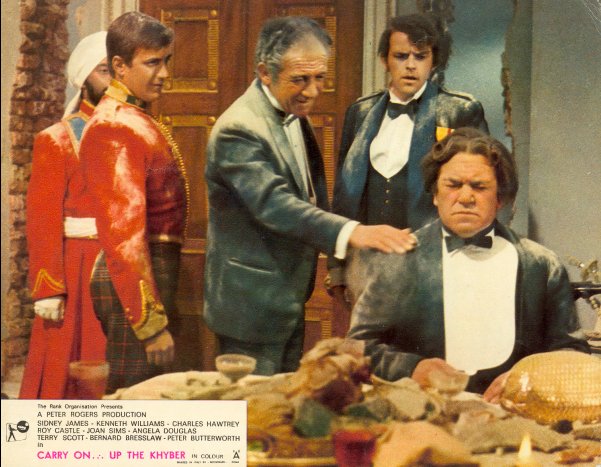
One of my favourite scenes from the funniest ever Carry On film, Carry On Up The Khyber, comes right at the end when the villanous Khazi of Khalabar (Kenneth Williams) discourteously attacks the Residence while Sir Sidney Ruff-Diamond (Sid James, of course) and his good lady wife (Joan Sims) are having a formal dinner.
In a gloriously demented show of stiff-upper-lippery the assembled diners refuse to admit that anything is happening. The musicians play on even while the ceiling falls in and the walls crumble. Change our ways because some dashed foreigners are set to slaughter us? By Gad, Sir, next you’ll be asking us to pass the port to the right!
Robert Fisk and the other staff of the Independent probably do not often think of themselves as Sons of the Empire. But I was rather struck by the headline an unknown sub-editor gave Fisk’s front-page Independent article yesterday. The article commemorated the third anniversary of the terrorist attacks of September 11 2001 – when the crumbling walls and the slaughter were, alas, real rather than part of a movie. The headline said: “We should not have allowed 19 murderers to change our world.”*
* = full story archives here.
It will be found from the Foreign Prints, which from time to time, as Occaſion offers, will be mention’d in this Paper, that the Author has taken Care to be duly furnith’d with all that comes from Abroad in any Language. And for an Aſſurance that he will not, under Pretence of having Private Intelligence, impoſe any Additions of feign’d Circumſtances to an Action, but give his Extracts fairly and Impartially ; at the beginning of each Article he will quote the Foreign Paper from whence ’tis taken, that the Publick, ſeeing from what Country a piece of News comes with the Allowance of that Government, may be better able to Judge of the Credibility and Fairneſs of the Relation
– from the The Daily Courant of March 11, 1702. The Courant was probably the world’s first daily newspaper.
Bloggers might not like the next bit:
Nor will he take upon him to give any Comments or Conjectures of his own, but will relate only Matter of Fact ; suppoſing other People to have Senſe enough to make Reflections for themſelves.
They are not artefacts, they are not animals, they are not a tourist attraction, they are people. They do not belong where animals do, they belong in settlements, villages, towns and cities like you and me.
– Sydney Tshepiso Pilane
This is an account of my wildly fluctuating sympathies as I gradually found out more about a legal case launched by the Bushmen of Botswana.
I first saw the story on Ceefax. It’s disappeared from there, so I can not quote, but I got the impression that the Bushmen had been evicted from the Kalahari game reserve and that the (possibly dishonest) reason the Bostwana government had given for evicting them was that it could not afford to provide services. Riiight. I powered up for Welfare Rant #2 on the way that welfare systems start by offering their clients services and end by making the ‘services’ compulsory and demanding that people live their lives in such a way as to allow the government to fulfil its side of the forced exchange with minimum inconvenience.
Then I thought, not so fast, Natalie. → Continue reading: Kalahari Bushmen, New Age Travellers and the paradoxes of state welfare.
I have a problem with Rowan Atkinson. He only has to open his mouth to set me off laughing. Bob.
Maybe we should start taking him seriously. Every few years Mr Blunkett takes it into his head to publicly demonstrate that he is not as other men are, extortioners, unjust, adulterers, or even as this publican, by making a new law against incitement to religious hatred and Mr Atkinson stands up to argue against him. This is what happened in 2001 and that is what happened again the other day in the pages of the Times, and on Radio 4’s Today programme where I heard him, waiting for a joke that never came.
The joke is indeed a long time coming. Freedom of speech in this country did not merely arise during a period of violent religious divisions but because those divisions were insurmountable by any means other than allowing liberty for all.
We at Samizdata are always happy to awe. When the occasion merits we also do our best to agitate, derange and discommode.
Basically the only tenable defence against our collective awesomenosity is to flatter our socks off. What a very sweet thing to say, Mr Goldberg, and me likey you fine.
“Our landings in the Cherbourg-Havre area have failed to gain a satisfactory foothold and I have withdrawn the troops. My decision to attack at this time and place was based upon the best information available. The troops, the Air and the Navy did all that bravery and devotion could do. If any blame or fault attaches to the attempt it is mine alone.”
– Memo composed by General Eisenhower, 5 June 1944.
Today, we commemorate one the most glorious chapters of German arms: the lightning-fast response of 21 Panzer Division to Eisenhower’s overconfident thrust, a response that rolled up the British left flank and culminated in the annihilation of the British and American invaders.
How appropriate it is that, lacking the the confidence in race-destiny that comes so naturally to the Germanic peoples, the Allied commander had actually composed his memo taking responsibility for failure beforehand!
Despite the somewhat tense international situation, the commemorative ceremonies have proceeded with our customary German precision. It is certainly a sign of how the bitter memories associated with the dawning of the atomic age over Hamburg, Smolensk and Manchester all those years ago have faded that for the first time we have welcomed to our remembrance the President of France, speaking from Vichy by audio-visual link, and the General Secretary of the British Communist party speaking from London. Many have seen in this technical and political triumph a sign of a possible convergence between the two great systems, National Socialism and Communism, that currently dominate our world.
I just found out about the latest Al-Qaeda beheading. I haven’t seen the video. Probably I never will.
I thought of Daniel Pearl. I wondered how and when the murdered man’s family learned of the manner of their son’s death. I wondered if he himself knew what was about to happen, as Fabrizio Quattrocchi did.
And such is the unalterably tactical nature of the human mind that mixed in with all that I thought:
Thanks for the reminder, Hellspawn. No thanks for the killing; we’ve had enough of that, but thanks for the reminder. In all this agonized talk about what we are, we were beginning to forget what you are. What you stand for.
What your pictures show.
Andrew Sullivan thought the same way, evidently:
And they [Al-Qaeda] are as stupid as they are evil. Iraqis now have contrasting images. Do they want to be run by people who cut innocent people’s throats at will or by people who have removed a dictator and are investigating unethical abuse of prison inmates? Zarqawi has now done something for our morale as well as his. He has reminded us of the real enemy; and he has reminded the Iraqis. One simple question: will CNN now show these video stills?
‘Underground, overground,
Wombling free,
The Wombles of Wimbledon Common are we.
Making good use of the things that we find,
The things that the everyday folks leave behind.’
I was half watching one of those interminable nostalgia programmes on TV last night when my intention was caught by the voice of Bernard Cribbins, whose vocal intepretation of the flawed yet quietly heroic role of Orinoco (not to mention Tomsk, Wellington, Tobermory, Madam Cholet and Great Uncle Bulgaria) in The Wombles will forever have its place in the hearts of all who heard it.
Among the many interesting things he said (did you know that all those endearing dithery mutters were ad-libbed?) was that Womble-fixated kiddies used to go to Wimbledon Common and drop litter there in the hope that a Womble would come and take it away.
This proves something. I am not sure what, but something.
I am currently re-reading Are We At War?, a collection of letters to the Times 1939-1945. (Pub. Times Books 1989.) Here are some extracts from letters on the subject of identity cards:
From a letter from Antony Wells:
Sir, -While obtaining, recently, a National Registration identity card for my small daughter, I remarked that it was pleasant to think all this bothersome business would soon no longer be necessary. I was blandly informed by the clerk that my expectation was quite wrong, since registration was to continue after the war. On looking at the card in my hand, I discovered it was valid until 1960.
In happy fact, identity cards were seen off as a result of a court case soon after the war. But the fact that the government saw fit to plan for them to expire so many years after issue shows how purported “emergency measures” have a way of becoming permanent. The letter was written in December 1944 and the war was quite clearly nearing its end; the government could not have seriously believed it would go on until 1960.
This second extract comes from a letter from (Baron) Quickswood:
…Such cards may seem only a small inconvenience, but they are seriously dangerous to liberty in two ways: -First, they facilitate all sorts of further regimentation of citizens, and that is, of course, why it is desired to retain them; secondly, they have a most mischievous moral effect in treating the individual as a numbered item in the aggregate that makes up the State. There lie before us two alternative conceptions of the State: it may be thought an organization useful to individuals and essentially their servant, or it may be thought a pagan demigod for whom the individual exists, whose service is his greatest glory and whose supremacy is without limit.
…We have to fear an Anglicized totalitarianism, humane and benevolent but esentially destructive of personal liberty and initiative; and there will be a strong coalition of philanphropists and bureaucrats eager to regulate their fellow-citizens. We must be jealous for our liberties, and to begin with must resist being numbered by convicts in order to facilitate our servitude.
I have nothing to add to that.
In his latest post Chris Bertram of Crooked Timber gives the background to, and an unedited version of, his letter in today’s Guardian.
I agree with every word of his letter. Paticularly the bit about scavenging for soundbites that the Guardian edited out.
Judging from what I’ve read in blogs and the press about Cavanagh’s unreconstructed views, he did not put forward the standard libertarian argument that to forbid racial discrimination is to violate the human right of free association. (The standard libertarian view is the view I hold. It is quite compatible with thinking that in all but a few special situations racial discrimination is morally wrong, a view I also hold.) According to Edward Lucas in a letter further down the page, “We invited Mr Cavanagh [to the ICA debate that started all the fuss] as a leftwing critic of equality of opportunity. He argued, for example, that it leads to an overemphasis on competition between individuals.”
In other words the views I hold would be even more likely than Mr Cavanagh’s to be described as pyschotic by David Winnick MP, a member of the Commons Home Affairs Select Committee. As described by the Guardian this prominent Labour MP’s own views appear close to totalitarian. He does not merely think it is pyschotic to oppose the discrimination laws he thinks it is psychotic even to question them.
That’s us lot for the loony bin then.
Still, you never know with the Guardian. Tomorrow we might be treated to the amusing spectacle of Mr Winnick saying that he was quoted out of context, just like Mr Cavanagh before him.
Kids in Lee county, Florida are being thumb printed every time they get on or off a school bus. Yes, you read that right, thumb printed, in the name of safety. Could somebody please explain to me how thumb printing a kid when they get on or off a school bus increases their safety by one iota?
Is there any stupid idea that someone, somewhere won’t try and implement in the name of almighty safety? Good lord, this just boggles my mind! And what’s really sad is that these kids are going to grow up with this, never knowing a time when you didn’t just present your thumb print or any other identifying feature whenever asked. They’ll be used to constantly being surveilled and tracked, their lives fed into a computer and analyzed — all for their own good, of course. They’ll also never know a time when they didn’t have to watch anything they did or said because ears are everywhere and there is always some dipstick with a moronic zero-tolerance (zero-thought, more like) policy ready to toss you out on your ear should you say or do the slightest thing they might not like.
I read these stories, I wonder what kind of generation is being raised under these ludicrous “safety” rules, and I despair.
– Myria of It Can’t Rain All The Time
“God made the 20th Century to teach us that the notion that things work better when experts plan them is a fallacy. It’s a pity that a hundred-million or so had to die to illustrate the lesson. But now we got it. Right?”
– John Weidner
|
Who Are We? The Samizdata people are a bunch of sinister and heavily armed globalist illuminati who seek to infect the entire world with the values of personal liberty and several property. Amongst our many crimes is a sense of humour and the intermittent use of British spelling.
We are also a varied group made up of social individualists, classical liberals, whigs, libertarians, extropians, futurists, ‘Porcupines’, Karl Popper fetishists, recovering neo-conservatives, crazed Ayn Rand worshipers, over-caffeinated Virginia Postrel devotees, witty Frédéric Bastiat wannabes, cypherpunks, minarchists, kritarchists and wild-eyed anarcho-capitalists from Britain, North America, Australia and Europe.
|