We are developing the social individualist meta-context for the future. From the very serious to the extremely frivolous... lets see what is on the mind of the Samizdata people.
Samizdata, derived from Samizdat /n. - a system of clandestine publication of banned literature in the USSR [Russ.,= self-publishing house]
|
Philip Chaston is a regular contributor to the Airstrip One blog. He believes that the current political climate in Britain presents an exciting and unique opportunity.
Last Monday I went to the University of London Union to watch a concert given by the band British Sea Power. With me were a couple of friends, a carpenter and a handyman from South London. Just prior to the gig, I had been assailed by their voluble and bitter complaints while we downed some pre-concert alocohol in the Toucan Bar which is just around the corner from Soho Square in Central London.
The level of dissatisfaction with the government and the public services in London and the South East has risen over the last few years as people have seen their taxes rise without any perceived improvement in public services. This has been linked to increasing concern over levels of immigration. As my friend said, “I’m going to vote BNP in protest. Who else can I vote for?” → Continue reading: The Protest Vote
Tedd McHenry writes in with some creative musing on an idea that would allow even the most extreme privacy fetishist to harness a splendid cost minimizing technology whilst keeping the user shielded from intrusive data mining. With apologies to John Donne for the editor imposed title.
This idea was inspired by Highway 407 in Toronto, Canada, which is a toll highway. I do not know if it is privately managed, but it could be. I am very interested in both toll roads and private roads, which have been discussed before on samizdata.net. Highway 407 solves the toll-collection problem with two technologies. When a car enters and leaves highway 407 its licence plate is photographed, and that information is used to bill the owner for the distance traveled on the highway. Regular users can get a subscription wherein they mount a transponder on their car, which makes billing easier (and gives them a discount). Both of these technologies make toll roads much more viable by making toll collection cheaper and easier. But they both entail a very serious compromise of privacy, in that someone collects information on where and when your car travels.
The solution that occurred to me was to have, for lack of a better name, a privacy agent through which a car owner could subscribe to the highway. The transponder would be registered to the agent, and the agent would collect from the car owner. There would be no way for the bill to be tied to any actual person or vehicle.
Then it occurred to me that this system could be generalized for any service. You could interact with governments and markets through your privacy agent, much as subscribers to anonymizer.com interact with the web. Privacy agents could provide credit and debit card services allowing you to buy any product or service anonymously. Where a service requires identification (name, social insurance number, etc.) you would simply provide your privacy agent account number (and a PIN, to prevent fraud). Your public identity would be somewhat like a corporation, but with a reversal: whereas a corporation limits the liability of its owner but must publicly declare who he is, this body would not limit the liability of its owner but would also not publicly declare who he is.
There must be some holes in this plan, other than the obvious difficulty of selling it to politicians, but I am not coming up with them on my own. Any thoughts?
Tedd McHenry, Surrey, BC, Canada
Nick Timms recounts a new yet sadly familiar tale of how the state just sees us as things to be managed for its convenience. The state is not your friend.
My friend Ron, a semi-retired gentlemen, who after a working life fairly high on the corporate greasy pole, now pursues several different activities including taking his pedigree dogs to shows and sitting as a magistrate, told me today about a visit he had recently from an employee of his local planning office.
I should explain that first he had a visit from the local environmental health department because a lady neighbour of his had complained about the smell of his kennels.
Ron has kept fairly rare pedigree dogs for showing for the last fifteen years and he is meticulous about hygiene and cleanliness. His home is in a semi-rural area backing onto some woods and running behind his house is a pathway used by some of the locals as a shortcut. This area is also frequented by foxes and the dog foxes mark their territory with a particularly pungent urine. Apparently when Ron’s bitches are in season the dog foxes make a special effort and spray the whole area thus causing the offending stink.
Ron showed the environmental health officer around his kennels and the officer was apparently satisfied that he kept his dogs in a good and healthy manner.
However, very shortly after this he was visited by the local planning department. His visitor told him that as he kept more than six dogs at his home he had to apply for change of usage. Ron asked for what usage he should apply and was told he should apply as a breeder. Ron explained that he was not a breeder as he only occasionally had litters and he kept the pick and sold the rest only to what he considered would be good homes. He did not do this as a commercial venture so he was not a breeder.
He was told he would still have to apply for change of usage because case law indicated that local town planners could decide for what purpose he used his home and they had decided that having more than six dogs was one of their criteria. (Apparently all homes are granted rights of usage when they are registered and the local planning office can withdraw or alter these rights.)
Ron asked how much this application cost and was informed that it was around £250 [note: about $400]. Ron then asked would his application be approved and was told “No” because the local planning office wanted him to appeal so that they could have a test case. The appeal application would cost Ron another £200-£300. And he could still lose the case.
Ron resorted in the end to telling his officious visitor that he was a local magistrate and that under the Human Rights Act – and he made up some paragraph – the local planning office was unlikely to win the argument.
This seems to have silenced the secret police for the moment, although they may just have decided to pick a softer target. Ron is anxiously awaiting further developments but as he commiserated to me, his council tax went up by nearly 20% this year which is probably paying for more little führers who cannot get a real job.
Nick Timms

Matthew O’Keeffe also feels the same pangs as Johnathan Pearce at the passing of that magnificent artifact of the 1960’s
I had mixed feelings watching the footage of Concorde’s last flight today.
Concorde belongs with Eurotunnel in the category of things which should never really have been built – at least not by profit-seeking realists. This may even be unfair to Eurotunnel which will now be with us in perpetuity and was built with private money. Concorde, by contrast, was financed by the British and French taxpayers at the behest of the very ridiculous Tony Benn (as Minister for White Hot Technology or some such nonsense). And now it is heading for the scrapyards.
And yet, and yet, through the 1980’s and 1990’s Concorde was the very symbol of the bull market. The shock troops of capitalism could lunch in London before having dinner and closing their deals in New York (it never really made sense the other way round, incidentally, on account of the time differences). As Jeremy Clarkson put it on the radio today, fast is good.
I travelled on the rocket only once myself – and that was the day after the Paris crash. I had a business trip to Wall Street planned that week, purely by chance. Meanwhile, all the supermodels, actors and other weak-kneed types had cancelled their Concorde tickets leaving British Airways happy to upgrade me from Club World to Concorde – with a seat in row one to boot! I was almost ecstatic as we went through the sound barrier and promptly ordered a bottle of their finest champagne – much to the disapproval of the partners from Goldman Sachs who were siiting next to me. Happy days …
One of the more striking statistics of 9-11 is that Concorde lost 40 of its frequent flyers. I’m not sure how many Concorde frequent flyers there could have been but my guess would be not more than a few hundred. Concorde has suffered from the slump in the stock markets on either side of the Atlantic in general but from the particular horror of 9-11.
To end on an optimistic note, historians may look back on this day as the real start of the next big upturn in the world’s economies. One thing that denotes economic cycles is that companies nearly always invest too heavily at the top – and cut back too savagely at the bottom. (British Airways is particularly bad in its timing – they sold Go for £100m to venture capitalists who sold it on to EasyJet a year later for £400m). That our national carrier should retire its flagship, on a route between the two centres of world capitalism, suggests to me that we may be at such a trough point right now. So farewell Concorde – but here’s to the next twenty year bull market.
Matthew O’Keeffe
Patrick Crozier has a modest plan for the rejuvenation of London…
With the mayoral election less than a year away I feel it time that I declared my hand. OK, so this is not entirely serious. Any candidacy would need funds, an organisation, assembly candidates and all those involved would have to realise that it wouldn’t have a prayer and that the only purpose of the exercise would be to secure publicity. But if we did have all those things this would be my manifesto. That’s the great thing about manifestos: they’re cheap.
Some Observations and Some Basic Principles
London is a great city – after all, it’s home to most of Samizdata’s writers. Millions of people would seem to agree with them coming here from all over the world to find a better life for themselves. But London seems to be getting worse when it could be getting a lot better. In particular it suffers from three major problems: crime, transport and property prices. My aim, if elected, would be to: reduce crime by 90%, reduce property prices by 50% and to make getting around the city a simple and predictable (if not necessarily cheap) business.
I believe that civilisation is at its best when people are free. It is freedom which promotes prosperity, innovation and responsibility. And yet for 100 years we have been chipping away at freedom, progressively heaping taxation and regulation upon a once free people with results that are all too plain to see. If London is to be better then first it must be free.
Housing
Property is too expensive. With a three-bedroom house costing six or seven times the average wage, millions are postponing and even abandoning the idea of having children. This is hardly a sustainable state of affairs. Prices are high because demand is high and supply is low. The answer is to increase the supply.
If elected I would abolish all planning laws and all building regulations. Immediately, people would start to build. Up mainly. And why not? We shouldn’t be scared of living in flats. Many people around the world enjoy good quality high-rise living where raising a family is as easy and as pleasant as living in a semi-detached. All that we have to do is to allow it to happen. I believe that by scrapping the regulations we will see the development of all sorts of new ideas in architecture as well as a massive increase in capacity. We might well see the development of self-build (people designing their own houses) as is seen in places like France and Spain.
Would we lose all our nice old buildings? Some, for sure, but do we really need all of them, especially as there is a chance we might get some nice, new ones in exchange? → Continue reading: Crozier for Mayor
After reading Natalie Solent’s article called A law-abiding person has nothing to hide?, reader Matt Judson wrote in with this cautionary tale as a case in point. The camera does indeed lie.
I have read with interest your posts on security cameras, and the threat they represent. I was especially interested in your post on the idea that law-abiding citizens have nothing to fear from security cameras and other surveillance technology, because I was recently unjustly accused of vandalism due to security video.
I recently moved to Nob Hill in San Francisco. Nob Hill is justly famous for the lack of parking; After a few weeks of struggle, I surrendered, and chose to pay $255 per month to park in the Masonic Garage.
Purely by coincidence, my friend works in IT for the Masonic Center of San Francisco, which oversees the garage. Friday morning, he sent me an email: “Emergency: call me now! This is not a joke.” I called him, and he told me that the garage manager had asked for his help in emailing security camera video. The garage had caught someone keying a car on camera; they identified the suspect because he drove off a few minutes later, and they had his license plate number. They wanted to send the video to the owner of the car, so that the owner could take it to the police and file charges.
When he looked at the video, he was shocked to see that I was the suspect on the video. He did not think that I was the kind of person who would vandalize a car, but he thought I looked very suspicious on the tape. If he had not known me, he would have sent the video off without a second thought.
I told my friend that I have never keyed a car in my life. That was me on the tape, no question. I knew what I was doing when I was on the camera: I checked for my car on one level, but did not see it; I then turned around, thought about heading for the stairway, and then decided to take the elevator to the next level. I did all of this next to the car that had been vandalized.
At lunchtime, I went to the garage to speak to the garage manager. I told him that it was not me, and asked him to review the tape carefully. He replied that the garage had already reviewed the tape carefully, and they were convinced that they had the right person. He suggested that I call the car owner and try to work out a deal so that I would not be charged.
My friend believed me, and spent the rest of the day reviewing video. Two days after I was caught on video, he found video of a group of teenagers doing something to the car in question; when the teenagers noticed the security camera, they covered their faces and ran away. My friend took the video to the manager, and forced him to call me to apologize. His apology was grudging, of course: “Your friend found someone who was maybe more suspicious than you were.”
If it had not been for an incredible stroke of luck, I would have been in for a major headache, perhaps charged with a crime. The initial reviewers of the video tape were completely untrained in viewing video; they did not bother to review the tape carefully; the way they passed on their suspicions resulted in a psychological set that I was guilty; if I had not had a close friend in the process, it would have been very hard to convince anyone of my innocence. Lastly, the garage was going to pass the video on to the owner of the car without telling me; if the car owner had seen me in the garage and recognized me from he video, what would he have done?
Law-abiding people do indeed have something to fear from security cameras.
Matt Judson, San Francisco
Steve Dasbach reminds us that ‘conservative’ George Bush loves big government and grandiose new bureaucracies just like his predecessor did
In the two and a half years since George W. Bush took office, 2.7 million Americans have lost their jobs. The vast majority (2.5 million) have occurred in manufacturing, prompting the President to announce a bold, innovative new program to boost manufacturing employment.
He’s going to – drum roll, please – appoint a manufacturing czar [the proposed formal title: Assistant Commerce Secretary for Manufacturing and Services].
It’s a classic political move. If a president wants to make it look like he’s doing something, but has no idea what to do, he appoints a ‘czar’. However, a ‘Manufacturing Czar’ will do nothing to help the millions of Americans who have lost their jobs.
President Nixon started the trend in 1973 by appointing John Love as Energy Czar. Of course, his appointment did nothing to help solve the energy “crisis”, leading President Carter to up the ante and create the Department of Energy. That didn’t accomplish anything either, other than create a gigantic new bureaucracy.
Since then, we’ve been blessed with Drug Czars, Heath Care Czars, Aids Czars, and Privacy Czars, to name just a few.
President Clinton even appointed a ‘Counter-Intelligence Czar’ just before he left office, charged with developing:
a national counterintelligence strategy identifying and prioritizing the keys to American prosperity and security. Informed by such a strategic analysis, the czar will then coordinate the efforts of the intelligence, defense and law enforcement communities.
We saw how well that worked on September 11, 2001. → Continue reading: Wishing upon a Czar
Brian Micklethwait did a posting a blog age ago (on Saturday) about higher education, and commenters have been gouging occasional lumps out of each other ever since. Normally such comment wars can be left to the consenting adults (or not-so-adults) directly involved. However, the latest comment (number 47) in this particular ruckus is such a choice one that it deserves a separate posting here. Brian not sure if it is entirely fair to its victim, but he loves it anyway.
Guessedworker,
I am very far from being an idealist, I am however an ideologue in that I am a consistent advocate of the doctrine of pure anarcho-libertarianism.
You are quite right that the dogmas of the liberal left are a menace and they need to be refuted, I spend much time doing that whenever I encounter such people, especially the marxoid greens who abound. However also a threat to liberty are the equally pernicious dogmas of the social conservatives, of which you are an advocate. I do not think that the state should be supporting or oppressing any groups at others expense. You may not want to sort out the laudable traits in people but I certainly do and the only way to do this meaningfully is to allow the market to work.
There has been nothing like a free market in personal behaviour and self expression for the last forty years. There has been instead a mixture of on the one hand repression and on the other hand state subsidy of fecklesness. This looks to you like a free market because you haven’t the first idea of what a free market actually is. It may well be that we have an ‘eternal nature’ as you say but your narrow and clumsy understanding of it is a useless guide to policy, it is the dumb interplay between the fools on the left and you fools on the socially conservative right over the last forty years that have brought forth the ‘rivers of pain’.
For my own lifestyle I seek no subsidy but I certainly will not tolerate any repression. I want not equality but freedom.
Paul Coulam
The Guardian reports that ID cards are to be pilot tested in ‘a small market town’ by the home office. Biometrics will be tested – facial, iris and fingerprint recognition systems.
I am horrifiied that the government is inching towards making us instantly identifiable and knowing too much. Once they have ID cards they will be that much nearer to integrating tax and passport systems, no doubt under the cover of anti-terrorist rhetoric. “To be controlled in our economic pursuits means to be…controlled in everything” said Hayek. To control us they need to know us, this is a fight we must not lose.
Paul Staines
Ed. update: White Rose has more on the subject as it keeps a closer eye on issues of ID cards, privacy, surveillance and other vagaries of state…
Kevin Connors talks about a certain British civil servant with a licence to kill, er, drive
Bond purists know that there are only two ‘proper’ cars for 007 to drive, an Aston or a Bentley. But for many years, while the British auto industry decayed, neither Aston or Bentley produced anything James would be caught dead in (book readers might recall Gardner gave him a Mulsanne Turbo in 1984). But over the last decade, the British Car business has been undergoing a renaissance, riding a wave of American and German capital and technology. The fruits of this are really starting to come now. Two years ago, Aston Martin (now owned by Ford) introduced their beautiful V12 Vanquish, seen in last year’s Die Another Day. But still, relative to the breathtaking Ferrari 575M Maranello, it’s only real competition, most automotive commentators declared it an also-ran. (While the comparison is far closer than that of the classic DB5, introduced in Goldfinger, and the 1964 Ferrari 500 Superfast, to say nothing of the incomparable 250GTO. Even the Lamborghini 350GT and Maserati 3500 GT, would likely have cleaned the DB5’s clock.)
Now, all that is behind us. After many teases, Bentley Motor Cars, (now owned by Volkswagen) is finally releasing their latest masterpiece, the Bentley Continental GT:
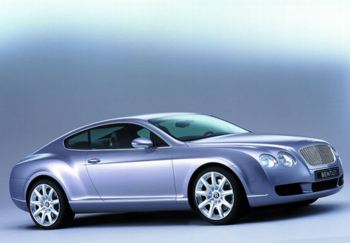
It has no competition.
This 4 passenger, 5000lb, W-12, AWD monster does 0-60 in 4.7 seconds, the same as a Porsche Carrera. It tops out at 198 mph, faster than all but a handful of 2 seat super-exotics. All this while coddling the passengers in the lap of luxury.
With plenty of room for Q to hide toys, this is a car Commander Bond would love. Of course, the next car 007 actually drives will be determined by the real world consideration of how much the manufacturers are willing to pony up in product placement money. And, although the producers know the fans want to see Bond in a British car (and not a plastic toy Lotus, even if it does go underwater), If Toyota forked over enough, James might be driving the new Supra.
BUT WAIT!
There’s a new player on the scene
I didn’t consider this at first, because of the leading name on the moniker. However, on further consideration, there’s likely more actual British engineering and manufacturing content in this than the Bentley. Ladies and gentleman, coming in about six months, I give you the revolutionary Mercedes-Benz SLR McLaren:
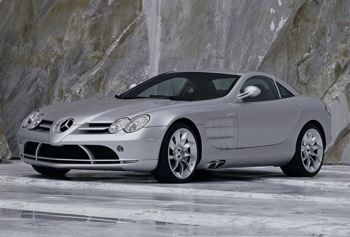
As opposed to the Bentley’s porcine two and a half ton mass, carbon composite construction helps keep the SLR to a svelte one and three-quarters. This, along with slightly greater horsepower (580, not 605 as stated on spec. sheet), shave a full second off the Bentley’s 0-60 time. Top speed is 211 mph. A handful of currently available automobiles are in the performance league with the SLR: the Lamborghini Murcielago (also VW, btw), the Pagani Zonda C12-S 7.2, the Ferrari Enzo, and the Saleen S7. But all these are, to one degree or another, racing cars for the street. The SLR promises to be the first super-exotic that’s also a viable daily driver.
Of course, the SLR costs (before Q-izing) two or three times the price of the Bentley. But, to Her Majesty’s Government, it’s just chump change seeing as they have all those taxpayers to call on.
R K Jones eschews the crudity of opening a can of whoop ass and prefers to see rebellion served up in shot glasses
Those obsessed with fine whiskeys are perhaps already familiar with Malt Advocate magazine. Those with functioning livers may think of it as the Guns & Ammo for the discerning tippler. Each issue contains detailed looks at the international trade in liquor, almost always with an anti-regulatory bent. People expect to see reasoned support for free trade in the pages of the Wall Street Journal, or (sometimes) The Economist, but a drinks trade magazine? One doesn’t expect to buy a glossy, high-end specialty liquor magazine for the political commentary, but the current quarter’s issue (sadly, only teasers are available on-line) is worth a look. Any forum where a prominent American distiller opens his portion of a panel discussion (concerning regulation and taxation of the industry) with the words…
We need another Whiskey Rebellion
…is worthy of support.
Given the international, and free trading character of the liquor industry, I suppose the only real surprise should be that the paper mache puppet head brigade hasn’t yet begun picketing distilleries. Does the tone of the magazine mean anything about a change in attitude in the world? Or am I deceiving myself? I don’t know, but writers of a libertarian bent going back as far as Ayn Rand (and further) have been criticizing businessmen for a lack of ideology. Thus it is nice to see an industry niche publication that ‘gets it’.
Self-deception may be central to the human condition, and not exclusively confined to libertarians. However we often seem to have a particularly wide streak of it when it comes to looking at the world around us for signs that others may some day come round to sensible views. Just the same, it is always pleasant to see indications precisely that may indeed be happening.
RK Jones

Phil Bradley observes a nasty combination: voodoo science allied to voodoo economics
The European Parliament’s adoption last week, of ‘the world’s first Kyoto Protocol mandated multi-national emissions trading scheme (ETS) covering greenhouse gases’ gives me an opportunity to rail against the biggest government instigated boondoggle in the history of the world – namely the Kyoto Climate Change Protocol. Yes, it still rumbles along, destroying prodigious amounts of wealth without producing any measurable benefit. 117 countries are now signatories, although it has no material effect on most of them, except to funnel some money from rich countries into projects of dubious value. The latest signatory is Switzerland, who, reading between the lines, did so under pressure from the EU.
No one really knows how much Kyoto is costing, or how much it would cost were it to be fully implemented, which it never will be. All we do know is that it both reduces growth and diverts resources into economically pointless activities. This link estimates that by 2010, Kyoto will cost the UK around US$35 billion a year, and result in the permanent loss of half a million jobs. Reams of left-wing econo-babble has been written on how Kyoto will actually increase investment in windmills or whatever and stimulate economies. The simple fact remains that any increase in resources to produce the same result necessarily makes us poorer.
The Kyoto Protocol is an object lesson in what happens when you combine agenda-driven leftists with some dodgy science, a media that is mostly ignorant about most things, and politicians who want to be moral and righteous irrespective of the cost to the taxpayer. Bring them together in a UN sponsored framework that is not accountable to anyone, and you have the right formula for this madness.
Climate change is something I have been interested in for long time. In part, it probably stemmed from spending my childhood playing in the woods and fields situated on a glacial terminal moraine that marked the southern limit of last great ice advance across England. I recall being suitably awestruck when someone explained to me that 10,000 years earlier, where I was standing was the edge of a great ice sheet that stretched all the way to the North Pole.
Climate changes, has always changed and will always change. While we have an imperfect understanding of the mechanisms underlying the changes, we do have accurate data on the climate cycles themselves. These cycles vary from a few years to many thousands of years, and perhaps millions of years. To take England as an example, since the Norman Conquest, the climate has varied from about as warm as the south of France, to about as cold as south central Sweden. The last century has been more or less in the middle of the range for the last thousand years.
The weather is something people can relate to. It is immediate – they can see and feel it, and it affects their lives. In particular, extreme weather can be very disruptive to people’s lives. The Left is always on the lookout for anti-capitalist issues. When some scientists started to suggest that man-made increases in carbon dioxide levels in the atmosphere were causing a warming trend in the climate, then it did not take long for the media to start publishing alarmist stories of super-hurricanes, floods and droughts of biblical proportions, rising sea levels flooding whole countries, and wholesale extinctions of animal and bird species. It made great copy on a subject people were interested in, and was written by self-styled environmental correspondents. Most of whom graduated in media studies or similar and could not pass a basic high school science exam.
A number of unusually hot summers in North America have now given way to a number of unusually cold winters, in line with a well-understood short-term climate cycle. It also appears that much of the widely publicized increase in global temperatures over the 20th century was a measuring artifact due to most measurement points being in urban areas that are getting warmer for reasons that have nothing to do with global warming. Anyone interested can find more information here.
In the mean time, global warming was ‘clearly’ a problem for the whole world and of course that well-known fixer of the world’s problems, the United Nations, got into the act, resulting in Kyoto. Even if the world were facing a global catastrophe (and don’t imagine for a moment that it is), Kyoto doesn’t fix the problem. All it does, in line with left-wing agendas, is hobble developed countries with huge costs, it does nothing to limit the fastest growing carbon emitters – the developing world, and picks a ludicrously arbitrary target of some percentage of carbon emissions in a particular year for a country, and for which there has never been any scientific justification. If atmospheric CO2 really were a problem, then probably the only way to fix it would be to build a massive infrastructure to scrub CO2 from the atmosphere. Of course, it is not a real problem and Kyoto is not a real solution.
Of the countries that are affected by the Kyoto Protocols (and most are not), the USA has, as usual, taken the most rational approach, and rejected it outright. Japan has decided that compliance will be voluntary – what ever that means. In both Canada and Australia, Kyoto remains deeply controversial. Australia has yet to ratify it, and while Canada has, there is still substantial resistance from the provinces (you would think Canada would be in favour of some climate warming). Which leaves Europe left holding the UN’s baby, valiantly trying to save the world by implementing Kyoto, and in the process impoverishing its citizens. As usual!
Phil Bradley
|
Who Are We? The Samizdata people are a bunch of sinister and heavily armed globalist illuminati who seek to infect the entire world with the values of personal liberty and several property. Amongst our many crimes is a sense of humour and the intermittent use of British spelling.
We are also a varied group made up of social individualists, classical liberals, whigs, libertarians, extropians, futurists, ‘Porcupines’, Karl Popper fetishists, recovering neo-conservatives, crazed Ayn Rand worshipers, over-caffeinated Virginia Postrel devotees, witty Frédéric Bastiat wannabes, cypherpunks, minarchists, kritarchists and wild-eyed anarcho-capitalists from Britain, North America, Australia and Europe.
|

