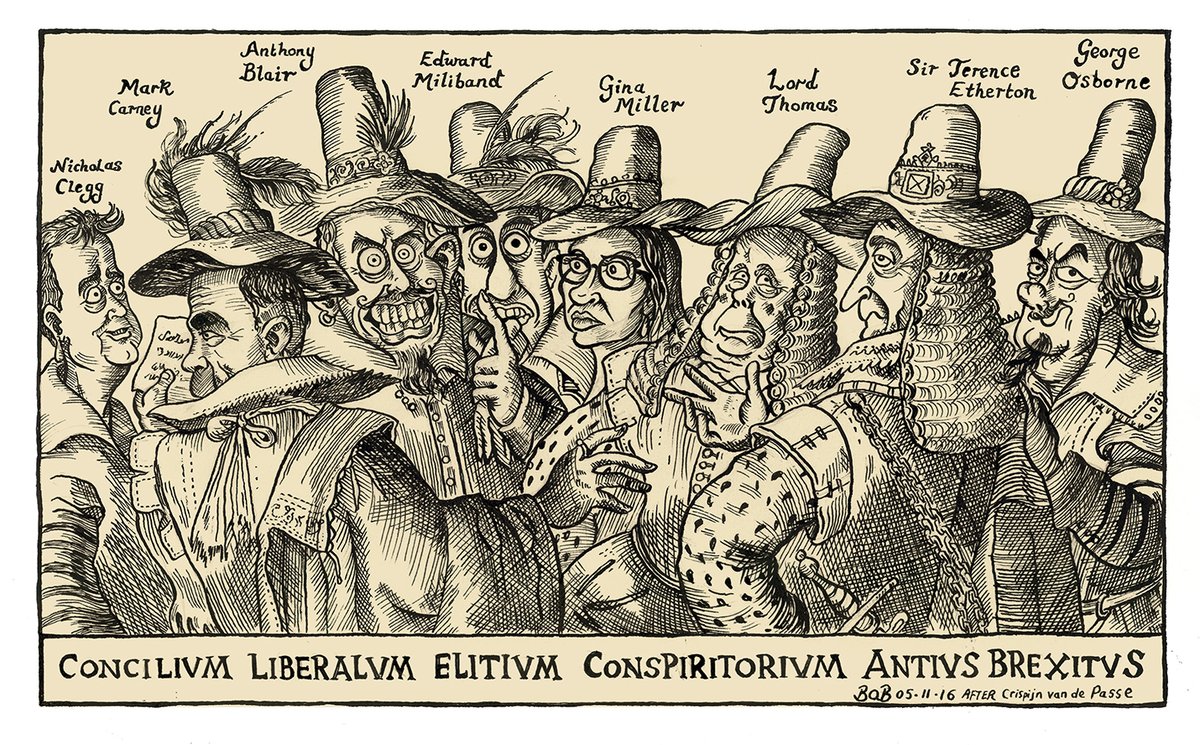
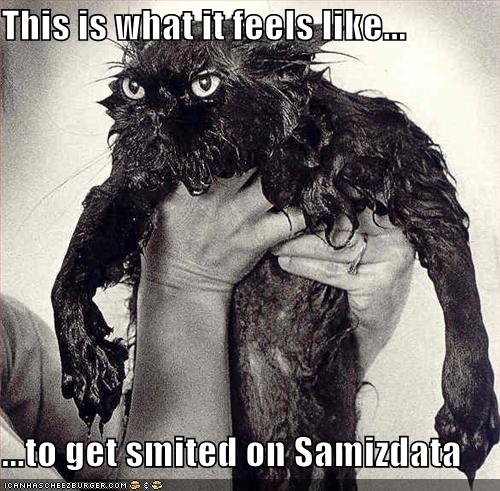
It is often said that Guy Fawkes was the only man to ever enter Parliament with honest intentions…
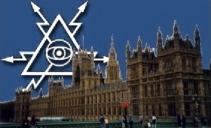
But to mix the metaphors, this year more that most.
|
|||||
|
It is often said that Guy Fawkes was the only man to ever enter Parliament with honest intentions… But to mix the metaphors, this year more that most.
November 5th, 2016 | 8 comments - (Comments are closed)
 This argument is illogical and does not hold water. There are many acts which the government can carry out on the international plane under the European treaties which have the effect of altering UK domestic law, and in doing so either confer rights on people or deprive them of rights. Whenever the UK representative on the Council of Ministers joins in passing into law a directly applicable EU Regulation then the Crown in using the prerogative power to alter internal UK law without that alteration of the law going through Parliament. This is simply a consequence of the direct effect machinery of the 1972 Act. So why should it be OK to have “more Europe” through exercise of the prerogative power, but wrong to have “less Europe” as a result of Article 50 being invoked and the direct effect parts of EU law ceasing to apply within the UK? Nothing in the wording of the 1972 Act supports such a distinction. – Martin Howe QC, Thomas Sharpe QC, Clive Thorne, Francis Hoar from Lawyers for Britain November 4th, 2016 | 8 comments - (Comments are closed)
The High Court has ruled that the government must get Parliamentary approval before it triggers Article 50. So we are a three-line-whip away from triggering Article 50. Big deal.
November 3rd, 2016 | 55 comments - (Comments are closed)
… then it would be well into the rebellious years of smoking behind bike sheds and dealing with raging hormones, because today Sami turns fifteen, which means it can legally do the wild thing in France as of this moment. What could possibly go wrong? 😛 
November 2nd, 2016 | 20 comments - (Comments are closed)
I was searching for God and found Cthulhu. So I asked why he wasn’t running for President of the United States this year. He replied the market for Greater Evils was saturated. November 2nd, 2016 | 20 comments - (Comments are closed)
There is a petition to ban Sharia councils (incorrectly described as Sharia courts), and given my often stated critical views of Islam, you might think I would be supportive. But that is not the case, as I find myself in full agreement with HM government’s position (it is not often I write that!) and I think their response to the petition is correct (emphasis added):
And I would have to say that is a very good response. You cannot ban Sharia councils without the state sweeping away yet another layer of civil society and replacing it with yet more top-down statism. Voluntary arbitration is a long standing tradition in this country and a Sharia council is just that: voluntary arbitration. The amount of misinformation and disinformation swirling around is remarkable. Such councils cannot involve anyone who is not willing to participate, and cannot impose decisions that are repugnant to secular national law. It is no different to two parties deciding to settle some dispute over a cup of tea in front of a Church of England vicar. Well ok, a Sharia council might involve Turkish coffee rather than tea. But in either case, neither is permitted to step outside the bounds of secular law. If there is any role for the state, and that is a big ‘if’, then it might be to educate people from minority communities that such councils are entirely voluntary and people are free to say “No”, or even “Hell no!” when they are suggested as a means of arbitration. November 1st, 2016 | 41 comments - (Comments are closed)
O’Doherty unintentionally summed up the real problem with this judgement. That is, that private businesses should never have to offer ‘justification’ for discriminating – not to the state, the Equality Commission, or anyone else. Just because you run a bakery, that doesn’t mean the state gets to intervene in your matters of conscience. What’s more, this case is not clear-cut. While Lee claimed he was discriminated against on the basis of his sexual orientation, McArthur insists that Ashers refused to make the cake because of the message on it, not the sexual preference of the customer. Now, many people said that Ashers should have made the cake because it offers a public service. But this simply isn’t true. It is a private business. There is an enormous difference between discrimination by public services, which are run by the state, and private businesses, which are run by individuals. Public services must be freely accessible to all. But private individuals must be free to run their businesses according to their own moral judgement. October 30th, 2016 | 17 comments - (Comments are closed)
I received the following e-mail from Airbnb:
I have added emphasis to the words religion, gender identity and judgment as they particularly leapt out at me. So I am being told by Airbnb that I must not judge someone based on a prescribed list of things, some simply matters of genetics or location, but others being ideas someone has chosen to believe or adopt, which is a very different category to race for example. This is the first time I have ever had a company or indeed anyone ask me to sign an agreement to interact socially in a certain manner as a precondition to doing business, or they will cancel any existing bookings I might have in their system and prevent me from making any in the future. Well that is their prerogative of course, but does anyone else find this utterly bizarre? Now I have travelled to a great many places on this planet over the years (well, not by Michael Jennings standards perhaps, but most would say I was very well travelled). I am also a straight white atheist who thinks all religion is arrant nonsense. And yet I have stayed in hotels, motels, yurts, boats and b&bs owned by Christians, Jews, Muslims, Buddhists, Animists, Homosexuals, Heterosexuals, and goodness knows Whateversexuals, and never once had any problems due to the owner’s religious beliefs or personal peccadilloes, because I am really a very tolerant person. And yet none of the proprietors have required me to sign an agreement not to ‘judge’ their religion or what they do in bed, so such topics really never came up, which is just as well because when I am asked what I think, I typically say what I think (unless the person is pointing a gun at me). But if a hotel ever sent me a confirmation e-mail for a booking and included a rider stating: “as a precondition of this booking, please confirm that you will not judge our religious beliefs…” or perhaps “as a precondition of this booking, please confirm that you will not show bias against my demands to be called Doris even though I have a beard and a baritone voice…” well my terse reply would be: “Cancel reservation”. Yet this has never actually happened, because most people who run hotels or B&Bs are just not that stupid. Perhaps making such demands does not seem like unhinged behaviour at Airbnb HQ in San Francisco, but that is indeed how it strikes me. And so even though I have never once in my entire life had a problem renting a room anywhere in the world, I will be closing my Airbnb account, deleting their app, and telling Airbnb to get stuffed for their sheer effrontery and presumptuousness. October 29th, 2016 | 56 comments - (Comments are closed)
Lacan’s collected Écrits, published in 1966, were one of the sources drawn upon by the student revolutionaries in May 1968. Thirty-four volumes of his seminars followed, published by his disciples and subsequently translated into English, or at least into a language that resembles English as closely as the original resembles French. The influence of these seminars is one of the deep mysteries of modern intellectual life. Their garbled regurgitation of theories that Lacan neither explored nor understood is, for sheer intellectual effrontery, without parallel in recent literature. Unexplained technicalities, excerpted from set theory, particle physics, linguistics, topology, and whatever else might seem to confer power on the wizard who conjures with them, are used to prove such spectacular theorems as that the erectile penis in bourgeois conditions is equal to the square root of minus one or that you do not (until worked on by Lacan) “ex-sist.” – Roger Scruton on Slavoj Žižek, a man who has raised complete gibberish to an art form. October 27th, 2016 | 24 comments - (Comments are closed)
Anyway, my point is that it was the dissatisfaction of a large number of people with the mainstream media’s coverage of a major global event that drove the growth of blogging, both in the US and Britain. We are now in a period where people’s dissatisfaction with the mainstream media is plumbing new depths as it behaves abominably over issues such as the US election, immigration, and a whole load of others which people care deeply about. Twitter and Facebook have already shown they are prepared to censor unwelcome opinions, which has left more than a few people voiceless (at least until Gab picks up and develops a smartphone app.). Indeed, I’ve always been surprised how many bloggers – who had full control of their own hosting platform and content – switched to Twitter, where they had none of the former and now, we discover, not so much of the latter either. The beauty of blogging for me was always that I run the site and its content is wholly mine and subject to nobody’s approval. There is no “report inappropriate content” on this blog. This period in the runup to the US Presidential Election is starting to feel a lot like the spring of 2003: plenty of angry voices and a feeling nobody is listening. If Trump loses, the opposite side will try to silence them. One way of making themselves heard is via a blog, leading me to believe that we might see a renaissance of blogging in 2017. Either way, I’ll still be here. Hopefully. – Tim Newman, very accurately describing what caused the blogosphere to appear seemingly ab nihilo, and why similar conditions of widespread alienation may well be coming into alignment to cause a new media surge tide once again, perhaps this time ab Milo. October 26th, 2016 | 58 comments - (Comments are closed)
I am not a huge fan of twitter but sometimes it is a good place to get a sober heads up on breaking show biz stories…
Elfwick is a genius. October 25th, 2016 | 22 comments - (Comments are closed)
Steven DenBeste, who ran a blog called USS Clueless back in the early days when we were all known as “warblogs”, has pressed Ctrl+Alt+Del and gone to the great blogroll in the sky. Steven and I often agreed on things, for he was certainly not an ‘idiotarian’, but we often crossed swords as well. Like me he was an atheist but nevertheless, Godspeed Good Sir, you were part of the social media New Wave before anyone called it social media. October 25th, 2016 | 29 comments - (Comments are closed)
|
   |
||||

All content on this website (including text, photographs, audio files, and any other original works), unless otherwise noted, is licensed under a Creative Commons License. |
|||||


Recent Comments