We are developing the social individualist meta-context for the future. From the very serious to the extremely frivolous... lets see what is on the mind of the Samizdata people.
Samizdata, derived from Samizdat /n. - a system of clandestine publication of banned literature in the USSR [Russ.,= self-publishing house]
|
Over on the Von Mises Institute site, there is a superb critique by Ralph Raico of the final installment of Robert Skidelsky‘s airbrushed biography, John Maynard Keynes: Fighting for Britain, 1937-1946 (New York: Viking Press, 2001). Raico makes it clear the extent to which dishonesty and revisionism have characterised this and other hagiographies of Keynes
It is now clear that [Robert Skidelsky] refuses to confront these shameful comments of his hero. So, for all practical purposes, Keynes’s fawning words on Stalinism have been thrown down an Orwellian memory hole, rarely if ever to reappear in the literature.
[…]
But if Keynes was such a model champion of the free society, how can we account for his peculiar comments, in 1933, endorsing, though with reservations, the social “experiments” that were going on at the time in Italy, Germany, and Russia? And what about his strange introduction to the 1936 German translation of General Theory, where he writes that his approach to economic policy is much better suited to a totalitarian state such as that run by the Nazis than, for instance, to Britain?
Read the whole review. Highly recommended.
As there was quite a lot of interest last time I showed one of these, here is the latest one.

This is a snapshot of where Samizdata visitors came. Also in the last 72 hours we have had e-mails from Brazil, USA, Canada, UK, Ireland, Spain, Italy, Germany, Israel and Australia.
Slobodan Milosevic Is the Scapegoat in a Show Trial by Marko Lopusina and Andre Huzsvai is nothing less than lies on the scale that the Nazi holocaust never happened. Marko Lopusina and Andre Huzsvai are not ‘presenting an interpretation’ when they make remarks like:
Were allegations of Milosevic’s “war crimes” in Bosnia and Croatia true, he would have been indicted in 1995, instead of rubbing elbows with U.S. politicos at the Dayton peace talks. Were Washington serious about toppling him, it could have done so in 1996 by supporting the Serb opposition movement, Zajedno.
“War crimes” in Bosnia and Croatia? What were they then, a mass suicide? And the idea that Zajedno would have toppled Milosevic in 1996 is preposterous. Lopusina and Huzsvai are deluded fantasist apologists for a mass murderer. If they wish to sue me for defaming them I will be happy to give them my address and see these two sacks of shit in court.
Natalija was going to write a first hand account of why these two pieces of crap are wrong but was so distressed by it that she decided to just ignore these cretins. The editors of the L.A. Times should hang their heads in shame for allowing this travesty of the facts to touch the pages of their publication. Shameful and disgraceful.
The L.A. Times belongs nowhere except in the bottom of cat litter trays. Kudos to Matt Welch for heaping righteous disdain on these people and for Brian Hoffman‘s letter to Matt.
Coming soon to the L.A. Times: the serialisation of the Protocols of the Elders of Zion
Between 1937 and 1945, Heinz produced a version of alphabet spaghetti for the German market that consisted solely of little pasta swastikas.
[Update: probably an Urban Legend. Too bad, I rather liked the image of little baby Fritz having a tantrum on May 9 1945 “Waddaya mean, no more yummy little swastikas?”]
The music industry is a wonderful example of how established players in any market often feel they have a vested interest in stasis rather than dynamic change. Rather than see new technical innovations as potential boons, the industry has spent a fortune trying to use the state to defend its existing business models with an army of lobbyists and lawyers, attempting to un-invent the technologies that they (rightly) see as shattering the current structure of its multi-billion dollar industry. Steven Den Beste has a good article on the subject and makes an excellent point regarding the self-defeating culture in the boardrooms of the music industry majors:
As long as the industry doesn’t see it from that point of view, they will continue to try to fight the future. No industry can ultimately survive if it thinks of its customers as enemies; ultimately the industry has to adopt the point of view of its customers and cater to their desires. You cannot sell someone what you want them to have. You have to sell them what they want to buy.
A classic case of this syndrome of ‘customer-as-enemy’ was provided by Steve Heckler a VP from Sony Pictures Entertainment in August 2000 who said:
The [music] industry will take whatever steps it needs to protect itself and protect its revenue streams,” Heckler said. “It will not lose that revenue stream, no matter what. […] Sony is going to take aggressive steps to stop this. We will develop technology that transcends the individual user. We will firewall Napster at source – we will block it at your cable company, we will block it at your phone company, we will block it at your [ISP]. We will firewall it at your PC.
Although Sony tried to apply some damage limitation spin to Heckler’s remarks soon afterwards, this is clearly delusions of grandeur on a spectacular scale and is exactly the mentality to which Den Beste has alluded. The major players think they can translate their wealth into political muscle and use the state to crush would-be new entrants that seek to undermine their businesses. taking out Napster has only encouraged this flawed thinking. Additionally yet more money is being spent on technological fixes which are also doomed to fail due to the ‘Swiss Watch Effect’ (it is cheaper and easier to smash a Swiss Watch than it is to make one): they spend millions on copy protection that will be broken within months or weeks by the worldwide army of Internet linked 15 year old crackers who work for free.
Another indication of the scale of ‘wrong-think’ going on in boardrooms is that they do not seem to realise that many people’s CD player is their computer. I might have purchase the new Natalie Imbruglia CD White Lilies Island but I have read that most computers gag on some of the tracks due to copy protection and I do tend to play a CD in my computer whilst I surf the Net. As a result I have not bought the CD. Well I suppose if the company strategy is to make it hard for me to rip any tracks into MP3s, one way of doing that is to discourage me from buying their products all together. Somehow I don’t think that was quite the effect they were hoping for but that is the one they have got.
[Update: article amended with Steve Heckler of Sony’s exact remarks thanks to the excellent input of readers Tino D’Amico and Joachim Klehe]
The British International Development Secretary Clare Short did a bit of off-message, and hence truthful, commentary by pointing out that the French state is one of the primary obstacles to Africa’s economic development due to their insistence on Europe-wide protectionist trade policies.
Now whilst I usually regard Short as a subjectivist economic ignoramus and thus part of the problem, not the solution, she is quite right in her remarks in this subject. The fact is that French policy in African being aimed at maintaining French control rather than fostering African development. My family has had quite a lot of first hand experience of doing business in Africa and I know this to be true on many levels.
Socialists have the gall to claim to be the people who care about the impoverished Third World and yet put duty on African goods which can run as high as 300% in order to protect the EU’s grotesque Common Agricultural Policy. The EU are in truth the architects of misery, poverty and starvation if Africa and France is the ring leaders of this ignominious association of the statist, regarding their preposterous concepts of Francophone prestige in Africa as being more important that African prosperity.
Clare Short is just another statist clod but she is quite right that France’s strong presence in Africa is a truly malign influence. I could have told her that 20 years ago. Who cares of people are living in abject poverty in Chad just so long as things are status quo on the Quai d’Orsay.
“Blog this, you Bounder!” “Bloggin’ ‘ell!
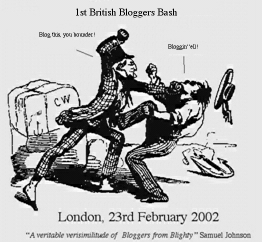
A veritable verisimilitude of Bloggers from Blighty Samuel Johnson Only a very few spaces left. E-mail for details if you are a blogger in the British Isles.
Adil, all messages to your e-mail address are bouncing. I need to get in contact with you a.s.a.p!
Matt Welch makes some excellent points about the reality of world trade but the following bit suggests he does not read the Samizdata very often.
If free traders spent as much time railing against rich-country protectionism as they do making fun of the anti-globalization kids, the pig-puppet audience would dwindle to a core of fog-headed Maoists, and more importantly, destitute people around the world could vault out of poverty much faster.
We are wounded Matt! You mean we are not your default page when you boot up the ol’ box every morning? We often go though periods of railing against the immorality and stupidity of protectionism. Such as:
Stupidity beyond the measure of language by Natalija Radic on February 1st:
Jospin is a man who is responsible more than any other political figure in the EU (and that is saying something) for people like me being fined and harassed by EU states for trying to do business within the EU because I am an outsider, just another Slavic white nigger girl. Naturally he takes much the same view of Africans and Asians who try to do business in the EU.
Comments worth repeating by Perry de Havilland on January 30th:
To be “strongly against world trade” is to be in favour of poverty and against free association. It is to favour force over choice. It is to favour death and famine in the third world. Anyone who actually wants for the peoples of South America, Africa and Asia to prosper should be demanding not an end to world trade but the removal of all barriers to entry to the US and EU markets. At a stroke that would result in cheaper products for common working western people as cheaper African, South American and Asian goods become available. Immediately the economies of third world nations would improve as they could sell their products without immoral grotesque discriminatory tariff barriers.
What free trade actually means by Natalie Solent on December 18th 2001:
So the European Union, having stopped Africans making a respectable living as producers and traders by denying them access to us, then bestows a lesser largesse via ‘Third World Aid’. Adding insult to injury, the EU then expects gratitude from the very people they have discriminated against. Of course what happens is that Africans, now being dependent on largesse rather than their own efforts, take on the character of beggars, whiny when desperate and sullen when temporarily a little better fed. We in our turn take on the character of patronising social workers-cum-lords of the manor. What a pity, when we could be interacting as equals and fellow human beings.
… and those are just the ones I can be bothered to find. So you see, Matt, here on Samizdata this particular group of free traders really really doesn’t like protectionism and we attack it on both economic and moral grounds quite often.
There is nothing to the rumour that mentioning BRITNEY SPEARS increases the hit rate for a blog.

Blog me baby one more time!
And his name is Will Quick. When Will is in full vitriolic flight, it is a thing of wonder to behold. If, like me, you enjoy savouring the savage directness possible with the English language, then read Will’s latest spleen venting invective regarding all manner of folk that grievously irk his anti-idiotarian sensibilities:
Where a pack of stupid, venal whores whose tarnished Olympian wares are for sale to the highest bidder in the lowest bidet can profess distaste for a minor show of honest patriotism, though if somebody had thought to keep them supplied with sufficient hot and cold running hookers, they’d have no doubt been out waving American flags themselves.
These are disconnects so blindingly obvious you’d think they’d be pointed out in every major media outlet in the United States. But they aren’t. Which means somebody else has to do it. That would be us. That’s what we’re good for. Pointing things out.
With a chainsaw.
It’s a dirty job, but someone has to do it. Read the whole article and then go put some fuel in the motor of your chainsaw.
Miss Veen has a series of sublime cat haiku which will be immediately recognisable to people who live with cats. For example:
The rule for today.
Touch my tail, I shred your hand.
New rule tomorrow.
Blur of motion, then-
Silence, me, a paper bag
What is so funny?
Small brave carnivores
Kill pine cones and mosquitos
Fear vacuum cleaner.
Read them all. Meow.
|
Who Are We? The Samizdata people are a bunch of sinister and heavily armed globalist illuminati who seek to infect the entire world with the values of personal liberty and several property. Amongst our many crimes is a sense of humour and the intermittent use of British spelling.
We are also a varied group made up of social individualists, classical liberals, whigs, libertarians, extropians, futurists, ‘Porcupines’, Karl Popper fetishists, recovering neo-conservatives, crazed Ayn Rand worshipers, over-caffeinated Virginia Postrel devotees, witty Frédéric Bastiat wannabes, cypherpunks, minarchists, kritarchists and wild-eyed anarcho-capitalists from Britain, North America, Australia and Europe.
|





