We are developing the social individualist meta-context for the future. From the very serious to the extremely frivolous... lets see what is on the mind of the Samizdata people.
Samizdata, derived from Samizdat /n. - a system of clandestine publication of banned literature in the USSR [Russ.,= self-publishing house]
|
UPI reported recently in an article titled Big brother is big business that the UK is the most remotely surveilled state in the world.
Advocates point to its efficacy at the same time as national crime rates are soaring. A study by the Scottish Center for Criminology suggested that “spy” cameras had little or no effect on crime. It concluded that “reductions were noted in certain categories, but there was no evidence to suggest that the cameras had reduced crime overall.”
Yet more and more CCTV cameras appear on our streets every day as companies vie for state contracts to bring Orwell’s vision of a Britain under all pervasive observation to reality. Authorities invariably claim that they are to discourage violent crimes and burglary, yet increasingly they are used to prosecute people for transgressing traffic and litter regulations. Nightmarish.

When the state watches you,
dare to stare back
John Weidner‘s Random Jottings is a rambling, strangely structured blog that reminds me of wandering through an antique shop. It is a place filled with peculiar and fascinating artifacts, some clearly desirable and collectable and others curious but of unclear purpose like a button hook or silver chatelaine.
You are as likely to find information about a resurgence in skilled oriental rug making in Turkey as you are to see commentary on the war in Afghanistan. It may be the only blog I would describe as ‘charming’. Visit daily because who knows what you might find?
As is obvious from the previous article, we have a new gun in town… by the name of Adriana Cronin. You will quickly discover she is blogosphere’s very own Lara Croft, complete with serious motorbike and a need for speed.
Steven Green has modestly put himself forward for consideration as the next Pope. However John-Paul II has given the Vodka Pundit some sound ex cathedra advice about the wisdom of taking his job.
The latest (April) edition of British society magazine Tatler (no link to article) has a short piece by leading British Playwright and signatory to the Free Slobodan Milosevic Petition, the wonderful Harold Pinter. As a result, perhaps readers might like to e-mail the editors of that respected publication to request another nice Harold Pinter article in the next issue called:
- What the in-people are wearing to the society war-crime trials in the Hague this year
Or maybe…
- Waxed Barbour Jackets and green wellies, the perfect fashion accessory for the well heeled ethnic cleanser and soooo easy to wash the blood off.
Yes, it is good to see the journal for the elite of Britain wanting to branch out from covering the parties of polo players, models, actors, actresses, stock brokers, society gardeners, designers, minor royals and bankers, and now also showcasing apologists for mass murdering ethnic cleansers as well. Rupert and Camilla will be pleased!
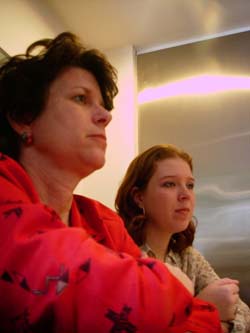
The Samizdata Team based in and around London was delighted to be able to meet famed blogger Joanne Jacobs and her daughter for lunch in Central London yesterday.
Joanne and her daughter looked on impassively whilst the Guardian journalists were burnt in effigy for their amusement.
Natalie Solent regaled the room with her ‘The time I went shopping and forgot to leave the Chieftain Tank’s hand brake on’ story.
Not everywhere in the Islamic world forces women to hide under burqas.
 
As Jordanian society gradually evolves towards a more sophisticated extended order, I cannot think of an image more subersive and corrosive to the joyless Pan-Islamist world view than Queen Rania of Jordan: intelligent, elegant, articulate and Palestinian.
Not bloody windmills, solar panels or cow shit furnaces, I mean real, usable and practical power: fuel cells and nuclear fusion.
John Ellis points out some excellent advances in fuel cell technology. Fuel cells are truly the wave of the future and I look forward to them gradually replacing not just batteries but the internal combustion engine for many uses one day.
I have always thought it was very revealing that we do not see protestors from the Green movement constantly holding up placards demanding more money be spent on fuel cell and nuclear fusion R&D.
 Thanks to ‘Darsh’ for the cool animated icon Thanks to ‘Darsh’ for the cool animated icon
Over on Blithering Idiot, blogger Will Sulik has a hilarious post called Hermeneutics in Everyday life which needs some libertarian perspectives added:
14. An anarcho-libertarian refuses to acknowledge the validity of the repressive state to place force-backed STOP signs and accelerates past.
15. A minarchist libertarian halts at the STOP sign and waits for evolutionary epistemology to transform the understanding of society-state relationships to the point where all roads become private property.
16. An Randian refuses to see any objective reason to STOP at the sign and plows into the back of the minarchist, causing automotive catallaxy.
New blog Global Grumpy raises an interesting point about the surprising lack of reaction from the US media and muted reaction from conservative bloggers regarding the asinine steel tariffs. He also links to a somewhat pointless article on Slate on the legality of the subject, as if the problem was a legal one rather than an economic and political one. The fact left wing bloggers have little to say is hardly surprising but one can only speculate why the neo-con bloggers are not howling much louder.
Bush’s action is clearly damaging to the US economy due to the inevitable knock-on effects it will have on international trade, not to mention the increased costs passed on directly as US steel becomes more expensive. I was expecting to hear people making much stronger remarks about ‘The Bush Steel Tax on US consumers’ (for that is what it is). The headlines I was expecting were:
- ‘Bush causes squeals of delight amongst anti-globalization advocates’
- ‘Is Bush trying to get France to award him the Legion d’Honneur for inconsistency?’
- ‘Bush encourages reduction in global trade’
- ‘Bush to World: please add tariff barriers against goods exported from USA’
- ‘Bush tells Russians: ‘Yeah I know we are proping up your economy with aid on one hand and trying to wreck your steel industry with the other… so what? If you need money go sell nukes to Iran and stop bugging us’
I hope the reason for this is not the flip side of a phenomena I saw many times during the ghastly Clinton years: even when Clinton occasionally got something right (very occasionally), so great was the detestation of several otherwise analytical commentators (and friends) that they opposed policies which if conducted identically under any US president except Clinton, they would have supported without question. I wonder if ‘wartime’ admiration for Bush has not cause a similar blindness in the other direction towards a truly inane policy.
This is not a trivial issue and could have disastrous implications for the international trade system that are far more important than an industry which employs 150,000 people out of a population of 260 million.
[Note to ‘Global Grumpy’: the two e-mail addresses I have for you both bounce]
‘Crypto-Libertarian-in-denial’ Brian Linse is mistaken as to which weapon was the result of the humourous ‘which weapon are you?’ test: Dale Amon was the H&K PDW…my result was

Alas as Brian points out, the only weapon I can legally own in Britain is… a squirt gun. 
At least if I am attacked by a female mugger, I can try to instigate an impromptu wet tee-shirt contest.
I do not know why I do it to myself. I watch Enterprise, the latest and by far the lamest of the Star Trek series and have to restrain myself from throwing things at the television. In the latest idiotic episode, the crew of a freighter starship which has been repeatedly attacked by non-human pirates finally captures one and tries to strong arm information out of the prisoner to gain a tactical advantage in order to retaliate effectively against their tormentors. However we are shown that the virtuous Star Fleet crew of Enterprise do not approve of this. Not just the fact the freighter crew are trying to beat information out of the captive but the very fact they are holding him at all, we are lead to believe, is bad. I wonder what Captain Archer of the Enterprise would have to say about Guantanamo Bay?
Many TV shows have fantastical settings and an implausible premise underlying them, but this is not in and of itself a bad thing. It is fiction after all. The socialist future for humanity posited by Star Trek is implausible but sadly by no means impossible. The technology theorised for the future is likewise as good a guess as any other. All that is okay. What is not okay is the fact that the human characters simply do not act like humans. They are utterly implausible as future examples of homo sapiens: people simply do not act that way when in life threatening situations. We are shown that tracking down and attacking the people who have been repeatedly attacking you is bad.
I wonder what Star Fleet would do if some alien species hijacked a starship and flew it into the 23rd Century equivalent of the World Trade Centre? Well they certainly would not a George Bush style “smash the Taliban” on them, that is for sure! Any culture that demanded such behaviour would simply not survive contact with less squeamish cultures or more rational disaffected members of its own culture. Star Trek is truly TV with rocks in its head.
Then look at Alias, the new spy-drama with the superb Jennifer Garner. It too has fantastical settings and a highly implausible underlying premise (a college girl/spy-commando).
And yet whereas the dismal Enterprise fails miserably to convincingly portray human interaction within its given premises, Alias does so triumphantly. Quite apart from the fact Jennifer Garner can act the socks off any of the current Star Trek cast, the show is superbly written and the characters plausibly drawn. Within the extraordinary fictional settings in which the show occurs, the people act like humans. They act the way you or I might act is suddenly plunged into the scripted situations. Jennifer Garner’s character, Sydney, was shown being tortured (none of the namby pamby crap of many shows… we actually see her being electrocuted and Garner makes it look very unpleasant indeed). Later in the episode, she escapes and in doing so takes an electro-prod from a guard. We see her standing over the man who had earlier presided over her torture and, if this had been Star Trek, we would have been treated to a brief sermon on the importance of non-violence or some disdainful grimace as she asserts her moral superiority as ‘New Socialist Woman’ over her ex-captor. But fortunately it was not Star Trek. Sydney steps over to the prone helpless man, jabs him with the electro-prod and as he screams says words to the effect, “Yeah, it hurts, don’t it?”
So which do you think makes for a more engaging story? Alias rocks!

Jennifer Garner as ‘Sydney Bristow’ in Alias
|
Who Are We? The Samizdata people are a bunch of sinister and heavily armed globalist illuminati who seek to infect the entire world with the values of personal liberty and several property. Amongst our many crimes is a sense of humour and the intermittent use of British spelling.
We are also a varied group made up of social individualists, classical liberals, whigs, libertarians, extropians, futurists, ‘Porcupines’, Karl Popper fetishists, recovering neo-conservatives, crazed Ayn Rand worshipers, over-caffeinated Virginia Postrel devotees, witty Frédéric Bastiat wannabes, cypherpunks, minarchists, kritarchists and wild-eyed anarcho-capitalists from Britain, North America, Australia and Europe.
|