We are developing the social individualist meta-context for the future. From the very serious to the extremely frivolous... lets see what is on the mind of the Samizdata people.
Samizdata, derived from Samizdat /n. - a system of clandestine publication of banned literature in the USSR [Russ.,= self-publishing house]
|
The sharp eyed and attentive amongst you may have spotted the funky monkey that has appeared in the ‘free market’ section of our sidebar… we have acquired a sponsor!
But not just any sponsor.
The Gold Casino is an off-shore internet casino (obviously) in the most literal sense of the term. It is located on a server in the Principality of Sealand, a fully independent micro-state off the shore of Great Britain. Don’t like the state? Go set up your own.
No I am not joking!
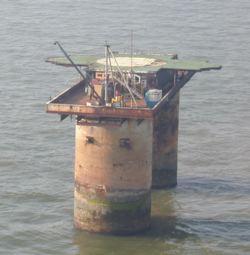
Well I did say micro-state, didn’t I?
So take a peak at what our sponsor is offering by poking the funky monkey and check out their message via the link underneath the sidebar graphic. I assure you it is far more interesting that the usual marketing blather one is usually confronted with… you will see why we find them so ideologically agreeable!
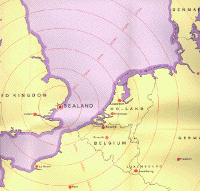
It adds a whole new nuance to the term ‘off-shore business’
The proposed EU regulation of blogs and other forms of Internet speech being suggested by the Council of Europe (a quasi-governmental think-tank whose views have inordinate sway with the EU’s policy making elite) is very revealing about what lies at the heart of The Great European Project.
Steven Den Beste has written a rather good article on why the press is treated differently than broadcast media which use the finite resource of the electromagnetic spectrum. One can argue that as the EM spectrum is finite, it is reasonable to share out its use and as clearly not everyone can set up a radio or TV station, some rules to prevent the use of the media from becoming over mighty are justified. This is not quite how I see that issue myself but the contention is far from absurd.
One can even make the far less supportable assertion that because in reality setting up a newspaper is far beyond the means of most people simply because it is so expensive, the state should regulate the press, at least to some extent. Not surprisingly I flatly reject this notion and think the only defence individuals need against the established press are laws against libel. However the thinking behind this sort of regulation is at least easy to understand and can, if you accept the state as an essentially benevolent neutral institution (which I certainly do not), be seen as a way to prevent abuses of power by an over-mighty media corporation given the vast asymmetry of access to public opinion between a newspaper and an individual.
But when the Council of Europe start urging the EU to regulate blogs like this one, it should be clear that none of the arguments which can be applied to broadcast media and or the press apply here. As I mentioned in my previous article on this issue, if you have a cheap computer and a crummy modem, it still only takes about five minutes and no money whatsoever beyond your dial-up or broadband connection charges to set up a blog. There is no asymmetry of access to the public involved here. Granted, setting up an effective blog is another issue entirely, but simply getting viewable grievances in front of blogosphere eyeballs is simplicity itself.
So if anyone can set up a blog, and there is no finite resource in need of being allocated ‘fairly’ and there are no de facto capital related barriers to ‘market’ entry, what are we to make of this Council of Europe proposal to regulate us? → Continue reading: What is really going on in Europe?
People in the US, who take notions of Freedom of Expression and Private Property for granted, will be astonished by the latest steaming pile of wisdom to emerge from the clenched cheeks of our European would-be masters. Declan McCullagh reports:
The all-but-final proposal draft says that Internet news organizations, individual Web sites, moderated mailing lists and even Web logs (or “blogs”), must offer a “right of reply” to those who have been criticized by a person or organization.
With clinical precision, the council’s bureaucracy had decided exactly what would be required. Some excerpts from its proposal:
- “The reply should be made publicly available in a prominent place for a period of time (that) is at least equal to the period of time during which the contested information was publicly available, but, in any case, no less than for 24 hours.”
- Hyperlinking to a reply is acceptable. “It may be considered sufficient to publish (the reply) or make available a link to it” from the spot of the original mention.
- “So long as the contested information is available online, the reply should be attached to it, for example through a clearly visible link.”
- Long replies are fine. “There should be flexibility regarding the length of the reply, since there are (fewer) capacity limits for content than (there are) in off-line media.”
It’s pretty zany to imagine that just about every form of online publishing, from full-time news organizations to occasional bloggers to moderated chat rooms, would be covered. But it’s no accident. A January 2003 draft envisioned regulating only “professional on-line media.” Two months later, a March 2003 draft dropped the word “professional” and intentionally covered all “online media” of any type.
Read the whole article.
So what is the message to the EU I mentioned in the title? Simple:
We will not comply
We have a comments section on samizdata.net in which people can and do comment about what we write, but access to that comment section is at our capricious discretion. If we decide we want to IP ban someone or want to delete their remarks from our comments section because we think they are offensive, or even if they are not offensive but we just bloody well feel like doing it because we have a headache, then we bloody well will. This is our private property.
We are already hosted on a server in the USA and I am quite confident our hosters would tell the EU where they can stick any demands to yank us off the net because we decline to submit to political moderation of the form our free speech takes on our private property (i.e. the server space we rent from them). If we have to go entirely pseudonymous and log onto Samizdata.net in order to post via ‘dead drop’ servers rather than submit to EU regulation of how we manage the information on our blog, then that is exactly what those of us who post from within the rapidly emerging EU tyranny will do. We utterly reject political moderation of free speech in civil society. This is not about giving people a voice but rather about replacing social interaction (which is what true free speech is), with political interaction mediated and mandated by the state.
If these regulations become the law of the EU (as seems likely), we will not obey, we will not cooperate, we will not accept that anyone has a ‘right’ to reply on our blog. Do you think we have said nasty things about you and want to reply regardless of our unwillingness to let you use our comment section? Fine…go to blogger.com, sign up (for free), click on ‘create a new blog’ and voila… you have your own blog on which you can scream about how those mean old Samizdatistas ‘done you wrong’ to your heart’s content.
And if the EU says we have to let you comment… tough shit, it ain’t gonna happen. The people who write for Samizdata.net all now live next door to Samizdata Illuminatus, in Arkham, Massachusetts.

 
And of course I am sure he does not particularly care what I think either. In an article titled Europe and Liberalism, he notes that Ramesh Ponnuru has praised him for changing his mind about the European Union.
Sullivan now thinks the European Union is not such a good thing as he once thought and both he and Ponnuru have finally noticed that having the EU completely swallow Britain is also not in the national interests of the USA. In fact that Americentric utilitarian observation seems to be the entire basis for their opposition to The Great European Project. Massive regulatory statism? Dramatic erosion of due process? Ever higher taxes? ‘Fortress Europe’ trade barriers with the rest of the world? Spectacular corruption? Higher unemployment? No… the reason to finally start glaring at the EU across the Atlantic is to preserve the UK’s ability to support the US in foreign policy matters and to work for US interests from within the bastions of Fortress Europe.
This narrow utilitarian argument seems to be what has brought Sullivan to stop being a cheerleader for the EU without much of a nod to the idea that maybe the EU is bad for Britain. So whilst I am happy to see a fairly influential commentator like Sullivan stop arguing Britain should embrace the EU even more deeply, he has nothing whatsoever to contribute to the British domestic debate on the subject. In fact, the stated views of Sullivan play to anti-American sentiments within Britain so harmoniously that I really wish he would just shut the f**k up.
To argue that the reason Britain should not allow its national sovereignty and identity to be submerged by Europe is because it does not suit the United States, is to put many of the people who dislike the EU in Britain in rather a quandary. Many such folks dislike the EU because British interests matter far more to them that those of the EU… and for exactly the same reason they are also highly suspicious of the USA, seeing it as subordinating ‘our’ interests to ‘their’ interests. For an example of anti-EU sentiments allied to deep and festering suspicion of the USA, you need look no further than Air Strip One. I see little value in Sullivan actively kicking the none-too-tight lid off latent anti-Americanism with statements like:
Keeping Britain both in the [United States of Europe] and outside of it militarily, diplomatically, and monetarily should become a prime U.S. objective in foreign policy. Without it, the United States could lose its most valuable military and diplomatic ally.
But the fact is almost no one who actually (in theory) gets a vote on the subject, not even Atlanticist enthusiasts like myself, think US interests are more than passingly germane when trying to argue against Britain sleepwalking to the gaping maw of that half-dead and half-mad leviathan called the European Union.
It seems Sullivan is no fan of the social/cultural Anglosphere meme. What with him being a party political right-statist (a Republican) and only a passing commentator on things like objective rights and moral philosophy, I suppose it is not all that surprising to read him taking a highly collectivist ‘American national interests’ view of pretty much everything, but then this is precisely why his views are of little value in any positive way to people outside his American national collective.
I would argue that the Anglosphere does exist as a cultural vibe, but it is something that can be made a great deal weaker precisely by attitudes like Sullivan’s. The underlying cultural basis for UK political support for US actions in Iraq sprang from these very real Anglosphere notions. Yet if I thought the United States government was working to keep Britain inside a United States of Europe (just not too far inside) for its own interests and at our expense, which is to say working against people like me who are calling for the UK’s complete withdrawal from the EU, then I would be bulk purchasing US flags to burn in demonstrations in central London… and if a relentlessly Atlanticist Anglosphere person such as me thinks that, one can only speculate what less pro-American segments of popular opinion might think.
If the US government wants Britain as an ally, fine. But if it wants to sacrifice individual British people as political cannon fodder to mitigate the effects of EU power? Want to know where you can stick that? I will continue to regard US civil society as having many admirable qualities and still feel an Atlanticist affinity to it regardless… but at that point the US government loses its ‘lesser evil’ status for me and becomes just another enemy on every level as the last basis for having incidental common goals vanishes.
We started off on Samizdata.net with a sitemeter.com tracker… alas the java version which tracks referrals refused to work when we upgraded our site to Movable Type, so we added a Extreme tracker. That too is doing strange things now since our latest Movable Type upgrade (all referrals are being recorded as coming from our MT installation rather than the actual referral page) and as I have never, not once, got a reply from their tech support people no matter how often I send them messages (and I have their premium paid-for version), I am looking for recommendations regarding:
- What might be causing our problem with the Extreme’s tracker?
- And is the java version of sitemeter’s premium counter likely to work with MT 2.6x?
- Are there any better premium trackers out there as I hate to keep paying for crap service from Extreme?
Any suggestions?
An update regarding tonight’s ‘Undercurrents debate’ on BBC Radio 3 Night Waves, 9:30 pm UK time (also via Internet).
The topic is:
Is Democracy Dead – superceded by the power of the markets and the media?
Participating will be George Monbiot, John Lloyd, John Kay and me.

I was just watching a report on early morning TV which was in itself a rather mundane piece about how the authorities in Britain are clamping (immobilising) cars which are stopped on the road and found to have unpaid vehicle tax. Yeah yeah, whatever.
But then came a remark which astonished me…
“Unpaid annual Vehicle Excise Duty costs the British economy millions of pounds per year”
Now without getting into the rights and wrongs of vehicle ownership taxes (as opposed to road use taxes), the implication is clear: money not paid to the state for the privilege of owning your own several property does not create wealth… only when that money is safely in the hands of the state does the British economy benefit. Note, the words use are not “costs the British state millions…” but rather “costs the British economy millions…”
And with that tax money taken out of private hands, the state creates a net gain in wealth how exactly? Hiring more wealth destroying bureaucrats? And of course that money you selfish tax dodgers have not paid to the state is going to be flushed down the toilet rather than being used for some alternative economic activity, right? Likewise immobilising people’s transport because they have not paid an annual ownership tax, and thereby preventing those people making deliveries or getting to work, that does not British economy a penny, right?
Arrogance and ignorance in equal measure. The state is not your friend.
Our RDF & XML syndication feeds were buggered up…
…and now they are not. Hurrah 
Tomorrow night my disembodied voice shall be appearing on BBC Radio 3, on the programme Night Waves at 9:30 pm UK time (also via Internet).
Along with George Monbiot, John Lloyd, the eminent journalist and former editor of New Stateman, and possibly one other person, we shall be discussing democracy, globalization and politics.
A democracy is a form of government in which the people, either directly or indirectly, take part in governing. The word democracy originates from Greek, and means rule of the people.
– From Wikipedia
In my recent trip to the FACT centre in Liverpool to evangelise for the blogosphere, it was suggested to me by a young lady that one of the great things about blogs is that in contrast to the established media, they are inherently democratic.
She was somewhat surprised when I disagreed. The young lady then suggested that as blogging empowers the common man by allowing them to express their views to the world without big business media owners or the government getting in the way, that it must surely be democratic. I agreed that blogs do indeed give people an unprecedented means to express themselves directly by disintermediating both the established media and the state, but there was nothing democratic about that whatsoever.
Democracy is about politics, and politics is about the use of the collective means of coercion. Democratic politics thus refers to systems by which the people who control those collective means of coercion are chosen and made accountable via one of several methods of popular voting. For something to be ‘democratic’ therefore, it must be amenable to ‘politics’. Therefore for a blog to be ‘democratic’ that does not mean it is empowering or that it disintermediates the state. In fact it means the state, which is to say democratic politics is very much involved.
But you, the reader, do not get a vote on what get written in the articles on Samizdata.net. You may agree with what an article says or you may utterly disagree, but what gets written does not depend on how popular those sentiments are. We write what we want to write.
Where you do get to choose is whether or not you decide to come back and read us again. Much as in an open market, I might decide to try and sell my fruits and meats to those who pass by, yet I cannot force them actually purchase any of my goods if they do not wish to. They cannot stop me offering for sale those things I think makes economic sense but if I am wrong about what the market wants or if others make a better offer, then the passers by will choose to shop with someone else.
Where potential clients do get a vote, albeit indirectly, rather than a ‘market choice’ regarding what I sell, is when the polity regulates what can or cannot be sold. For example it may be up to me if I wish to try and sell veal or chickens or bananas, but I may be prohibited from selling crack cocaine or flamethrowers. So to that extent a market can be made more subject to politics and less to several choice.
And so it is with blogging, at least to a point. But to the extent that if Samizdata.net was to suddenly and highly improbably start advocating Nazi politics (such suggestions are illegal in Germany) or rather more plausibly call for the overthrow of Islamic law wherever it pertains (such suggestions are illegal in Saudi Arabia) then the very fact it is so extraordinarily difficult to prevent such sentiments being proffered by us makes us the very antithesis of ‘democratic’. You can do the ‘equivalent of refusing to buy’ in a market, i.e. you can just stop reading what we write, but you cannot actually stop us from writing. You, the reader, do not get a vote on that.
Blogs are therefore something which empowers the individual, the blogger, regardless of the wishes, and therefore the votes, of a collective who might wish to have a say in what a blogger writes. The correct analogy is therefore the market place… a blog is a open air stall in a marketplace for ideas called the blogosphere. If you find the ideas we are ‘selling’ interesting (even if you do not agree with them) you will come back for more. If we horrify you or even worse, bore the pants off you, you will probably not come back. But we will write what we will write. There is nothing democratic about that… and long may it be so.
We Samizdatistas are in the blogging business for the long haul and so it is very gratifying indeed to be involved with a highly a successful blog… we may not be in the same league popularity wise as Instapundit or Andrew Sullivan but we are nevertheless a significant fixture in the Blogosphere.
However as our hit rate steadily creeps upward, so do our bandwidth costs. As a result, Samizdata.net has finally succumbed to the economic facts of life and our sidebar now has buttons which give our truly global readership the option to send us a donation via PayPal to help defray our mounting bandwidth expenses.
I have just got back to London after spending the night in more northern parts, where I gave a talk about blogs and blogging at Liverpool’s rather swanky new downtown FACT (Film, Art & Creative Technology) centre.

Many people are looking for the FACTs about blogging in Liverpool
It is good to proselytize the joys of blogging to a wider audience. Although though the audience was rather technology savvy, blogging was a completely concept to many of the people there. Also interesting was to see a couple people in the media lounge where I turned up to give my talk reading Salam Pax’s blog.
On a day in which an article in The Times notes the power of blogging to scare the living daylights out of some sections of the established media and quotes blogger Mickey Kaus, it is interesting to see our blogger-in-arms in Iraq helping to raise the profile of blogging generally in places like Liverpool.
I even managed to meet a new potential client for my latest business endeavor, a blogging consultancy that will show companies how blogs can greatly assist their businesses. Together with two fellow Samizdatistas David Carr and Adriana Cronin, who was the one who thought up and elaborated the idea, we have started a new venture called the Big Blog Company.
Blogs are increasingly starting to enter the public consciousness … we are spreading like a virus but are much more fun that SARS 
|
Who Are We? The Samizdata people are a bunch of sinister and heavily armed globalist illuminati who seek to infect the entire world with the values of personal liberty and several property. Amongst our many crimes is a sense of humour and the intermittent use of British spelling.
We are also a varied group made up of social individualists, classical liberals, whigs, libertarians, extropians, futurists, ‘Porcupines’, Karl Popper fetishists, recovering neo-conservatives, crazed Ayn Rand worshipers, over-caffeinated Virginia Postrel devotees, witty Frédéric Bastiat wannabes, cypherpunks, minarchists, kritarchists and wild-eyed anarcho-capitalists from Britain, North America, Australia and Europe.
|





Recent Comments