We are developing the social individualist meta-context for the future. From the very serious to the extremely frivolous... lets see what is on the mind of the Samizdata people.
Samizdata, derived from Samizdat /n. - a system of clandestine publication of banned literature in the USSR [Russ.,= self-publishing house]
|
Sometimes I read articles which seem to prove the existence of parallel universes. What I am curious about however is how does my web browser manage to access them from within this universe? I really must drop David Deutsch an e-mail and ask him to theorise.
For example, see this article sent from some alternate Earth, called ‘Britain counts cost of diplomatic furore over Berezovsky‘ (I apologise if the transdimensional shift causes your browser to crash):
The furore also probably extinguishes any hope that Russia will agree to let suspects be extradited to Britain over the London poisoning of former KGB agent Alexander Litvinenko
So by this I can only assume that some people think that if only Britain was ‘nicer’ to the Russian regime, there was at some point a ‘hope’ that the Russian leadership might allow the UK to extradite the people who could confirm the already obvious fact that the Russian state ordered Russian agents to assassinate Alexander Litvinenko in London.
Yes, I am sure the Russian authorities are really keen to do that. Not in this universe, of course, but I am sure that must be true in some other universe otherwise how else would it end up in a newspaper article?
I am fairly sure it is too late for an April Fool and I cannot detect humour at work in the writing so no doubt journalists Patrick Wintour and Laura Smith, the ones in this universe that is, are rather bemused by this transdimensional strangeness from their alter-egos from the universe in which politeness and pliability by Her Majesty’s Government can be expected to get Russian leaders to implicate themselves in murders on British soil.
Russian tycoon Boris Berezovsky, who was granted asylum in the UK due to his treatment by the Russian state, had said he wants to engineer the overthrow of Vladimir Putin:
“We need to use force to change this regime. It isn’t possible to change this regime through democratic means. There can be no change without force, pressure.”
To which a Kremlin spokesman said:
“In accordance with our legislation [his remarks are] being treated as a crime. It will cause some questions from the British authorities to Mr Berezovsky. We want to believe that official London will never grant asylum to someone who wants to use force to change the regime in Russia.”
Yet the Kremlin seems to think it can murder its political opponents in London and at home and that is just fine and dandy. Who says Russian politicians do not have a sense of humour, eh?
What is sauce for the goose…
Today’s news has two splendid examples of how holding a ‘high office’ (in a company, institution or government) is in no way an indication of intelligence or good judgement (and therein lies the reason I am in favour of having as small a state as possible).
We have just seen the Royal Navy and UK government suffer a P.R. debacle at the hands of Iran, so if there was even the faintest glimmer of wit to be found within the Ministry of Defence, one would assume that they would be working to make sure this whole affair passes through the news cycle and flushes down the memory hole as quickly as possible. Right?
Hell no. Against the usual practice (and therefore involving a proactive decision by the Minister to ‘do something’ rather than just shrug his shoulders and say “sorry, my hands are tied, it’s the regulations, you see.”), for some inexplicable reason the MOD has said the fifteen former captives can sell their stories to the press, thereby guaranteeing this whole event will stay ‘live’ for as long as possible. Very clever. Clearly this government has passed mere ineptitude and moved into its terminal senile dementia stage.
The second one is not an indication of a spectacular (almost comical) lack of political acumen on display but rather an example of a truly moronic moral calculus. We see senior British clerics berating Britain for not thanking the Iranian state for returning the servicemen and woman they took from Iraqi waters at gunpoint. I am sure there is some commandment in the Bible about the victims of a crime thanking the unrepentant perpetrators of the crime but I cannot off-hand think where that is.
It is moments like this that I am almost moved to ‘thank God’ (yes, I am being ironic) for the fact I managed to shake off the mental shackles of youth and become entirely God and Church-free.
I think Colonel Tim Collins has it about right:
Col Tim Collins, who led the 1st Battalion Royal Irish Regiment in the 2003 invasion of Iraq, said: “It’s a close call as to which organisation is in the deepest moral crisis – the Church or the Ministry of Defence.”
Indeed.
If this story about Britain’s so-called ‘public service’ state owned broadcasting channel is true, the end of the BBC cannot come to soon.
Amid the deaths and the grim daily struggle bravely borne by Britain’s forces in southern Iraq, one tale of heroism stands out. Private Johnson Beharry’s courage in rescuing an ambushed foot patrol then, in a second act, saving his vehicle’s crew despite his own terrible injuries earned him a Victoria Cross.
For the BBC, however, his story is “too positive” about the conflict. The corporation has cancelled the commission for a 90-minute drama about Britain’s youngest surviving Victoria Cross hero because it feared it would alienate members of the audience opposed to the war in Iraq.
To be honest I find it hard to believe the people who run the BBC could be so overt in imposing their tax funded biases on the channel. If this is true, even I am shocked by the crassness of it.
Iran can called for the UK government to make a ‘goodwill gesture’ towards Iran in return for them freeing the fifteen naval personnel they abducted in Iraqi waters. This is entirely reasonable and the UK should respond by promising that if the Iranian government will keep control of the Pasdaran (a military organisation that relates to the regular Iranian military in a similar way to which the SA or SS related to the Wehrmacht), the UKGov will make sure that ‘rogue elements’ of the Royal Navy do not mine Iranian harbours or start torpedoing Iranian shipping.
Of course as Iranian weapons keep finding their way into Basra and killing British soldiers, perhaps a different sort of exchange is really needed. After all, as there are no shortage of internal opponents to the Iranian regime, surely it is well past time that UK weapons started turning up in the hands of Iranian anti-government elements as well… think of it as another way of furthering globalisation and international trade.
I was on BBC Radio Five Live this morning to voice some opposition to the IPPR, a populist authoritarian think-tank who are arguing companies selling flights, holidays and cars must be compelled by law to propagandise on behalf of the environmental movement.
Adverts for flights, holidays and cars should carry tobacco-style health warnings about climate change, a think tank has said […] Simon Retallack, the IPPR’s head of climate change, said the evidence of aviation’s negative environmental impact was “just as clear as the evidence that smoking kills”. […] “We know that smokers notice health warnings on cigarettes, and we have to tackle our addiction to flying in the same way,” he said
On air I challenged Mr. Retallack that by comparing smoking. something which results in a habit-forming chemical (nicotine) entering a person’s body, to flying, a choice made by a person entirely devoid of habit forming chemicals, he was pathologising people who made decisions he disapproved of.
If you disagree with the orthodoxy of the political class and keep making ‘wrong’ decisions, then you are an ‘addict’… and of course we all know addiction is something that must be ‘treated’. What does that remind you of?
In a sense I have done the same thing myself in the past, suggesting a pathological need to control other people with the threat of violence (i.e. laws) is more or less the defining mental state of members of the political class everywhere in the western world today… which is why IPPR’s constant output of new and innovative ways to control people is often well received by the radical centrist control freaks of both the Labour and ‘Conservative’ parties.
Update: you can hear the brief exchange on ‘Breakfast’ (08:38 am… time is 02:38 into programme)
<child’s voice>
“Stand still, citizen! Facial recognition software has identified you and made a cross-check with the national ‘Good Citizen’ data base.”
“You have not denounced anyone for…thirty… days… please remember that community policing is a civic duty and reporting people is easy and fun! Just use your mobile phone and send a text SMS to Whitehall 1212 with the name, address and crime of a school mate, family member or co-worker!”
“And remember, if you accumulate ten ‘Good Citizen’ points for denouncing smokers, homophobes, people eating high fat food, anyone making racist jokes in private, people making unauthorised D.I.Y. repairs to ‘their’ houses, anyone using illegal light bulbs, anyone questioning the unanimous and state approved scientific truth about global warming, home schoolers or people who buy banned war toys for ‘their’ children, you will get to appear on the Big Brother reality TV show by having your home’s internal CCTV footage broadcast live for seven days!”
</child’s voice>
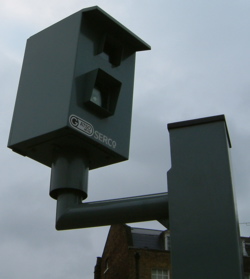
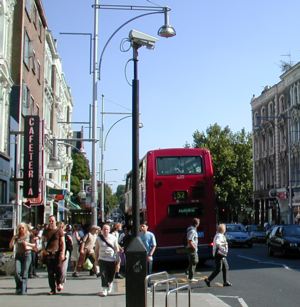
From the linked article: “According to recent studies, Britain has 4.2million CCTV cameras – one for every 14 people in the country – which amounts to 20 per cent of the global camera total.”
Welcome to modern Britain.
Sean Gabb has been a busy chap lately. As mentioned in an earlier post, the latest issue of Free Life Commentary exposes the fraudulent nature of the British Conservative Party’s ‘intellectual revival’.
Also Sean will be on BBC Radio 5 Live on Sunday 1st April at 11:30am UK time, to discuss whether ‘junk food’ advertisements should be banned (no prizes for guessing what his position is). This programme takes calls and so some of Samizdata.net’s readers might like to ring the relevant number and air their views. All the BBC Radio 5 details, such as telephone numbers, e-mail addresses, and on-line listening, can be found here.
Another thing of interest and relevance: the Libertarian Alliance has released its latest pamphlet called Habits Are Not Illnesses: A Response to Dr Robert Lefever, by Joe Peacott.
Bryan Appleyard has written a piece on the inimitable Guido Fawkes, but alas he has made a whole host of gross factual errors:
He started submitting entries to the transatlantic libertarian blog samizdata.net/blog, but they were never accepted, possibly because Samizdata was neocon and Staines isn’t. He’s a real libertarian, not a corporate shill like the average neocon. So he began his own blog, adopting the Guido persona.
Firstly, we did in fact publish quite a few of his various ‘guest post’ articles here on Samizdata… probably 70% of the ones he sent to us. And to find this out, all Bryan had to do was use the search box in the right hand sidebar of this blog to discover that.
Secondly, far from me (or Samizdata) being neo-con in contrast to Paul-the-libertarian, 95% of the time you could not fit a piece of paper between my views and those of Paul Staines. And of the 5%, I suspect the vast majority of our differences would be tactical, not philosophical. So as for me being a corporate shill, well Bryan is talking through the cushion on his seat, and that is putting it politely. If I am on the payroll of big business, my cheques must keep getting lost in the (state owned) postal service.
Thirdly, I did indeed turn down several of the-man-who-became-Guido’s articles for Samizdata but not a single one of them were rejected for ideological reasons. I turned down some because they were defamatory and other because this blogs does not really concentrate on party politics to the extent Paul likes to (and that is also why Guido and Samizdata are not ‘competitors’… we have quite different ‘mission statements’).
Not up to your usual standard, Bryan. Consider your arse fact-checked.
Just thought I would share an extract from a letter I wrote to someone asking if I was ant-war or not:
Not all the contributors to Samizdata support the war in Iraq and Afghanistan. It is not an ‘editorial policy’. Some of us do and some of us do not.
I am no more anti- or pro-war than I am anti- or pro-knife. It rather depends what it is used for. There are justified wars and there are unjustified wars and in this imperfect world in which we live there are wars which are shades of both.
I am not a neo-con who supports anything the US or UK state does overseas because it is the US or UK state doing it. I spent a considerable time in Croatia and Bosnia in the 1990’s observing the war there at very close quarters indeed. That experience well and truly cured me of any residual pacifism or squeamishness about the fact there are many truly evil people in this world who need to be confronted with violence. In fact there are some people with whom the only reasonable form of interaction is to put 8 grams of copper jacketed metal through their skulls at 710 metres per second.
However I suspect that is not what you are asking me…if you want to know do I have a problem with just shrugging my shoulders at the fact a homicidal mass murdering tyrant with a history of invading neighbouring countries had controlled Iraq for two decades with some help from my tax money … well, I do have a problem with that and so I did support the drastic remedial action of ejecting Saddam by force on the basic and rather non-purist notion “the bastards are going to tax me to fund the volunteer military regardless, it might as well be used for something that actually reduces the sum total of evil in the world even though that is going to be messy as hell”.
Afghanistan on the other hand was a no-brainer: the Taliban governed state supported a direct attack on the USA, ergo the Afghan state was the one who actually initiated the war, not the USA.
Unlike many, I did not expect the aftermath in either Iraq or Afghanistan to be pretty but I did not (and still do not) see that as an excuse for giving the Ba’athists a free pass to keep gassing entire villages and feeding people they do not like into wood-chippers feet first.
Ideally the Iraqis themselves should have done for Saddam, but of course when they tried immediately after Gulf War Episode I, the wonderful George Bush senior left them hanging out to dry after having previously openly encouraged them.
So yes, I supported the war in Iraq (for rather different reasons to the US and UK govts, it must be said) because I find nothing libertarian about drowning out the screams of two decades of tortured Iraqis by holding a couple copies of Murray Rothbard’s ‘The Ethics of Liberty’ over my ears.
Jesus did not say, “I was hungry and you lobbied the government to tax others to feed me.” He said, “I was hungry and YOU fed me.”
– W. E. Messamore. Read the whole thing.
Paul Joyal, an outspoken critic of Vladimir Putin has been shot in the USA. Does this remind you of anything?
Of course it could just be another random street crime, but if not and this turns out to be another (hopefully just attempted) assassination of an overseas political enemy living in the west, then it is clearly well past time to start loudly demanding the state does one of the few legitimate things it taxes us for… protecting us all from the armed servants of a foreign government.
Could it be time to start threatening Putin in the most literal way? If he keeps killing people in the west then not only should Russian embassies be closed forthwith, those expensive security services we pay for should start motivating the Russian security services to behave via whatever means come to mind. I can certainly think of a few.
I will watch with interest to see what information comes out about this case. It could, after all, have just been a robbery.
|
Who Are We? The Samizdata people are a bunch of sinister and heavily armed globalist illuminati who seek to infect the entire world with the values of personal liberty and several property. Amongst our many crimes is a sense of humour and the intermittent use of British spelling.
We are also a varied group made up of social individualists, classical liberals, whigs, libertarians, extropians, futurists, ‘Porcupines’, Karl Popper fetishists, recovering neo-conservatives, crazed Ayn Rand worshipers, over-caffeinated Virginia Postrel devotees, witty Frédéric Bastiat wannabes, cypherpunks, minarchists, kritarchists and wild-eyed anarcho-capitalists from Britain, North America, Australia and Europe.
|