We are developing the social individualist meta-context for the future. From the very serious to the extremely frivolous... lets see what is on the mind of the Samizdata people.
Samizdata, derived from Samizdat /n. - a system of clandestine publication of banned literature in the USSR [Russ.,= self-publishing house]
|
A commentator on Breitbart, ‘Rob’, says of the decision by the FBI not to recommend charges relating to alleged violation of the law relating to the use and security of the Secretary’s private email server:
“Until this election, the corruption, coercion, and sleazy backroom deals were just that… backroom. The Clintons… AND Obama… have revealed who they are: criminals. IF in light of this clear abortion of justice this country elects Hillary, the United States DESERVES to collapse and disintegrate just like Rome. Shame on Comey. Shame on Lynch. Shame on Obama. And shame on that sleazy criminal hag Hillary. Disgusting… all of them, and I would love to watch Attorney General Chris Christie put them all in prison next summer.”
You might think so from reports from the usual quarters, including the Grauniad in a piece, which even by the low standards of legal waffle, is utterly devoid of anything approaching a reasoned legal argument. But from their point of view perhaps, job done.
However, some heavyweight lawyers have weighed in with an opinion piece providing some arguments that Brexit would only be lawful if Parliament approved it. And you can imagine their concern that the clearly expressed will of the electorate might be ignored, why the BBC has even picked up this article, letting it be more widely known.
‘…we argue that as a matter of domestic constitutional law, the Prime Minister is unable to issue a declaration under Article 50 of the Lisbon Treaty – triggering our withdrawal from the European Union – without having been first authorised to do so by an Act of the United Kingdom Parliament. Were he to attempt to do so before such a statute was passed, the declaration would be legally ineffective as a matter of domestic law and it would also fail to comply with the requirements of Article 50 itself.’
So that was all a waste of time then, and Mr Cameron has resigned for no good reason (from his pov), I hear no one say.
Let’s look at this a bit, (btw my answer is ‘No’).
Article 50 – The relevant provisions of Article 50 read as follows:
1 Any Member State may decide to withdraw from the Union in accordance with its own constitutional requirements.
2 A Member State which decides to withdraw shall notify the European Council of its intention. In the light of the guidelines provided by the European Council, the Union shall negotiate and conclude an agreement with that State, setting out the arrangements for its withdrawal, taking account of the framework for its future relationship with the Union. That agreement shall be negotiated in accordance with Article 218(3) of the Treaty on the Functioning of the European Union. It shall be concluded on behalf of the Union by the Council, acting by a qualified majority, after obtaining the consent of the European Parliament.
3. The Treaties shall cease to apply to the State in question from the date of entry into force of the withdrawal agreement or, failing that, two years after the notification referred to in paragraph 2, unless the European Council, in agreement with the Member State concerned, unanimously decides to extend this period.
Article 50 is part of the Lisbon Treaty, and it is enshrined in law by an Act of Parliament (this Treaty was the one that Mr Cameron gave us that ‘cast-iron’ guarantee of a referendum on, until is was ratified, when it was ‘too late’ to have a referendum.)
Looking at 1, this seems to me to leave the decision to withdraw to the member state, and for it not to be a matter for the EU, and nothing more. If a member state decides to leave, it need only follow its own requirements, i.e. the EU does not presume to over-ride any such mechanism, fair enough, and the decision itself must be lawful, lest a would-be dictator seeks to rush out of the EU on the way to mimicking Belarus.
2 sets out the mechanism for the departing State to notify the European Council. Nothing fancy there, a verbal statement could do it, but a handwritten letter would be polite. “Dear Donald, We are ducking out of the European Union in accordance with the terms of Article 50, this letter is our formal notification thereof, Chauzinho, signed ….”. And then a negotiation starts.
Looking at 3, the Treaties shall cease to apply to the State in question etc. from the date of entry into force of the withdrawal agreement (whenever that might be) or, failing that, 2 years after the notification, unless the European Council unanimously* decides to extend this period (in agreement with the departing state)
(*Pay attention folks, 50 (3) crops up below.)
So if nothing is agreed to extend time, or if we don’t leave earlier, exit is automatic after 2 years. Perhaps the Chilcott committee will find a new task for the next decade or so, negotiating Brexit?
The problem, it seems, is that the lawyers think that the Royal Prerogative is constrained by law, in that the Sovereign (on the advice of her Ministers) can do no wrong, but also cannot do anything that is unlawful such as exercising her Prerogative when Parliament has provided for it to be exercised in a particular way or with prior Parliamentary approval, in which case it is no Prerogative at all, of course.
All very well, but the exercising of Article 50 is simply doing what ‘it says on the tin’, the right to withdraw is inherent in the Treaty, so exercising a right provided for in the Treaty is not (well it seems fairly obvious to me anyway) a breach of the Treaty or of EU law. One might ask, if Article 50 does not allow for withdrawal, what on Earth does it provide for?
But of course, it goes much deeper than that, the exercise of the Prerogative is constrained by Parliament and the law. The first line of attack is to argue that Parliament has to approve a decision to leave the EU.
Is this found in 50 (1) “…in accordance with its own constitutional requirements…” Of course, the UK has no written constitution (moan the Lefties), but the referendum was held by authority of an Act of Parliament, and it was only ever ‘advisory’, i.e. it was legally a pointless exercise, as the outcome mandated nothing, whereas a 2011 Referendum did mandate a change in the law in the event of approval to changes in the voting system, by delegated legislation within the Act. So the Act that provided for this Referendum could have provided for a mechanism for its implementation by its own provisions mandating the Prime Minister to trigger article 50 in the event of ‘Leave’ prevailing, or by requiring another Act (which is necessarily subject to Parliament’s will) to trigger Article 50. The Prime Minister may ignore this Referendum outcome completely, of that there is no legal doubt.
But then again, Parliament has constrained the power of the executive (i.e. the Crown as advised) in relation to treaties. Step forward The European Union Act 2011. This Act is a sort of ‘entrenching’ Act, which sets out various obstacles to Treaty modifications without a referendum in the UK, see section 4.
4 Cases where treaty or Article 48(6) decision attracts a referendum
(1) Subject to subsection (4), a treaty or an Article 48(6) decision falls within this section if it involves one or more of the following—
(a) the extension of the objectives of the EU as set out in Article 3 of TEU;
(b) the conferring on the EU of a new exclusive competence;
(c) the extension of an exclusive competence of the EU;
(d) the conferring on the EU of a new competence shared with the member States;
(e) the extension of any competence of the EU that is shared with the member States;
(f) the extension of the competence of the EU in relation to—
(i) the co-ordination of economic and employment policies, or
(ii) common foreign and security policy;
(g) the conferring on the EU of a new competence to carry out actions to support, co-ordinate or supplement the actions of member States;
(h) the extension of a supporting, co-ordinating or supplementing competence of the EU;
(i) the conferring on an EU institution or body of power to impose a requirement or obligation on the United Kingdom, or the removal of any limitation on any such power of an EU institution or body;
(j) the conferring on an EU institution or body of new or extended power to impose sanctions on the United Kingdom;
(k) any amendment of a provision listed in Schedule 1 that removes a requirement that anything should be done unanimously, by consensus or by common accord;
(l) any amendment of Article 31(2) of TEU (decisions relating to common foreign and security policy to which qualified majority voting applies) that removes or amends the provision enabling a member of the Council to oppose the adoption of a decision to be taken by qualified majority voting;
(m) any amendment of any of the provisions specified in subsection (3) that removes or amends the provision enabling a member of the Council, in relation to a draft legislative act, to ensure the suspension of the ordinary legislative procedure.
Zzzzz…. But nowhere in this Act has Parliament put any brake on the exercise of the notification to leave the EU under Article 50! That right is left untouched, yet it could have been constrained. Furthermore, this Act requires a referendum on certain decisions by Ministers (i.e. the Crown) by Section 6.
6 Decisions requiring approval by Act and by referendum
(1) A Minister of the Crown may not vote in favour of or otherwise support a decision to which this subsection applies unless—
(a) the draft decision is approved by Act of Parliament, and
(b) the referendum condition is met.
(2) Where the European Council has recommended to the member States the adoption of a decision under Article 42(2) of TEU in relation to a common EU defence, a Minister of the Crown may not notify the European Council that the decision is adopted by the United Kingdom unless—
(a) the decision is approved by Act of Parliament, and
(b) the referendum condition is met.
(3) A Minister of the Crown may not give a notification under Article 4 of Protocol (No. 21) on the position of the United Kingdom and Ireland in respect of the area of freedom, security and justice annexed to TEU and TFEU which relates to participation by the United Kingdom in a European Public Prosecutor’s Office or an extension of the powers of that Office unless—
(a) the notification has been approved by Act of Parliament, and
(b) the referendum condition is met.
(4) The referendum condition is that set out in section 3(2), with references to a decision being read for the purposes of subsection (1) as references to a draft decision and for the purposes of subsection (3) as references to a notification….
Try an espresso to stay with me, but furthermore, the Schedule to this Act sets out ‘Treaty provisions where amendment removing need for unanimity, consensus or common accord would attract referendum’.
And here we find, at the bottom, Article 50 (3):
Article 7(2) (determination by European Council of existence of serious and persistent breach by member State of values referred to in Article 2).
Article 14(2) (composition of European Parliament).
Article 15(4) (decisions of European Council require consensus).
Article 17(5) (number of, and system for appointing, Commissioners).
Article 19(2) (appointment of Judges and Advocates-General of European Court of Justice).
Article 22(1) (identification of strategic interests and objectives of the EU).
Chapter 2 of Title V (specific provisions on the common foreign and security policy).
Article 48(3), (4), (6) and (7) (treaty revision procedures).
Article 49 (application for EU membership).
Article 50(3) (decision of European Council extending time during which treaties apply to state withdrawing from EU).
So Parliament has set limits on what Ministers of the Crown may do in respect of the Lisbon Treaty, and has said nothing at all about the exercise of the right to withdraw requiring Parliamentary approval, it has left this area alone. Yet, if the UK were to partake in a decision to change the requirement for unanimity from the European Council when extending time during which the withdrawal mechanism applies to a departing state, this would require a referendum.
Of course, triggering Article 50 and Brexit will still leave Section 2 (2) of the European Communities Act 1972 intact and in force, maintaining the supremacy of EU law in the UK after Brexit, because nothing in Article 50 dis-applying the Treaties would necessarily repeal that section of UK law. But that would leave a post-Brexit Parliament in the odd position of being bound by a predecessor Parliament’s decision to make EU law supreme and limit its power to amend EU law. Would anyone suggest that such a situation would last?
The final arguments against Brexit may well be that to leave the EU is a breach of someone’s Human Rights, and is therefore void or should be stopped, or, alternatively that the decision to leave is a breach of EU law and therefore void.
But of course, by the very nature of the EU, the UK’s courts, even if they were minded to grant an injunction or interdict against notification of Brexit (making it void) cannot constrain the EU or stop it from doing what it wishes, such as showing us the door.
UPDATE 19072016: Court challenge to be heard in the High Court of England and Wales in October 2016.
The Liberal Democrat party, with its host of 6 MPs (much reduced in 2015) have pledged to ignore the Brexit referendum result and to campaign for the UK to remain in the EU.
“Nigel Farage’s vision for Britain has won this vote, but it is not a vision I accept”, declared Lib Dem leader Tim Farron yesterday. “Even though the vote was close, the majority of British people want us to leave. But we refuse to give up on our beliefs”, he said.
Mr Farron, the relatively obscure leader of the party of heavyweights such as Cyril Smith, went on:
Mr. Farron argued that his party’s proposition was justifiable in a democratic society as older people’s votes were somehow less valid and because a vote against the EU was really a vote against Westminster.
“This was not a vote on the European Union alone”, he said, but a “howl of anger” against politics.
So, once the votes are counted, and if that ‘fails’, they are then ‘interpreted’ and in line with socialist logic, they don’t mean what a plain reading might fairly be taken to show that they mean. But is he not also saying that the vote was against him, as a member of the Westminster Parliament?
I would like to contrast this attitude with that of General Pinochet, well-known ‘strongman’ of Chilean politics from 1973 to 1990, who held a referendum on his junta (well, him) continuing to rule Chile in 1988, and who respected the outcome rejecting his continued rule, with a little prodding perhaps from General Matthei, the Air Force member of the junta (and friend of the UK in the Falklands War), who called for the result to be respected.
I suppose what we are seeing is a political auto-endoscopy by the Left, each trying to get further up their own arses than the other, with Nicola Sturgeon, Scotland’s First Minister indicating that the Scottish Parliament may have a veto on Brexit, a surprising interpretation of constitutional law from someone who is a solicitor.
I am confident that the bulk of people will see through all this, and see the Left, in all their shades, for the totalitarians that they are.
Of all the dire threats, this from the French Economy Minister (there is one? an economy I mean) is the most chilling, since it reminds me of how far we have fallen.
Leaving the European Union would make the UK as significant as Guernsey, France’s economy minister has said
So the rate of income tax would be a standard 20% and there would be no VAT and no Capital Gains or Inheritance Tax? That’s some good deal for being insignificant.
Of course, this 20% tax rate is an anomaly in Guernsey, it was introduced as 4 shillings in the pound (20 shillings per pound/livre) in WW2. Let’s look at some of the measures the Nazis introduced in the occupied Channel Islands.
On arrival in the islands, the Germans issued proclamations imposing new laws on the resident islanders. As time progressed, additional laws restricting rights were posted and had to be obeyed. The restrictions included:
Confiscation of:
weapons (1940)
boats (1940)
radios (1940) then (1942)
motor vehicles (forced sale) (1940)
cameras (1942)
fuel
houses
furniture
Restrictions on:
fishing (1940)
drinking spirits (1940)
exporting goods (1940)
changing prices of goods (1940)
patriotic songs and signs (1940)
more than three people meeting together (1940)
access to beaches
fuel
freedom of speech
access to medicines
some clubs and associations.
Changes to:
drive on right of roads (1941)
rations (1943, 44 & 45)
clocks to German time (1940)
Forced to accept:
curfew (1940)
exchange rate to Reichsmarks (1940)
census (1940)
identity cards (1941)
growing vegetables
food rationing (1940)
increase in income tax to 4/- (1940)
lodgers billeted
German language in schools
Cycling in single file (1941)
work from Germans
censorship
Well we have a long way to fall before that state of affairs, and cycling in double file is by no means discouraged bar some circumstances by the Highway Code, presumably in the hope of causing more accidents.
So let freedom reign, even though the sky (and tax rates) may fall.
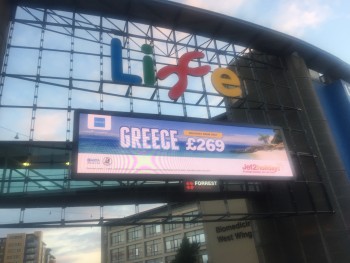
And today, I couldn’t help noticing the timing of these sequential adverts on a hoarding in Newcastle.
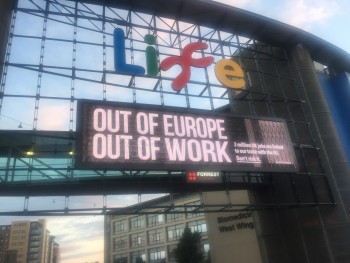
and next this:
Try as I might, I cannot but chuckle at news coming out of Argentina, of a lawmaker, Señor Lopez, from the Kirchnerite movement in Argentina being arrested in the alleged circumstances of hiding between 5-8 millions of dollars worth of cash and a gun in a convent.
An Argentine former secretary of Public Works with the Cristina Fernandez administration, Jose Lopez, and currently a member of the Mercosur parliament, was arrested on Tuesday in the Buenos Aires province locality of General Rodríguez while he was trying to hide bags full of money and an automatic gun in the garden of a convent.
The reason for the formal arrest was possession of a war weapon, a Sig Saguer rifle, loaded with 25 cartridges.
Lopez was arrested with six bags and a suitcase stashed with dollars, Euros, Yuan and Qatar currency as well as very expensive watches (Rolex, Omega). “We found 160 bundles of cash, 108 of dollars, and some of them still thermo-sealed with the stamps from China’s central bank”, revealed Cristian Ritondo, head of Buenos Aires province security. Ritondo said Lopez tried to bribe the police officers and went into shock when they did not accept, and later suffered a deep depression.
At first he told the officers he was planning to donate the funds to the nuns monastery. In effect one of the nuns interviewed said that Lopez had visited them the previous day and “he was quite crazy”, saying he had stolen the money which was to help the monastery, “but today when he turned up and started dumping the bags, police arrested him. I told the officers he was a good man, he came once a year to visit us and would help us with donations of coffee and tea”
Corruption in Argentina is, at least, like a certain beverage, reassuringly expensive. The comments are quite good, especially the one about the nuns needing a good Rolex to time their prayers.
If tunnel building were an Olympic support, I suspect that Switzerland would bestride the top step of the podium and its virtually unknown national anthem would blare out to the cheering crowd, thrilled by the culmination of a 20-year slog of building the Gotthard base tunnel, the world’s longest rail tunnel, which opens today, co-incidentally the anniversary of a British naval triumph against the French, the Glorious First of June (with those rebellious colonists being involved tangentially).
This twin-bore tunnel opened on time and within budget, and it runs level and almost straight through the varying geology of 35 miles of Swiss mountain, a fantastic achievement, but with sadly 9 deaths, but that seems very low over 20 years and 35 miles. If it can be traversed, per reports, in 17 minutes, that’s an average speed of over 120mph. The idea is to get lorries crossing the Alps through Switzerland off the Swiss roads. Switzerland is, of course, (along with Liechtenstein) surrounded by the European Union but outside it.
And meanwhile, as the Swiss literally give geology both barrels, in England, we have our glorious Channel Tunnel and the Channel Ports (as the Sage of Kettering relayed to me once ‘The problem with the Channel Tunnel is that it has a government at both ends.‘). Well, today a House of Commons committee has come up with a rather skeptical report about a new plan to cope with cross-Channel traffic. For those who do not drive in the South-East of England, there is a standing plan in place to cope with the vagaries of the joys of free movement of goods in the glorious European Union whenever the Channel Tunnel runs into a problem (e.g. when the French start horsing around, burning sheep etc.), called ‘Operation Stack’, where the Kent police close an entire motorway, the M20, and park lorries bound for the Continent on it pending the cessation of hostilities, typically a period of 5 days of so, when a major motorway becomes a lorry park, and to Hell with the locals.
part of the M20 was used 32 times last summer by queuing lorries – a process known as Operation Stack.
The British answer to this problem is, of course, to shell Calais and demand its return to English control (er, no), it is to build a 65 hectare lorry park at a cost of £250,000,000. This would be as big as Disneyland (the one in California) and bigger than the Vatican (a mere 44 hectares) and with the added bonus of no Pope. It will allow 4,000 lorries to be parked whilst the benighted lorry drivers await the restoration of normality. One might ask why each lorry space would cost £62,500 (c.$90,000 US)?
Do we see here cultural differences between the UK and Switzerland? The acceptance of failure and its normalisation, a tendency towards inflated cost and an attitude of weary resignation, against a positive can-do attitude that bulldozes through problems.
So why can’t we be like Switzerland?
Postscript: Eric’s comment indicates that the Swiss may not have been above a bit of creative accounting in completing the tunnel on time and in budget, for which I am grateful, I may have been misled by the BBC (which in Cyrillic was the acronym for the Soviet Army Airborne Forces, what a co-incidence).
Private property appears to have come under attack in Georgia (Stalin’s Georgia), where a vegan cafe has reportedly been attacked by meat and sausage-throwing ‘Neo-Nazis’ (aren’t they busy, these ‘Neo-Nazis’?).
A vegan cafe in Tbilisi has appealed for public solidarity after being invaded by alleged ultra-nationalists wielding grilled meat and sausages.
More than a dozen men stormed into the Kiwi cafe in the Georgian capital on Sunday evening, the cafe said, shouting and throwing meat at patrons.
A brawl erupted but the attackers fled before police arrived.
The cafe has appealed for public support, saying it was no prank but a case of intimidation by neo-Nazis.
It’s as if Seattle had come to Georgia, and wasn’t welcome. And note the sly elision in the reporting of this incident, linking it with some other, dark forces…
The incident comes amid growing concerns about the rise of far-right nationalism in Georgia.
Last week, hundreds of nationalists marched through central Tbilisi – waving Georgian flags and anti-communist banners, reports said – to mark independence from the Soviet Union in 1991.
Homophobia is also commonplace in Georgia, correspondents say. The country made world headlines in 2013 when a small group of LGBT activists were attacked by a large mob led by an orthodox priest.
But wasn’t homosexuality disapproved of in the USSR?
So what are we to make of events in Tiflis, as Georgia’s capital is called by some?
Why would neo-Nazis object to vegans when you-know-who was history’s pre-eminent vegetarian?
The Facebook post of the café rounds off with the ominously dreary declaration:
“‘…café is continuing to work and is ready to accept all costumers (sic.) regardless of nationality, race, appearance, age, gender, sexual orientation, religious views etc. Equality is the most important thing for us. Animal liberation! Human liberation! ¡No pasarán!…’
But where is ‘political views‘ in that declaration of tolerance?
The local police, however, appear to have had a beef with the vegan café…
The police arrived only after the attackers had left*, but the cafe said even some of those officers behaved aggressively, “yelled with anger, said that we are guilty of what had happened”. Some cafe workers were taken in for interrogation.
Let’s hope the staff weren’t grilled too unpleasantly by the police.
* In the Facebook post, the café reports that ‘…Surreptitiously Nazis left, got away clean…’.
The Leave campaign have helpfully reminded the good people of the UK that if the UK were to leave the EU, it would be possible to eliminate VAT on domestic heating. This is one of many ills of the monstrous regime of Value Added Tax, which bring with it a gruesomely complex web of regulations and case law, quietly throttling economic activity throughout the EU.
In fact, if we left the EU, we would not need to have VAT at all. There would of course be an even bigger hole in the public finances without VAT revenue, but it would be an opportunity to simplify taxation, reduce rates and make an improvement to most people’s standard of living.
VAT was a modest 8% when Mrs Thatcher came to power, having promised not to double VAT, she allowed her Chancellor, Sir Geoffrey Howe, to hike VAT to 15%, which had been the plan all along.
The Conservatives secretly agreed plans for a “massive” increase in value-added tax from 8 to 15 per cent almost a year before the 1979 general election, party papers from the period, seen by the Independent, show.
The charge that the Tories would double VAT on taking office was levelled during the election campaign by the Prime Minister, James Callaghan, and other leading Labour figures. It was denied both by Margaret Thatcher, the leader of the Opposition, and byGeoffrey Howe, the shadow Chancellor, in a campaign in which the impact on prices of the Conservative’s declared plans to switch from direct to indirect taxation played a significant part.
Sir Geoffrey (now Lord Howe) declared: “We have absolutely no intention of doubling VAT.” The allegation was depicted as one of Labour’s “dirty dozen” lies in a Conservative press release.
But papers marked “secret” and circulated in numbered copies only show that proposals for a “massive” hike in VAT to 15 per cent or even 17.5 were canvassed in February 1978 by Lord Cockfield, a member of Sir Geoffrey’s economic team.
I recall reading musings in the press in the 1980s to the effect that moving from direct to indirect taxation was an improvement in terms of liberty. Now at least there is talk of removing some things from VAT.
Even in the dying days of the last Labour government, there was a backhanded acknowledgment that reducing taxes is good, when the rate of VAT was lowered from 17.5% to 15% for a year, (with howls of indignation from the Conservatives and Lib Dems) before it was hiked again to its current (Standard) rate of 20%. For some reason, as part of the ‘Single Market’, VAT has to be levied on goods and services in line with EU law at rates that seem to be between 17 and 27%. Quite how this helps free trade is, frankly, opaque.
However, as a rule of thumb, the crappier the government, the higher the VAT.
The BBC’s Japan Correspondent, Mr Rupert Wingfield-Hayes, has written about his (thankfully brief) detention in North Korea after covering the visit of three Nobel Laureates. Working for the Socialist Monster clearly did not impress the North Koreans.
He tells us that he was asked if he thought that Koreans spoke like dogs, after he wrote that a North Korean official ‘barked’ at him. He was asked if he thought Koreans were ugly, as he referred to an official as ‘grim-faced’. He could not have known that he would only be detained for 10 hours, which is a shorter time than some get in jail for not paying the TV licence and a resultant fine.
His ordeal developed with an ominous introduction:
Two of our old minders now appeared at the door.
“We are taking you to meet with the relevant organs,” they proclaimed. “All will become clear.”
It did not become clear, as his surreal interrogation showed (emphasis added).
“Do you think Korean people are ugly?” the older man asked.
“No,” I answered.
“Do you think Korean people have voices like dogs?”
“No,” I answered again.
“Then why do you write these things?!” he shouted.
I was confused. What could they mean? One of the articles was presented to me, the offending passage circled in black marker pen:
“The grim-faced customs officer is wearing one of those slightly ridiculous oversized military caps that they were so fond of in the Soviet Union. It makes the slightly built North Korean in his baggy uniform comically top heavy. “Open,” he grunts, pointing at my mobile phone. I dutifully punch in the passcode. He grabs it back and goes immediately to photos. He scrolls through pictures of my children skiing, Japanese cherry blossom, the Hong Kong skyline. Apparently satisfied he turns to my suitcase. “Books?” he barks. No, no books. “Movies?” No, no movies. I am sent off to another desk where a much less gruff lady is already looking through my laptop.”
It turned out that his interrogators construed his prose as ‘grim-faced’ = ‘ugly’ and took ‘barks’ literally. Odd really, as I assumed that they had eaten all the dogs in North Korea in the 1990s famine.
His theory as to why he was detained in quite simple:
Why did they choose to detain and expel me? My best guess is that someone high up decided my reporting had endangered the success of the Nobel laureates’ visit. Pyongyang yearns for recognition. Their trip was of great importance to the government. The three Nobel laureates were shown the very best of the country. They met its brightest students. Our coverage was a threat to that plan, and an example needed to be made.
He was very much luckier than any Korean and many Westerners detained in North Korea.
And those three Nobel Laureates’ visit? How smart do you have to be to better understand North Korea?
As if Brexit the Movie needed a counter, news reaches us of what appears to be a co-ordinated campaign amongst the ‘Luvvies’ (an affectionate (?) term for those who act or have acted for a living etc.) to implore us to remain in the EU.
By their friends shall ye know them.
“Britain is not just stronger in Europe, it is more imaginative and more creative, and our global creative success would be severely weakened by walking away.”
Well that is quite a remarkable claim. Would Shakespeare have produced better plays if the Spanish Armada had won? Have the Luvvies unleashed a Hellburner into the Leave campaign’s flotilla of arguments?
Who said anything about ‘walking away‘? Aren’t we quite happy where geography has put us?
But there is reputedly an economic angle:
Alan Johnson, chair of the Labour In for Britain campaign, said leaving the EU would mean higher tariffs on exports and digital and creative industries were “better off with the UK in EU” with access to the single market.
Good luck with tariffs on theatrical productions, and streaming.
A bit of balance in the article from Lord (Michael) Dobbs, a Conservative peer and author.
“Culture owes nothing to committees.
“Ancient Greece was the birthplace of our civilisation yet today, because of the EU’s appalling policies, streets that were once filled with the world’s greatest philosophers and playwrights are choked with desperate beggars and mountains of rotting rubbish.
“These are the realities of the EU. It’s failing. The dream is dead. We need to move on.”
I’m sure that Soviet and East German Culture owed a lot to the Central Committee, but let’s not go there.
I have never read or taken an interest in Harry Potter, I only bought one such book as a requested present for a young family member, for which I apologise. However, J K Rowling, Labour donor, renowned author and Cybernat 5-minute hate subject, has gone up in my estimation as she stood up for Donald Trump’s right to visit the UK, echoing the attitude of Voltaire.
‘I consider him offensive and bigoted. But he has my full support to come to my country and be offensive and bigoted there.’
The best-selling author said that Trump’s freedom to make ‘bigoted’ remarks, ‘protects my freedom to call him a bigot. His freedom guarantees mine.’
She warned that attempts to repeal any of those freedoms, however well intentioned, means ‘we have set foot upon a road with only one destination.’
We know what that destination is. She goes on.
Rowling explained that if she was to back a travel ban of Trump, because of his offensive comments, then she would have ‘no moral grounds on which to argue that those offended by feminism or the right for transgender rights or universal suffrage should not oppress campaigners for those causes.’
‘If you seek the removal of freedoms from an opponent simply on the grounds that they have offended you, you have crossed a line to stand along tyrants who imprison, torture and kill on exactly the same justification,’ she added.
Such a pity about the working, as my maths teachers used to say, but positive sentiments in favour of liberty and openness to debate are welcome and refreshing, albeit depressingly scarce in public debate.
A couple of unrelated incidents, and a political milestone all in the news today appear to me to sum up the ascendency of the ‘clown class’ in modern Britain, where personal responsibility and personal dignity appear to be outmoded notions.
Firstly, after a bomb scare led to the abandonment of the last football match of the Premier League season between Manchester United and Bournemouth, it appears to have turned out that the realistic but inert suspect device found just before kick-off was in fact a practice bomb left by a company engaged to plant suspect devices as part of a security drill. But this was only found out long after the event and after the Army had carried out a controlled explosion on the device.
What part of counting them all out and counting them all in was too hard to organise? Did no one remember the drill?
Secondly, it appears that a senior woman police officer in Greater Manchester Police has been suspended after attending a conference on Women in Policing.
Assistant Chief Constable Rebekah Sutcliffe has been suspended after the alleged “inappropriate behaviour” following a reported row with Superintendent Sarah Jackson.
The pair are said to have become embroiled in a “loud disagreement” over who had the “best boobs” while attending the Senior Women In Policing conference.
Quite how this would be a breach of police discipline, even if the alleged incident happened, is not immediately clear. However, ACC Sutcliffe has been reported as saying:
“I’ve nothing to say. This is an incredibly stressful time.”
Thereby immediately contradicting herself. And grammarians may ponder if she ought to have said ‘better boobs’ rather than ‘best’ as surely the comparative applies, rather than the superlative?
But if this is a stressful time, what on Earth are you doing in policing? Try something really stressful, like bomb disposal, like Lt-Cdr John Bridge GC GM and bar. He would have come in handy at Old Trafford yesterday.
And finally, Natalie Bennett is not going to stand for re-election as Leader of the Green Party when her term expires. So the party memorably described as ‘Communism for middle-class women’ will have a new leader. So the Schadenfreudefest of Ms Bennett being interviewed (very softly I think) on any topic may no longer be repeated so as to expose the Greens for what they stand for, banning anything that they can think of. This of course may be a negative development in terms of the political landscape, but why didn’t she either resign at the time or stand on her record?
|
Who Are We? The Samizdata people are a bunch of sinister and heavily armed globalist illuminati who seek to infect the entire world with the values of personal liberty and several property. Amongst our many crimes is a sense of humour and the intermittent use of British spelling.
We are also a varied group made up of social individualists, classical liberals, whigs, libertarians, extropians, futurists, ‘Porcupines’, Karl Popper fetishists, recovering neo-conservatives, crazed Ayn Rand worshipers, over-caffeinated Virginia Postrel devotees, witty Frédéric Bastiat wannabes, cypherpunks, minarchists, kritarchists and wild-eyed anarcho-capitalists from Britain, North America, Australia and Europe.
|




