We are developing the social individualist meta-context for the future. From the very serious to the extremely frivolous... lets see what is on the mind of the Samizdata people.
Samizdata, derived from Samizdat /n. - a system of clandestine publication of banned literature in the USSR [Russ.,= self-publishing house]
About a year ago Konstantin Kisin of Triggernometry stirred up controversy by suggesting that Rishi Sunak, former British Prime Minister, was “not English”. At the time, I tried to write something and failed miserably. The other week the controversy flared up again as Sunak, himself, belatedly commented on the affair. Once again, I tried to write something and once again I failed. I kept tying myself up in knots before coming to the conclusion that it was all a bit futile. The real question – the important question – is whether someone is pro-British or anti-British. Having said that there has to be something to be pro or anti, which implies the existence of Britishness. So what is this Britishness? It is largely ethnic but not entirely. People can join and they can leave.
So, going back to the original question, where does Rishi Sunak fit on this British/pro-British/anti-British spectrum? Well, he’s not British and given his actions in office it is difficult to tell whether he is pro or anti. Next question: what about Keir Starmer?
P.S. I wrote this before watching Kisin’s most recent monologue. Which was a mistake because he does a much better job of explaining the situation before suggesting the obvious solution: re-establish the British Empire.
This week it was announced that Manchester City FC – which has dominated English football in recent years – has been found guilty by an independent panel of 114 charges relating to the breaking of the Premier League’s financial rules.
The essential charge is that the owners of the club – in essence the Government of Abu Dhabi – spent more than they were allowed to. Money was funnelled through various off-balance sheet means.
I am not sure I am using “balance sheet” correctly.
The judgement leaves little room for doubt. There were only ever 115 charges. The Premier League’s language is not diplomatic.
I doubt that the “appeal” will amount to much.
I am in two minds about the rules themselves. On the one hand, I think people should be allowed to waste their money in any way they choose. On the other, I don’t like seeing clubs go bust.
Everybody knew. This always stank.
The investigation only came about because emails were hacked and published in – of all things – Der Spiegel. Before that the Premier League in traditional British style had turned a blind eye.
Manchester City seem to think that denial and obstruction is the way to go. They have to know that is not the case. This may be a cultural thing.
And a political thing. The Prime Minister has thought it a good idea to wade in. It is even beginning to look as if British politicians can be bought. Well, to those who didn’t already think that British politicians could be bought.
Such machinations do not bode well for the integrity of the government’s recently-formed “independent” football regulator.
Politics and sport don’t mix. The whole point about sport is that it takes you away from politics.
This is about sporting integrity: the idea that everyone is playing by the same rules, on and off the pitch. And it is not just the principle of the thing. Sporting integrity sells.
The Premier League must understand it will take a hit from this. A huge hit. The only real question is how big and for how long. A few years ago I took to watching the Indian Premier League (that’s cricket). It turned out that the team I had been supporting had been bribed to throw games. I haven’t watched cricket since and I doubt I ever will.
The punishment must be severe. It is the only way that sporting integrity can be rebuilt and shown to be being rebuilt.
There could be all sorts of claims for compensation: “…We would have had this player. We would have won this. We wouldn’t have been relegated” etc. This could take years to settle.
Punishment must also be swift. The fans will have their say. There is going to be a very unpleasant atmosphere every time Manchester City take the field. If they take the field… What would happen, I wonder, if clubs refused to play them?
None of the above has anything to do with the fact I am a Watford supporter and am looking forward to the day when my team wins the FA Cup despite suffering the biggest-ever defeat in a final.
The other day the people of the small Oxfordshire village of Piddington voted to leave Great Britain. Of course, they have no intention of doing any such thing: this was an attempt to demonstrate locals’ anger at the proposal to house over a thousand illegal immigrants at a nearby disused military base.
But what if a few more towns and villages were to follow suit? After all it is difficult to see why decent people would want to be part of a debt-ridden, crime-ridden, economically-stagnant, fascist dystopia whose leaders would much rather the said decent people were dead. What if such a movement snowballed and ended up with swathes of the country voting for what might be called Brexit2? They might join forces. They might have a convention. Sonorous phrases like “When in the Course of human events, it becomes necessary for one people to dissolve the political bands which have connected them with another…” might get an outing in England’s green and pleasant land. They might even make a stab at self-government.
Of course that would cut no ice with Britain’s rulers who believe in the divine right of the communist election-rigger. Any attempt by the secessionists to actually leave would be ruthlessly crushed. The only real question would be if the British (anti-British?) state would have the wherewithal to do it. If they did not, who knows? maybe we would all be applying for a passport to Piddington.
These [socialist] writers were obviously counting on the proverbial humility of a certain section of our people, who believe that a person who is incomprehensible must be profoundly wise.
On new Prime Ministers:
The Press succeeded in the magical art of producing names from nowhere within the course of a few weeks. They made it appear that the great hopes of the masses were bound up with those names. And so they made those names more popular than any man of real ability could ever hope to be in a long lifetime. All this was done, despite the fact that such names were utterly unknown and indeed had never been heard of even up to a month before the Press publicly emblazoned them. At the same time old and tried figures in the political and other spheres of life quickly faded from the public memory and were forgotten as if they were dead, though still healthy and in the enjoyment of their full viguour. Or sometimes such men were so vilely abused that it looked as if their names would soon stand as permanent symbols of the worst kind of baseness.
On art:
The more vile and miserable are the men and products of an epoch, the more they will hate and denigrate the ideal achievements of former generations.
On cancel culture:
The tactics of Social Democracy consisted in opening, at a given signal, a veritable drum−fire of lies and calumnies against the man whom they believed to be the most redoubtable of their adversaries, until the nerves of the latter gave way and they sacrificed the man who was attacked, simply in the hope of being allowed to live in peace. But the hope proved always to be a foolish one, for they were never left in peace.
On the middle class:
Those among whom I passed my young days belonged to the small bourgeois class. Therefore it was a world that had very little contact with the world of genuine manual labourers. For, though at first this may appear astonishing, the ditch which separates that class, which is by no means economically well−off; from the manual labouring class is often deeper than people think. The reason for this division, which we may almost call enmity, lies in the fear that dominates a social group which has only just risen above the level of the manual labourer – a fear lest it may fall back into its old condition or at least be classed with the labourers. Moreover, there is something repulsive in remembering the cultural indigence of that lower class and their rough manners with one another; so that people who are only on the first rung of the social ladder find it unbearable to be forced to have any contact with the cultural level and standard of living out of which they have passed.
On education:
There is no reason why millions of people should learn two or three languages during the school years, when only a very small fraction will have the opportunity to use these languages in later life and when most of them will therefore forget those languages completely.
Have you got it yet? I bet you have. The language used and the way I’ve framed the question suggests a well-known historical figure and someone we’re not supposed to agree with.
But it’s interesting, isn’t it? Whatever he was, he was not a numpty. Well… he was a numpty. But he was clearly capable of recognising patterns and coming up with theories to explain them. Some of which were correct.
Which makes me wonder. Getting hold of a copy of Mein Kampf is not the easiest thing in the world to do. For instance, there were no second-hand copies on eBay last time I looked. I can’t imagine they are that scarce. So I assume eBay and others have been leant on by the authorities.
So, what are they so worried about? We are told that Hitler was a raving loony. That is the narrative. But it is not true. Read Mein Kampf for more than a few minutes and you realise that there’s more to the guy. But the government can’t stand that idea. Apparently. It fears the idea that rather than being a raving loony, Hitler was a raving loony with an ability to reason. Crazy not stupid, so to speak. But why would that idea so threatening to the government?
P.S. I’ve just read the Jewish stuff. Oh Boy.
P.P.S FWIW, I am reading the Murphy translation. I understand there are quite a few translations out there. Or were.
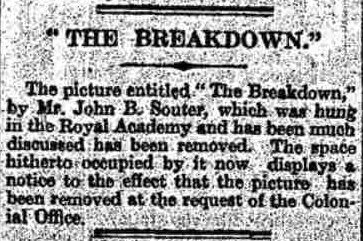
Long-time Samizdata readers will know that one of my hobbies is to read The Times (of London) from a hundred years ago. It is often the case that the most interesting articles are also the shortest. Take this one for example:
The brevity of the article may have something to do with the brevity of The Times. This article appeared in the 10 May 1926 edition i.e. in the middle of the General Strike.
I never cease to be surprised by the amount of censorship – formal and otherwise – that went on a hundred years ago. The era was not part of Keir Starmer’s “proud tradition of free speech.” Or maybe – come to think of what Starmer understood by “free speech” – it was. Anyway, I had to find out what all the fuss was about and if you click on “More” you can find out too.
The Britain of the mid-19th Century was the greatest civilisation that has ever existed. It had a mighty empire, a mighty navy, it had wiped out the slave trade and it was at the forefront of the Industrian Revolution, the greatest improvement in living standards in history. And now, as I write, it is hanging on by a thread: divided, debt-ridden and weak.
So, where did it all go wrong? Here – in reverse chronological order – is my list of the key dates:
2008. Reaction to the Financial Crisis. Had the banks just been allowed to go bust and the banking regulation that reduced their numbers abolished we would not be looking at 20 lost years.
1997. Opening the borders. Allowing the establishment of hostile communities in your country is not a good idea.
1987. Leaving the NHS untouched. By 1987, the Thatcher government had privatised just about everything. Only the NHS and education were left. And they flunked it. Mind you it would probably have been electoral suicide.
1969. Failure to defeat the IRA. If you reward terrorism you get more of it.
1965. Race Relations Act. Keir Starmer is wrong. Britain does not have a “proud tradition of free speech”. But it did have some free speech. This act along with various successors outlawed some forms of speech. Those successors progressively outlawed freedom of association which might have gone a long way to taking the sting out of the Integration Crisis.
1964. Abolition of the Death Penalty. I appreciate libertarians tended to be divided on this issue. We may have a lot to say about what the law should be but very little about what should happen when it is broken. But if you are going to end a long-standing tradition it had better work. It didn’t.
1963. Robbins Committee. This led to the subsidisation of higher education and the subsidisation of student living costs. Where you get subsidy you get communism.
c.1948. Ending of the right to defend oneself with a firearm. I got this from the late Brian Micklethwait but I haven’t been able to confirm it. Brian’s point was that if you couldn’t use guns to defend yourself there was very little point in having one and so it became easy for the state to ban them.
1948. Nationalisation of rail. Along with coal, steel and many others along the way. Losses, strikes, decline, waste, unemployment.
1947. Town & Country Planning Act. Pretty much stopped building anywhere where people might want to live. A huge contributor to putting home ownership out of the reach of millions.
1931. Abandoning the Gold Standard. Inflation and boom and bust became the order of the day.
1920s. Abolition of the Poor Law. I mean to write about this one day but TL;DR while the Poor Law had many shortcomings it did at least keep people alive while keeping the costs down.
1922. Creation of the BBC. A monopoly communist propaganda organisation using the most powerful media then in existence which non-communists were forced to pay for. What could go wrong?
1920. Beginning of the War on Drugs. Other than the crime and changes to the drugs themselves (making them more dangerous than ever), the persistent failure of the War on Drugs gave the state the excuse for ever greater assaults on civil liberties.
1918. Universal Adult Male Franchise. This meant that people could vote themselves other people’s money. It very quickly led to the replacement of the (not very) Liberal Party by the (not-at-all liberal) Labour Party. Mind you, it should be pointed out that a lot of the damage was done well before.
1910. People’s Budget et al. In introducing the state pension, a state GP service and unemployment benefit this laid the foundations of the Welfare State that is currently doing such a good job of bankrupting the country.
1910. Payment of MPs. I put this one in tentatively. I would like to say it meant Members of Parliament no longer had to have made something of themselves but given that a large number of them came from rich families that is not quite true.
1906. Taff Vale Judgement. This effectively put trade unions above the law leading to endless strikes, uncompetitiveness, industrial decline and unemployment.
1890s. Death Duties. Bit by bit this destroyed the aristocracy by forcing a fire sale every time the head of the household died. [And that did what exactly, Patrick? Summat! It did summat!]
1875. Trade Union Act. This allowed picketting or the intimidation of non-striking workers by trade unionists. I have to thank Paul Marks for bringing this one to my attention.
1870. Forster Act. This established state education along with all that went along with it such as indoctrination, poor quality education and the opportunity costs involved in children not being able to earn money or learn a trade.
1845. Banking Act. This began the extension of the Bank of England’s monopoly to the whole of the country.
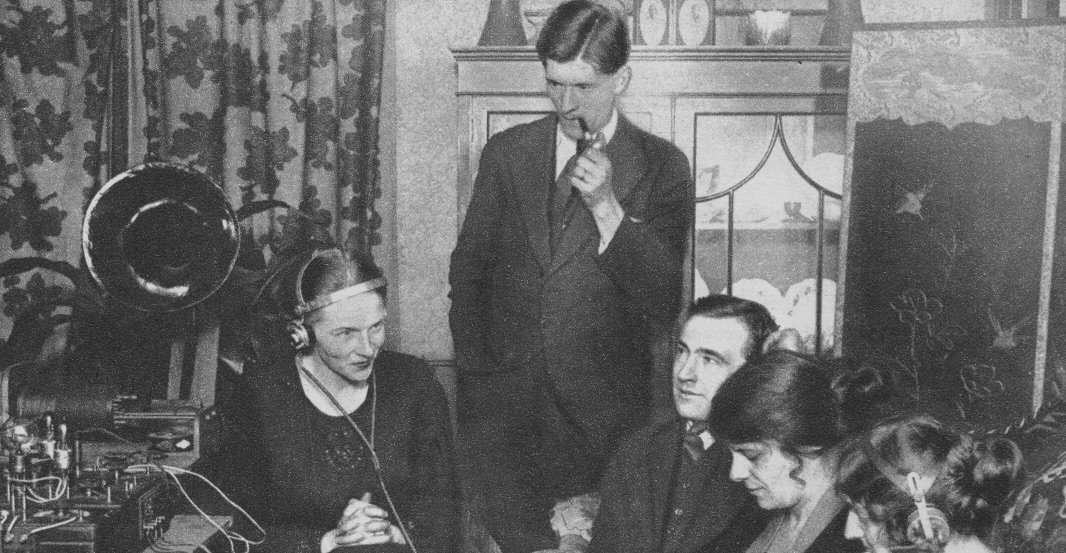
In the beginning there were wireless sets. But the government worried that these could be used by spies for a foreign power. So it demanded that wireless owners took out licences. The licences were free the government just wanted to know who had a wireless. Just in case.
Then someone came up with the idea of broadcasting. Music, lectures, news, that sort of thing. The government came up with a scheme. They would charge a fee for the licence. It would also demand that wireless manufacturers make a contribution. To sugar the pill it would make it illegal to sell a wireless set that wasn’t made by a member of the British Broadcasting Company.
The minister responsible for this? One Neville Chamberlain.
And so in late 1922 the BBC, in the shape of such regional broadcasters as 2LO, came into being. And it was very popular – save for the fact that building one’s own set was illegal. But the arrangement had an expiry date. And a committee was set up to decide what to do next.
A hundred years ago it reported and as you can probably guess, the manufacturers were ditched with the recommendation that a public body to be known as the British Broadcasting Commission be put in its place financed entirely through the licence fee.
Why? I seem to remember being told that the Company was in dire financial straits. But there’s not a hint of it in the report as published in The Times. Actually, there is very little justification at all. Although they do say this:
Notwithstanding the progress which we readily acknowledge, and to the credit of which the company is largely entitled, we are impelled to the conclusion that no company or body constituted on trade lines for the profit, direct or indirect, of those composing it can be regarded as adequate in view of the broader considerations now beginning to emerge.
So you are getting rid of something you “readily acknowledge” is a success for something that might work?
We do not recommend a prolongation of the licence of the British Broadcasting Company or the establishment of any similar body composed of persons who represent particular interests.
I’ve got some bad news about how that’s going to work out.
We think a public corporation the most appropriate organization. Such an authority would enjoy a freedom and flexibility which a Minister of State himself could scarcely exercise in arranging for performers and programmes, and in studying the variable demands of public taste and necessity.
The British Broadcasting Commission will be appointed by the Crown, and the Committee feel that the proposal is an interesting development in the application of the principle of public ownership.
So, the whole thing was a communist experiment. Great. And then there was this doozy:
It is felt that that principle can be easily applied in this instance, because broadcasting must of its very nature be a monopoly.
Clearly that argument falls because it is not true that broadcasting is a monopoly. But even if it were, as a libertarian, in principle I would prefer such things to exist in an unfettered free market.
Before it became Lenin in the lounge
Update 10/4/26. Incredulity has been expressed over the idea that d-i-y wireless sets were illegal. They were but only for about a year or so. And I don’t think there were any prosecutions. Oddly enough, when “interim” licences were first issued – for just such sets – the number of licences doubled more or less overnight.
The other day the Triggernometry boys sat down with a Professor Robert Pape to discuss the Iran War. Here are his main points along with my commentary:
Airstrikes do not change regimes. – Spot on. They don’t change their aims either. Although they may change their capabilities.
The 12-Day War of 2025 didn’t work. – That sounds about right. It would appear that Iran still has stocks of the stuff you make nuclear bombs out of.
Kharg Island will be difficult to take. – Nonsense.
Iran has become an oil “hegemon”. – In other words, by demonstrating it can close the Straits of Hormuz it dominates supply. I doubt it.
Suicide bombing has nothing to do with religion and everything to do with desperation. – While I am always open to other ways of looking at things I can’t help but notice that suicide attacks are almost never carried out by Westerners however desperate.
The Obama deal, which Pape advised on, is as good as it gets. – He’s losing me.
Israel is involved in ethnic cleansing in Gaza. – Now he’s completely lost me. “To Hell or Connaught” it is not.
Israel will end up having to allow inspections of its hitherto unacknowledged nuclear facilities. – Maybe, but there won’t be any bombs to inspect because by then the Israelis will have used them.
There was something else that bugged me. It was his general tone: defeatism mixed with smugness.
*Of course, this interview does no such thing. It seems to me that Obama’s guiding principle was the destruction of American liberties and their replacement with a communist tyranny. The Papes of this world just provided suitable intellectual cover.
Dr. Mackail, in one of his recent essays, has laid fresh stress on this point when he says there were not enough Romans left to carry on the work of Rome. There are fears among those who are responsible for Government to-day, fears not yet gripping us by the throat, but taking grisly shape in the twilight, that the Great War, by the destruction of our best lives in such numbers, has not left enough of the breed to carry on the work of the Empire. Our task is hard enough, but it will be accomplished ; yet who in Europe does not know that one more war in the West and the civilization of the ages will fall with as great a shock as that of Rome ? She has left danger signals along the road ; it is for us to read them.
– Stanley Baldwin (Prime Minister as was), 9 January 1926. Maybe fear of a repeat of the collapse of the Roman Empire is an ever-present feature of Western civilisation. I still fear it though.
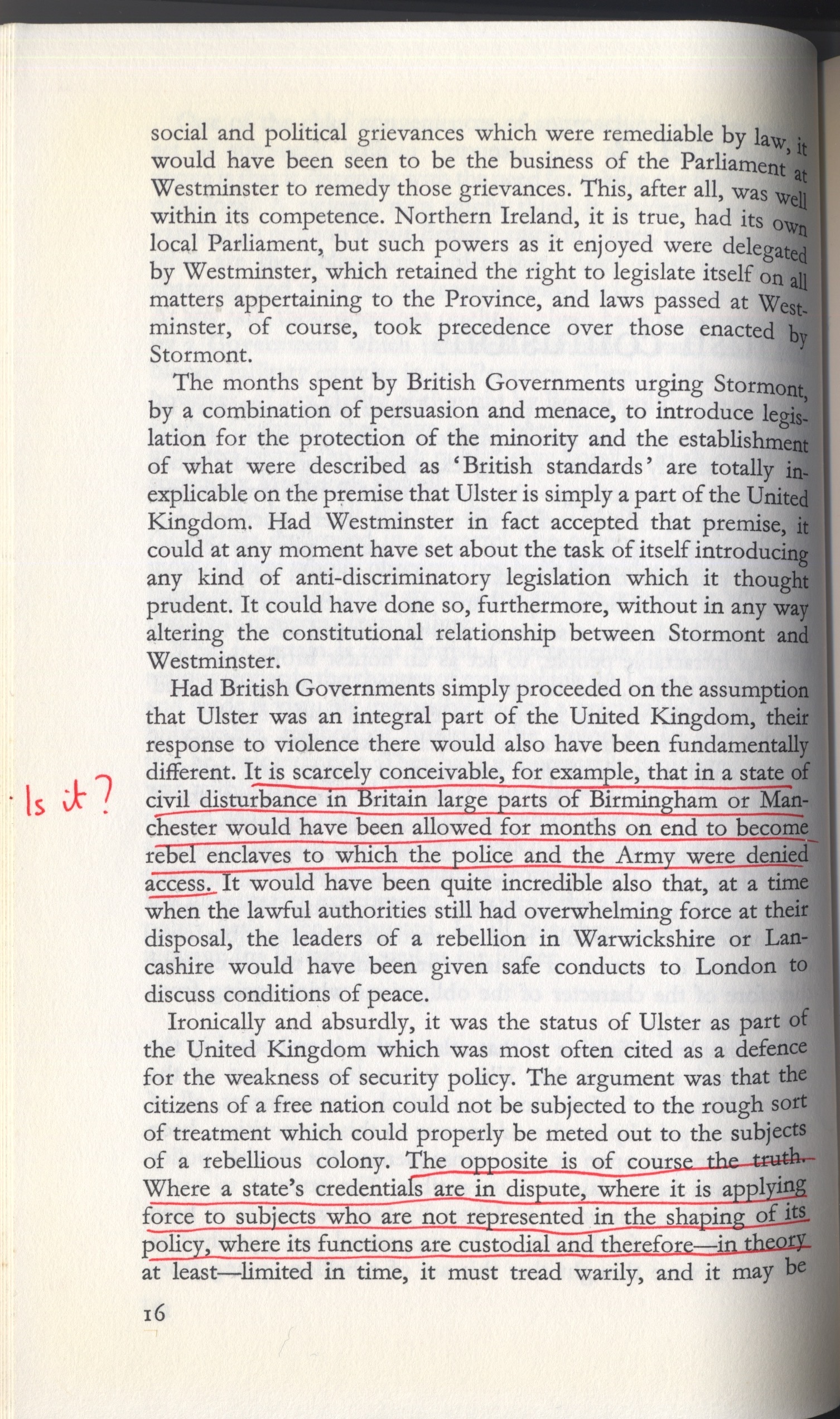
News today got me thinking about a quote from T.E Utley’s Lessons of Ulster which was first published in 1975. Below is a scan from my copy.
Click for full page.
For the uninitiated he is referring to the creation of a “no go” zone in Londonderry which lasted from 1969 to 1972.
Lessons of Ulster is a magnificent work. Flicking through it 30 years after having read it I was surprised how perceptive he was – more perceptive that I recall thinking at the time. But as you can see from the marginalia, I didn’t entirely agree with Utley and after hearing the news that the threat of Islamic violence has led to Israeli football fans being banned from attending a match in Birmingham I think I can claim that I was right and Utley wrong. Sure, we may not be seeing barricades but there can be little doubt that the British state lacks the will to face down mob violence.
Lest I am doing Utley a disservice, he did also have this to say:
It… seemed to me that, in some degree at least, the tragic conflict in Ulster might turn out to be a rehearsal for an even more devastating challenge to authority on this side of the Irish Sea.
Although – given that this was written in the 1970s – I think he was probably thinking more about communists and trade unions.
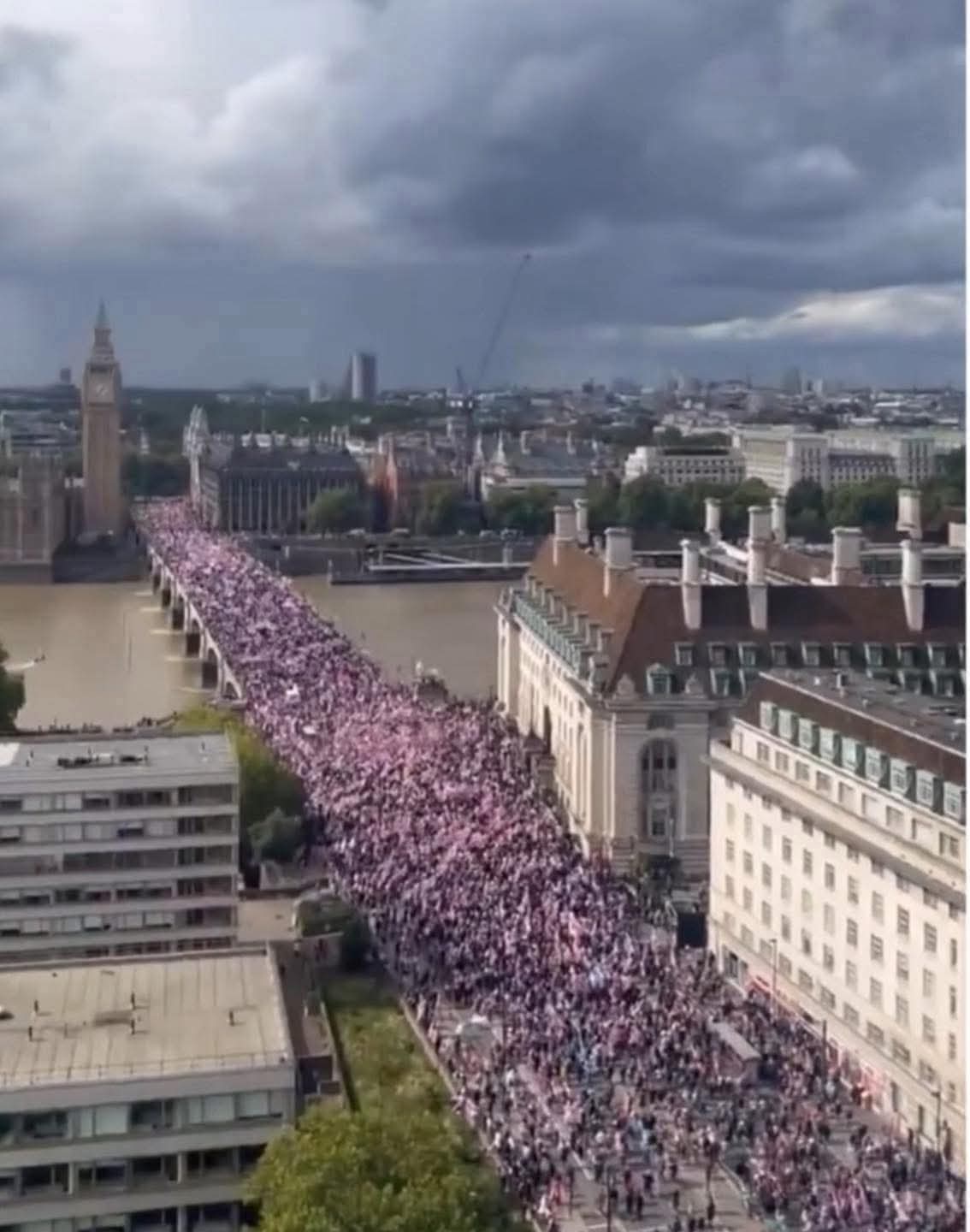
This has been the subject of some debate. Tommy Robinson says 3 million. The police say 150,000. That’s quite the discrepancy.
Oddly enough, I am in a rather good position to judge. I was there. Did I count them all? No, I didn’t. What I did do, however, was skulk around the back. Oh, and do some maths.
The plan was for everybody to assemble in Stamford St which, for those who don’t know, is a street in South London between Blackfriars and Waterloo Stations. Stamford St was packed and there was an overflow into Southwark Road, Blackfriars Road and Blackfriars Bridge. I was right at the back of the overflow into Southward Road. I would say that extended for – if I am being generous – 100m. (My apologies for using Nazi units but I can’t be arsed to do the conversion.)
Whitehall is 700m long. Stamford St is about the same length. So with the overflows we get 1000m of march. Stamford St is maybe 30m wide. So we get the whole march – I didn’t see many late comers – in 30,000m².
So how many people per metre? I understand the rule of thumb is 4. For comparison, Wembley manages to 90,000 people sat down in 90,000m². Four standing in the same space as one seated? Bit of a squeeze but possible.
The Samizdata people are a bunch of sinister and heavily armed globalist illuminati who seek to infect the entire world with the values of personal liberty and several property. Amongst our many crimes is a sense of humour and the intermittent use of British spelling.
We are also a varied group made up of social individualists, classical liberals, whigs, libertarians, extropians, futurists, ‘Porcupines’, Karl Popper fetishists, recovering neo-conservatives, crazed Ayn Rand worshipers, over-caffeinated Virginia Postrel devotees, witty Frédéric Bastiat wannabes, cypherpunks, minarchists, kritarchists and wild-eyed anarcho-capitalists from Britain, North America, Australia and Europe.
All content on this website (including text, photographs, audio files, and any other original works), unless otherwise noted, is licensed under a Creative Commons License. Powered by WordPress & Atahualpa





Recent Comments