[AIUI etc, etc.]
In the beginning there were wireless sets. But the government worried that these could be used by spies for a foreign power. So it demanded that wireless owners took out licences. The licences were free the government just wanted to know who had a wireless. Just in case.
Then someone came up with the idea of broadcasting. Music, lectures, news, that sort of thing. The government came up with a scheme. They would charge a fee for the licence. It would also demand that wireless manufacturers make a contribution. To sugar the pill it would make it illegal to sell a wireless set that wasn’t made by a member of the British Broadcasting Company.
The minister responsible for this? One Neville Chamberlain.
And so in late 1922 the BBC, in the shape of such regional broadcasters as 2LO, came into being. And it was very popular – save for the fact that building one’s own set was illegal. But the arrangement had an expiry date. And a committee was set up to decide what to do next.
A hundred years ago it reported and as you can probably guess, the manufacturers were ditched with the recommendation that a public body to be known as the British Broadcasting Commission be put in its place financed entirely through the licence fee.
Why? I seem to remember being told that the Company was in dire financial straits. But there’s not a hint of it in the report as published in The Times. Actually, there is very little justification at all. Although they do say this:
Notwithstanding the progress which we readily acknowledge, and to the credit of which the company is largely entitled, we are impelled to the conclusion that no company or body constituted on trade lines for the profit, direct or indirect, of those composing it can be regarded as adequate in view of the broader considerations now beginning to emerge.
So you are getting rid of something you “readily acknowledge” is a success for something that might work?
We do not recommend a prolongation of the licence of the British Broadcasting Company or the establishment of any similar body composed of persons who represent particular interests.
I’ve got some bad news about how that’s going to work out.
We think a public corporation the most appropriate organization. Such an authority would enjoy a freedom and flexibility which a Minister of State himself could scarcely exercise in arranging for performers and programmes, and in studying the variable demands of public taste and necessity.
The Times’s own report of the report has this to say:
The British Broadcasting Commission will be appointed by the Crown, and the Committee feel that the proposal is an interesting development in the application of the principle of public ownership.
So, the whole thing was a communist experiment. Great. And then there was this doozy:
It is felt that that principle can be easily applied in this instance, because broadcasting must of its very nature be a monopoly.
Clearly that argument falls because it is not true that broadcasting is a monopoly. But even if it were, as a libertarian, in principle I would prefer such things to exist in an unfettered free market.
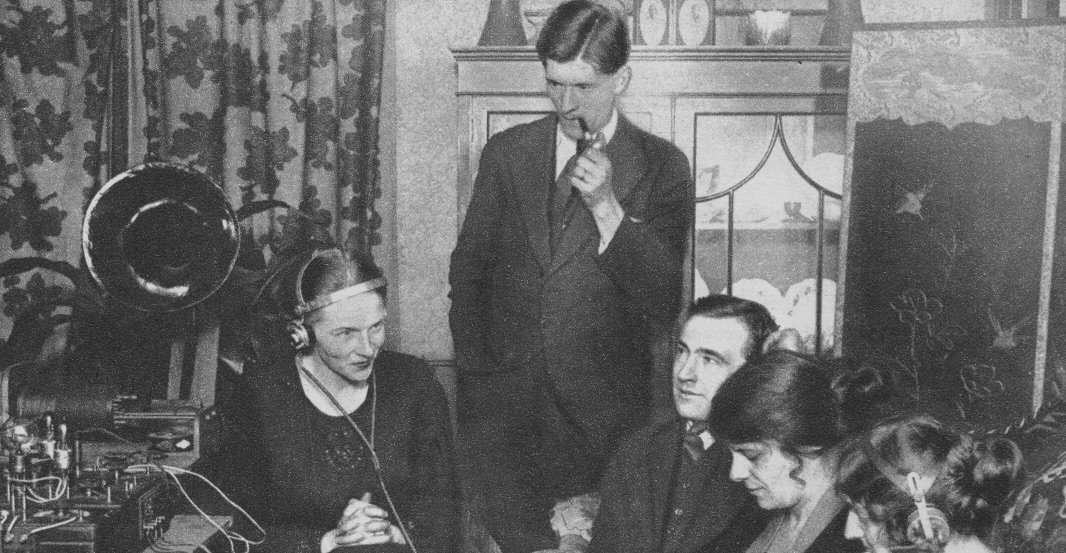
Before it became Lenin in the lounge
Update 10/4/26. Incredulity has been expressed over the idea that d-i-y wireless sets were illegal. They were but only for about a year or so. And I don’t think there were any prosecutions. Oddly enough, when “interim” licences were first issued – for just such sets – the number of licences doubled more or less overnight.


“building one’s own set was illegal”
So, no Tom Swifts then? Didn’t Folks tinkering in sheds. Folks tinkering in sheds from the Curies to Steve Wozniak* is where true innovation occurs.
PS. I once built an FM transmitter!
*A lock-up garage in his case but I think the point remains.
IIRC there was some sort of compromise in which you could build your own set so long as you had the appropriate licence and you built the set with British-made components.
From ‘FREE’ to ‘FEE’ is such a slight change – or a big one..
It should be borne in mind that, at the time, radio was seen in a similar light to AI today: there was a great panic about who owned the technology, and The Nation — whichever one you happened to be in — being Left Behind. RCA was a similar kind of a deal to the pre-nationalised BBC, and pre-dated it (it probably gave our lot ideas): a state-ordained patent cartel intended to stop the British Marconi Company from dominating the American radio business.
None of this excuses 1926 and the utterly bizarre continued existence of the BBC, but it does help explain its origins.
People often forget that Neville Chamberlain was not “right wing” (in the sense of believing in smaller government – like Edmund Burke or, later, John Bright), he, like his father Joseph Chamberlain, was a statist – he believed in an ever bigger state, ever more “public services” and so on.
Lord Halifax was even worse – although very mean with his own money, he loved government spending (claiming that ever more government spending “helped the poor”) and wrote essays on political philosophy arguing for a form of Christian Socialism (whilst, at the same time, being a leading member of a supposedly Conservative political party) – the “rights of the community” must be, according to Lord Halifax, held to override the liberties of the individual – and he kept asking for members of the Labour Party to be included in the government, even BEFORE World War II.
It does not surprise me that Mr Chamberlain supported the monopoly BBC – the ideology of statism seems to have captured the British establishment from the late 19th century onwards (although many members of the British establishment were statists even in the early 19th century – for example Lord Stanley – later the Earl of Derby, and Lord Russell – who the absurd history books falsely claim supported laissez faire).
As for modern Conservatives – they have been complaining about far left BBC bias since the early 1960s (more than 60 years), but have done nothing to end the BBC Tax (“License Fee”).
The ideological straight jacket, the refusal to understand that “reform” (appointing this or that “reformer”) to the Collectivist BBC will not work, and that it must be defunded, is deeply depressing.
President Trump at least tries to get rid of taxpayer funding for leftist indoctrination – but British politicians are just puppets of officials and “experts”.
British “Conservatives” even complain to “Ofcom” about the BBC – failing to understand that a body such as “Ofcom” will, by its very nature, always end up controlled by the left.
A Conservative would not appeal to “Ofcom”, a Conservative would GET-RID-OF “Ofcom”.
How many British Chancellors have reduced statism, increased liberty in the economy, over the last 60 years?
One – Nigel Lawson (the overrated G. Howe did NOT reduce statism – quite the contrary).
That is it – one Chancellor in the last 60 years or more, has reduced statism.
That should tell people all they need to know of the British establishment – of the British system of government.
For example, in the early 1970s the Heath-Barber government did not understand that inflation was a monetary matter – that it was an increase in the money supply, they thought it could be tackled by government edicts, and they did not understand that to have a effectively functioning labour market, the powers given to trade unions by government laws needed to be repealed (not new laws added – old ones repealed) – again they tried to control wages by government edicts, not by freeing the market.
The level of economic understanding of someone like Prime Minister Edward Heath was on the same bone-ignorant level as that of the Emperor Diocletian.
And the leaders of the other political parties were the same.
The officials and “experts” did not have to work hard to control these politicians – as the politicians were as ignorant as the officials and “experts”.
Only two Prime Ministers in my life time are worth any respect.
Margaret Thatcher – who was undermined from the start, and eventually overthrown in a squalid anti-democratic coup in 1990, and Liz Truss – who really does believe in liberty (as Margaret Thatcher did), but was never really Prime Minister – being “in office, but not in power” and forced out of office within a few weeks – but an utterly vicious smear campaign that most people still believe today.
Most people still believe that “Liz Truss crashed the economy” – they might as well believe that the world is flat.
I was building my own radios when I was 8 years old. You’re saying that picking up a screwdriver and a few electronic components was actually ILLEGAL in Britain in the 1920s? That’s insane.
Radio and electronic technology was built on the tinkering of interested skilled individuals. Where on earth would the technology have come from if you were banned from learning anything about it until you were employed as an adult by an approved employer? And how on earth would that employer have obtained *their* knowledge in order to be able to employ people?
And more than a passing whiff of the disdain for “trade” – the idea that this might controlled by rather-grubby, non-PLU people who were in it for the money, and not by high-minded, right-thinking, properly-educated People Like Us, appointed by the King, no less, who would ensure that the lower orders would only hear what we know is good for them. Hence Lord Reith – literally, the secretary of the 1922 committee, a pillar of Conservative politics.
How this system continues to function, over 100 years later, in the communication age we live in now, boggles the mind.
llater,
llamas
M7JGH, In my youth I read a lot of accounts of British soldiers, sailors and airmen escaping from German or Japanese POW camps in World War II. A recurring theme in these accounts is them secretly building crystal radio sets, and it is quite often stated that they had done this before as children, sometimes in the Boy Scouts or similar, but often while simply tinkering. Knowledge of how to make one was evidently widespread. So I don’t think that the prohibition can have been enforced at all strictly. I suspect it wasn’t enforced at all. The fact that I had never heard of it before now reinforces that idea.
@ Natalie Solent – the UK trend to building “crystal sets” grew from the monopoly position of the original BBCompany (not Corporation) which effectively controlled the manufacture and licensing of vacuum-tube radio recievers from 1922 until 1926, and charged an absorbent price for them, as well. Amplification to the level required for a loudspeaker required the use of vacuum tubes.
A crystal set, which has no amplifier and thus needs no vacuum tubes, power supplies, batteries, or much of anything else, can be made at home just-about from household and hardware-store items, and while it will only produce enough output for an earpiece or headphones, will receive signals, especially in the “middle” frequency ranges, just as well as its bigger, amplified brothers. I built several crystal sets when I was a boy in the 60s, and with a 100-foot wire aerial in the back garden, I could listen to Radio Carolone all night for free. Many of my contemporaries did the same. In the US, by contrast, the radio hobby developed around vacuum-tube receivers, as there was no monopoly and no licence to worry about. I understand that for a while there was a lively transit of vacuum tubes from the US to the UK, because of the much-easier availability and lower prices.
llater,
llamas
llater,
llamas
M7JGH,
Well, yeah. I wouldn’t be self-employed in IT if it wasn’t for “buggering about” (I apologise for the tech term) when I was primary school age.
Clearly that argument falls because it is not true that broadcasting is a monopoly. But even if it were, as a libertarian, in principle I would prefer such things to exist in an unfettered free market.
Using a piece of land is a monopoly — Get off my lawn — but that doesn’t mean all land is owned by the government. Instead the rights to use the land is sold to private owners who control the monopoly on that space. The broadcast airwaves could have been sold or rented to private corporations split up by frequency and power (which roughly corresponds to geographical area), and those companies could have optimized the utility of those airwaves. Instead we got the government making a whole mess of the thing. Radio frequency allocation is shockingly inefficient, though in recent times it has become much more efficient since the government started doing just what I suggested in limited scope.
When someone says “this is a natural monopoly” my immediate thought is “you mean you have so little entrepreneurial expertise that YOU can’t think of a way where there can be competition.” These decisions are usually made by bureaucrats who frankly couldn’t organize a piss up in a brewery, even if they nationalized the beer company. If you got a first in classics or PPE you probably aren’t qualified
To fill out the history before Patrick’s post:
From its founding in the seventeenth century until it was abolished by Parliament in 1969, the General Post Office (GPO) held the monopoly on the dispatch of communications from one person to another. It was an office of government, overseen by the Postmaster General, who was a government minister.
When the telegraph was invented in the mid-nineteenth century it was deemed a sort of communication, albeit via wire, so its regulation was assigned to the GPO.
When telephones were introduced they were seen as another form of communication, like letters, but along wires like telegraphy, so its regulation was assigned to the GPO.
Then Marconi integrated various previous inventions to produce radio. It wasn’t radio as we know it today; it used a spark-gap generator to produce the same dits and dahs as the telegraph. In fact, it was called “wireless telegraphy”, and as such its regulation was assigned to the GPO.
In 1912 the White Star Line, the owners of The Titanic, claimed to have the most advanced wireless system in the world. In fact, they were still relying on Marconi’s “wireless telegraphy” system. But by then there was a new system: continuous wave (CW) radio. That’s the radio we recognise today. It was called “wireless telephony” at the time. And since the GPO already regulated telephones you can guess who got to regulate the new type of radio.
By the way, Alan Turing may have come up with the concepts of Colossus, but it was the GPO’s Tommy Flowers whose electrical engineering knowledge made it possible.
Philip Scott Thomas – quite so, your history is correct.
And the government Post Office should never have been given a monopoly – and, indeed, should never have been created.
The Von Taxis family (and others in Europe) showed that there was no need for such government interventions, indeed that such government interventions were harmful.
Fraser Orr – quite so Sir.
The history of the British telephone industry between the mid-1870s and 1911 is fascinating, with more twists and turns than can be fit into one sentence, but since you’re trying to be concise I won’t quibble. What is striking, as you say, is how obviously it set the template for radio.
130-ish years on, we’re still suffering for the establishment’s horror at Bell-Edison’s National Telephone Company emerging as a major competitor to the Post Office. Every time I look at it, I find “the moment Britain’s decline began” slipping further and further back. The passage of the Telegraph Act in 1892 is my current candidate.
One of my favourite (?) examples of the complete inanity of state control over communication means is found at Eucla, on the South coast of Australia. From the 1870s until about 1920, this was the site of a telegraph station, which was there because the State-regulated telegraph system to the West used the American version of the Morse code, while that to the East used the International system, which is now the standard. I may have these back-to-front, but you get the idea. For 50-odd years, telegrams coming into this station were written out by hand by a receiving telegraphist and passed over to a sending telegraphist, who re-transmitted them onwards in the other format. A whole (small) town was based on this inanity, which could, of course, on no account be altered.
Who remembers Baroness Thatcher’s example of the difference between state enterprise and private enterprise – the time to get a telephone installed? The GPO – oh, about 6 months. Bell Telephone, in the USA – is it alright if we can’t do it until tomorrow?
llater,
llamas
llamas – quit so.
Sam Duncan – the decline started even further back.
To the 1870s – for example the 1870 Forster Education Act, the birth of “Public Prosecutions” for crimes against private persons, and the horrible year of 1875 – where Disraeli demanded that local councils do about 40 things (whether or not local taxpayers wanted councils to do those things) and, to a great extent, put unions above the law (even allowing paramilitary obstruction – “picket lines”) – nothing to do with “legalizing union” (they had been legal since the 1820s – and were only made illegal in the wars with France, due to their connections with the enemy). The establishment were soon pretending to care about the unemployment they had created – in 1906 they go the whole hog and put unions almost totally beyond the law, and they still pretend to be concerned about unemployment (which, of course, goes up).
Liberty is in decline from the 1870s onwards – at least in Britain it is.