We are developing the social individualist meta-context for the future. From the very serious to the extremely frivolous... lets see what is on the mind of the Samizdata people.
Samizdata, derived from Samizdat /n. - a system of clandestine publication of banned literature in the USSR [Russ.,= self-publishing house]
|
I am not sneering; I am genuinely asking.
For the last few months I have been education blogging. I’ve never been much good at working out site stats, and things are made harder by my education blog sharing its numbers, or all the ones that I see, with my personal blog. But, going only by how the comment rate has gone from zero to detectable, my education blog is now showing occasional but definite signs of life. I reckon that education blogging is rather like teaching. To begin with you often achieve very little, but if you stick at it, good things may eventually start happening.
In connection with my education blog, and in connection with the helping out that I am now doing once a week at one of the supplementary schools run by the think tank Civitas, I find myself asking: what is the point of learning maths? I entirely accept that there is a point, in fact many points. It’s just that I don’t know much about what these points are. Some of the boys at the supplementary school – two in particular spring to mind – strike me as showing real mathematical talent, at any rate compared to the others. What can I say to them that might encourage them – and encourage their parents to encourage them – to get every bit as far in maths as they can? What use is maths? For lots of people, especially for lots of teachers and lots of children, that is surely a question worth knowing answers to.
I don’t need to be convinced about the usefulness of arithmetic. People cheating you out of change in a shop, or loading you with debt obligations that you did not understand when you made the deal – working out floor areas and carpet costs – getting enough nails and screws and planks when you are DIYing about the house – just generally keeping track of work. I get all that. And, I find, I’m pretty good at teaching arithmetic to young boys and girls, partly because I do indeed understand how important it is.
But what about the kind of maths that really is maths, as opposed to mere arithmetic, with lots of complicated sorts of squiggles? What about infinite series, irrational numbers, non-Euclidian geometry, that kind of thing? I, sort of, vaguely, know that such things have all manner of practical and technological applications. But what are they? What practical use is the kind of maths you do at university? I hit my maths ceiling with a loud bump at school, half way through doing A levels and just when all the truly mathematical stuff got seriously started, and I never learned much even about what the practical uses of it all were, let alone how to do it.
I also get that maths has huge aesthetic appeal, and that it is worth studying and experiencing for the pure fun and the pure beauty of it all, just like the symphonies of Beethoven or the plays of Euripides.
But what are its real world applications? Please note that I am not asking how to teach maths, although I cannot of course stop people who want to comment about that doing so, and although I am interested in that also. No, here, I am specifically asking: why learn maths?
Occasional Samizdatista Michael Jennings works as a Something in the City, analysing things like technological trends. Not at all coincidentally he has a PhD in maths. He is the ideal sort of person to answer such questions, and he and I have fixed to record a conversation about the usefulness of mathematics later this week. But I am sure that a Samizdata comment thread on this subject would help us both, if only by helping me to ask some slightly smarter questions.
Some social critics go on about The Permissive Society, but what we are really facing is The Priggish Society currently being created by busybody politicians and other authority figures… Going out for a night in a bar with close friends is now denounced as “binge drinking”. Smoking an occasional joint means you are a “drug addict”.
– Alex Singleton
The inevitable has happened. The British government has nationalised Northern Rock, the stricken British mortgage lender and bank that got itself into terminal trouble last year as a result of its ambitious, nay, reckless policy of relying on funding itself through the short-term money market. When inter-bank rates spiked, as they did as a result of the credit crunch caused by the US sub-prime mortgage meltdown, Northern Rock suddenly found it impossible to go on funding its mortgage products. It was ruined.
As I have said several times before, the most logical, if painful step, would have been to let the company go bust; depositors would be protected if necessary, but otherwise, the company would be wound up. It would have been a painful, even traumatic example of how unwise lending policies can go unstuck. It would have served, for years to come, as a harsh reminder about the dangers of trying to run a bank without sufficient savings to back it up its lending. Instead, the government’s move to pick up the tab for Northern Rock’s problems will act, however marginally, to weaken the necessary harsh message that should come out of the Northern Rock fiasco.
Now, I know that Samizdata readers will not give a brass farthing about the EU angle, but a thought does occur to me, as it has to others: how on earth can the company be allowed to offer highly attractive savings rates, which are more attractive than those of some of its competitors, when Northern Rock is able to enjoy the status of a tax-funded company, when other, rival banks, such as Alliance & Leicester, are not? How, exactly, is the British government going to be able to square its actions with the single market of the EU?
Just asking.
You have nothing to lose but your place at the trough and a whole world to win!
One non-conservative Big Government Republican (George Bush Sr.) praising the ‘conservative’ credentials of another non-conservative Big Government Republican (John McCain). I assume I am not the only finding this more than a little absurd. These guys are not ‘neo-cons’, they are ‘non-cons’.
I was pleased to read that Allister Heath has been appointed as Editor of City AM, the free daily newspaper distributed in the City of London. The City is generally quite sound, but somehow I think the addition of a noted Hayekian libertarian as editor of this popular freesheet will help the City get even sounder.
Allister came on the scene in the 1990s when he co-founded the LSE Hayek Society. During the heyday of The European Journal, a Eurosceptic magazine, it was Allister who was editor. He says that when someone gave him a copy of Ayn Rand’s Atlas Shrugged, he found it full of things that resonated with him. For the past few years, he’s been working on The Business, firstly as Economics Editor, then Deputy Editor and finally as Editor, where he has been a consistent and effective critic of Gordon Brown’s economic policy.
But not green television the way you think. South African blogger 6000 is “not sure where this came from originally or if it’s true”, but he adds: “But you know, this is SA and people are nothing if not resourceful. It’s a cool story – I choose to believe.” Me too.
Spending fever has reached all walks of South African life. Here’s a fellow who lives in a squatter camp beyond Somerset West in Western Cape who now wants a television set – a new one, mind, not that second-hand thing in the pawn-shop window – so he buys one from the High Street furniture retailer.
But he’s back next day, saying the things keeps switching off just at the crucial moment. The shop checks it out and can find nothing wrong, but soon enough he’s back with the same complaint.
This time the shop sends out a technician to pop round to see what the problem is. When the technician gets there, he discovers our guy’s shack draws its electricity from a nearby traffic light, and that the TV only works when the light is green.
Good to know that almost everybody down there can afford to have “spending fever”, even if some prefer to economise on their electricity bills. 6000 has this as a mere scanned image of a newspaper report. I think it deserves the .html treatment.
With the occurrence of yet another violent attack on a crowd of disarmed people in the news, Glenn Reynolds suggests we start sueing the universities. If a University or any other organization defines its facility as a ‘Gun-Free Zone’ it has an implied contract duty to protect you, and if it has failed to take measures to do so is in breach of that contract.
Think of it this way: you have a constitutional Right of self defense. When a property owner or government makes entry onto that property contingent upon waiving that Right, they imply they will in return defend you against harm. This is not all that different from a situation I faced a decade ago as a C-level manager at a UK ISP. If our net news feeds were wide open, we were a common carrier; but if we put any sort of filtering into effect we were expressing editorial control of content and therefor liable for what we missed, be it child-porn or whatever.
Let the fun begin!
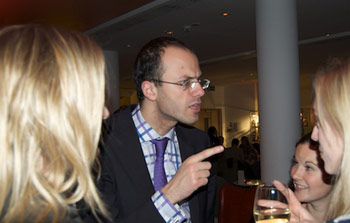
Some people are their own worst enemies. Take, for example, the rather eccentric-looking chap in the photograph below. He appears to have rather clumsily allowed himself to be portrayed as a depraved menace when he is but a makeover away from becoming a card-carrying member of The Great and The Good.
A network of “suicide gurus” who use the internet to advise people how to kill themselves has been exposed…
One of the most notorious figures on the internet suicide scene is Nagasiva Yronwode, a self-confessed Satanist who runs a shop selling occult books and charms in the small Californian town of Forestville, north of San Francisco.
Yronwode, 46, describes himself as the “outreach director” for an extremist cult called the Church of Euthanasia, which advocates suicide as a means of saving the world from the effects of overpopulation.
Does this self-defeating fool not appreciate just how seductive his central message would be to the bien pensant? Indeed, they are treading water just waiting for someone like him (only a plausible, marketable version) to come along. All he needs to do is to make himself a bit more presentable. → Continue reading: Image is everything
Kosova has declared its independence from Serbia and if ever a people have justification for not trusting the political institutions of another, it is the Kosovars. Perhaps this will, as some fear and other hope, start a wave of reasonable and logical separations… starting with Taiwan maybe?
Michael Totten has a superb article up that compares the approach to counter-insurgency followed by Israel under the dismal Ehud Olmert, and that of the US in Iraq under General David Petraeus.
What Totten points out is that the policies promised by Barack Obama for Iraq (in essence remove the army and drop bombs on anyone who seems to be the Bad Guys) is essential the same as the demonstrably failed approach used by Ehud Olmert in Lebanon. Israel blew the crap out of Lebanon from the air and achieved precisely zero of its war aims.
Read the whole article.
The latest control freak ravings from UKGov are the impending crusade against bottled water:
Drinking bottled water should be made as unfashionable as smoking, according to a government adviser. “We have to make people think that it’s unfashionable just as we have with smoking. We need a similar campaign to convince people that this is wrong,” said Tim Lang, the Government’s natural resources commissioner. Phil Woolas, the environment minister, added that the amount of money spent on mineral water “borders on being morally unacceptable”.
Very telling, no? People deciding to spend their own money on something “borders on being morally unacceptable”. Let me what you what is morally unacceptable: that force addicted control freak tax parasites like Phil Woolas have the gall to tell people how to spend their own damn money. “Immoral”? You do not know the meaning of the word, Woolas.
I loath almost all canned and bottled soft drinks (or ‘soda’ in American parlance)… vile phoney tasting sweet muck… and so I am delighted that finally the UK has followed long standing European custom and now conveniently sells bottled water almost everywhere.
And it is The Economist. Unlike some of my fellow Samizdatistas, I am a fan [1]. But then, I am a liberal – conservative only in my suspicion of social management and ‘fixing’ things without enquiry as to whether they are actually broken.
This week in the print edition there is an excellent supplement: The electronic bureaucrat (introduction here). It is clear-sightedly critical of e-government of all kinds, without falling into the know-nothing technophobic rants that I fear some of those who oppose the database state do:
[G]loom, fear and optimism are all justified.
[1] Though I sincerely hope putting Martin Sheen on the cover of the Intelligent Life quarterly was one of its deadpan jokes.
|
Who Are We? The Samizdata people are a bunch of sinister and heavily armed globalist illuminati who seek to infect the entire world with the values of personal liberty and several property. Amongst our many crimes is a sense of humour and the intermittent use of British spelling.
We are also a varied group made up of social individualists, classical liberals, whigs, libertarians, extropians, futurists, ‘Porcupines’, Karl Popper fetishists, recovering neo-conservatives, crazed Ayn Rand worshipers, over-caffeinated Virginia Postrel devotees, witty Frédéric Bastiat wannabes, cypherpunks, minarchists, kritarchists and wild-eyed anarcho-capitalists from Britain, North America, Australia and Europe.
|






Recent Comments