We are developing the social individualist meta-context for the future. From the very serious to the extremely frivolous... lets see what is on the mind of the Samizdata people.
Samizdata, derived from Samizdat /n. - a system of clandestine publication of banned literature in the USSR [Russ.,= self-publishing house]
|
There you were, in a world of pedants, clergymen and golfers…and here was this wonderful man who could tell you about the inhabitants of the sea, and who knew that the future was not going to be what respectable people imagined
– George Orwell on his discovery of the writing of H.G. Wells, as quoted by Cynthia Crossen of the Wall Street Journal, in a context that is quite worth reading, as is the follow up discussion at io9. Come to think of it, these sorts of “respectable people” (along with those who believe that housing is not a high risk investment and therefore expect to be bailed out with my savings when this turns out not to be so, those who are in favour of the television licence fee, and…) may be what I have in mind when I proclaim how much I despise the middle class, as I am prone to do.
To look at this from a UK perspective, I have given this a lot of thought as we have a general election next year (Civil Contingencies Act permitting). Abstention or a vote for a party other than Cameron’s “Conservatives” runs a real risk of preventing the eviction of the Labour party that has done so much damage in the past 13 years. Given another 5 years they could add incalculable damage to an already impressive list.
On the other hand, a vote for the “Conservatives” would vindicate Cameron’s position, kowtowing to the supposed BBC/Guardian left of centre (quite a long way left of centre actually) “consensus”. In the short term Cameron would do less harm than another Labour government, but his success would result in future “Conservative” governments following the same policies so we would be stuck with them for the long term.
The question I asked myself was: do I think Labour can do more damage in 5 years than Cameron’s “Conservatives” can in 10, 15 or more? My answer was no, another five years of Labour is less threatening than an indefinite period of Cameron “Conservatism”. Once defeated Cameron would be dropped like the proverbial hot brick and then it will time to start working for a new leader with Conservative beliefs.
– Commenter MarkE
I guess this is a good reason as any not to fly on Ryanair.
Michael Barone in the Washington Examiner asks: Can the Republicans win the House in 2010?.
Might I suggest this is actually not the right question or at least not a very interesting one to ask.
How about “Would it actually make much difference if the Republicans win the House in 2010?”
Until the Big State Tax and Regulate schmucks like McCain, Romney and their entire ilk are explicitly repudiated and figuratively (and in a perfect world, literally) thrown into Boston Harbour, I will tell you what difference re-electing the party that gave the world George Bush (either) will make… No meaningful difference at all.
Obama is the bastard child of the both parties, make no mistake about it. Nothing he is doing now would have been even within the realm of political possibility if the state had not already been vastly expanded with Republicans in the Whitehouse.
No child left behind indeed… they will be paying for this legacy for a very long time.
No one who gives a damn about liberty should even consider supporting the Republicans until they have had a profound and merciless internal blood-letting and made themselves worth voting for by throwing the Big Staters out. They are not even close to that point yet.
Now is very much the time to call for as much Republican disunity as possible because so much hangs on what happens now. If the mega-statists keep control of both parties as completely as they have over the last twenty years, there will be no way out of the deepening hole.
I have my doubts – which grow by the day, to be honest – about what exactly we are achieving by the operations in Afghanistan. This story is picked up by me at random, but of course there are hundreds of deaths that hit home the mesage about what a grim struggle that conflict is proving to be. May this gallant soldier rest in peace, and my condolences to his friends, comrades and family.
I just picked this up from a Jane’s newsletter:
UK Conservatives plan procurement overhaul. The UK’s procurement process will undergo “root and branch reform” if the Conservative party wins the next General Election, Shadow Defence Secretary Liam Fox told the Jane’s UK Defence Conference on 7 September. The Conservative politician said that the current procurement team was bloated and required significant changes in personnel. “How can it be that, while we have a navy of only 34,000, we have almost 24,000 people working in procurement alone?” he asked. “Military personnel are routinely placed in roles inside the procurement process for which they do not have the required skills or experience.
As Glenn Reynolds is wont to say: “Indeed”.
There is a rumour floating about that a lot of water has been found on the moon:
Reliable sources report that there will be a press conference at NASA HQ at 2:00 pm this Thursday featuring lunar scientist Carle Pieters from Brown University.
The topic of the press briefing will be a paper that will appear in this week’s issue of Science magazine wherein results from the Moon Mineralogy Mapper (M3) aboard Chandrayaan-1 will be revealed.
There is both good and bad to this discovery from our viewpoint. Much will depend on whether the deposits are limited to polar cold traps as has long been suspected or are to be find over a broader polar area. The presence of ice cuts down the required consumables budget for any lunar settlement. The fewer bulk imports required, the nearer the time at which settlement is feasible. The downside is an International Regime led by the United Nations no doubt will be created to ration this valuable resource.
My presumption is they have finally found large deposits of real ice inside some of the polar region craters. The theory for the last thirty years has been that when comets strike the moon, most of the volatiles escape into space, but some linger long enough to find their way into the shadowed polar craters where the temperature is so low that water cannot remain a gas even in vacuum. About 25 years ago I helped a friend of mine, Dr. Francis Graham, to gain funding from the Space Studies Institute to do some telescope work on this problem. His results were negative but I believe Francis may have been one of the first to attempt the search.
Here is a nice little video, via the blog of Tom G. Palmer, singing the praises of free trade, ahead of the upcoming G-20 meeting in the US. Incidentally, the recent decision by The Community Organiser to slap tariffs on Chinese tyre imports – focusing particularly on China – looks to be especially dumb. Given that the Asian giant holds rather a lot of US debt, and has the ability to switch dollars for euros on a vast scale, making such a move seems almost reckless. About as clever as moving to switch off anti-missile defence over Poland on the 70th anniversary of Hitler’s invasion of Poland. In the latter case, the decision may have been right on specific military grounds, but the timing was dumb. Was not part of the appeal of the chap from Chicago that he did not make such errors?
We were promised that Mr Obama would be all smooth and charming to other countries, unlike the terribly vulgar Mr Bush with his Texan drawl (sarcasm alert). But I am not really sure that Mr Obama is not as capable of making an even more dangerous mistake: he pisses off really important, or potentially important, allies and large economies in a position to act. Annoying the French, as Mr Bush wonderfully did, is hardly a mistake, but hitting China with a very public act of protectionism, most decidedly is.
The Castrol oil company (a subsidiary of BP) is about the run an advertising campaign that does the following:
At certain intersections, they will be erecting electronic billboards combined with cameras. Cameras will photograph registration plates of oncoming vehicles. Using the registration data, the make and model of car will be pulled from a database that has been helpfully sold to Castrol by the DVLA (ie the government body that handles vehicle registrations in most of the UK). The billboard will then displace to the motorist recommending which particular type of oil should be used in his car.
No registration data will be stored for later use. I guess that makes it all right then.
Someone please tell me that this is an April Fools joke. Yes, I know it is September.
Because of my interests and network of friends in the business, things of interest often cross my virtual (and real) desk. Sometimes they are surprising. This time my jaw is still laying under the desk and I am applying a healthy dose of skepticism until I really, really am sure these are real and not exceedingly good fakes. I do not think they are and I have examined them closely. The first is the F/A-37, reportedly capable of Mach 3.5 supercruise and top speed in excess of Mach 4. It is shown on board the USN George Washington for catapult fit tests according to the source.
The only thing I can say about this one is it has some familiar resemblance to some test articles I am aware of, and it looks a bit like some things which have been described coming out of Groom Lake. Other than that, it has me absolutely flat-footed… if it is real.
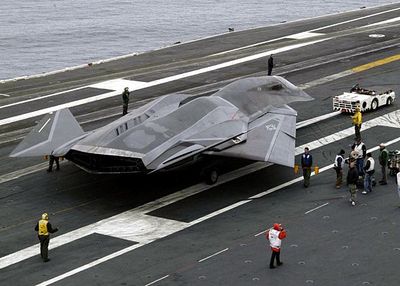
F/A-37 prototype on USN George Washington.
Photo: original source unknown (Now pinned down to the making of the movie “Stealth”)
The second aircraft caught me only a little less flat footed. I am well aware of the base design of the aircraft but to my knowledge it was just a concept design, something that might or might not be built 20 years from now. Given the efficiency and strength and capacity (larger than the Airbus 280) this has got to have Airbus executives reaching for the Maalox… if it is real.
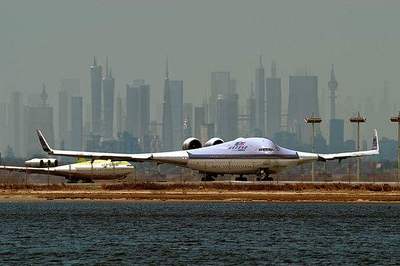
Boeing 797 Blended Wing/Body aircraft.
Photo: original source unknown. (Now pinned down as photoshopped.)
Given that these images are now slithering their way around the mailboxes of the cognoscenti, I am certain we will be hearing more about them one way or the other. I think this is on the up and up, but I am just not yet sure of it.
So, any comments on what has this Samizdata Editor in a state of flabbergasted shock?
Even though I dislike most Oliver Stone films, Wall Street is one of my favourites, precisely because the “Greed is Good” speech is essentially correct even if the word “greed” is a bit misleading. Which is why I might just take a risk and watch this sequel when it hits the UK.
Madsen Pirie has a new book, 101 Great Philosophers. It’s an amazingly compact account of the ideas of those who made modern thought. It’s a heroic venture, romping through the giants of Western civilization at a cracking pace which allows only 400 words on each of them. The result is a highly condensed overview of philosophy and philosophers, enough to give even a beginner a working grasp of what it’s all about, but with enough meat to interest philosophers themselves in his take on the subject.
It takes a cool analytical brain to do this (which Madsen has), and he has produced a book that will lead many into a subject they had previously only wished they knew more about. I rather think that academic philosophers will disparage it, largely because it demystifies their subject. Their careers are made by writing technical papers for each other that bear little on what philosophy can offer to our lives.
In an age when people demand condensed information they can absorb quickly, I think Madsen has produced a book that delivers the goods. Its available from Amazon, and it’s a fascinating and highly informative read.
|
Who Are We? The Samizdata people are a bunch of sinister and heavily armed globalist illuminati who seek to infect the entire world with the values of personal liberty and several property. Amongst our many crimes is a sense of humour and the intermittent use of British spelling.
We are also a varied group made up of social individualists, classical liberals, whigs, libertarians, extropians, futurists, ‘Porcupines’, Karl Popper fetishists, recovering neo-conservatives, crazed Ayn Rand worshipers, over-caffeinated Virginia Postrel devotees, witty Frédéric Bastiat wannabes, cypherpunks, minarchists, kritarchists and wild-eyed anarcho-capitalists from Britain, North America, Australia and Europe.
|





Recent Comments