We are developing the social individualist meta-context for the future. From the very serious to the extremely frivolous... lets see what is on the mind of the Samizdata people.
Samizdata, derived from Samizdat /n. - a system of clandestine publication of banned literature in the USSR [Russ.,= self-publishing house]
|
In my youth, we libbos used to go to P.J. O’Rourke for American libbo laughs. Now that mantle – of American, deceptively profound, politically right on the money laughs – has passed on to IMAO man Frank J. Fleming, whose book, Obama: The Greatest President in the History of Everything is coming out quite soon now.
Good recent Frank Jism:
Things often overwhelm and underwhelm, but seldom do things just whelm.
You see? It’s funny (I think), but it also gets you thinking. Where did the word “overwhelm” come from, from which the word “underwhelm” has recently been derived (because as soon as you say “underwhelm” everyone immediately understands)? “Overwhelm” means that “whelm” must once upon a time have meant something too. But what? Is it an upper class mispwonouncing of “realm”? Does “whelm” have a future, as a word? I’m not trying to be funny (although that is one of the standard methods of actually being funny). I’d really like to know.
This is good too:
I support double standards. I expect better behavior out of conservatives than I do liberals.
And this:
You know how everyone has their idea of what a fair tax plan is? Well, I have now unveiled the “Frank J. Fleming Super Double Extra Fair Tax Plan” at PJ Media and it is the fairest of them all. I mean, it’s crazy fair. You’ll recoil in horror and scream, “No! Too fair!” That’s how fair it is.
I need something to end this with, now. I know. Here’s my funny yet deceptively profound and right on the money tax plan: The Top Rate of Income Tax Should Be Cut To Zero. If FJ’s tax plan is too fair for you, that might be just right.
Earlier this evening I attended a libertarian get-together in the upstairs room of a pub (the Rose and Crown in Colombo Street, London SE1), organised by Libertarian Home, and in particular by leading LH-er Simon Gibbs.
If what you would like would be a convivial evening in a London pub where, if you are not a libertarian you are going to have to explain yourself, whereas if you are you aren’t (unless you feel like it), then why not get in touch with Simon Gibbs and invite yourself along to the next one of these things. If my experience this evening was anything to go by, you will be made very welcome.
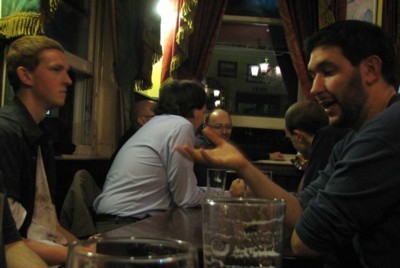
Here is a photo I took of the other end of the table from where I was:
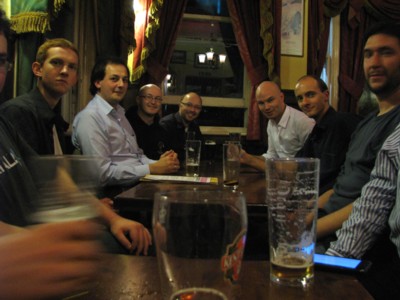
And here’s another snap from the same spot, moments later, after I’d asked if I could interrupt everything, and “take some photos”:
I am surprised what good photos these are, technically, given the light. If you are surprised what bad photos they are, technically, then clearly you don’t know my photos.
These photos do not include anything like everyone who was present. They are accurate in suggesting that the gathering was youngish (certainly compared to me), and bright, but inaccurate in suggesting that this was an all male affair. It’s just that the ladies present were seated nearer to me, and my lens is not wide-angle enough to have included them.
In particular, missing from that snap are two of the people who, it so happened, I spent a bit of time conversing with. For the first time ever, I got to meet Trooper Thompson in the flesh, whose blog I have long had a liking for. And, I also got to meet “Misanthrope Girl”, whose blog I have not properly noticed until now. Trooper Thompson got chased out of the Samizdata commentariat for saying something rude about a gun (I think that was it), approximately a decade ago, which, having finally met the guy, I now think is a shame. Misanthrope Girl would also fit in here very well.
I had to leave earlier than I would have liked, but I am still very glad I went. I heard about this gathering by attending the Liberty League Conference, where Andy Janes (mentioned here recently already because of that Zimbabwean bank note), who also helps organise these evenings, suggested I might like to attend the next one. Perhaps, I thought to myself, and perhaps not. But then Andy gave me a physical copy of the leaflet that he had been handing out at the Occupy London occupations. These guys, I thought, maybe have something about them. (See also this open letter to the London occupiers.) Maybe they do. We shall see.
What will happen to the Euro? I am not asking “what should happen”, but what will happen. Take this opportunity to put your predictions on the internet, and later be hailed as a true prophet or derided as a false one.
Via CityAM, here is an interesting article about the UK’s own space industry. It is bigger than might be supposed from first glance.
(Thanks to my good friend Tim Evans, over at the Adam Smith Institute and the Cobden Centre, for the pointer).
BTW, one of the big places for registering space-related companies these days is the Isle of Man. No doubt, in centuries to come, the Tranzis will be trying to shut down tax havens in outer space.
For any of you who may be feeling particularly depressed about the state of the economy, politics and the regulatory leviathan in general, this will cheer you up greatly. It certainly improved my overall outlook.
Although this trend is very much a good thing, I do have some concerns. One of them is for intellectual property protection. All advances in technology and the arts are the result of intellectual endeavors, and assuring the rewards and return on investment of those endeavors is essential to continue the advances. Another concern I have is for ‘real’ property rights. I would very much like to hear from any of the Samizdata commentariat who have access to, and perhaps even do business in “l’economie de la débrouillardise.”
As the dollar and the Euro flare off into nothingness like the methane from a decomposing landfill, I presume System ‘D’ is Plan ‘B’ for advanced Western societies as well. How will that unfold?
Today is our blogiversary…Samizdata crawled out of the primordial ooze of the blogosphere on Friday, November 02, 2001.
Our name was a wee bit longer then but like some vestigial tail, it eventually dropped off once we learned to walk upright… and it took us a while for our flippers to evolve into feet… but here we are all those years later, still blathering on about the things that irk or amuse us.
13,315 articles and 226,617 comments later…
…Blimey, where did all those years go?
“All this [illicit trade] suggests that, while customs barriers stifled trade, they did not necessarily increase isolation. The `fortress’ of France was remarkably porous. Any commemoration of European unity should remember the smugglers and pedlars who helped to keep the borders open.”
Page 152, taken from The Discovery of France, by Graham Robb. The entire book is crammed with wonderful examples of French life down the ages, and in particular, I am struck by what were, by the standards of the time (18th and early 19th centuries) vast migrations of people within the country in a way that resembles the even longer migrations of people around the world today. Even the “Tour de France” cycle race seems to have its echoes in the heroic journeys made by pilgrims, travellers and labourers of ages past.
This is a great book if you are thinking of spending a week in that country. Robb has also written a fine biography of that giant of French literature, Victor Hugo.
Science is the belief in the ignorance of the experts.
– Richard Feynman, quoted by Matt Ridley in his Angus Millar lecture at the RSA in Edinburgh, the entire text of which you an read at Bishop Hill. Do read the whole thing. Following on from the above quote comes one of the best summaries of why climate skeptics are climate skeptics that I have ever encountered.
Does anybody know if Ridley’s brilliant lecture is, or will be, available on video?
I’m now reading that book I mentioned here earlier, by Harvey Sachs, about the first performance of Beethoven’s Ninth.
The event itself was nearly shifted by Beethoven, for both financial and organisational reasons, from Vienna (where Beethoven lived for all his adult life) to Bonn, which caused a great gang of Viennese high-ups to write Beethoven a public letter, begging him to keep the show in Vienna. Of this letter, Harvey Sachs writes (pp. 30-31):
The letter-signed by seven aristocrats and various well-known local bureaucrats, musicians, music publishers, and the piano maker Andreas Streicher – is valuable not only as proof of the esteem in which Beethoven was held in his adoptive city but also because it demonstrates how deeply the notion that great music could be both “immortal” and widely disseminated had taken hold in Europe within Beethoven’s lifetime. Pre-nineteenth-century audiences had tended to lose interest in music that failed to follow the dictates of fashion. Bach, who was born in 1685 and whose works were already stylistically passé at the time of his death sixty-five years later, would have been delighted but astonished to learn that his music would be venerated and widely performed nearly three centuries after it was written. He may have believed in the hereafter, but he wrote for the here and now – for the church ceremonies and court occasions that took place as his life unfolded and for the instruction of the musicians of his day. Haydn (1732-1809) and even Mozart (1756-1791) still worked within the specific-piece-for-specific-occasion system, although the fact that Mozart began at the age of twenty-eight to keep a catalogue of his works, and the even more significant fact that he and Haydn published as many of their compositions as possible, demonstrate composers’ dawning ambition to have their works survive them, perhaps even for a considerable time.
Not until Beethoven’s day, however, did winning a place in posterity become a major goal – the greatest goal, for many composers. With the rise, in his lifetime, of the bourgeoisie, middle-class families were able to give their children music lessons, and Hausmusik – music in the home became the home entertainment system of the 1800s. The equipment required for making it comprised a piano, one or more other instruments and/or voices, and printed music, the demand for which increased almost exponentially. This phenomenon occurred just as the figure of the Romantic genius – the artist as a being unhampered by normal constraints – was taking hold. The music of the brilliant, eccentric Beethoven circulated widely, and the conviction that this music would become “deathless” was a logical consequence of both his persona and the diffusion of his works. In the letter from his Viennese admirers, the reference to “the many who joyfully acknowledge your worth and what you have become for the present as well as the future” is an exceptionally significant sign of the times: The arts were no longer to be considered mere “means and objects of pastime.” Composers were becoming the high priests, perhaps even the gods, of a secular religion; the best among them were expected to create works that would endure, . . .
All of which reminded me of something Benjamin Britten once said:
The rot set in with Beethoven.
Meaning, Beethoven was the first of a huge tribe of artists who from then on took themselves, and were also taken by others, a whole hell of a lot too seriously. Beethoven was, of course, entitled to think of himself as a genius. In his case, it helped to turn him into the genius he became. Most of his imitators got the trappings of genius off pat enough, but neglected the bit in the genius rule book where it says that you have to produce works of genius.
After writing that, I tried googling that Britten quote, and look what I found, almost immediately. Yes indeed, a review of The Ninth by Michael Henderson, which begins thus:
‘The rot set in with Beethoven’, said Benjamin Britten, who, cold fish that he was, could never understand the idea of the artist as hero (though he admired Mahler, whose music is nothing if not attention-seeking). He had half a point, because the past century has been chock-full of artists, or ‘artists’, who have asked us to soothe their fevered brows. They are still around today. No matter. Their egotism cannot disguise Beethoven’s greatness, . . .
Snap.
“Cradle-to-grave employment (at least outside the public sector) has been dead since at least the end of the Cold War. Undergraduate degrees in English and Film and Sociology and Philosophy (and a thousand other subjects) have had debatable workplace utility for as long as I’ve been alive.”
– Matt Welch.
Whether the issues are terrorism, AGW, contagious diseases, the movies of Charlie Sheen (that was a joke), today’s advocates of Big Government often look to the Transnational solution. Let’s have one government! No more hiding places for bad people!
As readers might recall, I have written a few times about tax havens and the importance of the freedom of people to migrate not just their physical selves, but their money. Now, depending on your point of view, tax havens are either refuges of scoundrels who refuse to pay whatever levels of tax are imposed on them by their fellows, or, in a more classical liberal vein, places for people who want to avoid double-taxation and where people can exercise their proper freedom to acquire, transmit and enjoy their private property as they see fit. This is not, I hasten to add, always a black-and-white issue. Some tax havens have been bolt-holes for crooks. And if you believe that even the smallest of governments need to tax to pay for basic services, then people who try to not pay anything for services they use by using offshore banking deserve a degree of censure. Governments could do a lot to put some of the shadier havens out of business by just reducing their own taxes, of course.
It is clear, in my view however, that the current campaign against tax havens as waged by groups such as the Tax Justice Network goes way beyond this sort of legitimate concern about criminal moneys. These guys want world government. Tax competition – which is another way of saying that countries should be free to set different taxes – is something they detest.
And now the Tax Justice Network argues that the Organisation for Economic Co-operation and Development, which is basically a club of rich nations (staff there pay no tax, by the way), is ineffective, because the tax treaties signed by various countries using OECD standards don’t allow revenue departments to automatically seize information from other countries in a hunt for tax “cheats”. Oh no, the OECD is a toothless tiger, and what is needed is a fiercer animal: the United Nations! Yes, the same UN that, let’s not forget, did a splendid job in the Balkans during the 1990s, and which has prevented many a massacre in Africa, and which, as we know, was so fierce in its imposition of arms controls and sanctions vs the government of the late, unlamented Saddam Hussein of Iraq.
Forgive my sarcasm, but if there is anything more deluded than the oppressive idea of putting tax policy in the hands of an unaccountable body with such members as Russia and Iran, never mind good old Britain and the US, it is the idea that such a body could possibly be relied upon to deal fairly, impartially and thoroughly with the always-sensitive issue of tax.
Meanwhile, other people, such as Wendy McElroy, are waking up to my recent concerns about US foreign over-reach on the issue of tax.
Well thank you IPCC authors for letting us know what is really behind that “very likely” assessment of attribution [of] 20th century warming. A lot of overbloated over confidence that cannot survive a few years of cooling. The light bulbs seem to be just turning on in your heads over the last two years. Think about all the wasted energy fighting the “deniers” when [you] could have been listening, trying to understand their arguments, and making progress to increase our understanding of the causes of climate variability and change.
– Judith Curry, the climate-change non-alarmists’ favourite climate scientist, commenting on an article by Paul Voosen on Greenwire: “Provoked scientists try to explain lag in global warming”.
|
Who Are We? The Samizdata people are a bunch of sinister and heavily armed globalist illuminati who seek to infect the entire world with the values of personal liberty and several property. Amongst our many crimes is a sense of humour and the intermittent use of British spelling.
We are also a varied group made up of social individualists, classical liberals, whigs, libertarians, extropians, futurists, ‘Porcupines’, Karl Popper fetishists, recovering neo-conservatives, crazed Ayn Rand worshipers, over-caffeinated Virginia Postrel devotees, witty Frédéric Bastiat wannabes, cypherpunks, minarchists, kritarchists and wild-eyed anarcho-capitalists from Britain, North America, Australia and Europe.
|





Recent Comments