We are developing the social individualist meta-context for the future. From the very serious to the extremely frivolous... lets see what is on the mind of the Samizdata people.
Samizdata, derived from Samizdat /n. - a system of clandestine publication of banned literature in the USSR [Russ.,= self-publishing house]
|
So, a company notes that its natural food product has scientifically documented positive health effects… and a bunch of underhanded bureaucrats underhandedly silences them:
Quote of the Day: “Experience should teach us to be most on our guard to protect liberty when the Government’s purposes are beneficent.” – Justice Louis D. Brandeis
Only an organization as evil as the FDA could manage to harm public health, free speech, and due process, with a single action.
The sample letter to Congress below explains how the FDA accomplished these things in the name of protecting you from . . .
Wait for it . . .
Walnuts!
But hey, is that not what we pay them for via our voluntary tax system?
The world’s financial system, run by institutions that were a few short years ago considered to be too big to fail but which are now too big to bail, is collapsing. But, the making of mere things, not now nearly so fatally deranged by government imposed regulations or corrupted by government supplied moral hazards, continues to flourish. Will thing-making survive the financial turmoil of the next few years? Who knows? Meanwhile, it has been and it remains a good time to be alive and thing-using.
A thing I particularly enjoy using is my digital camera. However, my current camera feels a bit ancient, and I believe I could now get a better one. But which? In this posting I solicit advice on the matter.
Very roughly, there are now three types of digital camera. There are the little ones like face powder cases which people carry for fun, such cameras often nowadays being included in mobile phones. At the other extreme, there are the SLRs with a small mountain of lenses you can attach to them, for people who, facing the choice between life and photography, have chosen photography. And then there are cameras for people like me, who adore photography but who also want lives. What we want is the absolute best camera we can have, without having to swap lenses all the time.
Well, that’s how it sometimes seems to me. To be more polite to the SLR crowd, it may be more a matter of how they like to photograph, compared to how I like to. They photograph slowly and carefully and infrequently. I photograph voraciously and opportunistically, one moment snapping something right under my nose (like a mad safety notice), and the next moment wanting to capture something I spot in the far distance (like a big new tower with something else amusing in the shot between it and me – often involving a trick of the light which may vanish at any moment), and I never know which it will be until I see it. You can surely appreciate how annoying swapping lenses back and forth would be for me. What I want is one super-versatile lens, which I can either make erect or flaccid depending on distance, within about one second. For the SLR fraternity, artistic impression and precision of image is all. For me, those are good, but the point of the snap is what is being snapped. So long as you can see that okay, usually in a photo that I include in a blog posting, good enough, technically speaking, is, for me, good enough.
For several years now I have had a Canon S5 IS, and very satisfactory it has been. But now, things have moved on, and I can now get a technically much improved camera, with does much better pictures and has massively more zoom, hardly any bigger and while still not having to faff about with those lenses.
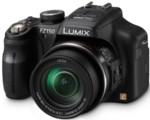
Those who think I am wrong and that I should get an SLR can comment away to that effect all they like, but I will pay no attention. What I want is comments about what I am now looking at. And what I am now looking at is two cameras of the sort that I have just described, the Panasonic Lumix DMC-FZ150 and the Canon SX40 HS.
There are already an abundance of reviews of these two beasts on line, including even reviews like this, which compare the two head to head. But, I would love to know what our commentariat is able to tell me about this choice, before I go ahead and make it. → Continue reading: Which superzoom camera should I now buy?
Over a year ago, I mused about the possibility that the wristwatch might die out as a result of new technologies. For the moment, I give that possibility a fat zero. Although I can barely afford a beauty like this Patek Phillipe or Vacheron Constantin on my income, I have always been partial to watches. They are some of the oldest examples of Man’s genius for matching precision, practicality and beauty.
I was reminded of the greatness of the wristwatch by the fact that Geneva – home of the Swiss watchmaking industry – soon plays host to an annual fair showing of the finest watches in the world. Here in London, the Saachi Gallery in Chelsea hosts the SalonQP fine watch fair. Another chance for your humble writer to look at things he can’t afford.
Away from the glitzy world of uber-expensive watches, we should recall that this year is the bicentenary of the death of Nevil Maskelyne, the Astronomer Royal who clashed with John Harrison. Harrison solved one of the greatest challenges of his age: how to make a clock so accurate and yet robust that it could be carried on ships at sea, hence making possible accurate navigation. Maskelyne, who took a dim view of the older Harrison’s views, is sometimes portrayed as a villain of this story, although the writer Nick Foulkes argues this is unfair (article is behind a paywall).
Anyway, if you are interested in this tale, check out the National Maritime Museum in Greenwich, London, which has started a project to research the history of the British Board of Longitude. The makers of the fabulous time-pieces of the 18th and 19th Centuries played their part in forging the modern world.
And of course, there are famous watches in films, such as that square Tag Heuer that Steve McQueen used to wear, or 007’s Rolex Oyster. And I think it was Buzz Aldrin who wore a watch over his spacesuit: one of these beauties from Omega.
“Looking up at the huge modern edifice of the euro tottering, tilting and melting – a Corbusian nightmare as imagined by Dalí – it is easy to forget how prevalent was the view that Britain would condemn itself to a second-class status in Europe and a lesser role on the global stage if it stayed out of the shiny new currency. Even some of the staunchest Eurosceptics, who saw that the euro was economic folly and a constitutional affront, fretted privately that it would bulldoze all before it……It is astonishing to hear the very same people who said Britain would be consigned to irrelevance outside the euro now insisting that we have a neighbourly duty to prevent its implosion: we do have such a duty, but it is based on hard-nosed self-interest, not obligation to the continental sages who – betraying their ignorance of history and its magnificent unpredictability – once insisted that their grand projet would inevitably succeed.”
– Matthew d’Ancona.
Most politicians don’t know any better. They certainly don’t know any economics. So the same toxic policy mix of Keynesian deficit spending and Monetarist money printing has been implemented around the world since this crisis started four years ago. Just like in any other recession of the past forty years, ever since Nixon cut the last link to gold and fulfilled every interventionist’s wildest fantasy: unlimited paper money under full control of the state! Yeah, baby, no more recessions!
Alas, it is not working, is it?
Rates were cut and the state did not only spent money it didn’t have, as usual, it spent much more money it didn’t have. But the economy did not recover. So more of this policy was implemented. And then, more again. In fact, by any standard, never before in modern times has the economy been ‘stimulated’ more through Keynesian and Monetarist government intervention than over the past four years. Balance sheets of major central banks have tripled, banks have been receiving limitless funds for free and will continue to do so forever, and governments are running deficits the likes of which mankind has only ever seen at the height of major wars, and which are increasingly funded by the printing press.
It is still not working.
You would probably guess that the interventionists of Keynesian and other ilk would be a bit more humble by now. Maybe check a few of those premises in their models? Or maybe start thinking again about those elusive explanations for what’s wrong with the economy in the first place? Are we really suffering from a lack of paper money and government spending? Maybe it is not simply down to all of us being too depressed, morose, and in need of some policy Prozac. Maybe something else is broken.
Alas, no. The academically trained Keynesian economist is too committed to his or her beliefs to let the facts get in the way. Why has policy not worked? Because, wait for it, we have been too timid. We need the same policy. We just need more of it. A lot more.
– from the latest Schlichter File, posted today.
LATER: See also this recent interview with Schlichter.
George Monbiot begins a banker-bashing article in the Guardian with these words,
If wealth was the inevitable result of hard work and enterprise, every woman in Africa would be a millionaire.
Inevitable result? That is a lot to ask, in Africa or anywhere.
If in most of Africa in the last half-century the probable, or, Dear God, the permitted, result of the hard work and enterprise of women – or men – had been a modest increase in wealth, and not, as it mostly was, the expropriation of whatever you had gained and a chance to be murdered as a hoarder or class enemy by whatever Derg or other bunch of socialist thugs was calling itself the government that week, why, then Africa might have thrown off poverty the way Taiwan and South Korea did.
As Adam Smith said, “Little else is requisite to carry a state to the highest degree of opulence from the lowest barbarism, but peace, easy taxes, and a tolerable administration of justice: all the rest being brought about by the natural course of things.” Let us remember those who died in avoidable famines because that “little else” was too much to ask from Africa’s leaders, and from their Guardian reading admirers.
Even Africa is now slowly but surely getting richer, now that the worst of the folly has been thrown off. Inevitable wealth as the result of enterprise and hard work was not necessary to bring about this result. Just a half-decent chance at it.
Given the proximity of Remembrance Day (11 November), there is something particularly nasty about the theft of metal from war memorials. With prices of some metals at high levels, thieves are tempted to desecrate such things, as well as steal bells from churches, and so on. Boris Johnson is in trenchant form on the subject today.
Once again, I am reminded of how awful a lot of the comments on the Daily Telegraph now are, as shown by much of the commentary linked to BJ’s piece. A lot of the sentiment is to the effect that all this thieving is caused by immigrants. But as one person put it, to steal scrap metal, you need scrap dealers, and they are, often as not, from the indigenous population. It is not as if thieving is something invented by people who come to this nation from abroad.
Guido Fawkes, aka Paul Staines, takes time out from his usual regime of dishing the dirt on our unlovely Political Class and goes into a more reflective tone of voice with a good piece about one of the lessons of the financial crisis: the problem that the people who run banks often have no financial liability for losses. He’s not the first person to state this, of course: Kevin Dowd, who gets regular plugs on Samizdata, has been writing about this issue for years.
The issue of whether publicly listed, limited liability banks are a problem or not is one that often puts classical free marketeers at odds. Some self-styled free market purists argue that limited liability, inasmuch as it is created by statutory law rather than an emergent phenomenon arising from private contracts, is bad. Others might argue that LL is valuable in making it possible to have large-scale investment projects. Even so, there does appear to be some case, in my view, in looking at the rules under which banks operate. With our current fiat money system, fractional reserve banking, deposit protection and the rest, it seems anomalous that bank shareholders and bondholders, in addition to the cozy protections thus described, have the additional protection of limited liability. One idea, as Dowd has argued, is to increase the total liability that any owners of banks have. So if a shareholder owns, say, £100 of stock in Fred Smith Bank Corp, then his or her liability can be double that amount, or treble that amount. This may not satisfy the purists, but it would, in part, curb some of the more foolish risk-takers.
It should be remembered that in countries such as Switzerland, its collection of genuine private banks (not listed behemoths such as UBS) are private partnerships, and family members – as at Pictet – have unlimited liability for losses. It tends to focus the mind. Exploring how bankers and owners of banks can be made to take a more prudent view on risk-taking makes more sense, in my view, than creating daft and draconian rules on bonuses and salaries for senior staff.
By the way, when Guido Fawkes writes a strong piece like this, it seems to traumatise his less intelligent commenters.
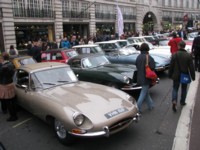
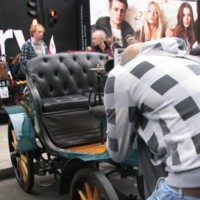
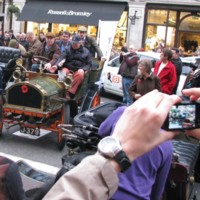
Yesterday, they closed off Regent Street, the famous central London shopping venue, to traffic, to make way for … some cars. I made my way to Regent Street, on the off chance of some photo ops, and was not disappointed.
There were E-Type Jags and Minis (i.e. real Minis – not the horribly huge German rehashes we see now), because both are celebrating their fiftieth birthdays this year:
And there were even more exotic vehicles, like this one:
If there was a sign explaining that, I missed it. Anyone? It looks vaguely familiar, as having been involved in something like a land speed record.
There were also new vehicles on show, involving various drearily alternative means of propulsion, but looking exactly like regular cars.
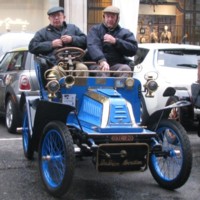
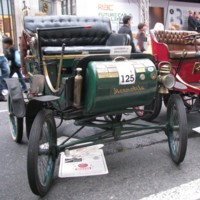
But the really old cars were something else again:
There were lots and lots of those. And it would be putting it very mildly indeed to say that I was not the only digital photographer present:
Nor was I the only digital photographer who was intrigued by many of the smaller mechanical details of these old cars:
The weather was rather grim, but the rain held off long enough for me to take all these snaps. Click on all of the above to get them bigger, and if that isn’t enough, go to my own blog, to see many, many more.
By the way, I’m not anti-German about everything they’ve done to Britain’s motor industry. I love what they’re doing with the Rolls Royce.
To politicians, endless horror is much preferable to a horrible end.
– Samizdata commenter “Plamus”, discussing the future of the Euro here.
Beijing is full of empty shopping malls and empty apartment buildings. There are at least 60 million empty housing units in China, and probably a great many more than that. The absurd construction boom that continues to go on here is many times bigger than the rest of the world combined, and the Chinese banks are many times more bankrupt than those anywhere else
– Michael Jennings (currently in Beijing)
It is often said that Guy Fawkes was the only man to ever enter Parliament with honest intentions…
|
Who Are We? The Samizdata people are a bunch of sinister and heavily armed globalist illuminati who seek to infect the entire world with the values of personal liberty and several property. Amongst our many crimes is a sense of humour and the intermittent use of British spelling.
We are also a varied group made up of social individualists, classical liberals, whigs, libertarians, extropians, futurists, ‘Porcupines’, Karl Popper fetishists, recovering neo-conservatives, crazed Ayn Rand worshipers, over-caffeinated Virginia Postrel devotees, witty Frédéric Bastiat wannabes, cypherpunks, minarchists, kritarchists and wild-eyed anarcho-capitalists from Britain, North America, Australia and Europe.
|









Recent Comments