We are developing the social individualist meta-context for the future. From the very serious to the extremely frivolous... lets see what is on the mind of the Samizdata people.
Samizdata, derived from Samizdat /n. - a system of clandestine publication of banned literature in the USSR [Russ.,= self-publishing house]
|
I looked at my screen this morning and saw this…
BILLIONS was temporarily wiped off the US stock market last night after hackers broke into the Twitter account of the Associated Press and announced that two bombs had exploded at the White House, injuring Barack Obama
Sayeth the news article and my immediate thought is… why?
If the White House… hell, let us think big… and indeed all of Washington DC was fortuitously tragically blasted into a huge smoking crater by an unexpected meteorite, killing every politician, government functionary and policy wonk who works there, surely that would be a economic windfall that should add billions to the US stock market, at a stroke removing a significant portion of the most active members of the parasite class from the world’s largest economy.
Just sayin’
Taking offence cannot be equated to being criminally victimised.
– “Cannot” as in: “should not”. Sadly, they just did. That’s Richard Carey, writing at Libertarian Home about the disappearance of the blog and twitter feed of Old Holborn, and other twitter accounts, for the crime of being “inappropriate and offensive”.
One of the many excellent things about the excellent Indian Premier League is the opportunity that it has given to West Indian cricketers to do great things on a cricket field, as impressive as the great things done by their great fast bowlers in the 1970s and 1980s. There are now about half a dozen West Indians making their mark on the IPL. It is no exaggeration to say that what the Indians are doing is saving the West Indies for cricket.
Not that long ago, there was talk of West Indians, dispirited by the failure of their players to do the sort of grafting you have to do to do well in five day international cricket matches in places like England, giving up on cricket altogether, and switching to basketball, or some such American alternative.
Not now. The innings of Chris Gayle in this game, which I am now watching (thank goodness for the recent multiplication of digital TV channels in the UK) on my telly, open mouthed, is already the talk of the West Indies. Got to be. I don’t know what time of day it is over there, but trust me, they are awake and cheering themselves hoarse. As of now, Gayle is 154 not out, off 54 balls. Even if you know nothing of cricket, know this: that’s dynamite stuff. Gayle is only a handful of runs away from breaking the record for the biggest twenty-twenty innings ever, set in the very first IPL game by a guy from New Zealand.
Yes. West Indian IPL Commentator: “This is now the highest score ever in all twenty-twenty cricket.” Gale 161 not out. And counting.
West Indian IPL Commentator: This is now the biggest twenty-twenty total ever. 251-3 and counting. The South African AB de Villiers has just got out for 31, made in 8 balls. South African cricket has been somewhat in the doldrums ever since the Hanse Cronje match-fixing scandal, and the IPL has been a shot in the arm for South African cricket also. They are now the top team in the world, at test cricket. Twenty-twenty mania hasn’t done them any harm either.
Globalisation, commerce, free people spending their own money on what they love, previously poor countries getting rich, individual people in previously poor countries getting rich, by cheering up the entire world – well, my version of the entire world anyway. I love it. Love it. Opposition players all clustering around Gayle to shake his hand. 175 not out. Kiwi Commentator: “You’ve broken record after record tonight. It was one of the best innings anyone here has ever seen.” Amen.
I just wish that more of my fellow countrymen could see all this. The English continue to talk head-in-sand nonsense about the IPL. In this silly piece, David Hopps talks about the IPL being “an essentially trivial Indian T20 tournament”. As so often, the word “essentially”, as the late Kingsley Amis observed many years ago, here means “not”.
There is actually an Englishman playing in this match, Luke Wright of Sussex. And good on him, because he has had a pretty good IPL so far, once he got to play. Good on him today, because he bowled in this game, and his bowling figures were: 4-0-26-1. In a game like this one, those are impressively normal numbers, even if the reason Wright did that well was that he was bowling some of his overs just after Gayle got to a hundred, and Gayle was having a bit of a chill, man.
Lovely.
LATER: The Guardian sums it up.
Plebs is a sitcom set in ancient Rome. They showed the sixth and last of (the first?) six episodes of it last night on ITV2 TV, and they’ll be showing this again tonight.
I’ve been recording Plebs. In the opening scene of this latest episode, the three leading characters, Marcus (who wants to be more successful while still being nice about it, the voice of concerned normality), Stylax (more of a Jack the Lad type), and Grumio (their slave), are out and about in the town, watching the ancient Roman version of the media, i.e. people orating and/or selling in the market place.
Mad Soothsayer Woman: “The seas will rise up and drown the people living in the lowlands …”
Doughnut Salesman: “Doughnuts!”
Mad Soothsayer Woman: “… and the sun shall beat down and burn all those people living in the hills!”
Doughnut Salesman: “Doughnuts!”
Mad Soothsayer Woman: “And those people living on the lands that are neither high nor low will also die through a combination of burning and drowning! None of you are safe! The end is nigh!!!”
Doughnut Salesman: “Come get your doughnuts!”
Stylax: “So, when’s the world ending?”
Grumio: “I dunno, I were listening to that doughnut guy.”
Marcus: “Nigh, apparently.”
Stylax: “Alright, nigh. Hang on, doesn’t that mean soon?”
Marcus: “To the people that say it, it means soon. To everyone else it means you’re a nutter, talking shit.”
Grumio: “I’m going to get a doughnut just in case.”
Sam Leifer and Tom Basden, the two man team who wrote, produced and directed Plebs, are either climate non-alarmists themselves, or at the very least they reckon that a lot of us now are, and that we’re ready for comedy which takes the piss out of our mad soothsayer tendency.
My original title for this was: “Are the plebs starting to see sense about climate alarmism?”, but I reckon our plebs have been sussing this out for quite a while now. Britain’s telly comedians are following public opinion on this rather than shaping it. Until a couple of years ago or so, they were constantly going on about how stupid climate non-alarmists were. Then they went quiet on the subject. Are they beginning seriously to see sense?
This made me laugh:
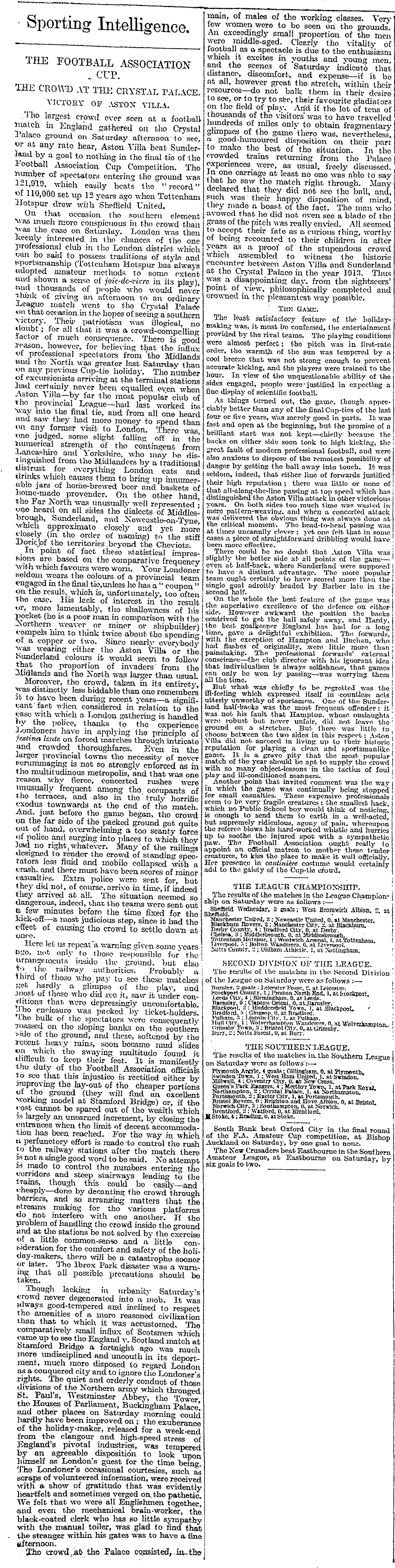
These expensive professionals seem to be very fragile creatures; the smallest hack, which no Public School boy would think of noticing, is enough to send them to earth in a well-acted, but supremely ridiculous, agony of pain, whereupon the referee blows his hard-worked whistle and hurries to soothe the injured spot with a sympathetic paw.
As you can probably tell from the language it’s from a while ago. 1913 to be exact and it’s from The Times’s report of that year’s FA Cup final. Yes, people then were making exactly the same complaints about footballers that they do now. At least they weren’t trying to eat one another.
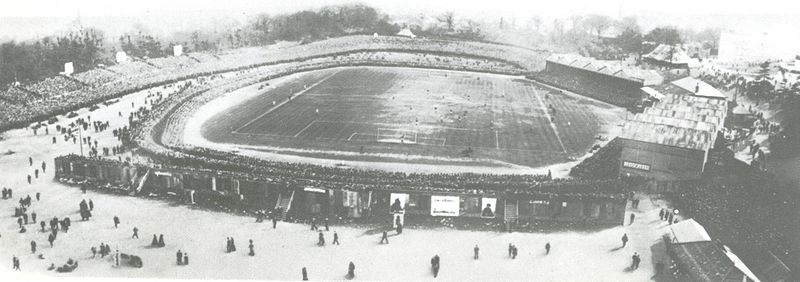
What is really astonishing is the size of the crowd. 120,000 (the second highest ever) at Crystal Palace, of all places. I googled and found this photo from 1905:
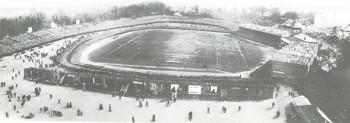
What a mess! But as the article I linked to points out most of the crowd had no idea what was going on. Not only that but it was clearly a dangerous place to be:
Many of the railings designed to render the crowd of standing spectators less fluid and mobile collapsed with a crash, and there must have been scores of minor casualties.
Read the whole thing as they used to say.
James Delingpole has a nice posting about a recent excellent performance by Peter Lilley, the Tory MP who seems, unlike many of them, to have retained a large measure of common sense. This is what Mr Lilley said recently about the constant run of conferences held to discuss environmental issues:
“Those whom the gods wish to destroy they first make mad. One of the early signs of madness is an indulgence in compulsive displacement activity, which could not be a better description of the whole COP process. Tens of thousands of people are displaced across the globe to an environment where they are cut off from reality and the rest of the world, where they can indulge themselves in demonstrating their lack of realism and reality, and where the original objective of obtaining a legally binding agreement between nations to reduce worldwide emissions has itself been displaced by the alternative objective of reaching an agreement to meet again—and to agree to reach an agreement at some distant future time. That is displacement activity on a massive scale, and it involves a massive degree of hypocrisy, given the huge emissions incurred by these eco-warriors as they swan across the globe in jets and hire fleets of limousines, so emitting more CO2 than a small African country.”
It is Earth Day today, by the way.
Imagine you are mountain climbing or hill walking with a friend. Disaster strikes, and your friend is badly injured. Weather conditions are such that if you leave him overnight, he will certainly die. With great difficulty you are able to half carry, half drag him most of the way down the mountain. At last you see the road in the distance. Making your friend comfortable as best you can, you leave him, stagger to the road, and wait a long time for a car to pass this lonely spot. Eventually one does – you stop it by practically throwing yourself in front of it – and tell the driver that there is a seriously injured man some way up the hill who badly needs help.
“I’m not getting blood all over the seats of my car,” says the driver and speeds off.
By the time another car comes it is too late.
Something a little like this happened to a man called Charles Handley climbing in Scotland in the 1950s or 60s. In 1985 the BBC made a gripping dramatised reconstruction starring Gareth Thomas (Blake from Blake’s 7) called Duel with An Teallach. In fact Handley’s experience was even worse: despite his incredible efforts at rescue, An Teallach claimed two of his friends that day. I could watch the play again online and clarify my nearly thirty year-old memories of it, but I won’t because it was one of the grimmest things I have ever seen.
Have you guessed where this post is going? Tweak the story a little. Now Charles Handley has a gun. You have a gun. You can damn well make that driver help you get your friend to safety. And if that means he has to carry your friend on his back to the car so that you can keep the gun trained on him, too bad.
Do you do it?
Stealing his car, even without the intention “permanently to deprive” him of it, as the Theft Act puts it, is a violation of his property rights. Temporarily enslaving him to help you carry your friend down to the car is even worse. I think I would do it, even so. Afterwards I would admit the crime, pay compensation and submit to punishment.
As anyone who has read Perry de Havilland’s post from yesterday will have guessed by now, what I have tried to do above is make a similar thought experiment to the one about being forced to rescue a drowning baby used by Sam Bowman of the Adam Smith Institute, the one pretty much everybody but me had no sympathy for. I tried to present a scenario that would appeal rather more to the Samizdata audience than Bowman’s somewhat contrived one. I have tried to inveigle you into sympathising with the bad guy – the government – in Jaded Voluntaryist’s excellent re-casting of Bowman’s analogy:
As an aside, this is not even close to describing welfarism. The people holding the gun aren’t disabled. And the baby isn’t drowning. And it isn’t a baby. And you’re not able bodied (at least not compared to the gun wielder). In fact, in his metaphor he has the relative power relationship completely backwards.
The able bodied arsehole is waving the gun at a disabled man, ordering him to carry some random stranger on his back. A stranger who may be disabled, or may be stupid, or may be lazy, or may just be unlucky. The stranger’s complicity aside, none of that is the disabled victim’s fault. And yet carry him he must because he’s not the one with the gun.
Will I be joining the vast majority of citizens in the countries of the developed world in supporting the welfare state, then? No. There is one crucial element of Bowman’s analogy that I have kept in my scenario, but which, as Jaded Voluntaryist implied when he said the baby was not drowning, does not apply to welfarism. That element is that my story depicted desperate circumstances, which is another way of saying it was a one-off. Welfarism is a system of indefinitely repeated thefts and partial enslavements. They say that it is a continuous crisis, that as there are always babies drowning somewhere you must always be rescuing them, but the insincerity of this claim is demonstrated by the fact that “somewhere” only includes the territory of your nation, state or other tax-gathering unit. Babies outside that arbitrary circle – glug, glug, goodbye. And how can it be justified for you to be forced to spend, say, 55% of your time baby-rescuing but not 56%, or every waking hour?
Overlapping this, welfarism is legitimized repeated thefts and partial enslavements. The man with the gun does not acknowledge or make reparation for his crime. It is he who decides what constitutes crime.
Furthermore there are all the factors that Jaded Voluntaryist implied in his re-casting of Bowman’s analogy. It is not just babies you have to keep rescuing, but adults, and once your presence is a predictable part of the system, those adults start acting like babies on the assumption that you will always be there. That is not likely to end well for you or them.
I will refrain from re-stating further objections to the system of welfare. I am sure most of you have thought of them already, but all these thoughts did lead me to another topic upon which the opinions of Samizdata readers and writers are much harder to predict.
Having to carry a stranger because otherwise the stranger will die is approximately the position of a pregnant woman expecting an unwanted child.
A key part of the pro-abortion argument is opposition to forcing a woman to give up part of her body and her time to carry the child. Foetus. Whatever. For instance, this comment from yesterday’s Guardian by commenter ZappBrannigan says,
Don’t let them win the battle of symbols. Don’t use their terminology. They are not “pro-life”. I propose “mandatory-gestation” instead.
Or here is commenter Thaizinred from the same comment thread:
No already born person has a right to directly use another person’s body to stay alive. People aren’t forced to donate their bodies, or body parts, even if someone else will die without them, even if the person who will die is their child.
The latter’s argument overstates the case. The pregant woman does not have to permanently give up her body or her body parts, but the general point is starkly made, and in a way that will resonate with many libertarians.
I am anti-abortion with reservations and get-out clauses. So I mock the Guardian readers and other “liberals” (in the degraded modern sense) who one minute angrily make the arguments above; who denounce anyone who opposes welfare or jibs at high taxes as a callous, selfish sociopath; who would abort themselves with a rusty coathanger rather than admit that Ayn Rand ever said a good word – and who next minute channel Rand , becoming the purest of pure no-forced-assistance libertarians when the topic is abortion. Such people end up saying that you must give half your time to helping strangers in no particular danger but have no obligation to bear temporary inconvenience to save the life of a being you caused to exist.
So much for them. What about you? To some, I would guess, it is very simple. You are not inconsistent. You are pure libertarians, perhaps indeed Objectivists and proud of it, and you make your stand on the property right of the woman to permanent, uninterrupted, unconstrained use of her own body. You might, perhaps, also think that the foetus is not human until birth but your argument does not rest on that, as Thaizinred’s comment did not.
To use another analogy, your view is that if the captain of a ship at sea sees survivors of a shipwreck clinging to wreckage, the captain can and, for some of you, ought to rescue them, but he does not have to and must not be compelled to.
A minority of libertarians – including me – have views more like these guys: that the foetus becomes human before birth (I shall leave aside the question of exactly when, or if “when” can be exact) and his, her, or its parents (I am trying not to beg the question of whether the foetus is human by choice of pronouns) owe him, her or it protection whatever the inconvenience just as they owe protection to their one day old or one year old child.
And suddenly I’ve run out of steam. This always happens when I talk about abortion and the related question of obligations to small children. There are so many sides to the question. What about rape? What about unintended conception? What about the difference between actively killing and merely withdrawing sustenance? Can I come up with a reason to forbid the Spartans to expose their babies on the mountainside that does not open the door to welfarism and all its ruinous consequences? What about this, that and t’other?
Abortion is a sharp issue. Not many of us have carried out a life or death rescue, with or without force being used. Quite a lot of people have had abortions or been closely affected by them. I hope discussion won’t be too acrimonious, but I think almost anything is better discussed than not.
[W]hen you pull a gun the implication is that you will use it. All subsequent actions proceed on that basis. When you raise your interactions to that level here in Wisconsin you should bear in mind that Wisconsin is a concealed carry state. You better be prepared to play for the stakes you wager.
– Samizdatista Midwesterner, discussing the implications of coercing people into ‘doing the right thing‘ with threats.
Today I received one of those collective emails with a big list of recipients at the top. It was from Tim Evans to the Essex University Liberty League, and copied to the rest of us, suggesting all the copyees as potential speakers to the Essex University Liberty League. I was pleased to be even suggested, because I was a very happy student at Essex University in the early 1970s. Fingers crossed, hint hint.
But much more importantly, following a little googling for the Essex University Liberty League, I found my way to this, which I had not noticed before and which is a video of a talk given by the noted libertarian historian Stephen Davies to … the Essex University Liberty League. Having both hugely enjoyed and been hugely impressed by the talk that Stephen Davies gave to the Liberty League Freedom Forum in London just under a fortnight ago, on the subject of healthcare, I cranked up this video about the history of British libertarianism and had a listen.
Brilliant. The time, nearly fifty minutes of it, just flew by. Davies really is a master communicating a large body of ideas and information, seemingly with effortless ease, in what is (given the sheer volume of all those ideas and all that information) an amazingly short period of time, although in other hands the same chunk of time would feel like an eternity.
Thank goodness cheap videoing arrived in time for Davies to be extensively captured on it, for two reasons. First, it would be very hard to take notes that would do justice to a Stephen Davies talk, and it would be impossible to remember it all. There is, every time, just too much good stuff there. You want to be able to hear it all again, with a pause button available. Second, I get the distinct impression that Davies knows a great deal more about the present and the past of the world, and of the people trying to make the world more liberty-loving, than he has so far managed to get down on paper. Indeed, I sense that Davies’s recent IEA job, stimulating Britain’s student libertarian network, is a calculated trade-off on his part, between one important job, namely that, and the other important thing that Davies ought to be doing, namely writing down many more of his brilliant thoughts and discoveries and opinions and historical wisdoms than he has so far managed to write down.
Although, now would be a good time to flag up a piece Davies wrote for the Libertarian Alliance entitled Libertarian Feminism in Britain, 1860-1910, which is about the kind of thing his talk is about. The point being that most feminists then were libertarians, in contrast to the collectivists that most feminists are now. So, Davies has written some of his wisdoms down, just not as much as he might have.
However, meanwhile, and as a natural consequence of all the student networking that he has lately been doing, Davies does often give a talk, and sometimes someone records it. Like I say, thank goodness for video. And congratulations to whoever did video this particular Davies talk to the Essex University libertarians. Richard Carey, who did the short blog posting where I found the video, does not say who did this. Presumably an Essex libertarian. As I say, kudos to whoever it was.
Sadly, the Stephen Davies talk to LLFF2013 about healthcare was not videoed.
Reading the excellent blog The Last Ditch, there was an article about the Liberty League Freedom Forum 2013, written back on April 06th. And in the article, the author describes the views of Sam Bowman, of the Adam Smith Institute (and I am a great fan of the ASI) thus:
The two other sessions I attended also provided much food for thought. Sam Bowman of the Adam Smith Institute suggested that the standard libertarian approach to presenting our ideas appealed only to ourselves.
[…]
The most disturbing moment of the day was in Bowman’s session when he mentioned in passing the “standard” justification for welfarism; one that I had never heard before. If, he said, a baby was drowning in a puddle not only would a passing stranger have a moral duty to rescue it, but he would also have a moral right if, perhaps because of disability, he couldn’t do it himself to force someone else to do so at gunpoint.
This utilitarian remark passed without comment or challenge, but left me distinctly chilled. I don’t dispute a moral duty to save the child and I would shun forever someone else who failed to do so. But the idea that I would be justified in pulling a gun on the shunworthy one – or even killing him – if he failed to do his duty struck me as obscene.
Views like Sam Bowman’s are why I am so in favour of the private ownership of firearms.
When he (theoretically) points his (theoretical) gun at me to force me to risk my life to save another, I would say “Yes sir… oh and do you also want me to rescue that burning baby over there?”
And when he turns to look, I would (theoretically) produce my (theoretical) handgun and put two (theoretical) 40 cal rounds in the fucker’s chest and then one in his (theoretical) head.
And then I might actually go rescue the (theoretically) drowning baby and thereby have done two good things in a single day.
This is a lovely couple of paragraphs by Tim Worstall at the expense of that hardline opponent of global free capital movements, and socialist, Richard Murphy:
The major driver in growth is that two thirds of humanity are moving from 16th century peasant destitution to the 20th century petit bourgeois pleasures of three meals a day. As long as no one fucks that up with a Courageous State we can expect the global economy to expand 8 to 10 times in the 21st century just as it did in the 20th.
We do, after all, have a very large intergovernmental commission looking at these sorts of things for us. The IPCC it’s called. And such economic growth is actually one of their starting assumptions. No, really. so who are you going to believe? A retired accountant from Wandsworth or the scientific consensus?
When a blogger refers to a pit of bias and political intrigue like the IPCC to make a point against an attacker of low taxes and tax havens such as Murphy, it is really the end of the road.
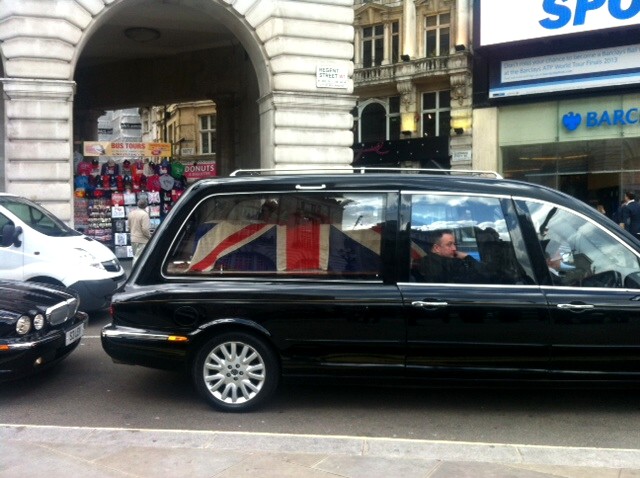
Today, at 1.54pm in the early afternoon, a friend of mine took this photograph at Oxford Circus, in London W1. We were talking on the phone and she mentioned that there was this important looking hearse driving by. I said can you take a photo of it? She managed just the one, and this was it:

Not having paid much attention yesterday to the Thatcher Funeral, and being a very inept Googler for information about such things, I am unsure about just what this is a photo of. The internet is full of news about what happened yesterday, but seems (to me) to be silent about any Thatcher related activity happening in London today.
Thatcher was cremated at Mortlake Crematorium yesterday afternoon:
Baroness Thatcher was this afternoon cremated at Mortlake Crematorium in South-West London.
After a reception for the guests at her ceremonial funeral, the body of the former Prime Minister was driven from St Paul’s Cathedral to the suburban district.
Her ashes are due to be interred next to those of her beloved husband Denis, who died in 2003, at the Royal Hospital Chelsea.
The hearse in the photo that my friend took certainly looks like the hearse on duty yesterday, as featured in the pictures at the far end of the link above. And who else, besides Thatcher, would merit a Union Jack?
So I’m guessing that this was indeed the Thatcher ashes, on their way to Royal Hospital Chelsea. If so, by a somewhat circuitous route, back through the middle of London.
But am I right about what this was? Or is egg is even now assembling itself on my face?
|
Who Are We? The Samizdata people are a bunch of sinister and heavily armed globalist illuminati who seek to infect the entire world with the values of personal liberty and several property. Amongst our many crimes is a sense of humour and the intermittent use of British spelling.
We are also a varied group made up of social individualists, classical liberals, whigs, libertarians, extropians, futurists, ‘Porcupines’, Karl Popper fetishists, recovering neo-conservatives, crazed Ayn Rand worshipers, over-caffeinated Virginia Postrel devotees, witty Frédéric Bastiat wannabes, cypherpunks, minarchists, kritarchists and wild-eyed anarcho-capitalists from Britain, North America, Australia and Europe.
|





Recent Comments