For those that already have, Mark Carney is the gift that keeps on giving. Borrowed imprudently and struggling to make those interest payments ? Worry not; the Bank of England has your back. For those that don’t have, the Bank of England is taking away your chance of ever realistically saving anything, now that interest rates have been driven down to new historic lows of 0.25%, and may go lower yet. For the asset-rich, for the 1%, for property speculators, and for zombie companies and banks, Carney is your man. For the asset poor, or for savers, or pensioners, or insurance companies, or pension funds, the Bank of England has morphed from being anti-inflationary fireman to monetary arsonist.
|
|||||
|
Of all the shallow, conceited and pernicious phrases to have emerged in political discourse in recent years, the term ‘post-truth politics’ takes some beating. Forget ‘unwitting racism’. Bin ‘glass ceiling’. Be gone ‘check your privilege’. ‘Post-truth politics’ surpasses them all in the stakes for fraudulent and fatuous self-importance August 9th, 2016 | 43 comments - (Comments are closed)
 Boy, the Guardian‘s commenters are not happy with this offering: “The secret life of a trade union employee: I do little but the benefits are incredible”. My respects to the paper for printing it. For all its faults the Guardian does present a variety of opinion. Many Libertarians and like-minded folk are reflexively against trade unions. I am not. I believe that any two people, or any two groups of people, should be free to come up with whatever deal suits them, and it is nobody else’s business to tell them they cannot operate under those conditions. A single union workplace? Fine, so long as you do not impose it by force or threats. (A comment from Laird below prompts me to add that perhaps the most common sort of imposition by force is the use of law. Neither employers nor unions need hire goons any more – they hire legislators instead.) Free competition between unions will in the long term raise the general standard, just as it does between companies or nations. If they are wise, trade unions will not simply compete to provide the highest wages or the best services for their members. They should also compete to promote the prosperity of the industries in which their members work. Militant trade unions have killed whole industries – ask the old men who used to be printers or dockers in the 1970’s – and smart workers know this. It looks like the anonymous writer of this piece is dimly aware that the union for which he or she works is beginning to pay the price for featherbedding:
August 8th, 2016 | 58 comments - (Comments are closed)
Now that the major party political conventions are over, H. L. Mencken’s assessment of “democracy” seem more prophetic than ever. “Democracy is the theory,” he wrote in 1916, that the common people know what they want, and deserve to get it good and hard.” Four years later, he foretold: “As democracy is perfected, the office represents, more and more closely, the inner soul of the people. On some great and glorious day the plain folks of the land will reach their heart’s desire at last, and the White House will be adorned by a downright moron.” Looks like this could be the year. August 7th, 2016 | 18 comments - (Comments are closed)
And no one realised what a revolutionary change the web would be. But now we know exactly what revolutionary change looks like! August 6th, 2016 | 13 comments - (Comments are closed)
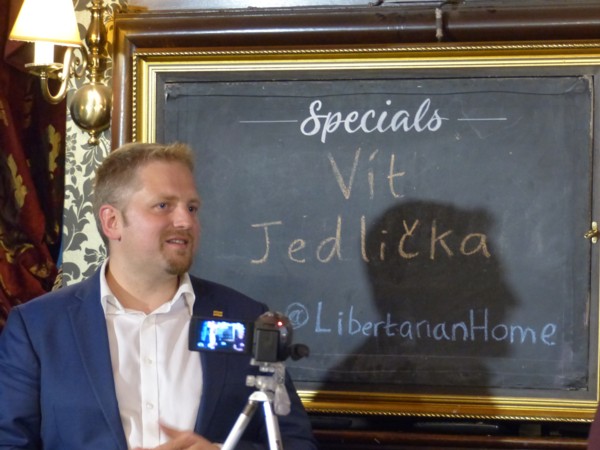
Last night I attended Libertarian Home’s first Thursday of the month meeting, at which the speaker was Vít Jedlička:
Jedlička is a libertarian politician. Maybe you think that’s a contradiction, but if we libertarians are to score any victories out there in the big wide world, we must have such people, and the very least we can do is listen to what they say, and, assuming we like the approximate sound of it, we should back them up and beat ours drums for them, even as we nitpick about details, tactics, principles, etc. I did zero homework for this meeting, and have done extremely little since, so many of those reading this will know a lot more about this man than I do. All I can now offer is a few thoughts about how he came across to me last night, and about what he definitely is – but also probably is not – achieving. Jedlička is trying to establish a small country, called Liberland. He has found a small chink in the armour of the state system, in the form of a small, unclaimed patch of territory between Serbia and Croatia. He and his collaborators have moved into it, and have declared it to be a state. Jedlička is careful to call what is happening out there in Liberland a minimal rather than non-existent state. After all, if only to defend itself against the rest of the state system, most notably the state of Croatia, Liberland needs something very like a state apparatus itself. There’s a lot of ducking and weaving going on. Jedlička struck me as a guy who, unlike some libertarians I could mention, including some who have become involved in schemes for new libertarian countries, well understands the difference between how the world ought to be, and how it actually is. When asked how he planned to stop this or that attack on Liberland, he did not descend into libertarian rant-mode about how such attacks would be wicked. Of course they’d be wicked. That wasn’t the question. Instead, he frankly acknowledged that this enterprise may not work. He presented it as very much a load-fire-take-aim, fear-the-worst-and-try-to-prepare-for-it but hope-for-the-best sort of an enterprise. Why then, the air of breezy optimism that Jedlička exuded all evening? Why the sense that at least something was definitely being accomplished, even if Liberland itself soon or eventually gets snuffed out? One word answer: publicity. → Continue reading: Vít Jedlička talks Liberland to Libertarian Home August 5th, 2016 | 11 comments - (Comments are closed)
Gosh who ever would have thought? Trouble is, as the authorities pretty much everywhere seem so keen to banish the very notion that any Muslim who murders someone is motivated by Islam, it is now impossible to believe anything the police say. Yes he may be a nutter, but that does not actually change anything if said nutter was motivated to act on his nuttiness by Islamic notions. This now means any genuine non-sectarian violence by a Muslim will be assumed to be sectarian by the general public regardless of the facts, and regardless of that the authorities say. And those authorities have only themselves to blame, because they have been misleading or just outright lied so often nothing they they say is credible any more. And that is a great pity. Maybe he was indeed just a common or garden variety nutter (the linked article is hardly conclusive), but I doubt many people actually think that is the case, and that includes me. August 5th, 2016 | 22 comments - (Comments are closed)
… Croatia’s Operation Storm was in day two of a rapid offensive to recapture the bulk of its territory from Belgrade backed separatists. It was the largest European land battle since the Second World War, ending on 7 August 1995 with the reoccupation of 4,000 square miles of territory. This was a dramatic demonstration of how effective the Croatian Army (HV) had become compared to just a few years earlier, and Operation Storm also represented a strategic victory for the Bosnian government as it broke the long siege of the Bihać enclave. Like all wars, it was not pretty, but it ended as it started, as an ethnic struggle with winners and losers and there is no point in thinking otherwise, and the less bad guys won in my opinion. Although Op. Storm did not end on August 5th, many Croatians see the HV recapture of Knin on this date as the most symbolic. It feels strange to me to tag this as ‘historical views’ as saw a great deal of that war first hand. I am getting old 😀 August 5th, 2016 | 8 comments - (Comments are closed)
The Bank of England just cut interest rates to 0.25%, announced it will buy 60bn government bonds and 10bn corporate bonds, and reduced its growth predictions (for what they are worth) from 2.3% to 0.8%. There is talk of reducing the rate of VAT. There is talk of reducing corporation tax, which incidentally worries Northern Ireland pundits because a plan to do the same thing there might lose some of its advantage. I am not sure whether to be happy or sad. I will stick to happy for now, because I am an unrelenting optimist. Could Brexit panic the establishment into turning Britain into Chris Patten’s Hong Kong to save the economy? Edit: I should have said John Copperthwaite, not Chris Patten. August 4th, 2016 | 43 comments - (Comments are closed)
Our international progressive elite combines arrogance and foolishness. It arrogantly presumes to know more about ISIS than ISIS knows about itself. Then these same elites foolishly seek to conform foreign and domestic policies to address the allegedly ”true” motivations of our Islamic enemies. Thus they increase our vulnerability without doing anything to deter aggression. When it comes to fighting jihadists, the same realities hold in 2016 as they did in 1016. The west’s best weapons against jihad are its warriors, not its theologians — or its politicians. August 4th, 2016 | 17 comments - (Comments are closed)
“The advocates of the minimum wage and its periodic boosting reply that all this is scare talk and that minimum wage rates do not and never have caused any unemployment. The proper riposte is to raise them one better; all right, if the minimum wage is such a wonderful anti-poverty measure, and can have no unemployment-raising effects, why are you such pikers? Why you are helping the working poor by such piddling amounts? Why stop at $4.55 an hour? Why not $10 an hour? $100? $1,000?” August 3rd, 2016 | 25 comments - (Comments are closed)
Over on Facebook, where I occasionally joust with Remainers who are still in shock and anger at the impertinence and evil of their fellows in voting to leave the EU, a person applauded an apparent suggestion that the result could be blocked, by the House of Lords, the upper chamber of the UK political system. I wrote this, and decided I might as well put it on Samizdata as well:
August 2nd, 2016 | 49 comments - (Comments are closed)
|
   |
||||

All content on this website (including text, photographs, audio files, and any other original works), unless otherwise noted, is licensed under a Creative Commons License. |
|||||
Recent Comments