We are developing the social individualist meta-context for the future. From the very serious to the extremely frivolous... lets see what is on the mind of the Samizdata people.
Samizdata, derived from Samizdat /n. - a system of clandestine publication of banned literature in the USSR [Russ.,= self-publishing house]
|
We’re living longer lives these days, we’re working for fewer decades of them and thus people are rationally saving for their expected golden years. Thus capital as a percentage of GDP rises – not to produce inheritances, but to produce incomes in retirement. And rises by potentially at least more than 100% of GDP.
We can’t see that this is a problem and we most certainly cannot see that this is an argument for greater taxation of capital. Quite the reverse in fact, people saving for their old age should be encouraged, not specifically taxed.
– Tim Worstall
What is funny is to watch the media try to interpret [Trump] through their prism of politics. It is like trying to understand the workings of a nuclear reactor through the prism of deconstructionist feminist semiotics.
– Fraser Orr
The essay by Mr Palmer is entitled “A New, Old Challenge: Global Anti-Libertarianism”.
The article examines three broad threats, which are serious, to classical liberalism: radical Islamism, the post-Gramsci Far Left, and what is called the “Alt Right”:
Unfortunately, the best argument that the defenders of civil society typically offer in response to those challenges is that the complex of personal liberty, the rule of law, and free markets creates more prosperity and a more commodious life than the alternatives. That’s true, but it’s not enough to deflect the damaging blows of the illiberal triumvirate of identity politics, authoritarian populism, and radical Islamism. The moral goodness of liberty needs to be upheld, not only in head-to-head encounters with adversaries, but as a means of stiffening the resistance of classical liberals, lest they continue retreating. Freedom is not an illusion, but a great and noble goal. A life of freedom is better in every respect than a life of submission to others. Violence and antagonism are not the foundation of culture, but their negation. Now is the time to defend the liberty that makes possible a global civilization that enables friendship, family, cooperation, trade, mutual benefit, science, wisdom — in a word, life — and to challenge the modern anti-libertarian triumvirate and reveal the emptiness at its heart.
Incidentally, for once Trump himself was spot on when it came to the question of Taiwan. Anyone finding it horrifying that he talked to the Taiwanese leadership in supposed breach of protocol needs to pull themselves together. The Chinese government has had it its own way for far too long, whether it is in terms of Western leaders humiliating their countries by kow-towing or with Chinese companies stealing intellectual property and technology and exploiting open markets in the West that it will not open properly at home to Western firms. Terrible Trump is onto them, which is a rare shaft of light in the darkness.
– Iain Martin. The article is actually mostly about Boris Johnson, another politician who commits lots of “gaffes” (MSM-speak for stating uncomfortable truths or comments deemed offensive for some reason, either valid or not.)
The story of the demise of slavery I take to have great significance for our evaluation of capitalism. The system is not to be judged purely by its material consequences. Relative or temporary happiness brought about by productive efficiency or growth cannot be the last word. Absent liberty and self-government, the situation would be inexcusable. We now can see that capitalism has as its essence individual freedom-rights. Without respect for these rights the system is in danger of turning into a monstrosity, as it would have in an unchecked antebellum South. It did so in Wilhelmine Germany and could do so still in crypto-communist China. Again, as in the case of the developing regions of today, liberty-rights are of the essence of capitalism as an improving force for humanity. If we do not see this we run the danger of suffering from the same tunnel vision of colonel Nicholson at the River Kwai.
– Pedro Schwartz
Yet another knife in the face of the rule of law is proposed in England and Wales, to deal with the problem of stalking.
The Home Secretary, Amber Rudd, appears to be pleased with the proposals.
New stalking protection orders will be introduced to better protect victims at the earliest possible stage, the home secretary has announced.
Amber Rudd called it “a practical solution to a crime taking place now”.
A closer inspection of the proposals reveals a familiar tactic, imposing a court order on someone who has not been convicted of any crime, and making a breach of that order a crime. This has already been in place since the Protection From Harassment Act 1997 was brought in, which was, IIRC, supposed to have dealt with this problem.
And look at the box of tricks that the State is offering:
The orders in England and Wales will help those who are targeted by strangers, giving them similar protection to domestic abuse victims.
Breaching an order’s conditions will be a criminal offence with a maximum sentence of five years in jail.
Police will be able to apply to the courts for an order before a stalking suspect has been convicted or even arrested.
The requirements of the order will vary according to the nature of the case. Typically, the suspect will be banned from going near the victim and contacting them online.
So no need to even arrest someone, just dump an order on them, and that will be a good start. But there’e more, all very Soviet if you ask me.
They might also be ordered to attend a rehabilitation programme, or undergo treatment if they have a mental health problem.
So without so much as a chance to argue your case, you could find yourself ordered to undergo treatment, and risk 5 years in jail if you refuse.
Not that it is much better that this could perhaps only follow a conviction.
So what do the police think?
The National Police Chiefs’ Council’s lead for stalking and harassment, Assistant Chief Constable Garry Shewan, said:”We want to stop stalkers in their tracks.
“The launch of stalking protection orders will help us intervene earlier and place controls on perpetrators to prevent their behaviour escalating while the crime is investigated.”
Not, I note ‘We want to bring suspects before the courts if the evidence justifies arrest, charge and a realistic prospect of conviction in a situation where it is in the public interest to prosecute, even though prosecution is a matter for the Crown, not the police.’, which would be a bare minimum of respect for the rule of law. But clearly not a shoot-to-kill to ‘stop stalkers in their tracks‘.
And what do the ‘charities’ think?
Rachel Griffin, director of the Suzy Lamplugh Trust which manages the National Stalking Helpline, welcomed the announcement.
“We are really excited that the order allows positive obligations to be put on a stalker,” Ms Griffin said.
“But of course that mental health treatment needs to be available at local level.”
This ‘trust’ is named for a murdered estate agent. I don’t see how killing the rule of law is an appropriate memorial to her. And did you note the sly hint that (State) funding is important?
And on what pretext is the rule of law being sacrificed, with a dagger in the chest for the beating heart to be pulled out and eaten warm?
Stalking protection orders form part of a package of government action to coincide with 16 days of action following the 25 November International Day for Elimination of Violence Against Women.
How about the elimination of violence against the rule of law?
Throughout our time in the EEC/EU Ministers have regularly used prerogative powers to bind us into EU decisions, regulations and judgements which Parliament has been unable to vote on or prevent. Many of these have adversely affected our right to be a sovereign and free people. It was curious that the High Court of England thought that was acceptable yet using the same prerogative powers to bring the right to self-government back was not. I hope the Judges understand three basic points. The first is the referendum was the decision. Government made that clear in Parliament and in a leaflet to all voting households. The second is Parliament can debate Brexit any time it likes, and has done so extensively already. The third is Parliament needs to make up its own mind on what it wants to vote on, and is free to do so. There can be plenty of votes on the Repeal Bill.
– John Redwood
Enjoy! [edit: Tuesday December 6th, SSL is now enabled.]

Baroness Warsi on Peston on Sunday, talking about “identity”:
Well there’s a big report coming out on Monday actually, a government report on integration, which tries to kind of unpick who it is we are, what it is that we can all convalesce around. …
It sounded as if she thought we had all been suffering from some sort of medical condition. Brexit? Perhaps she does think this, about that. But, she presumably had the word “coalesce” in mind.
At first I tried to type out what she had said from memory. But the only reason I was watching this was that my video machine had switched to it from something else, because it was about to record some rugby. And this machine can play back a recording even as it is still making it.
There is a good article on the Verge laying out the horrendous Investigatory Powers Act.
This is quite old – the previous presidential election – but I cannot help thinking, given the huge gap between the supposed cleverness of soon-to-be-gone President Obama and his actual performance on the job, that the actor Clint Eastwood summed up the current occupant of the White House perfectly with this speech.
On a totally separate point, I really enjoyed the Eastwood-directed film, Sully, starring Tom Hanks. What I liked about this film, like another Hanks film (Apollo 13) is its celebration of grace under pressure, of competence, and of a sort of grown-up maturity and adult willingness to accept responsibility. Given the state of the culture, these are good things to put out there on the Silver Screen.
Things were looking good for the Allies at the close of 1916. The French had pushed back the Germans at Verdun. The British were consistently doing much the same on the Somme. The Russians had made huge gains at the expense of the Austrians during the Brusilov Offensive. The Italians were continuing to attack and it appeared that it was finally all systems go on the Salonika Front. The only real fly in the ointment was Romania which was being invaded.
Away from the frontlines there was also plenty of scope for optimism. The British were at last getting guns and shells in sufficient quantities. The Irish rebellion had been crushed. The U-boat campaign was quiescent. Conscription seemed to be working. Even the Russians seemed to have turned the corner when it came to their supply problems.
Most importantly, the Western Allies – and particularly the French under a dashing young commander – appeared to have found the formula for winning battles on the Western Front.
Meanwhile the Germans were slowly and literally being starved by a combination of the Blockade and their own economic incompetence. Splits were beginning to appear with the communist, Karl Liebnecht demanding an end to the war. At the same time they were having to prop up their increasingly helpless allies. In Austria, the death of Emperor Franz Josef followed on the heels of the assassination of the Prime Minister by another communist in protest at the continuing refusal to recall parliament.
It must have looked like victory was just around the corner. In such situations you often find that unscrupulous politicians like to jockey for position in order to be able to take the credit. Not that such things would ever happen in Britain.
On 6 December, having out-manoeuvred his predecessor, David Lloyd George became Prime Minister.
Oh and the name of that dashing French commander – he of the formula? Nivelle. Robert Nivelle.
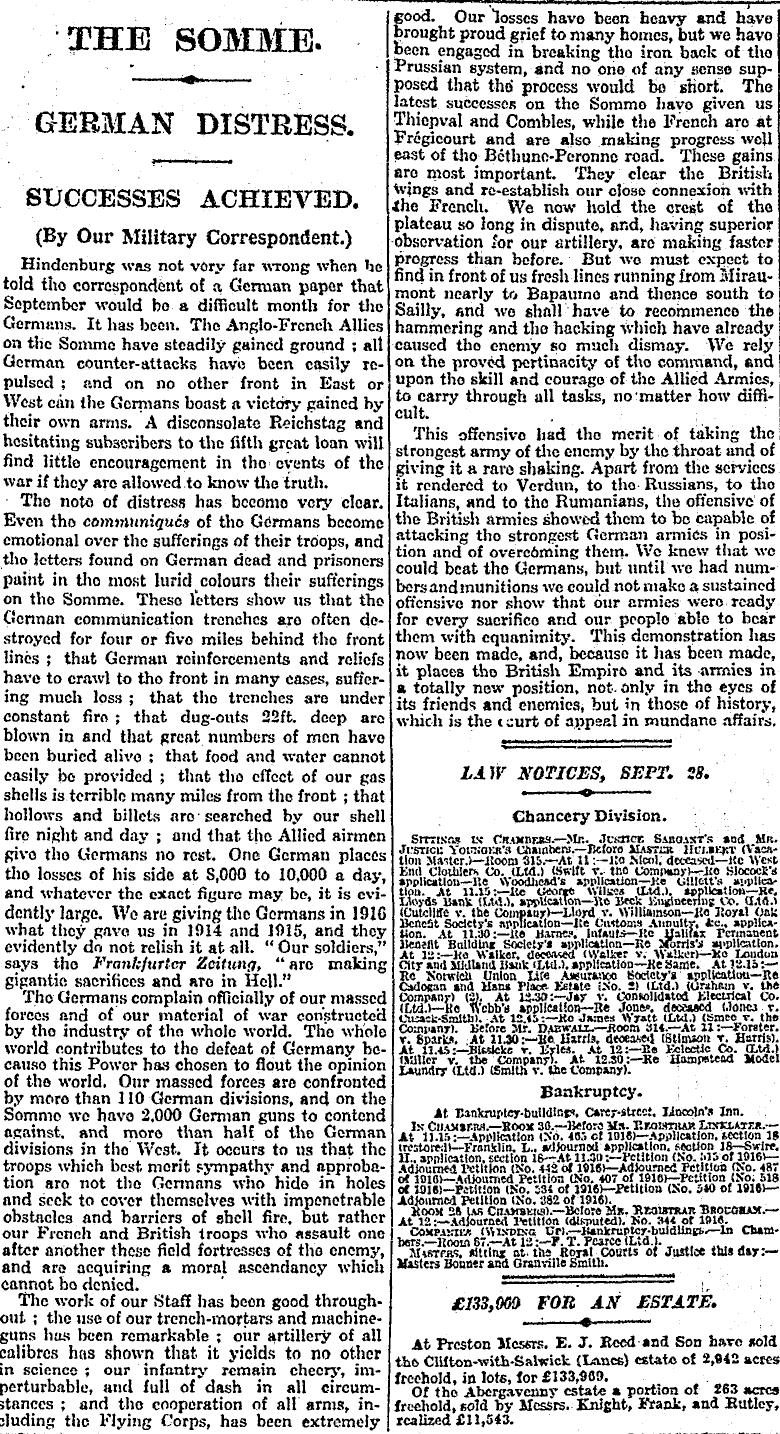
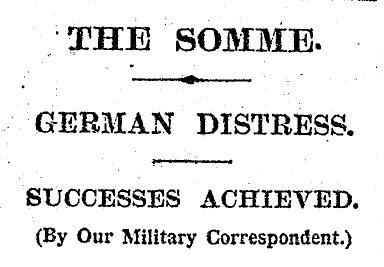 The Times 28 September 1916
|
Who Are We? The Samizdata people are a bunch of sinister and heavily armed globalist illuminati who seek to infect the entire world with the values of personal liberty and several property. Amongst our many crimes is a sense of humour and the intermittent use of British spelling.
We are also a varied group made up of social individualists, classical liberals, whigs, libertarians, extropians, futurists, ‘Porcupines’, Karl Popper fetishists, recovering neo-conservatives, crazed Ayn Rand worshipers, over-caffeinated Virginia Postrel devotees, witty Frédéric Bastiat wannabes, cypherpunks, minarchists, kritarchists and wild-eyed anarcho-capitalists from Britain, North America, Australia and Europe.
|





Recent Comments