We are developing the social individualist meta-context for the future. From the very serious to the extremely frivolous... lets see what is on the mind of the Samizdata people.
Samizdata, derived from Samizdat /n. - a system of clandestine publication of banned literature in the USSR [Russ.,= self-publishing house]
|
I’ve read the Daily Torygraph most days now, for the last decade or so, ever since that fateful day I stopped draping myself in the Grauniad every morning, as is the wont of most perennially tax-subsidised students. And pretty much most of the time I’ve found it quite a good newspaper, especially with topics such as its Free Country campaign. On the whole it has also seemed unbiased in its straight news reporting.
But then this morning I find myself staring at a this particular headline, in the news section, covering the changes to the UK’s telephone directory inquiries system:
Callers face chaos and high bills as directory rivals replace 192
For non-UK readers, this concerns the number we always used to phone to get through to directory inquiries. British Telecom, a previously government-owned telecom monopoly since opened up to competition, provided a near-monopoly service on this number, from virtually all fixed lines. → Continue reading: Free market causing chaos again
I defy anybody to refer to this guy as a chickenhawk:
A Danish pizzeria owner who refused to sell pizzas to Germans or Frenchmen because of their governments’ stance on the war in Iraq is to go to prison.
An appeal court upheld the conviction yesterday of Niels-Aage Bjerre for discrimination and his fine of £500. He said he would refuse to pay and will instead spend eight days in jail.
“I will not pay the fine but I’ll do the time instead,” said Bjerre. “It is a matter of principle.”
Now, speaking personally, I regard the boycotting of individuals as rather unfair and petty. Having said that, Mr.Bjerre should not be prosecuted for doing so.
Mind you, I bet if look the word ‘defiant’ up in the dictionary you’ll find this guy’s photograph underneath.
He said yesterday that both the courts and those who had reported him to the authorities were “traitors”.
“The judges have chosen to support those who do not support the official Danish position on the war against Iraq.”
His boycott would end only “if the governments of France and Germany change their attitude toward the United States and support Washington wholeheartedly,” he added.
He’s not just a restaurateur, he’s a neo-restaurateur.
I have just cast my beady eyes over this Stratfor article which, alas, I cannot link to (hefty subscription fee required) but here is the opening paragraph:
France is threatening to veto the consensus that the United Nations Security Council finally should lift sanctions on Libya. In the end, the French position is bluster. France cannot afford the heavy price a veto would levy. While Paris’ anti-American policies are wildly popular at home, they are affecting France in meaningful ways that will continue to impact French prestige, power and the country’s bottom line for years to come.
What follows is a detailed analysis in the impeccably objective Stratfor tradition but I reckon the above is enough to fuel a good-sized helping of thoroughly malicious glee on the other side of the Atlantic.
Interesting legal development – a group of Gulf War veterans are suing the banks and chemical companies that facilitated Hussein’s procurement or manufacture of chemical weapons to which the troops were exposed during the first phase of the Gulf War.
“Sixteen veterans from the Persian Gulf War filed suit Tuesday in U.S. District Court in Brooklyn, N.Y., against 11 chemical companies and 33 banks from throughout the world that allegedly helped Iraq construct and support its extensive chemical warfare program.
The banks named in the suit include Deutsche Bank AG of Germany, Lloyds Bank of the United Kingdom, Credit Lyonnais of France, State Bank of India, Banca Roma of Italy, National Bank of Pakistan, Arab Bank of Jordan, Bank of Tokyo and Kuwait Commercial bank. The companies that the suit claims have sold chemicals or materials to Iraq are headquartered in France, Switzerland, Germany, Great Britain and the United States – ABB Lummus Global Inc. in Delaware.”
The companies all do business in New York, where the suit was filed, so there is no issue of extraterritorial jurisdiction (the fatal flaw to date of that pet tranzi project, international courts).
The lawsuit will have to clear some very difficult legal hurdles before any recovery can be had. If these hurdles are cleared and the veterans receive damages, then the end result could be extreme reluctance on the part of any private business to sell anything, or provide any services, with a military application to any government. After all, liability for the damages, or even collateral or unintended damages, caused by weapons sold to a government, would probably shut down or impede the sale of weapons by the private sector to governments. Attempts to force governments to indemnify their suppliers would be, interesting, to say the least. Depending on exactly how the case goes off, it could clear the way for lawsuits against gun manufacturers for shootings and other crimes. Second order effects could will include the nationalization of defense industries and weapons manufacturers to bring them under the umbrella of sovereign immunity, or other special treatment for these firms.
If the firms were violating the law when they made the sales, then I can see holding them liable for the foreseeable effects of their illegal activity. If the sales were legal when made, then I begin to have a problem with this lawsuit, on both jurisprudential and policy grounds. The jurisprudence of imposing liability for actions that were legal when done is very troubling, of course. The policy implications, a few of which are noted above, are also troubling, although the notion of governments being pariahs in the marketplace for things that hurt people has a certain very definite attraction.
There is probably a drop-dead serious point to be made here about the gradual ‘feminisation’ of boys but, for now at least, I am content just to publicly guffaw at this latest forlorn attempt to make the world a safer place:
Children in Melbourne have been banned from dressing up as Batman, Superman and the Incredible Hulk because schools say the action hero costumes encourage aggressive behaviour.
At least 10 childcare centres have declared themselves “superhero-free zones”, claiming that youngsters who don capes and masks are more likely to end up wrestling, punching and karate-kicking unsuspecting classmates.
Lex Luther take note: all their childcare centres are belong to you!
The head of one childcare centre, Madeleine Kellaway, told the Sun Herald newspaper: “There is a lot of violence involved, where you get wham-bam aggressive behaviour.”
Perhaps the kids just don’t like her very much.
She said banning the superhero costumes had encouraged more creative play.
‘Okay children, today we’re all going to dress up as Outreach Co-ordinators and play a game of who can get most money from the government in order to implement a policy framework for achieving diversity in local authority management structure. Hooray!’
If I were a shareholder in Anglo American plc, the owner of de Beers, the world’s biggest diamond firm, I would be having a few sleepless nights over the cover story of Wired magazine, about a team of entrepreneurs working to produce artificial diamonds.
I am not a scientist, but this article makes it pretty clear that the technology to create high-quality gems is getting closer. Diamonds, of course, have all kinds of uses, not just in jewellery, but also in industrial applications such as in ultra-hard lathes, cutting equipment and so forth.
It also suggests that scientific advances are bringing us closer to enjoying all kinds of incredibly light and strong materials, of a sort that are bound to be useful for activities such as aerospace, space travel, construction, and possibly also for the military.
This is another welcome reminder that despite the daily news of political dishonesty, terror bombings and the antics of dysfunctional celebs, smart folk out there are hard at work producing all kinds of new and amazing stuff.
The UK state has long been scared of the effects of cannabis, especially its anti-state effect on people who want the freedom to eat, and smoke, and drink, whatever the hell they like.
But soon, specially selected National Health Service patients are to be given cannabis as part of a government-funded trial, costing half a million pounds, to see if it can work as an effective pain relief drug.
Of course, all of the sufferers from long-term pain who regularly use cannabis right now, illegally, to get themselves through the long days and nights of multiple sclerosis, and other painful complaints, could have told them this years ago. And have done so, many times. But not to worry. Spending half a million of other people’s money costs the government absolutely nothing, after all, so where’s the worry?
It should be interesting however, if Her Majesty’s Government do legitimise ‘medical cannabis’. Expect to see queues out the door of most General Practitioners’ surgeries filled with ‘migraine’ sufferers, for whom Nurofen doesn’t quite cut the mustard anymore.
Actually, I can feel this throbbing pain in my left temple, right this second, probably from all this cheese I’m eating on the Atkins diet. Maybe I should chuck the diet in, and get back to carbohydrates? Anybody got any ‘interesting’ chocolate cake mixture recipes?

Having just recovered from the shock of hearing about David Carr’s illegal tomato seeds, I’ve stumbled this morning across an even madder tax scam, this time originating from among our American friends in Seattle, in Washington State.
Apparently, and I’m still struggling to believe it, there’s a proposal to put a 10-cent coffee tax on every cup of espresso sold in the City of Seattle, to raise money for pre-school child care.
That’s Tax-tastic!
So what’s the alleged tax linkage between espresso coffee and pre-school child care? Linkage? Heck, we don’t need linkage. Here’s what John Burbank said, the man behind the proposed tax:
“I go into these places every day. One of the good things about Seattle is we love our coffee and we love our kids. So let’s make that connection.”
Has anyone reminded Mr Burbank that this is the land of the Boston Tea Party? I think someone should.
And while we’re waiting for the tax to go through, is Frasier available? I think I need a consultation to prevent early-onset total madness. The screens, please nurse. Quickly!
While I’m there in the recovery room, kids, you better watch out. One day, in the US, it’s a coffee tax. The next day, in the UK, it’s a Tetley Tea tax! Maybe those fine people in Boston won’t be the last ones to revolt over caffeine-based refreshments?
If you are one of those who favours privacy laws, to protect people against being snooped on, you might want to make sure you aren’t asking the government to make operations like this one illegal.
That link was in David Carr’s Samizdata piece yesterday, and there’s more comment from him and from the Samizdata comment pack.
The X-Prize entry from Armadillo Aerospace is coming along nicely. They’ve carried out a helicopter drop test. They’ve acquired a Russian space suit – sans gloves so far – from eBay. They’ve got the landing legs sorted. Most importantly, they have finally sourced more high purity 50% Hydrogen Peroxide. They are still having difficulties convincing the manufacturer (FMC) to sell them the hi-test rocket fuel grade. Nonetheless, this lets them continue the engine test series so they can solve problems identified in an earlier firing.
Armadillo Aerospace was created by John Carmack, one of the founders of Id Software. If you want to support private enterprise in space, buy their games! Of course, since they are the creators of such titles as “Wolfenstein”, “Doom” and “Quake”, you probably have already done so.
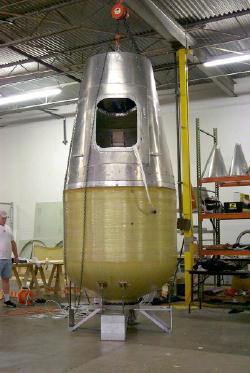
X-Prize entry under construction
Photo: Courtesy Armadillo Aerospace
The BBC reports that US Attorney General John Ashcroft has launched a strident defence of the controversial Patriot Act, saying it was the government’s responsibility to defend Americans in any way it could.
Mr Ashcroft highlighted support for the Patriot Act given earlier by members of Congress and the website lists quotations from members of both parties supporting the legislation, almost wholly dating back to October 2001 when it was introduced.
But since then dozens of cities and counties across the country have approved resolutions criticising the Patriot Act and various lawsuits have been brought to declare it unconstitutional.
Even the Republican-led House of Representatives has become involved in recent weeks, striking down “sneak-and-peek” rules which allowed government agents to search private property without telling the owner.
Other controversial areas – such as agents being allowed to scrutinise people’s library records without showing what crime they believe could be being committed – still stand despite challenges.
Telegraph reports that Tesco, a British supermarket chain, is taking pictures of everyone buying razors in a bid to cut down on shoplifting.
The experiment, at a Tesco store in Cambridge, has been condemned by civil liberty campaigners. Demonstrators have gathered outside the supermarket calling for a boycott until the “Big Brother” scheme is dropped.
Gillette razors in the company’s Newmarket Road branch are being tagged with individual microchips developed by Cambridge University’s Auto-ID Centre.
When anyone removes a product from the Mach 3 display, the chip triggers an in-store CCTV camera which takes a picture of the shopper.
Greg Sage, a spokesman for Tesco, said that the scheme was designed to keep track of its products within the store and stressed that the chips would have no further use once the products left it.
We would never compromise the privacy of our customers.
Police are said to be “impressed” with the images taken of shoppers, but civil rights activists claim that the microchips could soon be placed on a much wider range of products.
|
Who Are We? The Samizdata people are a bunch of sinister and heavily armed globalist illuminati who seek to infect the entire world with the values of personal liberty and several property. Amongst our many crimes is a sense of humour and the intermittent use of British spelling.
We are also a varied group made up of social individualists, classical liberals, whigs, libertarians, extropians, futurists, ‘Porcupines’, Karl Popper fetishists, recovering neo-conservatives, crazed Ayn Rand worshipers, over-caffeinated Virginia Postrel devotees, witty Frédéric Bastiat wannabes, cypherpunks, minarchists, kritarchists and wild-eyed anarcho-capitalists from Britain, North America, Australia and Europe.
|





Recent Comments