We are developing the social individualist meta-context for the future. From the very serious to the extremely frivolous... lets see what is on the mind of the Samizdata people.
Samizdata, derived from Samizdat /n. - a system of clandestine publication of banned literature in the USSR [Russ.,= self-publishing house]
|
I just found out about the latest Al-Qaeda beheading. I haven’t seen the video. Probably I never will.
I thought of Daniel Pearl. I wondered how and when the murdered man’s family learned of the manner of their son’s death. I wondered if he himself knew what was about to happen, as Fabrizio Quattrocchi did.
And such is the unalterably tactical nature of the human mind that mixed in with all that I thought:
Thanks for the reminder, Hellspawn. No thanks for the killing; we’ve had enough of that, but thanks for the reminder. In all this agonized talk about what we are, we were beginning to forget what you are. What you stand for.
What your pictures show.
Andrew Sullivan thought the same way, evidently:
And they [Al-Qaeda] are as stupid as they are evil. Iraqis now have contrasting images. Do they want to be run by people who cut innocent people’s throats at will or by people who have removed a dictator and are investigating unethical abuse of prison inmates? Zarqawi has now done something for our morale as well as his. He has reminded us of the real enemy; and he has reminded the Iraqis. One simple question: will CNN now show these video stills?
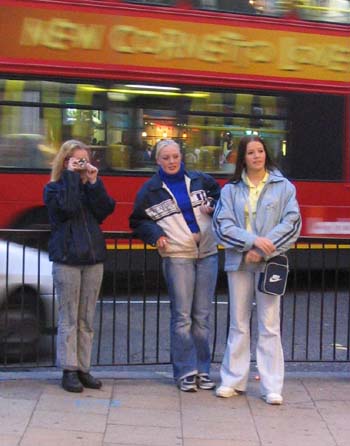
Well trade here seems to be rather light, so here, given that writing adequately is beyond me just now, are some photos I took earlier. Earlier this evening to be exact. The light was fading fast, but a few of my snaps came out okay.
I like the effect you get when the background is a London bus. Lots of colour, but blurred, and if the figures in the foreground come out well, it can look great.
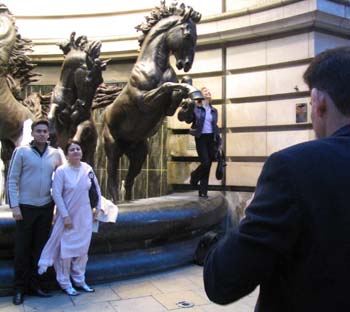
As you can see, I like to take pictures of people who are taking pictures. Sometimes, as here, I include the people they are photographing. And look, over on the right is a lady posing for another photographer away to the right. I only noticed her after I got home. The horses are a big fountain statue just to the edge of Piccadilly Circus, and are, I think, much more impressive than Eros.
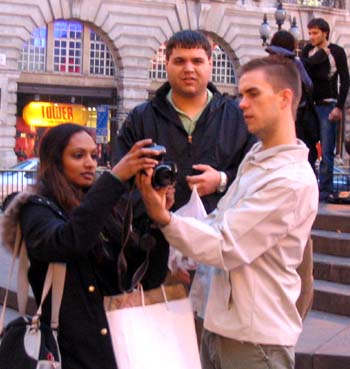
This next bunch of people are doing a characteristic digital camera thing which Real Photographers never do. They are looking together at the picture they have just taken on that little TV type screen that digital cameras mostly now have.
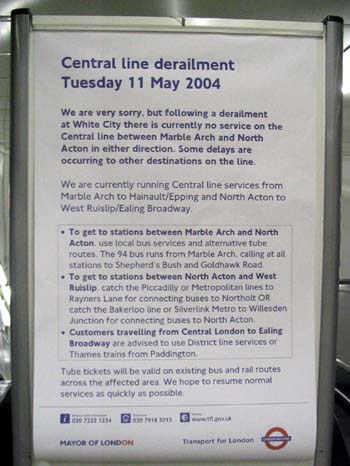
But now here is a shot of London life of a quite different sort. The London Underground is a creeking, groaning, deafeningly loud, hideously crowded … Underground. But they are amazingly quick to put up the posters about any problems they are having.
When I see posters like these, I am part angry, and part impressed. Such a fuck up, and so courteously explained!
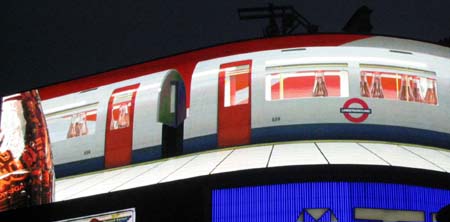
I cannot end on this grim note, so here is a happier Underground related picture, this time of a Coca Cola advert done in the lights of Piccadilly Circus, which are supposedly famous, but usually rather feeble, I think. But this was nice. This picture is probably too small, but trust me, it looked very fine.
London. As Doctor Johnson said, if you are tired of London, go to bed and get yourself a good night’s sleep and you will probably feel much better in the morning.
Belatedly, but no less relevantly, I was directed to the following Letter to Editor published in the Daily Telegraph last Saturday. It is from a British Army officer who was (still is?) in Basra. Its content was heartily approved by the Samizdata’s own Our Man in Basra – his quotable comment was I could have written every word myself…
Sir, I am a serving Army officer. Publication of photographs that are faked – as appears to be the growing consensus – does not assist our soldiers on the ground but, while such abuse is intolerable to us, brutalised Iraqi opinion differs from ours. Most Iraqis are baffled as to why we do not employ such methods.
Suggestions I have encountered while working with Iraqi governance institutions in Basrah include: crushing looters’ hands, wiring pylon saboteurs to the national grid and hanging rioters by the neck and beating them to death.
In Iraqi eyes, it is not through torture that we have failed Iraq. One year on from liberation, improvements have not materialised. We still seek military solutions to problems caused by policy. The Coalition Provisional Authority (CPA) inherited and perpetuated a Soviet-style centralised bureaucracy without the clear central direction or the threats to back it up that made the Ba’athist system work.
Poor salary decisions mean that operating budgets cannot be paid, so, while there are new police cars, they have no fuel and Iraqi jails lack money for food.
On March 13, after nine months of operations, the Rapid Regional Response Programme, the CPA’s principal project fund for improving Iraqi life had, in the South, identified almost $42 million (£23.5 million) of projects but, owing to excessively bureaucratic contracting, completed only a shameful $627,671 worth. Emergency Infrastructure Project funding achieved more, but millions of dollars worth of projects will not be completed when the June deadline expires.
Yet many Iraqis will endure all this for freedom and democracy. In terms of freedom, Iraqis are still arrested, held indefinitely without trial and, apparently, tortured. In terms of democracy, the CPA, fearing calls for national elections in which Islamic parties may succeed, has banned direct, democratic elections in favour of caucus-style selections derided as undemocratic by most Iraqis.
Meanwhile, those such as Moqtada al-Sadr, the rogue cleric regarded by most Iraqis as a foolish upstart whose lack of support would be revealed by polling, terrorise the country with armed militias. Next month, the CPA will hand over sovereignty and responsibility to an Iraqi nation singularly unequipped to cope.
Iraqis I have spoken to confirm that ousting Saddam was the right thing to do, but if overturning unpleasant regimes is to become a regular feature of foreign policy, we should ensure we have something better to replace them with.
In short, cherchez le politicien.
One casts far and wide for any ray of hope in current domestic American politics. The Bush campaign is depressingly, although perhaps wisely, silent on any of the quasi-libertarian Republican issues – gun control, deregulation, privatization of Social Security, tax cuts. As for the Bush record, well, if the rhetoric is depressing (he stated he would sign an extension of the moronic assault weapon ban), the reality is even worse, in the form of a spending binge beyond all precedent or belief. I note the sole exception of Bush’s rather anemic and backloaded tax cut, much of which is self-repealing.
The Democrats, predictably, are even worse. Their only real complaints concerning current domestic policy are fiscal – that spending wasn’t increased even more, and that taxes weren’t raised to pay for all that spending. Sure, you can catch the occasional Dem kvetching about such issues as tort reform or environmental deregulation, but those are dogs that are notable because they are not barking. There is no tort reform, there is no lightening of the regulatory burden. Democratic joke candidate Kerry floats the occasional trial balloon concerning a targeted corporate tax cut or Social Security privatization, but you know that is only so Senator Flippy can say he was for them before he was against them.
There is, in short, no evidence to be found in either major party that limited government and individual freedom (aside from the freedom to have an abortion, of course) have any place in the modern US of A. If it wasn’t for the fact that the best thing that could happen to the libertarian movement in the US would be to launch the entire current Libertarian Party into the sun, I would vote Libertarian. As it is, one simply despairs of advancing the libertarian agenda in current US politics.
Long eyelashes and watery eyes could thwart iris scanning technology used for the government’s ID card trial. An MP who volunteered to take part in the trial at the UK Passport Service headquarters in London complained the scanning was uncomfortable.
Home Affairs Select Committee member Bob Russell, who suffers from an eye complaint, said his eyes watered and staff were unable to scan his iris. Project director Roland Sables told MPs:
The pundits tell us that we should expect 7% across the board to fail with iris recognition, mainly due to positioning in front of the camera. Others are due to eye malformations, watery eyes and long eyelashes in a small percentage.
Hard contact lenses could also prove problematic. Mr Russell expressed concern about the scanning after his experience.
I think this is going to cause serious problems for people who suffer with bright lights and people with epilepsy. I think it will be necessary at every machine to have at least one member of staff who is a qualified first aider to a high level. I can see people keeling over with epileptic fits.
People with faint fingerprints would also be unable to register on the system, as would manual labourers, particularly those who work with cement or shuffle paper regularly, Mr Sables told the MPs.
The Plan is that by 2013, 80% of the population are expected to have a biometric passport or driving licence, at which point the government will decide whether to make the ID cards compulsory. The remaining 20% are presumably construction workers with long eyelashes, wearing hard contact lenses and suffering from epileptic fits…
Here is the answer to my question in the final paragraph of my earlier post about the treatement of Iraqi detainees in the Abu Ghraib prison:
On 31 January 2004, the Commander, CFLCC, appointed MG Antonio M. Taguba, Deputy Commanding General Support, CFLCC, to conduct this investigation. MG Taguba was directed to conduct an informal investigation under AR 15-6 into the 800th MP Brigade’s detention and internment operations. Specifically, MG Taguba was tasked to:
a. (U)Inquire into all the facts and circumstances surrounding recent allegations of detainee abuse, specifically allegations of maltreatment at the Abu Ghraib Prison (Baghdad Central Confinement Facility (BCCF));
b. (U) Inquire into detainee escapes and accountability lapses as reported by CJTF-7, specifically allegations concerning these events at the Abu Ghraib Prison;
c. (U) Investigate the training, standards, employment, command policies, internal procedures, and command climate in the 800th MP Brigade, as appropriate;
d. (U) Make specific findings of fact concerning all aspects of the investigation, and make any recommendations for corrective action, as appropriate. (ANNEX 4)
These were the findings:
(U) The US Army Criminal Investigation Command (CID), led by COL Jerry Mocello, and a team of highly trained professional agents have done a superb job of investigating several complex and extremely disturbing incidents of detainee abuse at the Abu Ghraib Prison. They conducted over 50 interviews of witnesses, potential criminal suspects, and detainees. They also uncovered numerous photos and videos portraying in graphic detail detainee abuse by Military Police personnel on numerous occasions from October to December 2003. Several potential suspects rendered full and complete confessions regarding their personal involvement and the involvement of fellow Soldiers in this abuse. Several potential suspects invoked their rights under Article 31 of the Uniform Code of Military Justice (UCMJ) and the 5th Amendment of the U.S. Constitution. (ANNEX 25)
→ Continue reading: A very long report
On my way to meet Samizdata’s own Perry de Havilland and Adriana Cronin this morning, I treated myself to a few chapters of Parliament of Whores by PJ O’Rourke. I first read this superb book when I was 13, but it won’t surprise anyone who’s read it to learn that I appreciate it much more as a beleaguered taxpayer.
I wouldn’t advise reading Parliament of Whores on public transport, though — one would have to be made of stone not to giggle (if one is a giggler) or laugh out loud at some of O’Rourke’s turns of phrase. Perry suggested that I post some of these, and who am I to disappoint? From the chapter on environmental moonbats (“Dirt of the Earth”) comes this passage — see if it reminds you of anything affecting the current global political climate.
Mass movements need what Eric Hoffer — in his book The True Believers, about the kind of creepy misfits who join mass movements — called a unifying agent.
“Hatred is the most accessible and comprehensive of all unifying agents,” said Hoffer. “Mass movements can rise and spread without belief in a God, but never without belief in a devil.” Hoffer goes on to cite historian FA Voigt’s account of a Japanese mission sent to Berlin in 1932 to study the National Socialist movement. Voigt asked a member of the mission what he thought. He replied, “It is magnificent. I wish we could have something like it in Japan, only we can’t, because we haven’t got any Jews.”
[…]
Business and industry and “their friends in the Reagan administration and Congress” make easy and even appropriate targets. Nobody squirts sulfur dioxide into the air for a hobby, after all, or tosses PCBs into rivers as an act of charity. Pollution occurs in the course of human enterprise. It is a by-product of people making things, things like a living…
Business and industry — trade and manufacture — are inherent in civilization. Every human society, no matter how wholesomely primitive, practices as much trade and manufacture as it can figure out. For good reason. It is the fruits of trade and manufacture that raise us from the wearying muck of subsistence and give us the health, wealth, education, leisure and warm, dry rooms with Xerox machines that allow us to be the ecology-conscious, selfless, committed, splendid individuals we are.
Our ancestors were too busy wresting a living from nature to go on any nature hikes. The first European ever known to have climbed a mountain for the view was the poet Petrarch. That wasn’t until the fourteenth century. And when Petrarch got to the top of Mount Ventoux, he opened a copy of Saint Augustine’s Confessions and was shamed by the passage about men “who go to admire the high mountains and immensity of the oceans and the course of the heaven…and neglect themselves.” Worship of nature may be ancient, but seeing nature as cuddlesome, hug-a-bear and too cute for words is strictly a modern fashion.
The Luddite side of the environmental movement would have us destroy or eschew technology — throw down the ladder by which we climbed. Well, nuts (and berries and fiber) to them. It’s time we in the industrialized nations admitted what safe, comfortable and fun-filled lives we lead. If we keep sniveling and whining, we may cause irreparable harm to the poor people of the world — they may laugh themselves to death listening to us.
In France on Sunday, Nicolas Sarkhozy has manouvered the UMP government party into supporting a referendum for the proposed EU constitution [link in French].
The decision to hold a referendum will be taken by President Jacques Chirac (anyone’s guess what that will be), but the call by the newly appointed Minister of Finance represents a shift away from automatic rubber-stamping by the French parliament.
Privately Chirac will be fuming. He hates Sarkhozy and fears his possible election in 2007 as President. Unlike the recently convicted fraudster Alain Juppé, Mr Sarkhozy might not feel inclined to whitewash the current President’s dubious financial history. Meanwhile, Alain Juppé the UMP party chairman, has endorsed Mr Sarkhozy’s call with the qualification: “within the constitutional prerogatives of the President”. Mr Juppé no doubt feels it is a good time to roll with his colleague’s punches.
On March 19 1995, the Aum Shinrikyo cult released the nerve gas Sarin on five trains of the Tokyo underground. Until 2001, I rated this the most frightening news story of the previous ten years. Why? Because until then the most severe weapons that had been used by terrorists had been conventional explosives. The expression “Weapon of Mass Destruction” is overused, but as the word is usually definted, this fit the bill. As it happened, due to a combination of inexperience in deployment and concern for the safety of the people actually deploying the weapons – the concentration of sarin in the containers was apparently substantially lower than Aum Shinrikyo had considered using – the Tokyo attack only killed 12 people, although a great many more were injured or otherwise affected by the attack.
But it was extremely close. Had a few fairly minor details been different, thousands would have died. As it happened, Aum Shinrikyo had one chance only to cause carnage of this kind. They were the kind of organisation that it was relatively easy for the Japanese authorities to round up and eliminate, and the Japanese authorities did indeed do this. But what they demonstrated is that a few skilled chemists with the sorts of resources that can be moderately easily bought on the open market in a developed country can produce extremely deadly chemical weapons.
It is now 2004, and such weapons have not been used again by terrorists. (In fact, I don’t think they have been used in warfare since then either. To be truthful, they are not terribly useful in achieving military objectives unless your military objectives include killing large numbers of civilians. Saddam Hussein in the 1980s seems to be the last person who was into using them in a big way. While on that, I hope Mr Hussein is enjoying his cell in Qatar or wherever it is). Since then, we have had far too many terrorist attacks using conventional explosives, and one attack in which terrorists attempted to see if the sorts of fantasies that exist in Tom Clancy novels and James Bond movies will work in real life. (The answer was clearly yes, once. I can’t imagine that September 11 type attack will work again, however). What we have learned since then is that there are terrorists out there who wish to kill westerners in large numbers, and who have operatives who are willing (or even eager) to die while delivering the weapons. Given that, an attack such as the one in Tokyo seems a fairly obvious way to achieve such objectives. So why hasn’t it happened? I find it impossible to believe that Al Qaeda would not attempt such an attack if it could. The only explanation must be that they do not have such weapons?
Why not? Demonstrations that something is possible are usually followed by somebody else trying it. So why not here?
→ Continue reading: The puzzle of why terrorists do not have weapons of mass destruction
I have just done a spot on Talk Radio, being interviewed by Mike Dickin, as is my occasional wont. From time to time, it is arranged that he and I will take it in turns to mouth off about some issue of the day.
Today what Mike Dickin was complaining about, and inviting me to complain about along with him, was this:
Business leaders have criticised new rules that require companies to provide prayer rooms and give religious holidays to non-Christians as “unacceptable and ridiculous”.
In a 99-page document published last week, the Commission for Racial Equality set out draft guidance on how companies should prevent discrimination against religious and racial minorities.
The most controversial proposal is that employers should have to provide prayer rooms and give time off for non-Christians to mark their own religious holidays.
Obviously commenters may want to say their thing about that, but I want to discuss something somewhat different. I found myself in partial but severe disagreement with Mike Dickin on this matter.
In particular, I think I observed an extremely common syndrome which does much to explain why proposals for intrusive laws have such an annoying habit of becoming intrusive laws. → Continue reading: Falling into the Mike Dickin trap
Conservative MP (and onetime leadership contender) Michael Portillo has a column in the UK Times [note: link may not be available to non-UK readers] in which he manages to illustrate everything that is so frustratingly wrong with British Conservatives.
This is not to say that his opinions are entirely unworthy. In fact, he hits several nails very squarely on the head:
Public esteem for business is alarmingly low. It is striking how much comment in the media is negative. In Britain those who most influence public opinion, the so-called commentariat, are in the main not involved in wealth creation. They are journalists, lobbyists, academics, religious leaders, civil servants and public service employees. They are generally given to scepticism or cynicism.
They are generally given to far more visceral sentiments but the point is still meritorious. However, it all starts going downhill from there.
I am a fervent advocate of free enterprise. Humankind has invented no better system for the generalised increase of prosperity. I believe that the creation of wealth is virtuous. People who work in business can and should feel that their efforts have a moral purpose. Without the profit motive we would not generate the resources that make it possible for government to build schools and hospitals and pay benefits to those who are poor or who cannot work.
Mr Portillo’s idea of ‘advocacy’ is to make a moral case for free enterprise based on nothing except a shameless pandering to the parasitical instincts of the public sector. Vote for capitalism, you will get a fatter cow to milk.
But these are not easy times for enthusiasts of capitalism. The cynics have received plentiful ammunition. We have witnessed the collapse of Enron, the American energy conglomerate, into a cesspool of deceit and trickery with its shareholders defrauded. Its auditors, Arthur Andersen, had one of the finest names in the business. The firm was associated with the highest ethical standards, a reputation built up over a century. After such rottenness was revealed within a venerated institution, it is difficult to be confident of anything.
Well, if that is ‘fervent’ I would hate to see ‘phlegmatic’. That sounds like a BBC editorial, written by the kind of people who believe that fraudulent behaviour is an inevitable and damning characteristic of free trade. Mr. Portillo seems to agree. → Continue reading: Limp
Every time I have a chance to read the news these days, which is not often as business gets in the way, I come across more pictures of American troops abusing, humiliating and otherwise subjecting Iraqi prisoners to appalling acts. As I have even less time to read what the blogosphere has to say about that, these are mainly thoughts based on the news and conversations with those who have been closer to action that I ever will be.
What the Abu Ghraib prison guards did is despicable, inhumane and immoral. No explanations and no amount of blame-shifting can change that. They should not even try – their posing in the photos shows how they enjoyed what they did. They disgraced the US army uniform and diminished the sacrifices of all those soldiers who were fighting, patroling and reconstructing Iraq, in the eyes of the world and the very people they were trying to help.
Abu Ghraib was a notorious prison in times of Saddam’s terror, where people were routinely tortured and disappeared. It probably still bears witness to the horrors that took place there. Perhaps some of the current inmates of the prisons were former guards or people who put others in it.
The prisoners were either ex-Bathists or Saddam’s soldiers i.e. PoWs and/or convicted or suspected criminals. In the first case, intelligence military or other was essential for protection of both the ordinary Iraqis and the troops. In the second case, generally, Iraqi prisoners were taken to the tribal leader or a local judge who would let them off. There was (is) no deterrent for those who wished to commit crimes in post-Saddam Iraq. The power vacuum was real for everyone. Iraqis did not know how to understand the new authority, they pretty much expected the new ‘masters’ to hang or shoot a few people to establish order and were surprised and frustrated when this did not happen.
A common ‘excuse’ by the perpetrators of the vile behaviour captured in the pictures is that they were obeying orders or that interrogators ‘turned the blind eye’ and let them make the rules for ‘softening up the prisoners to be interrogated’ as they went along. I find this very hard to believe, first of all, the ‘I was only obeying orders’ has not worked since WWII. Secondly, any interrogator worth his salt would certainly not want a bunch of sadistic prison guards demented with drugs to do with the Abu Ghraib prisoners the things we saw in the pictures. Humiliation can be counter-productive and even if it were to be used, it would need to be done by the interrogator himself to reap the ‘benefits’ of such treatment in the immediate questioning. ‘Shock of capture’ is far more effective as confusion, disorientation and uncertainly generate the kind of fear that is more likely to make people talk than subjecting them to all kinds of humiliation. That is more likely to bread resistance and negate the effects of the capture. This obviously varies according to circumstaces but the overall objective is always to control the experiences of the captured.
As for what made those reservists commit such atrocities, there is no mystery there. Anyone who has been bullied at school or any other institution knows just how easy it is for one or two sadistic sociopaths to pull an entire group in and then ‘socialise’ them and the rest of the environment to their abusive behaviour. This surely is far easier to do within a very strict hierarchy such as the military where the main instigator is in the position of power. This in no way exonerates those ‘pulled in’ from their individual responsibility just explains how something so unacceptable can become the social norm in an enclosed environment such as a prison. The real scandal here where was the hierarchy above the power-crazed prison guards?
|
Who Are We? The Samizdata people are a bunch of sinister and heavily armed globalist illuminati who seek to infect the entire world with the values of personal liberty and several property. Amongst our many crimes is a sense of humour and the intermittent use of British spelling.
We are also a varied group made up of social individualists, classical liberals, whigs, libertarians, extropians, futurists, ‘Porcupines’, Karl Popper fetishists, recovering neo-conservatives, crazed Ayn Rand worshipers, over-caffeinated Virginia Postrel devotees, witty Frédéric Bastiat wannabes, cypherpunks, minarchists, kritarchists and wild-eyed anarcho-capitalists from Britain, North America, Australia and Europe.
|





Recent Comments