We are developing the social individualist meta-context for the future. From the very serious to the extremely frivolous... lets see what is on the mind of the Samizdata people.
Samizdata, derived from Samizdat /n. - a system of clandestine publication of banned literature in the USSR [Russ.,= self-publishing house]
|
The case of Gayle Laverne Grinds highlights one of the most important issues of our time.
I wonder how many adverts for fatty, calorie-laden food this woman viewed during the six years she spent on the sofa in front of the television. I suppose the free marketeers would claim that exposure to these commercials had no bearing on the foods this woman consumed during her six years on the couch, and that she had the “personal responsibility” to choose not to eat them and to choose not to soil herself every day. But public health experts predict that by 2010, one person in three will die this way, and that 72 per cent of all schoolchildren will be one with sofas of their own. With increased funding for public education on the dangers of sofas and junk food, those rates could be substantially reduced. As it is, the government departments in charge of such education are criminally underfunded – and still the right-wingers and libertarians cheer on as tax cuts for the wealthy kill us and kill our kids.
The real question is this: How many innocent people have to die after spending six years on the sofa, eating unhealthy food, defecating and sitting in a mound of their own filth before we put big business in its place and tell these fast food and junk food companies that they cannot continue to run roughshod over the public?
We consider this our duty – to defend humanity against the scourge of intolerance, violence, and fanaticism.
– Ahmed Shah Massoud
Judging by the many dreadful reviews I have seen regarding Catwoman, this should be a turkey of epic proportions.
Well… bollocks to that.
It actually is not that bad. Sure, even a connoisseur of B-movies such as myself can see that it is not a great movie… the special effects were pretty good in places but during some scenes it was painfully obvious that they were computer generated. The dialogue was serviceable rather than inspiring, the story was derivative and predictable with some feminist claptrap tacked on. The acting was of variable quality – Halle Berry’s job was to shake her ‘thang’ and be alternatively sexy, confused, sexy, predatory, sexy, all of which she did to perfection; Ben Bratt’s job was to shake his ‘thang’ and be a ‘tough-but-nice-guy’, which he did engagingly; Sharon Stone’s job was to be sympathetic, unsympathetic, menacing and sexy, all of which she utterly failed to deliver which was rather disappointing.
But what strikes me is not the failings of this flick, which are indeed many, but the fact I found it vastly better than the reviews would have lead me to believe. It was by no means a waste of a few quid/bucks/euros and just confirms my suspicions that for most reviewers, sneering at things is a safer and more ‘credible’ option, a default mode in fact.
It is not a great movie, or even a particularly good movie… it just does not suck. Bored this weekend? You could do far worse than look at the exquisite Halle Berry strutting her stuff very effectively in Catwoman.
This is without a doubt the movie I have most anticipated seeing since spotting a certain trophy in the background of a few frames at the end of Predator 2 back in 1990.
Oh yeah. I mean, OH YEAH!
Looks like the US is playing hardball and refusing to compromise with the Islamists in Iraq. All to the good, I suspect.
The best chance for a reasonable long term political settlement in Iraq will come when Moqtada al-Sadr and as many of his supporters as possible are dead. Getting there will require resolve in the ongoing attrition battle but if the casualty numbers are even close to accurate, then things are going as well as can be reasonably expected in such a grim business.
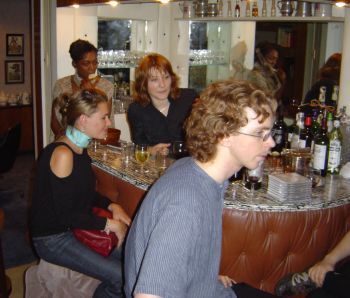
… yet another blog party at Samizdata.net HQ…
There are so many new bloggers ‘on the party circuit’ now that we have to rotate our invitation lists. So if you did not get an invitation, we (probably) still love you… maybe next time.
As my father used to say, diplomats are very good at marrying rich women and making polite conversation at cocktail parties, but don’t ever expect them actually to do something.
Taki
I use both a PC and a Mac (OS X 10.3.4) and I was wondering… is there any way to make the Mac not use that ghastly bugfest called Safari as the default browser?
Make it idiot-proof and someone will just make a better idiot
– Unknown
I have just returned back to London from a business trip to Edinburgh, now in the full swing of its major arts festival, when thousands of theatrical, comic and music acts strut their stuff. I was up in that fine city on more prosaic financial matters and although the weather was fairly dire for August – it rained all the time – I had an enjoyable trip and learned a lot more about the city.
First off, Edinburgh remains a serious financial centre. Quite a few traditionally London-based investment managers and financiers have happily turned their backs on the costs, noise and hassles of life in London in favour of Edinburgh. From the point of view of ‘quality of life’, the city has a lot to commend it. Commuting to work is much easier than in London, just for starters.
In the course of interviewing a CEO of a large investment firm, however, I was startled to be told that the top employer in the city is the local council. That’s right. The biggest source of jobs in the place is not a big fund manager, bank, IT firm or some other business, but the local municipality.
Therein lies the problem of modern Scotland, as far as I can see. Socialism has alas taken a deep hold of its public political culture at least as far as I can tell. The land of Adam Smith and David Hume seems to have forgotten some of the virtues of small government and red-blooded capitalism, as this article over at the blog Freedom and Whiskey makes clear I truly hope this changes in the future. And if it ever does, then other financial capitals of Europe could be in for some very tough competition indeed. Edinburgh could become a very pleasant and exciting place to work and is certainly becoming much easier to reach, as developments to its airport go forward.
Well, that’s all from me for a while. Off on holiday. See you later.
Discussing nationalised healthcare with those of a leftist frame of mind, it occurs to me that one is put at a disadvantage in attempting to demonstrate the merits of a private healthcare system if one restricts the options to a public health system versus private health system. This tends to conflate the separate benefits a private system would provide. Nationalised healthcare systems are wasteful and ruinously expensive but there are actually two separate phenomena contributing to this.
- Any business which is run by the government will have priorities unrelated to those of the customers of that business and will tend to provide the product or service it wants to provide, in the quantities it wants to produce as opposed to providing the product according to the customer’s demand. This leads inexorably to unsatisfied customers, gluts, rationing and shortages.
- ‘Free’ healthcare is a problem similar to the tragedy of the commons. If there is no cost to be borne by availing of ‘free’ healthcare, there is no corrective against frivolous use of this service. The phenomena of bored pensioners visiting the doctor for a chat is solely that of a system where that doctor’s time is paid by the taxpayer and not the loquacious geriatric. Hypochondria, held in check by a pay-as-you-go system is positively rewarded by free healthcare.
One is further disadvantaged by conflating nationalised health with redistributionism per se. Thus, if the matter for discussion is simply nationalised health versus private, one must not only convince the sceptic of the benefits of the market but also to abandon a, perhaps cherished, redistributionist outlook. Yet, it is not necessary to do so if these issues are separated. In agreeing to set aside the issue of redistribution in the first place it ought to be possible to agree with the leftist interlocutor that the government does a lousy job of running the health system. An ardent supporter of cradle to grave healthcare, if intellectually honest, may be persuaded to concede that, so long as the government still pays for it, healthcare would be better provided by the private sector. If this step is accepted, such an intellectually honest leftist might also note the role of incentives when healthcare is provided on a no-cost basis. In an alternative system, an individual might be provided with health vouchers or subsidised insurance, perhaps a no claims bonus might apply or a policy excess. In such a system, the government still picks up the tab but there is at least some incentive for the user to modify his consumption.
By separating the issues it may be possible to reach wider agreement on privatising health than would be possible with the issues lumped together. It is probably worth adopting such an incrementalist approach in lieu of the ‘greedy’ approach of the absolutist. For most of the issues which concern libertarians, a step in the right direction is not only useful in getting closer to one’s goal, it may also offer a noticeable improvement in its own right.
Jackie: “Do you ever make cakes for people?”
Monica: “No… I don’t like people.”
(Overheard at the Big Blog Company ‘open day seminar’ held this evening Samizdata.net HQ)
|
Who Are We? The Samizdata people are a bunch of sinister and heavily armed globalist illuminati who seek to infect the entire world with the values of personal liberty and several property. Amongst our many crimes is a sense of humour and the intermittent use of British spelling.
We are also a varied group made up of social individualists, classical liberals, whigs, libertarians, extropians, futurists, ‘Porcupines’, Karl Popper fetishists, recovering neo-conservatives, crazed Ayn Rand worshipers, over-caffeinated Virginia Postrel devotees, witty Frédéric Bastiat wannabes, cypherpunks, minarchists, kritarchists and wild-eyed anarcho-capitalists from Britain, North America, Australia and Europe.
|











Recent Comments