Liberty is to the collective body what health is to every individual body. Without health, no pleasure can be tasted by man; without liberty, no happiness can be enjoyed by society.
– Thomas Jefferson
|
|||||
|
August 30th, 2004 | Comments are closed
 Yet another attempt is underway to portray Ernesto ‘Che’ Guevara as someone who was actually admirable, rather than someone who should be remembered, if at all, as an inept communist thug and mass murderer who deserves to be buried under the scrapheap of history. Fortunately not everyone is fooled. 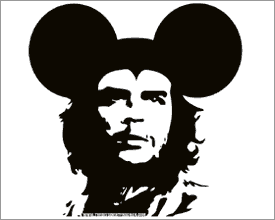 August 30th, 2004 | 26 comments - (Comments are closed)
The Australian Prime Minister, John Howard, has called an election for October 9. So we get to choose once again between a fuzzy right-wing statism, or a ‘Blair wannabe’ statism. You will excuse me if I do not get ferociously excited about this choice. One of the worst things about Australian elections is the placards that political parties insist on hanging on street poles. At no other time of the year are any other organisation permitted to do this, but political parties do like their perks; inflicting an eyesore I call it. I am not going to vote – I will defy the State, and not vote. That is an offence which will cost me a parking ticket fine. It is actually also illegal for me to advocate not voting to other people as well. As to who will win, I think the ‘Blair Wannabe’ Party will win; I wrote about this back in June and nothing has happened since to make me change my mind. In the great scheme of things, this is a small matter but it will consume the local media and blogs here for the next six weeks. August 30th, 2004 | 34 comments - (Comments are closed)
Power and Glory: Jacobean England and the Making of the King James Bible A claim on the dust jacket states:”The King James Bible is the greatest work of prose ever written,” and the message of the book, while not repeating it, is an elaboration of this claim; Nicolson, though not quite a believer or an unbeliever, is obviously besotted with the King James Bible, often called The Authorised Version, though it was never officially authorised by King or Parliament. It is now rarely to be found in the pews and on the lecterns of most churches, and hardly ever heard in public worship, where its language, already deliberately archaic even in its predecessors, has also been discarded and God, just like everyone else, is addressed as ‘you’. If Christians are a minority in the English- speaking world, then KJB readers and users are a minority within a minority. Does this matter? The Centenary of its publication in 1611 is approaching and is unlikely to be celebrated, or commemorated by as much as a postage stamp, the excuse being that this would be ‘controversial’ or ‘divisive’, in the way that 1588, 1688, 1603, 1605, and 1707 were or will be. Adam Nicolson has written a fine book, of interest to all of us brought up on the King James Bible, quotations from which resonate in the memory, even when not at once identifiable, while those from all other subsequent translations set the teeth on edge. Here we are told part of the story – for most of it is lost – of how this seminal work was produced. Why lost? The Translators (then and now capitalised), organized into six ‘companies’ of nine men, left few clues as to their working methods, their deliberations, discussions or disagreements and the manuscript sent to the printers has disappeared, possibly burnt in the Great Fire of London in 1666 (p. 225). Just as the whole scaffolding to build a great edifice is taken down and dispersed, so notes and drafts of the great translation ended up in the wastepaper basket, with some intriguing exceptions, and the fifty workers (four short of what there should have been) got on with their lives afterwards, leaving no memoirs, let alone diaries, of what it was like to have been on the project and not dreaming they had written the world’s bestseller, the Bible to dominate the English-speaking world for four centuries and help shape the English language. Only a few, fascinating scraps remain. Like the copy of the Bishops’ Bible (the text the Translators were supposed to revise) which the Bodleian bought from one of them (or someone) for 13/4 (pre-decimal for 2/3 of a pound), with his suggested emendations for the new translation marked in it. Or John Bois, the rather humble, impoverished but very learned Translator, who took notes of the revisers-translators’ discussions of the complete work and whose notebook has somehow survived – everything in it written in Latin, bar Greek, of course. This leads Nicolson to speculate whether the discussions were carried out in Latin. → Continue reading: The greatest work of prose ever written? August 29th, 2004 | 6 comments - (Comments are closed)
There has been a lively discussion in the comments section of Johnathan Pearce’s article here on Samizdata.net When libertarians disagree. It has thrown up so many interesting points that I felt a new article on the issues might be a good idea. It is pleasure to see so much intelligent discussion of strongly held views without the acrimony and name-calling that so often characterises debate on the internet. We have a problem that the label ‘libertarian’ sometimes it does not really inform as to what a person thinks, something which September 11th 2001 brought starkly into view, and I am not just referring to the more absurd uses of the term. For example a frequent commenter here on Samizdata.net, Paul Coulam, is a prominent libertarian and anarchist, well known in pro-liberty circles in London. He is also a friend of mine and has been known to get plastered at Samizdata.net blogger bashes. I too am fairly well known in the same circles and describe myself as a ‘minarchist’, or social individualist or ‘classical liberal’ or a… libertarian. I see Paul as a ‘fellow traveller’ of mine but clearly we have fairly major disagreements of where we would like to end up. We just agree on the direction we need to move from where we are now. I regard the state as probably indispensable, albeit a vastly smaller state than we have now, whereas Paul sees no state as the final destination. In my view the minarchist ‘classical liberal’ view to which I subscribe means the only legitimate state functions which can be funded via some form of coercive taxation are those which can only realistically be carried out by a state, and which are essential to the survival of several liberty. The military seems a fairly clear cut example of that to me (with the proviso I would like to see the state military as only ‘first amongst many’) and possibly a very limited number of other roles, such as (maybe) a centre for disease control function to prevent plagues, and some form of superior court function. So once you get over that core issue of small state or no state (no small feat), the rest is arguing over magnitude (also not a trivial issue), rather that whether or not you even have a military funded by some form of coercive action: that also means ‘how you use that miltary’ is an argument over degree rather than existence. In short I see the difference between a ‘libertarian’ (or whatever) of my non-anarchist ilk, and sundry types of non-libertarian statist as being one of the degree to which the state is allowed to accumulate coercive power. → Continue reading: Making the world a better place? August 29th, 2004 | 38 comments - (Comments are closed)
I recall, shortly after I first got myself on-line, frequently seeing the phrase ‘ROFLMAO’ appear on various chat rooms and fora. I had not a clue what this term meant but, after a little judicious detective work, I discovered that is was an acronym for the phrase ‘Rolling On the Floor Laughing My Arse Off’. Well, I was ROFLMAO when I read this:
Wherever would they get that idea??!! Although the cause of this spat is laid at the door of Mr Howard’s apparent equivocation over Iraq, I get the feeling that the real friction lies elsewhere. Strange as it may sound, I have been reading what sound like reasonably reliable reports in the UK press about squadrons of young British Conservative activists hot-footing it off to the USA to work in the Presidential election campaign…for the Democrats!. In the interests of accuracy, I think it ought to be said that this is far more about the Tories trying to pull some sort of rug from under ‘Teflon Tony’ than establishing any sort of link with either the US Democrat Party or Mr Kerry. But in any event, it is still a deeply ill-judged political blunder. The article alludes to an ‘alliance’ between US Republicans and British Conservatives and while I think that ‘alliance’ is too strong a term, there certainly has been a traditional affinity between these two centre-right Anglo-Saxon political tribes. That being the case, one wonders what these jet-setting young Tories were hoping to achieve by throwing their lot in with Mr Kerry? There is nothing to suggest that a President Kerry would somehow undermine Tony Blair. If the Tories cannot make a dent in him at home, then how are they going to land any meaningful punches on him via Washington? And if they imagine that they are going to be the subject of any outreach by either the US Democrats of the Guardian-reading classes at home then all I can say is that they are even stupider than they look (and they look fairly stupid). In short, the British Tories have managed to alienate one of their few powerful friends for no gain whatsoever and, since I assume that the leadership either gave their blessing to these transatlantic jaunts or, at the very least, turned a blind eye, then it merely reinforces my view that the British Conservatve Party is in the hands of buffoons and political pygmies. I understand that the streets of New York will be plagues this week by throngs of the Great American Unwashed wearing ‘George Bush=Hitler’ T-shirts. I do not imagine that any such items of radical apparel will be making an appearance at the next Tory Party convention. However, I do wonder if would get any sales with a ‘Michael Howard = Chief Wiggum’ version? August 29th, 2004 | 38 comments - (Comments are closed)
Time and time again, August 28th, 2004 | 5 comments - (Comments are closed)
While shuffling through a stack of magazines at the barber shop yesterday, I came across the August 9th issue of The New York Magazine. While not particularly familiar with the publication, one of the articles caught my eye. It was a conversation between Norman Mailer (NM) and his son John (JBM) entitled What I’ve Learned About Rage. If I was more into the political scene in New York I probably would have realized what was coming but I somehow confused the name Norman Mailer with Norman Rockwell (heh), so I read on preparing to receive some fatherly advice about managing emotions. I got a lesson, alright, but certainly not the one I was expecting. From the article, I gather that the Mailers are insiders with the New York Democratic (Socialist) Party. Besides being further proof that the mainstream media is in the tank for Kerry, the article was mostly how the Democratic Party can arrange protests during the upcoming Republican (Conservative) National Convention in New York. Those protests have already begun. The goal is to cause the most disruption to the Convention while simultaneously gaining the most favorable press for the Democrats. Disgusting, but dirty political tricks are nothing new to either side. The elder Mailer even suggested those sneaky Republicans really, really want lots of nasty riots and so will be secretly stirring up protests against their own Convention. I can not speak for the Republican planners, but that thought certainly gave me a rather nauseating glimpse into Mr. Mailer’s political mind. Anyway, what really flabbergasted me was a something only a few paragraphs into the article where the younger Mailer dropped this little bombshell:
Excuse me? Your party can not win with intelligent argument? Is that because you have no intelligent arguments to make or because the majority of people are too stupid to understand? This suggests either a very deep flaw with your basic tenets or a very dim view of the population in general. JBM continued with:
What indeed? The elder Mailer had a ready answer.
Double excuse me? You do not care what happens to the country as long as you win? I am beginning to understand why your party is bereft of intelligent argument! Now, maybe I am just naïve. Maybe this is really how all politicos feel. But when was the last time you supported a group who proudly proclaimed: “Our side is wrong. We do not care. If we make enough noise, you idiots will still vote for us”? August 28th, 2004 | 11 comments - (Comments are closed)
During the 2003 fiscal year, the federal government spent more than $6.5 billion securing classified information, according to a new “Secrecy Report Card” from OpenTheGovernment.org, a coalition of government watchdog and civil liberties groups. That’s an increase of more than $800 million from the previous year, according to the group, and a nearly $2 billion jump since 2001. But it’s only a best guess, really; the report card’s accounting doesn’t include a penny from the Central Intelligence Agency, which keeps even its overall budget classified. The big problem with having too many secrets isn’t that it’s a waste of money; it’s that it jeopardizes security, according to William Leonard. He’s the director of the ISOO, and, essentially, the man in charge of the government’s classification policies. By keeping knowledgeable parties from sharing what they know, “secrecy guarantees a less-than-optimal outcome,” Leonard told Wired News. “In analyzing intelligence, in developing military plans, there’s a price that gets paid.” That’s a view echoed by both the 9/11 Commission, in its final report (PDF), and several of the Defense Department’s top current and former spies. August 28th, 2004 | Comments are closed
A smart and thought-provoking blogger I have recently come across, Perry Metzger, who seems to hail from the anarcho-capitalist bit of the libertarian intellectual universe, does not like the way this blog has supported the military ouster of Saddam Hussein. Now, of course another certain Perry (de Havilland) of this parish thinks rather differently. Metzger asks how it is that folk who are so ardently opposed to the State can possibly countenance the use of force, including appropriation of wealth via taxation, to topple another regime deemed to be dangerous. Well, it is actually quite easy to answer that question in my view. First of all, not all libertarians believe a free society can exist without a minimal state, including one with the ability to provide external and internal security, which may include the need to take out violent and hostile foreign regimes. Second, the supposedly sacred libertarian principle that thou shalt not initiate force against another is not very useful when it comes to judging whether regime X or Y poses your country a particular threat or not, and whether action of a Bush-style pre-emptive sort is justified and perhaps even more important, whether it is prudent. Good people will and do differ a lot about that. Such disagreements cannot in my view be arbitrated solely by referring to abstract moral principles – although principles are of course crucial – but have to be also judged on events, by weighing up the possible consequences of an action or taking no action. In fact, taking no action and adopting a purely reactive approach to defence will also have consequences, not all of them necessarily good ones. There is no easy way to say which approach will always be better. So even two ardent libertarians who read a situation in the Middle East, say, could differ on fine points and end up having precisely the sort of heated debates we get in the comments sections. I have changed my mind on so many aspects of the current war in Iraq that my head will probably explode at some point. At one point I felt the whole affair was a dumb mistake and we would have been better off leaving Saddam in his palaces and let things run on awhile. But regardless of what I thought about facts on the ground and the news reports I read, I honestly do not feel that appeals to higher tenets of libertarian theory really ever decisively swayed my mind about the particulars one way or the other. August 28th, 2004 | 25 comments - (Comments are closed)
It appears that Sadr and his Islamo-fascist militia will be allowed to slip away from the Mosque of Ali in Najaf without further harm. Even if they are indeed disarmed (yeah, right) before they withdraw, the fact their organisational infrastructure will be left intact calls into question the whole point of opposing him in the first place. It seems to me that there are really only two sensible ways to see this: Either conclude that following a policy of using force to confront Islamic extremism is too bloody to stomach, leading inevitably to adopting a policy of withdrawal from wherever Islamic terrorism threatens modern global civilisation… …or conclude that once a decision to use force is taken, it will be followed through robustly and ruthlessly with the intention of killing fundamentalists leaders like Sadr and ideally as many of his hardcore supporters as is practical as well. In reality I expect neither clear conclusion will be reached in the corridors of power in Washington DC (and do not get me going about the buffoons who run the Foreign Office) and a middle-way fudge that is already being offered up in the established media will be the perceived wisdom as key elements of the political classes work to keep the world safe for Sharia, legally enforced burquas, clitoridectomy and judicial amputations. Surely the best way to ensure the survival of a tolerable regime in Iraq is to fill the graveyards with as many Islamic extremists as possible. If that policy is not acceptable, then surely one has no business using force to begin with as it seems perverse to kill people unless you are willing to do so for a damn good reason… either fight a war or do not, the middle way just gets you the worst of both worlds: you are hated for the people you kill and held in contempt for the people you would not kill. The opportunity was there to turn the mosque of Ali into a funeral pyre of Islamic political aspirations. Today was the very last chance to do exactly that but it looks like the opportunity will drift away by this evening. What a pity. August 27th, 2004 | 47 comments - (Comments are closed)
Perry de Havilland has pointed out previously that film critics seem to regard it as safer to sneer at films than to praise them. Praise a film (at least praise a serious but non knee-jerk leftist film) and you run the risk of being considered weak minded. Sneer at the film – and you are a sophisticated person who is not taken in by commercial tricks. The film critic of the Daily Telegraph is one of the sneering school of critics (that a Conservative newspaper allows its cultural coverage to be dominated by the standard knee-jerk crowd is, sadly, normal). In his review of The Village he duly sneered at the film – and, for good measure, sneered at The Sixth Sense and Unbreakable as well. Well this got my attention (which, I suppose, is the point of a review) as I liked both of these films. Many people got to see the Sixth Sense – but, and in my opinion unfortunately, most people followed the far stronger and more unified critical attacks on Unbreakable and did not see the film. Recently Unbreakable has been shown on British television and many people have said to me that they thought it was a good film. “Did you go and see Unbreakable when it was on at the cinema?” – “No, because the critics said…” It seems to me that what the critics really hated about Unbreakable was that it was not ‘tongue in cheek’ or a ‘good romp for the kids’ but also did not make any ‘serious’ (i.e. leftist) political points. Unbreakable was essentially a non political but serious film which examined the question of what if a man really did have ‘special powers’, why would he deny them – and what would make him not deny them. Of course one could say “Of course old Paul Marks liked the film – the hero is a bald security guard” as I am a bald security guard. However, the film stands up in the view of most people who have seen it (and most of these people are not bald security guards). As for The Village itself: Well yes, I liked the film (so thank you to Daily Telegraph reviewer for sneering at it – otherwise I would not have gone to see it). There are a couple of twists in the film (one fairly mild another more radical), but the film is well made, does make sense (and the more you think about the film, the more sense it makes that certain things happen the way they do) and was a good film to watch. If you go to see the film (because of what I write here) and do not like it – well I am sorry to have badly advised you. However, at least I am giving my honest opinion – not just sneering to seem hip. August 27th, 2004 | 21 comments - (Comments are closed)
|
   |
||||

All content on this website (including text, photographs, audio files, and any other original works), unless otherwise noted, is licensed under a Creative Commons License. |
|||||
Recent Comments