We are developing the social individualist meta-context for the future. From the very serious to the extremely frivolous... lets see what is on the mind of the Samizdata people.
Samizdata, derived from Samizdat /n. - a system of clandestine publication of banned literature in the USSR [Russ.,= self-publishing house]
|
The Guardian, biased but, so far as I can tell after one skim-through, accurate:
For supporters of John Kerry, who have seen allegations about the Democratic candidate’s military record sap his campaign, it must have seemed like a case of just deserts.
The president, George Bush, was last week looking vulnerable on the same grounds after CBS’s flagship current affairs show, 60 Minutes, broadcast a report claiming he had been suspended from pilot duties for failing to meet the required standards. It was also claimed that a commanding officer had been put under pressure to ‘sugar coat’ Mr Bush’s performance reviews.
But while CBS stands by its story, allegations have now surfaced that 60 Minutes based a large part of the report on forged documents.
Now as in last Friday. Surfaced as in we have now heard about it other than just via the blogosphere, who have been all over this for some time. But, better late than never. Much better.
Later on in the same report:
60 Minutes does not have a reputation for irresponsible journalism – it was the show that first broadcast the now notorious photographs of prisoner abuse at the Abu Ghraib jail in Iraq – and it takes the reliability of its stories seriously.
The CBS news president, Andrew Heyward, told the Baltimore Sun he had confidence in the story and it was appropriately vetted, but conceded it was a “political hot potato”.
Indeed. CBS throws more chips on the table with every passing hour.
My one objection to this Guardian report (apart from the fact that I knew it all already) is that it refers to things like “a report on the Free Republic weblog“, while linking only to the Free Republic weblog in general, rather than actually linking to the particular post it refers to. But such links – there are others to the top of other weblogs (Little Green Footballs, Power Line) – are, again, far better than no links at all.
If you do want links, you can of course track all of this on Instapundit. Scroll down and, you know, find the postings for yourself. Unless you think that everything of importance has all been said here. Oh all right then, here is a good Insta-posting to start, with lots of links, to other actual postings.
Changing the subject completely, I have just been reading a very fine description in this book (Maritime Supremacy and the Opening of the West Mind by Peter Padfield) about the defeat of the Spanish Armada. Light, better armed, much more agile little English ships sporting cruelly with the stately galleons of Philip II of Spain, occasionally capturing one, and changing the course of history. An excerpt (about the country that gained most from the Armada’s defeat, Holland) from the book can be found here. Sorry. Flying off at a total red herring tangent. Must stop doing that.
Compassionate conservatism is as insubstantial a notion as the Third Way — a circumlocution to avoid having to choose among conflicting values and competing claims to scarce resources. To talk of a compassionate or caring society is to turn a noble personal virtue into a destructive political affectation.
–Oliver Kamm
It seems that the same idea has indeed gone out like a clarion call from many watchtowers and mountain tops and it must be a great time to be in the gun store business in the good ol’ U.S. of A.
Heh 
(joyous tip of the hat to Freedom Sight for the link)
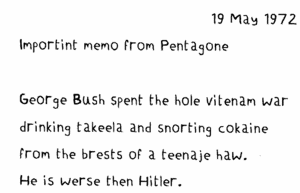
Here, at last, is the truth that the US Government tried to suppress.
They did not want the world to know but, thanks to the painstaking forensic skill and integrity of the Fourth Estate, the skeleton is finally out of the closet!
“We stand by the authenticity of this document” – CBS
“…..the smoking gun” – Reuters
“…incontrovertible proof” – Guardian
“…a major setback for the Bush Whitehouse” – BBC
“What else are they trying to cover up?” – New York Times
Case closed.
Freedom and Its Betrayal: Six Enemies of Human Liberty
Isaiah Berlin
Chatto & Windus, London, 2002
The Roots of Romanticism
Isaiah Berlin
Princeton University Press, Princeton, New Jersey, 1999
Berlin’s stock is probably drifting down, as is the way of things after an author’s death. This may be why the transcripts of these dozen lectures have been remaindered to the PostScript shop. A contemptuous review in this August’s The Oldie (which may be getting nastier, or I more sensitive) of a volume of Berlin’s Letters may also be indicative – Berlin’s work is all cod-Macaulay, he’s the most celebrated windbag in history, responsible for Stalin’s persecution of Anna Akhmatova and for failing to cop Burgess and Maclean and Anthony Blunt. So he can’t be much good, can he? But oh yes he can.
“Fifty years ago [in 1952 – begins the Editor’s Preface to Freedom and Its Betrayal] when the six hour-long lectures in this volume were delivered, they created a broadcasting sensation.”
To anyone who can remember what broadcasting was like fifty years ago, and it was, of course, entirely by the BBC, this is perfectly believable. I never heard them, and a recording of only one survives, but anyone who has heard Berlin’s wonderful spoken delivery, as I have when his later Mellon Lectures, The Roots of Romanticism, given in 1965, were re-broadcast in 1989, recordings of which are accessible, can believe it too. Berlin prepared his lectures with great care, first as complete works, then boiling them down to notes and finally to headings, then delivering them extempore in rapid-fire mode. Whether by design or not his method of composition employs consecutive adjectives, similes, near-synonyms or other modifiers that elaborate and as it were surround each point as it is made, at the same time illuminating it and yet introducing that element of redundancy which helps the reader stay on track while the vehicle containing the subject bounds and bounces exhilaratingly and unstoppably on. → Continue reading: Isaiah Berlin lectures on Liberty and Romanticism
NO2ID is launching its activities publicly:
Saturday, 18 September
11:00an – 2:00pm
The Corner Store
Covent Garden
33 Wellington Street, London, WC2E 7BN, Map
There will be a couple of speakers before lunch, including a Labour ‘rebel’, Neil Gerrard MP followed by campaigning around central London, i.e. handing out leaflets, setting up stalls on the street in a number of locations until mid-afternoon.
Please join them to Stop ID Cards and the Database State!

The NO2ID Coalition, who are trying to make sure Blunkett fails in his attempts to introduce mandatory ID cards, argue that:
NO2ID is launching its activities publicly:
Saturday, 18 September
11:00am – 2:00pm
The Corner Store
Covent Garden
33 Wellington Street,
London, WC2E 7BN, Map
There will be a couple of speakers before lunch, including a Labour ‘rebel’, Neil Gerrard MP followed by campaigning around central London, i.e. handing out leaflets, setting up stalls on the street in a number of locations until mid-afternoon.
Please join them to Stop ID Cards and the Database State!
The NO2ID Coalition, who are trying to make sure Blunkett fails in his attempts to introduce mandatory ID cards, argue that:
Cross-posted from White Rose.
The six stages of an election campaign:
1. Enthusiasm.
2. Disillusionment.
3. Panic.
4. The Search for the Guilty.
5. The Punishment of the Innocent.
6. Rewards and Honours for Non-participants.
…well, arms shops actually.
The absurd ‘assault weapon’ ban which prohibited certain weapons on the basis of largely aesthetic criteria, has expired in the USA as of today. However as Dubya made it clear that if there had been enough support for extending the ban in Congress, he would have signed it into law rather than try and veto it, please resist the urge to feel much gratitude for his lukewarm support for the Second Amendment.
However it was passed before and could certainly happen again.
And so I urge all the redoubtable gun owning men and women of the USA to run, not walk, to their nearest gun shop and purchase nice Kalashnikov or AR-15 or Ruger Mini-14 or FAL or M-14 or whatever, plus a goodly selection of flash suppressors and high capacity magazines, thus ensuring that there are soooooo many of the damn things in circulation that any future ban will simply have no effect.
Use the power of the Buycott, have fun at the range, arm yourself to the teeth and, best of all, absolutely enrage advocates of gun control in the process.
I mean, how good it that?

Good stance and correct breathing: now that is what I call gun control
One of the downmarket rags that sullies the newsstand on Sunday mornings here in Britain, The People, reports on a story that is so absurd that I would think it an urban legend if I had not read the official reaction to it. A man who works for Southern Railways and scrawls a daily joke on a whiteboard at Hove Station in order to cheer up miserable commuters has been suspended from his job, pending an official investigation. Why? Because one of his jokes was about a dyslexic who went to a toga party dressed as a goat. According to a Southern Railways official:
We had three complaints in two hours. Certain people do find things offensive and you have to be very careful these days. Some people might have found it amusing but we have to cater for all our customers.
Yes, “certain people” definitely make it their business to be offended by things. Howsabout ignoring them and catering for the customers who find it offensive that Southern Railways could be so incredibly silly? Another rail official tried to justify the suspension and investigation thusly:
It is something that could contravene our equal opportunities policy.
This is not “political correctness gone mad”. It is madness masquerading as corporate responsibility.
CNet new.com reports that a key patent holder’s demand for royalties has triggered concerns that promising RFID technology could become embroiled in an intellectual property battle.
The royalty flap stems from a new protocol, the Electronic Product Code Generation 2 standard, designed to improve the compatibility of radio-frequency identification (RFID) equipment from different suppliers and iron out a number of other technical kinks.
The patent claim comes on the eve of a new protocol’s debut. EPC Global, the organization that helped create the protocol, expects to finalize it at an Oct. 5 meeting. Now, some RFID backers fear other patent holders could come forward and demand royalties, slowing RFID’s progress.
Major companies, including Albertsons, Procter & Gamble, Wal-Mart Stores and German retailer Metro, have already begun to set up RFID systems and are eagerly awaiting the release of the new protocol to advance their projects. They expect RFID, a wireless tracking technology that may someday replace bar codes, to help them reduce theft, shave labor costs and handle inventory more efficiently.
Something tells me that HMG does not expect their proposed fox-hunting ban to be awfully popular with the country folk:
Police are planning to use spy cameras in the countryside to enforce a ban on fox hunting.
Chief constables intend to site CCTV cameras on hedgerows, fences and trees along known hunting routes to enable them to photograph hunt members who break the law after hunting with hounds is outlawed.
They used to warn that ‘walls have ears’. Now walls will have eyes as well. I suppose the panopticon countryside is nothing more than a logical extension of our panoptican cities. It is merely a matter of time before every workplace and every home is wired up to the Big Eye of Big Brother. Then the nightmare really begins.
There exist all manner of varying justifications for this surveillance-fever but there is only one reason that our political masters are deploying it with such alacrity: because they can.
The same technology that enables us to chatter with each other across national boundaries is being used to create a tightly-wrapped police state.
What a very, very grim future we face.
Cross-posted from Samizdata.net
|
Who Are We? The Samizdata people are a bunch of sinister and heavily armed globalist illuminati who seek to infect the entire world with the values of personal liberty and several property. Amongst our many crimes is a sense of humour and the intermittent use of British spelling.
We are also a varied group made up of social individualists, classical liberals, whigs, libertarians, extropians, futurists, ‘Porcupines’, Karl Popper fetishists, recovering neo-conservatives, crazed Ayn Rand worshipers, over-caffeinated Virginia Postrel devotees, witty Frédéric Bastiat wannabes, cypherpunks, minarchists, kritarchists and wild-eyed anarcho-capitalists from Britain, North America, Australia and Europe.
|






Recent Comments