On The Voice of Reason (slogan: “A penny saved is a government oversight”), there is a pretty clear headed little essay of what I think is most the reasonable position on this absurdly emotive case.
|
|||||
|
Get into a discussion with any self-described anarcho-capitalist and it is only a matter of time before you are directed to David Friedman for an answer to the conundrum posed. I have generally considered such appeals to authority as tacit admissions of defeat – if an argument is any good, it ought to be easy to summarise and explain. Conversely, it is often the least defensible arguments which require complex exposition (and by a third party to boot!). I was recently referred to Friedman by Scott Scheule during a discussion at my own blog and promised that Friedman would deal with the thorny question of what differentiates the “Free market protection agencies” predicted by anarcho-capitalists under anarchy from the real world “protection agencies” we observe in conditions approximating anarchy such as mafias and warlords. Friedman sketched out this scenario: → Continue reading: Free market protection agencies and the tragedy of the commons March 29th, 2005 | 66 comments - (Comments are closed)
 Here are a few items concerning the various ghastlinesses of the EU. First, a briefing paper from the Instituto Bruno Leoni, by Alberto Mingardi and Paolo Zanetto, about the Microsoft versus EU case. Pdf only, alas, but worth a look. Microsoft stands accused by the EU of daring to supply an operating system that is too good and does too much and has been ordered by the EU to cripple it and to tell all its rivals how it does everything. Microsoft wants to call its crippled version of Windows “Crippled Windows” and the EU says it can’t so there and has fined Microsoft Z zillion euros. To add lunacy to lunacy, the EU is now saying that when a multinational corporation wants to innovate, it must convince the EU that its innovation is a good idea. Never mind about convincing mere people. First, Mario bloody Monti and all his rapacious and power-mad cronies and successors have to be persuaded. So now, guess what, the EU is taking a swipe at the iPod. Microsoft said “the iPod is innovative – go investigate that”. So the EU duly started an investigation into the iPod! No need for it. No reason. Not necessary. What’s wrong with 78s? Hire a gypsy violinist. I embroidered somewhat there, but only somewhat. The picture that Mingardi and Zanetto draw of the EU is not pretty. Expressions like “shake down” and “sting” are hard to avoid when pondering the behaviour of the EU towards Microsoft. I would not normally have made myself read right through this piece, because it is too depressing. But I have been told to review it for here, where Mingardi adds some further comment on the case. Apparently Crippled Windows does not work as well as uncrippled Windows. Extraordinary. And here are a couple of EU-related pieces in today’s Telegraph. Patrick Minford writes about the costs of EU anti-dumping rules. His title says it all: The EU’s manufacturing policies are costing us a fortune. He is finishing a book. Thanks to Tim Worstall for that link. And here is a news report about the EU’s efforts to protect the government of Cuba from its dissidents. Do not provoke Fidel, says Louis Michel, the EU “development commissioner”. The EU would do better to concentrate on developing itself. I live in hope that the influence of the recent Eastern European additions to the EU, of countries where they take economic development seriously and seem to have quite a solid grip on what does and does not promote it, will improve the EU. But reports like those above make such optimism hard to cling to. March 28th, 2005 | 42 comments - (Comments are closed)
Bill Quick puts up 11 excellent reasons for limited-government types to be pissed off at the current administration. I found little to quibble with. Generally, I have found George W. Bush to be good, very good, on foreign affairs, and mediocre to bad on domestic issues. March 28th, 2005 | 20 comments - (Comments are closed)
It is often said that, in polite company, one should not discuss politics and religion. Samizdata does not pay heed to the first one and Brian and Jonathan have blown the second one, so I should be on safe ground. Every year, at the Easter Vigil, a most spell-binding melody is sung during the liturgy. Last night, as every year, I listened to Exsultet chanted, this time at the church of Our Most Holy Redeemer and St Thomas Moore, in the darkness with only candles illuminating the entire church. Its purpose is to rejoice in the resurrection and marks the begining of Easter Celebrations. (Let’s hear it for the barbaric Christian rituals.) Exsultet of Easter Vigil is certainly my favourite piece of both poetry and music, with Allegri’s Miserere coming close second. The orignal text, going back as far as St. Ambrose (4th century), entered the Roman tradition around the 9th-century as part of Gregorian chant tradition. It is a masterpiece of the liturgical tradition.  It is said to be the sublimest expression of joyful sound that has ever come from the human heart and mind. Mozart once said that it is the most beautiful music ever written and that he would have given all his works to be able to say that he had written the first line of the Exsultet. I could not find a decent audio file that conveys its full beauty and impact, but I found the text and the music score. Update: Here is an audio recording of the Latin version. 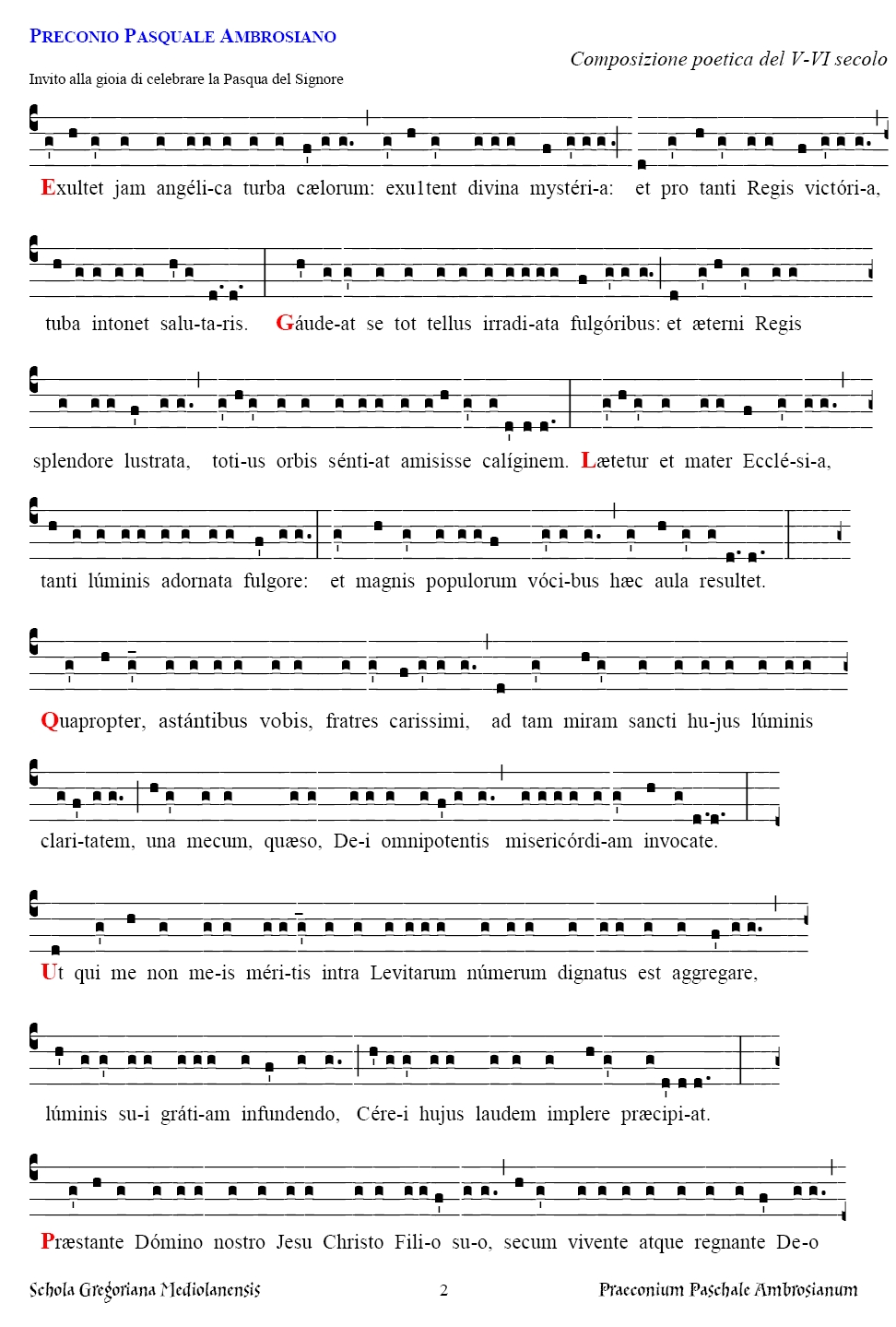 March 27th, 2005 | 9 comments - (Comments are closed)
I am watching the televised appearance of Pope John Paul at the Vatican at the moment. The old fella has only been able to say a few words for his regular Easter message to the masses thronging below in St Peter’s Square. It cannot surely be very long before he steps off this mortal coil. How should yours truly, a lapsed Anglican, think about what this man represents? Well, I am going to put any reflections on his contribution to the Catholic church, or his views about abortion, etc, to one side and focus on a more worldly fact about his extraordinary life and career. The Pope was, in my view, one of the three or four great men (and one great woman) who helped bring the Soviet Union, that evil and decrepit empire, crashing to its knees. Along with Ronald Reagan, Margaret Thatcher, Gorbachev and arguably, the power of cheap television advertising, the Pope helped bring about communism’s demise. I do not share the Pope’s faith, but in reflecting on his life on this Easter Sunday, it was hard not to suppress a lump in the throat. In my book, he is one of the giants of our age. March 27th, 2005 | 45 comments - (Comments are closed)
It is late but I simply must share this tale with you.
The battle results are described later:
The story has probably been covered in the US. We all know how knowledgeable most journalists are about military matters… so read a real battle report. It is really quite an awesome little vignette. It shows just how good our military folk are at their job. March 27th, 2005 | 13 comments - (Comments are closed)
The Line of Beauty is the name of the Booker prize-winner, a book about gay sex, snorting coke and a Thatcher-worshipping MP who indulges with his secretary. The book is a good read, and I’d recommend it highly. But The Line of Beauty also the name of a new cultural blog, inspired by the book. It is early days yet for the blog, but it is already showing some promise, with snippets about graffiti, Sotheby’s, and a discussion of memoirs written by ‘ordinary’ people. Do check it out. March 26th, 2005 | 2 comments - (Comments are closed)
I will start this posting, having written the rest of it already and therefore possessing foreknowledge of what it contains, with a warning to easily offended Christians. This posting contains ideas that may offend easily offended Christians. So, if you are an easily offended Christian and sincerely do not wish to be offended yet again, best to stop reading now. Christians are perfectly free to be offended by my anti-Christianity, just so long as they realise that I am likewise disgusted by many of the things they keep on proclaiming, mostly with no objections from me, both for its barbarity and for its contempt for normal standards of truth-seeking or logical argument. The offence is mutual. Okay. Today being Good Friday, I have taken it upon myself to give the talk at my last Friday of the month meeting. Getting another speaker at such a time, and then perhaps having to soothe him or her because only three other people showed up, is more bother than the looks-bad factor of me doing the talk myself. (I did the same on the last Friday of December 2004, which happened also to be New Year’s Eve. That went okay.) And since it is Good Friday, I will be talking about Pain: its history; how that history might explain why Christianity, and in particular the crucifixion story, has done so well down the centuries; the fact that recently pain has abated for lots of lucky people in lucky countries like mine, and the fact that this might do something to explain the recent decline of Christianity in lucky countries. Christianity thrives in adversity, but wilts in comfort, not least physical comfort, which is why completely wiping out Christianity has proved so hard. Communism tried, but the more you torment Christians the more like Christ they feel. Meanwhile Communism, lacking a story that makes any sense for those unfortunates caught up in its numerous failures, is itself rapidly crumbling, not least at the hands of Christians. Most histories of pain seem to be histories of pain relief, which is understandable. But what effect on life generally did the prevalence of pain have, in all the centuries when pain was prevalent? And what has been the effect of the recent and remarkable abatement of the pain, for millions upon millions of fortunate people, like me, and very probably, you too, for decade after decade? → Continue reading: Some Good Friday thoughts from an atheist about pain and its history March 25th, 2005 | 146 comments - (Comments are closed)
Airport security gets ever more surreal. Yesterday, I set off with my fiancee for the lovely island of Malta to spend the Easter break. At London’s Gatwick airport I had my first real experience of the wonderful charm for which security staff are famed, having never really had a glitch before. My hand luggage was seized by a woman who asked that I opened the bag. I was happy to do so. She fished out three novels from the bag, and after loudly making some rude comments about them and sniggering to a colleague (which was thoroughly unprofessional on her part) she picked up a small hair brush, and put it through an X-ray machine. She handed it back and with a grim expression pronounced that a hairbrush, at a certain angle, looked like a gun. Yes, a gun. In future it is definitely going in my heavy luggage. It really makes me wonder about what your average security guard thinks a gun is actually supposed to look like, let alone as to whether any of them have used a gun. Or maybe they comb their hair with an automatic. Oh, and the next time I fly down I’ll take a couple of porn magazines to really give some security jobsworth the vapours. Heh. March 25th, 2005 | 17 comments - (Comments are closed)
Though the pictures seem pretty, as a Christian, I probably would not care for the new book by Gerhard Haderer, an Austrian cartoonist. He depicts Christ as a “binge-drinking friend of Jimi Hendrix and naked surfer high on cannabis.” What daring iconoclasm! In 1905, maybe. In 2005, apart from six nonagerian nuns living in enclosed orders and a few hobby-protesters, nobody gives a monkeys. Yesterday if anyone had made the slightest suggestion that the furore that results from writing such a book qualified a man to be regarded as some sort of martyr for free speech, I’d have retorted that the “furore” had probably been budgeted for to the last euro by the publishers. “Regrettably, Herr Haderer, the market for Christian outrage is not what it was, and we cannot agree to your suggested advance.” Or I’d have suggested that if he wants to play martyr he could try it with the Muslims, who are more likely to enter into the spirit of the game. But by the holy bowels of Jimi Hendrix, the poor little poseur really is in danger of arrest. And do you know why? Because of the European arrest warrant, that’s why. An Austrian cartoonist and writer faces extradition to Greece (Greece: why does that not surprise me?) for something he wrote in Austria. I assume that Austria has no law, or dead-letter law, against blasphemy. So he wrote something that was legal in Austria but not in Greece, and now he faces extradition to Greece. He did not even know his wretched book had been published in Greece. I found this via Public Interest. Peter Briffa points out that when this law was introduced much was said by its sponsors about extraditing foreign criminals to Britain … and very little about the extradition of British people to foreign countries for “crimes” that might well not be crimes at all in Britain. Perhaps some legally knowledgeable reader can tell me if there is anything at all to stop this happening to, for instance, a British Samizdata contributor, if the authorities in some foreign capital should take a dislike to something he or she had written. March 25th, 2005 | 22 comments - (Comments are closed)
|
   |
||||

All content on this website (including text, photographs, audio files, and any other original works), unless otherwise noted, is licensed under a Creative Commons License. |
|||||

Recent Comments