We are developing the social individualist meta-context for the future. From the very serious to the extremely frivolous... lets see what is on the mind of the Samizdata people.
Samizdata, derived from Samizdat /n. - a system of clandestine publication of banned literature in the USSR [Russ.,= self-publishing house]
|
An assortment of cool web stuff* encountered in recent days:
Most excellent puppeteering in General Electric’s Facing That Void.
Fun CG animation ride. (warning:contains computer simulated amphibian genitalia)
I can’t remember a purer shot of joy than this Kokonono promo.
*Don’t even waste your time over a dial-up – this is all broadband stuff. Thanks to our rather disturbed friends at Screenhead, BTW.
The United States has imposed new quotas on textile imports in order to protect American textiles manufacturers from competition. The move is bad news for American consumers and it is also bad news for the world’s poorest. Some of the blame must be apportioned to the campaigns of protectionists like Britain’s Christian Aid which have been claiming – incorrectly – that textiles liberalization is not in the interests of the poor. They have helped create a worldwide feeling of unease about the end of quotas.
The result is that America has now taken action, not to help producers in developing countries, but to protect uncompetitive American producers. America’s move is unwarranted and unjustified. The former European trade commissioner and future WTO boss, Pascal Lamy, has attacked the new quotas:
Mr. Lamy said that the global trade body [WTO] had been easing out the quota system over the last decade and that all countries had been given ample opportunity to prepare for the changes.
“It is not the law of the jungle, and the W.T.O. rules were clearly set,” he said. “Why are some politicians now not recognizing that fact?”
Fortunately, the new quotas will have to go by 2008. But in the meantime, America’s move means that developing countries will have worse jobs, less wealth creation and less trade. Is this really what Christian Aid was aiming for?
Crossposted from the Globalisation Institute Blog.
One of the regular contributors to the Libertarian Alliance Forum posted this salutary tale concerning his local state school.
I felt that it deserved a wider audience.
Yesterday my wife went to register our oldest child at the local ‘gubmint’ school here in the Atlanta ‘burbs. It will be his first year in the public school system.
To prove that we live in the catchment area, she had with her an electricity bill with our address on it. There was a printed notice posted in the registration area. It listed the only forms of identification that would be accepted. At the bottom of the notice was printed “NO ACCEPTIONS!”
My wife found this illiteracy in a supposed place of learning to be very disconcerting, but carried on with the process.
Next, she was handed a slew of forms to complete and sign. One of the forms was a waiver for field trips. This form explained that “our student’s will attend a number of field trips…”
That was it. Glaring spelling mistakes on professionally printed notices, moronic misuse of an apostrophe on a form that must surely have been reviewed by the principal. A sickening feeling came over her and she had to make her excuses and leave, explaining that she would fill in the forms later.
The received wisdom of our day holds that only the state can be relied upon to provide children with a proper education. I wonder how long that canard can hold fast in the face of all the glaring evidence to the contrary?
[My thanks to Rob Worsnop who posted this to the Libertarian Alliance Forum]
A retaining wall in the Upper West side of New York at the Hudson River, just up-river from the George Washington Bridge has collapsed and buried several parked cars at the very least. I was unable to find out if anyone had been caught in the collapse: no one seemed to know at the time I was asking around.
Since I am on the same side as the collapse, I was unable to get into a position to get a picture. There is nowhere one could do so without standing on part of the hillside which has just collapsed and the NYPD has the cliffside cordoned off in both directions for many blocks. I know. I tried.
I do know that the Henry Hudson Parkway is closed and traffic in NYC is a royal mess right now.
I ha ve never in my life heard so many sirens and seen so many emergency vehicles. Lines of them filling city block after city block and off into side streets. Broadcast vans from every station in New York with a news program. Talking hairdo’s smiling into TV cameras every which way you look. Police smiling and saying absolutely nothing about what is going on. Lots of the folk thought it must be a terrorist threat because there was nothing but rumour floating through the gathered crowds.
You will get the details on the News at Eleven… but I will start uploading some of my on the scene photos. So, here goes… Dale Amon reporting Live and On The Scene in New York City…. Roll ’em!
Move along now, nothing to see here…
 Photo: D.Amon all rights reserved Photo: D.Amon all rights reserved
The line of emergency vehicles fades off into the distance.
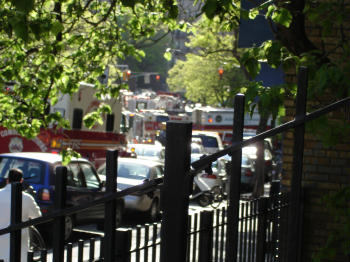 Photo: D.Amon all rights reserved Photo: D.Amon all rights reserved
Notice the herd of cameramen down on the edge of the hillside where they can all go down together. Somewhere along there and below is my best current guess as to where the collapse occurred.
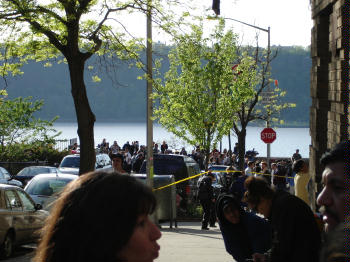 Photo: D.Amon all rights reserved Photo: D.Amon all rights reserved
Gee, Perry, when can we get one too?
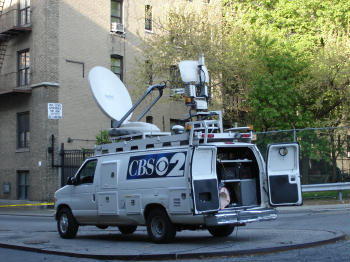 Photo: D.Amon all rights reserved Photo: D.Amon all rights reserved
The talking heads were out in force.
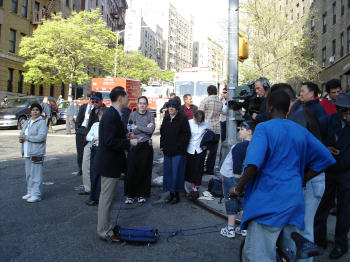 Photo: D.Amon all rights reserved Photo: D.Amon all rights reserved
A newsgirl and her cameraman.
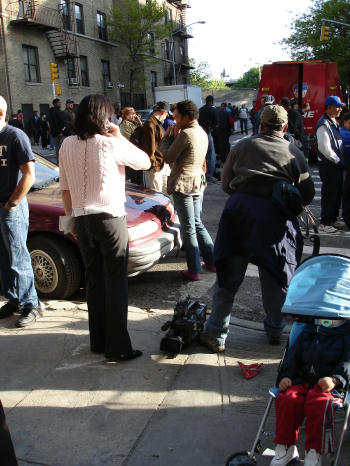 Photo: D.Amon all rights reserved Photo: D.Amon all rights reserved
This is a couple blocks upriver. Beautiful view but still cordoned off. Note the hardhats and police near the hillside.
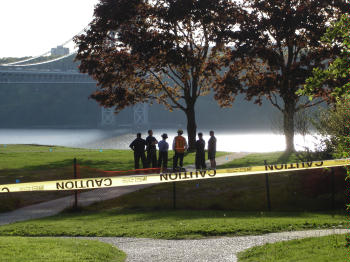 Photo: D.Amon all rights reserved Photo: D.Amon all rights reserved
This shot is from about three or four blocks upriver. Obviously you cannot see the collapse, but it does give you an idea where it happened. That is the George Washington Bridge.
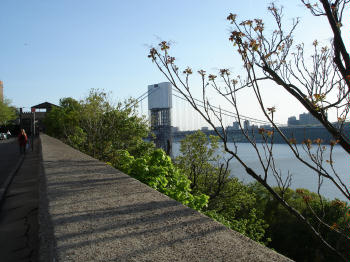 Photo: D.Amon all rights reserved Photo: D.Amon all rights reserved
Coffee break time I presume…
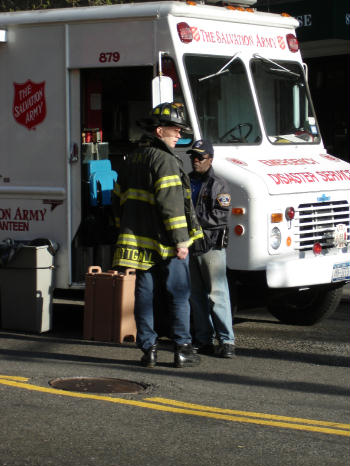 Photo: D.Amon all rights reserved Photo: D.Amon all rights reserved
Update: No one was hurt; cleanup will probably take through the weekend; traffic on the Henry Hudsen Parkway is being diverted at 181st St.
Morning Update: I was able to get to a location from which I could get a photo of the actual collapse area and it was not where I’d thought it, but a block further upriver. The big worry yesterday was whether or not some apartment buildings had been undermined. Engineers determined they were safe so this morning it was easy for me to get within telephoto range.
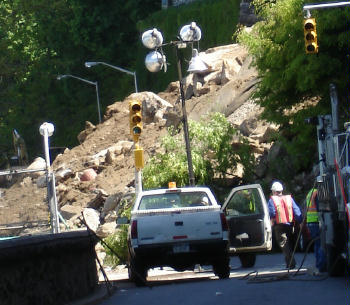 Photo: D.Amon all rights reserved Photo: D.Amon all rights reserved
In some parts of the world, non-performance is a serious matter:
An Italian man who married without telling his bride he was impotent must pay damages for abusing her “right to sexuality”, a top court has ruled.
The man had failed to fulfil his conjugal duty and deprived his wife of the chance to be a mother, Italy’s Supreme Court said.
His wife had already had the marriage annulled on the grounds of non-consummation.
The amount of damages will now be decided by a lower court in Sicily.
If this poor guy’s self esteem low to begin with, it must be hurtling down through the earth’s crust by now.
Dr Johnson’s Dictionary
Henry Hitchings
John Murray 2005
The fifteenth of April marked the 250th anniversary of the publication of Johnson’s Dictionary, the making of which Hitchings has subtitled The Extraordinary Story of the Book that Defined the World. Johnson lives on as a personality, immortalised by Boswell, but more for his idiosyncrasies and oracular bon mots than for his literary eminence. Should interest flag, the appearance of another biography or an interesting book, such as this one, revives him as an icon.
This is not to minimize his status as a writer (after all, how many eighteenth-century writers are nowadays – a word barely admitted by Johnson – read for pleasure?) However, the considerable bibliography listed by Boswell does consist mostly of what Johnson would certainly have regarded as ephemera, though the 208 bi-weekly numbers of The Rambler (March 20th, 1750 – March 14th, 1752), essays of 1200 – 1500 words, were collected, revised and published, going through ten editions during the lifetime of the author. His novel Rasselas can be compared to its advantage with Voltaire’s Candide, as treating the same subject matter in greater moral depth than Voltaire’s cynicism could plumb. Both were published in 1759 and so closely together that Johnson remarked that “there was not time for imitation”. Written hurriedly in a week to pay for his mother’s funeral and sent to the printer in instalments, it was never, Johnson claimed, actually read by himself – until 22 years later, when he came across a copy in Boswell’s coach, which he devoured with great interest.
Between the ephemeral and the immortal lies a dictionary, or, I should say lay. Until forty or fifty years ago the same dictionary could stay on the shelf for reference for the same period of time. Now the paperback dictionary attests its impermanence, as technological and social neologisms crowd in for recognition and definition. Whereas we accept the fluidity of our vocabulary and by extension of our language, from the late seventeenth century on there was a general suspicion, voiced by Dryden, Defoe and Swift, that both would lead to incomprehensibility. An authoritative” dictionary would prevent such a trend getting out of hand by “fixing” the meaning of words and even, by excluding some as unsuitable, “refining” the language “for ever”. Johnson moved away from this purist to the pragmatic approach of recording words which were used rather than prescribing those which should be. But he confined himself to the written word, preferably from the works of authors who were dead. → Continue reading: How Johnson did it in 42,773 words
At last, that bastion of idiotarianism the BBC is going to go off the air for a while, God willing! That these grasping tax funded parasites are going to strike during major televised sporting events is splendid news so maybe now more folks might be a bit less willing to shell out £125 (about $240) per year in order to support an institution filled with moral relativists, collectivists, reflexive anti-Americans and pro-Islamofascists.
A nice analogy from the inestimable Tim Blair, posting temporarily on Tim Dunlop’s blog due to an outage at his own.
High-income earners pay a higher rate of tax than people on low incomes. So why is it unfair, as Kim Beazley argues, that high-income earners receive a larger tax cut?
An analogy: your house and your neighbour’s house are both burgled. You lose a television. He loses a DVD player, microwave, his collection of Chomsky memorabilia (it’s an inner-city house), and a unique framed Leunig depicting Mr Curly’s pedophilia arrest. Would it be unfair if police were to return all of this fellow’s belongings, and you were only to get back your 24-inch Sony?
This morning I ran full tilt into a journalistic conflict of interest issue. I had to pull half of a story because my official position within an organization gave a subcontractor contractual clout. Their rules required a veto over publication of information on the event. The story items were neither earth-shaking nor of great import. Nonetheless, I was not allowed to use information I felt important to my article.
I feel it necessary to state this publicly as a matter of integrity. I do not claim that all blogs and bloggers should or must always do so. It is a matter of their individual choice. You, the reader, will place your trust accordingly.
I know such issues have been discussed here and there in both main stream and the practically main stream of major blogs. I certainly do not think there is any problem that most bloggers have real lives and work with real organizations doing real things. Or that bloggers make little or no pretence of being unbiased angels in white, pure mindless beings with no belief or ideals, capable of weighing ideas as the Egyptian God Ma’at weighed souls. We are not. We have no interest in being boring and unopinionated.
Here at Samizdata we attempt a reasonable level of professionalism in our writing and presentation. I am certain we do not always meet the full level of our aspirations, but we do indeed try. What we can promise is that our biases and conflicts are out on the table for all to see.
I have recently been re-reading (well, more like re-dipping into) Herbert Butterfield’s The Whig Interpretation of History (first published 1931), mainly because I prefer light (as in not weighing very much) reading when I am out and about in London, as I often am now.
The gist of this slim but profound and highly influential volume is that the past did not consist of people arguing about the same things as we argue about, and trying to do or to stop the same things as we are now trying to do and to stop. History is not a smooth ascending line during which perfection as we understand it slowly manifested itself, despite opposition of the same sort as we enlightened ones still face now. Monarchy, aristocracy, democracy. Religion, toleration, secularism. Tyranny, freedom. That kind of thing. The past had its own contending pre-occupations, its own contending definitions of progress. And just because something did lead to something else, that does not mean that they intended it to at the time. → Continue reading: Reformation and toleration: comparing Europe then to Islam now
I am on the road once again and sit in an upper Manhattan Starbucks as I write. I face another string of busy days; Saturday morning I fly to San Francisco where I will be doing my usual Wizard of Oz impression as a backstage magician for a JP Morgan technology business conference. Then, after a week of 6am crew calls and 12+ hour workdays, I will be off on a red-eye flight to Washington DC.
In DC I put on my National Space Society hat. Within that organization I am the overseer of conferences, The One Whom All ISDC Chairs Must Fear… which brings me around to why I am writing this article in the first place.
The National Space Society’s 24th International Space Development Conference starts on Thursday May 19th and runs through Sunday afternoon at the Sheraton National Hotel. It looks like it will be quite a show this year.
NASA is running some programming tracks of their own in conjunction with the Society this time around and we also have our usual strong private space showing. Our speakers include such luminaries of the private road to space as Burt Rutan, President of Scaled Composites and SpaceShipOne designer; Dr. Peter Diamandis, Founder and Chairman, X Prize Foundation as well as Chairman and CEO of Zero Gravity Corporation; Will Whitehorn, President of Virgin Galactic; Elon Musk, President of Space Exploration Technologies Corporation; Jim Maser President and General Manager, Sea Launch Company LLC; Jim Benson, Chairman and CEO of SpaceDev; David Gump, CEO of Transformational Space LLC; Eric Anderson, CEO of Space Adventures; Brian Feeney, Team Leader of The da Vinci Project (a Canadian based suborbital space venture); and many more.
But, as the late night TV commercials say, “Wait! There’s more!” This year we have an absolutely unforgettable and unmissable event: a Gala banquet in an exciting location whose management will not allow me to disclose to you. Go through the conference agenda and see where Hugh Downs is speaking. It is a great event and who knows? Maybe you will run into me there.
Whilst Britain remains fixated on the aftermath of Tony Blair’s unprecedented third term victory against their intellectually bankrupt and dependably inept opponents, it would behove people in Britain to pay a bit more attention to the electoral earthquake which shook Ulster which has resulted in David Trimble’s relatively moderate Ulster Unionist Party has almost completely collapsing in favour of Ian Paisley Democratic Unionist Party.
Now that the only two significant political players locally are the two extremist parties from either side of the sectarian divide, things look like they are about to get dramatically more… interesting. The message from the Northern Ireland’s protestant majority seems pretty damn clear to me but is anyone actually listening? I have a feeling I am going to be spending a lot more time keeping tabs on what get said on Slugger O’Toole, that most indispensable source of insights for all things Northern Irish, to see how things develop.
|
Who Are We? The Samizdata people are a bunch of sinister and heavily armed globalist illuminati who seek to infect the entire world with the values of personal liberty and several property. Amongst our many crimes is a sense of humour and the intermittent use of British spelling.
We are also a varied group made up of social individualists, classical liberals, whigs, libertarians, extropians, futurists, ‘Porcupines’, Karl Popper fetishists, recovering neo-conservatives, crazed Ayn Rand worshipers, over-caffeinated Virginia Postrel devotees, witty Frédéric Bastiat wannabes, cypherpunks, minarchists, kritarchists and wild-eyed anarcho-capitalists from Britain, North America, Australia and Europe.
|





Recent Comments