We are developing the social individualist meta-context for the future. From the very serious to the extremely frivolous... lets see what is on the mind of the Samizdata people.
Samizdata, derived from Samizdat /n. - a system of clandestine publication of banned literature in the USSR [Russ.,= self-publishing house]
|
As you can see from the photo, below, that I snapped at London’s Fenwick department store yesterday, the hype of supposed miracle wrinkle potion Creme de la Mer is not letting up. And why would it, when there are women like the one who told the Sunday Telegraph’s Elizabeth Day that she spends £850 per week – that’s $1700 US – on the cream so that she can rub it over her whole body?
 This is, clearly, madness. But what is even more mad is that people are so gullible. People tell themselves that if it did not work, the government would not let it be sold. Yet another instance of people relying on the state to do the critical thinking they should be doing for themselves. Sure, all that is lost in this case is a lot of cash, but it never stops frightening me that people are so eager to give up responsibility for their own choices. Of course, cosmetics are not the only area of peoples’ lives where they actually want to be freed from engaging their brains, but it is the one that concerns us here.
Day’s article tells us that the British Advertising Standards Authority – the main body that is supposed to “protect” consumers from cosmetic products (in the US, that’s the Food and Drug Administration) – last week “heavily criticised” cosmetics firm Estée Lauder for:
suggesting that it could “melt away the fatty look of cellulite” when, in fact, the ASA said that the company had not proved the product’s efficacy at removing cellulite.
But reducing the appearance of something and actually removing it are two different things. The fact is that – as beauty editor Kathleen Baird-Murray writes in How to Be Beautiful:
Many ordinary moisturisers will puff up the skin temporarily enough to ‘diminish the appearance of fine lines,’ so to prove that they are more effective than ordinary moisturisers, many anti-ageing creams will have undergone comparative testing. In other words, they will improve skin texture more than most, but they don’t actually claim to remove wrinkles for ever – it’s we who assume this because we’re paying a lot of money…
Further, the Advertising Standards Authority holds that if a cream causes actual physiological changes to the skin – such as real, permanent removal of wrinkles – then it is medicine and needs to be regulated as such.
One sad claim in Day’s article comes from a London PR person, Barbara Dodds, who says:
When one cream doesn’t work, I move on to another one in case that does. I probably spend about £100 a month on various products. I live in hope that the next one is actually going to get rid of my cellulite or my wrinkles and increase my self-esteem – but it never does.
In which case, Barbara Dodds is a fool, and it is up to her to curb her reckless and ridiculous buying habits. I am all for shouting it from the rooftops if a product does not work, but a lowering of expectations is clearly in order for far too many women. Fine, spend £850 per week on Creme de la Mer, but don’t come crying to the nanny state when it doesn’t turn you into Heidi Klum.
Cross-posted from beauty blog Jack & Hill
Comment is free but facts are sacred.
C.P. Scott, who knew about running newspapers in the 20th century. The New York Times has decided to reverse this maxim.
(Via Ann Althouse)
I am one of those sad and tragic people that only goes to the movies once in a blue moon, but I’ve already booked ahead to see the “Revenge of the Sith”, because I am a Star Wars tragic (mock in the comments all you like, I still get a kick out of these films.)
So I have been surfing round to all sorts of different sites having a look at what other people think of the film. I happened across this article in the Houston Chronicle. But my thoughts were dragged back towards this Galaxy by the final paragraph, about the reviewer:
Jake Hamilton, 17, has been reviewing films for the Chronicle’s Yo! section for three years.
I did a double take at that. This kid has been reviewing films for a newspaper since he was 14?
What I think is impressive is that the Houston Chronicle is willing to take a punt on young faces with fresh ideas. When you consider this compared to the very high barriers to entry that exist in Australian journalism, I have to say that I am amazed.
It is possible of course, that James Hamilton’s Dad owns the newspaper. However this sort of risk-taking and innovation is, as I say, a world away from the closed-shop of Australian journalism.
Mark Steyn comments here on the absurdity of trying to legislate to make our charming youth appear less menacing by stopping them from wearing hooded tracksuit tops of the sort familiar in any major city. As he goes on to write, the attempt by the government to try and regulate this sort of thing suggests the government has a terrible naivety about the ability of the State to improve things like manners and standards of conduct by brute force of law:
But respect is a two-way street, and two-way streets are increasingly rare in British town centres. The idea that the national government can legislate respect is a large part of the reason why there isn’t any. Almost every act of the social democratic state says: don’t worry, you’re not responsible, leave it to us, we know best. The social democratic state is, in that sense, profoundly anti-social and ultimately anti-democratic.
As Steyn points out, the habit of wearing hoods, large baseball caps and the like is in part a rebellion against the gazillions of CCTV cameras which now festoon so many of our town centres, shopping malls, public buildings and even, so the government hopes, our countryside. The law of Unintended Consequences, as Steyn says, applies. If you treat the populace like kids being minded by nannies in a creche, some of them will try and hide from nanny the best way they can. Of course, there is no reason why owners of private premises cannot enforce dress codes, as happens in pubs which ban people from wearing soccer shirts etc. However fair or unfair, owners should be allowed to insist on the dress code and behaviour they deem fit.
Perhaps this government might try to treat us like reasonably intelligent adults. You never know, the habit might catch on.
Paragraph one of this BBC story goes thus:
North Korea is in urgent need of more food aid, the UN has warned.
And the most chilling quote concerns what the South Koreans think of the North Korean nuclear bomb programme.
Our correspondent says that Seoul believes Pyongyang is raising nuclear tensions to extract a better aid offer.
In other words, this is a hostage situation, the hostages being the people of North Korea, and the hostage takers being the government of North Korea.
The usual way to end hostage situations is to storm the place and capture or kill the hostage takers. Although, come to think of it, giving the hostage takers a free, escorted trip to the nearest airport and then plane tickets to the alternative scumbag country of their choice, in exchange for the lives of the surviving hostages, would also be a good way to end this thing. Either scenario would be a big improvement.
My favourite bit of the story comes right at the end.
How come the people of North Korea are being so cruelly treated? Communism perchance? Actually, not:
Market reforms introduced in North Korea in recent years mean most people only get about half the food they need through the state and have to buy the rest themselves.
But rampant inflation inside North Korea is making it increasingly difficult for people to make up that shortfall.
Japan, the US and South Korea are key contributors to the WFP programme, but Mr Ragan says donations have slowed in the last two years.
Blame capitalism! Capitalist reforms are causing people to starve, and the capitalists are refusing to pick up the tab. The North Korean government should be more communist, in order to feed the people of North Korea properly, and the rest of the world should become more communist, in order to feed the people of North Korea properly.
Well, if the way to get someone to sort this mess out is for them to be allowed to announce that they are rescuing North Korea from the ravages of freedom and the free market, then I say: make the announcement, and get on with it.
Occasionally, life throws up little synergistic surprises. Last Sunday, I was reading a rather interesting opinon piece in the Daily Telegraph in the morning and then (quite unexpectedly) found myself breaking bread with the author of that article in the evening.
In common with a great many pundits (both amateur and professional) John O’Sullivan casts his eye over the persistantly and curiously comatose Conservative Party and, in doing so, makes a rather astute observation:
Throughout the West, but especially in the English-speaking world, parties are changing their class composition. Working and lower-middle-class voters are moving Rightwards, middle and upper-class voters, Leftwards. George W Bush won the votes of West Virginia miners in the last two elections; in Australia, John Howard was cheered by loggers: both lost votes among their own progressive middle class. Most “missing” votes in Britain belong to the working and lower-middles who have left Labour and are repelled by the Lib Dems but have not been given good reasons to vote Tory.
That may seem like a strange and rather radical suggestion to some but, actually, it does make quite a lot of sense. A great swathe of what we now call the ‘middle-class’ are not really bourgeois in the true sense of that word. Rather they are public sector professionals or elsewise beneficiaries of the client-state whose wealth and status is entirely dependent on a bloated and active government. Lower tax and less regulation is simply not in their interests.
On the other hand, members of the lower-middle and working class are having to hand over ever more of their hard-earned (either directly or by stealth) for ever less in return. It is their elderly parents who are expiring, neglected, in the corridors of state hospitals; it is their children who are being turned out from state schools without being able to read, write or articulate themselves.
This changing dynamic is just begging to be seized by anyone with the political savvy to spot the opportunity. Mind you, that probably rules out the Tories.
The recent television programme which has made the most difference to Britain has, I would say, been Jamie Oliver‘s show about school food. I did not see the show myself, but my sister, who used to be a General Practitioner, did see it, and was hugely impressed by it. She has not been the only one, to put it mildly. Never in the field of human cookery will so much be eaten, so differently, by so many, at the behest of just one celebrity chef.
My sister was especially impressed by the bit of his show where Jamie persuaded just one family to change the diet, for just one week, of their extremely troublesome and badly behaved children. The behaviour of the children was utterly transformed! They became nice, companionable people. Even more striking was that, as a treat for having eaten their meat and two veg (or whatever it was) and for behaving so well, the children were given another junk food meal, and they immediately reverted to being their old monstrous selves.
I have two comments to make about this story, beyond observing that it has had an electrifying effect upon Britain’s educrats, and school food providers.
First, it is quite wrong to blame the free market for this sorry episode. In a real free market, schools would fall over themselves to offer good meals rather than bad ones. Insofar as there is something resembling a private sector in British education, it does supply quite nutritious food. (I went to a succession of private sector schools, and the food was pretty good, in the adult sense of being nutritionally good.) When British state schools were instructed, by Margaret Thatcher, to farm out school catering to the lowest bidders, that was an exercise in state diktat, not of the freedom of a free market. In real free markets you are not compelled to buy the cheapest version of what you want. No, you buy what you truly want, and if you choose to buy something good but more expensive, fine. That is your choice.
But when the same old single customer (the government) decides that its purchases shall be obtained from slightly different suppliers, that does not make a free market. One single word, ‘privatisation’, was invented to blur this distinction, the idea being that moves in a free market direction had to be made one small step at a time, and once you have lots of separate school food suppliers, that might make it easier to move towards having lots of genuinely independent schools. And that may even be true. But the distinction thus blurred should nevertheless be insisted upon.
Second, since this is not actually a free market versus state diktat issue, but merely a good food versus bad food issue, then, if like me you agree with my sister that the kind of food Jamie Oliver has been recommending would be an improvement over junk food, then you will welcome the influence he is now having. I agree that a free market in education, as in everything, would be better. But given that education is largely nationalised, it is good, other things being equal, that the inmates of this system should be well fed rather than badly fed.
Sorry about the lack of new bloggage but a great many Samizdatistas are nursing serious hangovers in the aftermath of Saturday’s Close Encounter of the Third Kind with Vodkapundit, Jane Galt and twenty five other fine bloggy type folks…
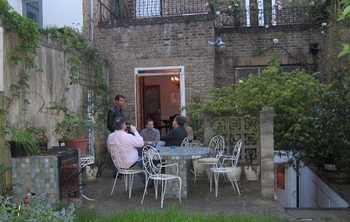
The smokers lurked outback
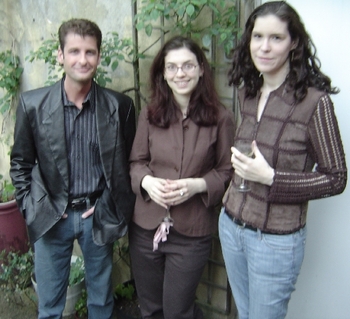
Yankee bloggers invade London!
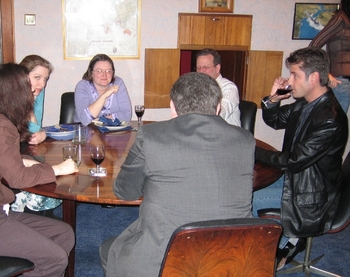
The conversations ranged from artificial intelligence to real stupidity
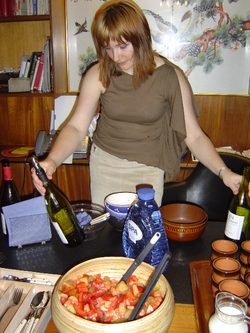
Epicurian Samizdata editor

Who the hell invited this guy?
I confess that I didn’t give any money to the tsunami relief effort, mostly because it became apparent to me within a few days that there was far more aid on its way to the area than could possibly be put to good use. I prefer that my donations go where they can make a difference.
Mark Steyn confirms that I was right not to waste my money (or rather, to give my money to the tranzis to waste).
Five hundred containers, representing one-quarter of all aid sent to Sri Lanka since the tsunami hit on Dec. 26, are still sitting on the dock in Colombo, unclaimed or unprocessed.
At the Indonesian port of Medan, 1,500 containers of aid are still sitting on the dock.
Four months ago, did you chip in to the tsunami relief effort? Did your company? A Scottish subsidiary of the Body Shop donated a 40-foot container of “Lemon Squidgit” and other premium soap, which arrived at Medan in January and has languished there ever since because of “incomplete paperwork,” according to Indonesian customs officials.
It was apparent to me that the US and Aussie military were doing everything possible to ensure that casualties would be minimized during the immediate crisis. Since long-term relief was being farmed out to the UN, and no fundamental reforms of either the UN or the countries receiving it were contemplated, well, the outcome and effectiveness of the long-term relief program was pretty predictable. The UN was being put in charge, so I sent my charity dollars elsewhere.
When rent-a-quote senators claim to be pro-U.N. or multilateralist, the tsunami operation is what they have in mind — that when something bad happens the United States should commit to working through the approved transnational bureaucracies and throw even more “resources” at them, even though nothing will happen (Sri Lanka), millions will be stolen (Oil for Food), children will get raped (U.N. peacekeeping operations) and hundreds of thousands will die (Sudan).
As tonight Samizdata.net HQ will be playing host to the Anglosphere Blogger Bash, featuring such A-list bloggers from across the Atlantic as Jane Galt and Stephen Green, blogging may be a bit erratic and/or ‘under the influance’.
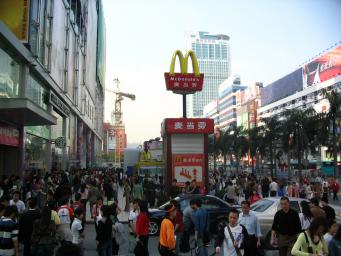

Much has been said and written (some of it by me) on the growth of the Chinese economy and the rise of China as an economic power, and of the growth of an immense manufacturing region on the sides (particularly the east side) of the estuary of the Pearl River between Hong Kong and Guangzhou (Canton). If there is a workshop of the world today the way there was in the north of England in the mid 19th century, then this is it. I have for a while wanted to go and look at it, but I have usually lacked either the time or the money. Ideally I would like to start in Hong Kong, work my way upstream through Shenzhen and Dongguan to Guangzhou, and then back down the other side of the estuary via Zhongshan and Zhuhai to Macau, on the opposite side of the estuary to Hong Kong.
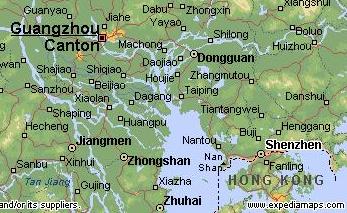
But alas I have still not been able to do this. However, in March I arranged a trip to Australia to visit my family. And I was able to manage a stopover in Hong Kong for three days. Although I was not going to be able to do the trip up and down the estuary that I had hoped to do, I was at least able to spend one day doing something a little interesting, which was to cross the border from Hong Kong to Shenzhen in China proper.
Well, sort of in China proper.Shenzhen is a “Special Economic Zone”. China gave Shenzhen this status in 1980 . (The status was subsequently given to Zhuhai across the border from Macau, the port of Shantou north of Hong Kong, Xiamen in Fujian provice across the water from Taiwan, and the southern island province of Hainan). These areas were given more economic freedom that the rest of China, and more importantly were open to investment from and trade with the rest of the world. This was convenient with the people of Hong Kong, as at that time Hong Kong was undergoing the transition from poor to rich, and labour in Hong Kong was becoming too expensive for the traditional textiles and other low cost manufacturing base to survive in Hong Kong. What happened was that the manufacturing moved across the border to Shenzhen, a boom ensued, and people (to the extent that they were allowed to) flocked to Shenzhen from other regions of China. Since then, much the same thing has happened to Shenzhen as happened to Hong Kong,although Shenzhen remains a less sophisticated place.
A lot of trading and lower level services, including that with slightly more questionable business practices, has moved to Shenzhen. Labour has become too expensive in Shenzhen for a lot of the low cost manufacturing to take place there, so it has moved further upriver, particularly to Dongguan. (Capacity constraints are much more stretched on the east bank than the west, which is the impetus for a proposal for a huge bridge connecting Lantau island in Hong Kong with Macau and Zhuhai on the other side of the estuary, construction of which is scheduled to commence later this year).
In any event, on Sunday morning I got the train from Kowloon to Lo Wu and (after a few hassles with getting a visa at the border) crossed over into Shenzhen.
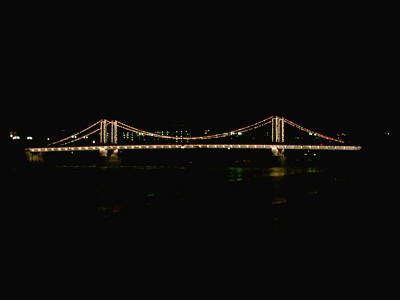
I guess this makes David Carr happy
Initially it felt like sleazy border towns everywhere, but it ultimately turned out to be far more interesting that that. → Continue reading: A belated report on a trip to the wild East.
There can surely be no more conclusive evidence of market success than the trademark name of a particular company becoming the commonly used verb to describe the activity for which said company provides its products. Have you ‘googled’ anyone today? Have you ever been ‘googled’ yourself?
As someone who ‘googles’ on pretty much a daily basis, I can find no material fault with this richly-deserved and glowing tribute in the UK Times:
Google is the modern Oracle, the all-knowing mechanical sage we consult to find, if not the answers to life’s questions, then at least a comfortable, reasonably priced hotel in Torquay. But is Google God?
I cannot recall such a mystical (and, for some, blasphemous) suggestion ever crossing my mind but, like the author, I am only too ready to wax lyrical about the benefits of Google’s simple and effective information gathering machine.
Google may have all the answers but, unlike God, lots of Google’s answers tend to be wrong, loopy postings from lonely people typing late at night in their underwear. Google moves in mysterious ways all right, but some of those ways are downright weird.
To whom could he possibly be referring? → Continue reading: Stick to what you don’t know
|
Who Are We? The Samizdata people are a bunch of sinister and heavily armed globalist illuminati who seek to infect the entire world with the values of personal liberty and several property. Amongst our many crimes is a sense of humour and the intermittent use of British spelling.
We are also a varied group made up of social individualists, classical liberals, whigs, libertarians, extropians, futurists, ‘Porcupines’, Karl Popper fetishists, recovering neo-conservatives, crazed Ayn Rand worshipers, over-caffeinated Virginia Postrel devotees, witty Frédéric Bastiat wannabes, cypherpunks, minarchists, kritarchists and wild-eyed anarcho-capitalists from Britain, North America, Australia and Europe.
|





Recent Comments