We are developing the social individualist meta-context for the future. From the very serious to the extremely frivolous... lets see what is on the mind of the Samizdata people.
Samizdata, derived from Samizdat /n. - a system of clandestine publication of banned literature in the USSR [Russ.,= self-publishing house]
|
Even in this era of intense news management and political spin, a public figure will still occasionally (and often inadvertantly) let a few morsels of truth slip out.
For the past two decades or so, and by every standard that can be accurately measured, participation in the established political process has been in steady decline. Voter turnout is consistently lower than it was in the 1970’s and membership of the main political parties is but a fraction of what it was in the 1950’s.
Not surprisingly, this has resulted in a hubbub of worry among the political classes with attendant brow-furrowing and hand-wringing over what should be done about it. Some of the more foolishly optimistic (or perhaps just ill-advised) politicos have launched themselves into toe-curlingly embarrassing campaigns to ‘get down with the kidz’ only to hurtle smack, dab into a wall of indifference. The less exhibitionist among them have been uttering dark murmurings about ‘compulsory voting’.
In the fullness of time, and as the disillusion spreads like sea-fog, I expect that those murmurings will become a demanding roar. In the meantime, the first member of the cabinet, former Defence Minister Geoff Hoon, has added his somewhat more audible murmur to the compulsion lobby.
I am not going to use this article to examine the arguments about compulsory voting, except to say that I am against it. More interesting to me (for the moment at least) is Mr. Hoon’s choice of words:
Mr Hoon said: “My fear is that as the older, more regular voters die, we will be left with a significant number of people for whom voting is neither a habit, nor a duty…”
Is that how Mr. Hoon thinks of voting? As a ‘habit’? As a ‘duty’? Where is the call to democratic arms? Where is the sizzle of enfranchised excitement? Where are the glamourous invocations of citizen empowerment? All long gone is the inescapable truth. Instead we are left with habit and duty.
If I were being charitable, I might suggest that Mr. Hoon chose his words for convenience rather than accuracy and that it would be unfair to second guess him on this basis. But I actually think that Mr. Hoon was being honest. Furthermore, I am prepared to extend to him the rare honour of actually speaking for the nation, or at least that ‘significant’ chunk of it for whom voting has become a sullen and thankless obligation, rather like slopping out the bedpan of an infirm and elderly relative while trying not to succumb to the guilt upon contemplation of the unspoken resolution that it would be better for everyone if they would just quickly and peacefully die.
Small wonder it is why young people don’t vote anymore.
The New York traditional music scene has been a home away from home for me for almost a decade. My familiarization with it began when I toured with a band and sang here in 1994; it expanded greatly when I worked on a series of internet webcasts and spent a good chunk of 1998 living in the East Village. During that hot summer of 1998 I had a weekly pub schedule to follow. The crowd of musicians I got to know so well floated in an eternal circuit from the Monday Session through to the Sunday Session. Many of the same people are still to be found on the same weekly rounds and only one of the Sessions has died off over the last seven years.
So… Sunday night. That’s the Doc Watson’s night. For the hardcore musicans, the Sunday drinking actually starts in the afternoon at the Thady Con’s Session, but I had engineering notes to prepare.
Doc Watsons is in the Upper East side and not the easiest place to get to from where I am staying in the Upper West. This business trip has been going well so I splurged on a taxi rather than the usual long A train and crosstown bus trip. The first taxi to stop was from a Car Service, not one of the metered Yellow ones. I have been around the city long enough to know to dicker the price before one goes anywhere. The ride is nicer but you could be in for a surprise if you have not got the price set first. If you are a stranger to the city you won’t know whether a price is reasonable or not so I would probably not recommend it without the advice of a local friend. The Yellow ones are safer for tourists.
I have sung at Doc Watson’s myself, although not in many years. I have been too busy surviving as a consultant to keep any material up to what I would consider professional performance standards. Since I have been there and done that, I have more to lose making a complete fool of myself on stage than most. One never knows: perhaps the day will fall when I must survive at it. It is best I not leave bar owners and public with memories of blue notes and effed lyrics to replace older,better memories of mostly competent performance. Instead, I competently hold up the bar and drink Guinness.
The pub has a Sunday anchor band that is usually John Redmond and Peter Rufli, fellows I know from years past. This Sunday John was not present and Peter had several other fine musicians with him.
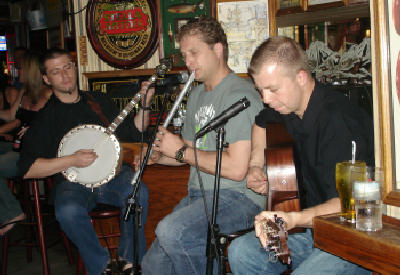
Right to left: Davie Ryan, Banjo; Peter Rufli, flute & whistle;
Dominic Cromie, guitar and vocals Photo: D.Amon, all rights reserved.
In addition to the craic of old acquaintances, Doc Watson’s has very good food and pulls a decent Guinness. I particularly like their Buffalo Wings platter.
If you have not spent time in New York, you are missing the real meaning of cross-cultural fertilization. The following photos show how Chinese culture has improved upon traditions long a part of the Irish music scene:
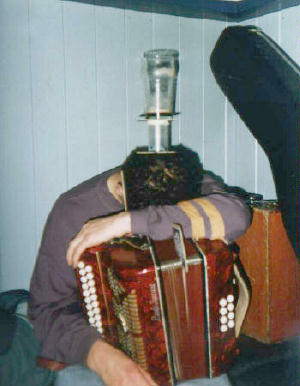
Traditional Irish beer balancing technique Photo: D.Amon, all rights reserved.

Chinese improvement Photo: D.Amon, all rights reserved.
It seems the entire editorial staff of Samizdata is travelling at the moment. I happen to at least have network access, although not much in the way of time to make use of it these last weeks. Nonetheless I seem to have been left the tiller to Samizdata with a small sign, “Back soon, Regards, Perry” on it. So I shall make do.
Right now I am in Manhattan for a few days away from the intensity of an R&D effort for a small DC area company. I have some work to do in New York also, but at least I have some time to call my own. I will post an article or three to make up for the scarcity of one Dale Amon from these virtual pages over these three months on the road – not to mention the temporary absence of Perry and Adriana from the global Matrix.
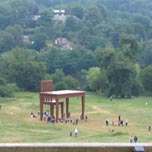
Yesterday I visited Hampstead Heath, to renew my acquaintance with the magnificent view of London that you can see from there, and also to see this rather entertaining sculpture, installation, visual pun, prank, call it what you will. Basically, it is a giant table and chair. It is called “The Writer”, because your average writer uses a table and a chair when writing. Hampstead Heath was chosen by The Writer’s creator, Giancarlo Neri, because of Hampstead’s literary associations. It will be on the Heath until October.
Click on these squares to get bigger pictures:
You cannot please everybody when it comes to public sculpture. Personally, I reckon just about anything is better than the kind of meaningless lumps that used to disfigure London – in fact more or less everywhere – in the sixties and seventies, until the fashion for sculpture that is of something came roaring back. The meaningless lumps were ugly as sin, and took themselves about as seriously as a religious cult, which they were. Neri’s installations, on the other hand, have a bit of wit and fun about them, like most public sculpture these days. And if you hate it, relax. It will soon be gone. I have my photos and I am happy. You can forget about it.
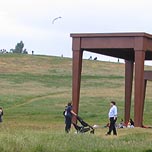
I particularly like where The Writer has been put. It nestles modestly at the bottom end of Parliament Hill Fields rather than strutting its stuff at the top of Parliament Hill. From Parliament Hill you can see the top of the table (top left) the way you cannot when you are closer to it (top right).
The view through it and back up towards Parliament Hill, with all those even smaller figures on the horizon (bottom left) is a particularly nice one, I think.
The Writer makes good use of the people who flock to gaze at it. It then looks much more amusing than it would be if there were no people under or around it. The joke of how big the table and the chair are only comes alive when there are normal sized people around to dramatise it.
Inevitably, because these are the times we live in, there is a website (bottom right), although I found this BBC report more helpful.
When I was studying for my Ph.D. at Cambridge University in the 1990s, I made friends of many nationalities, which was an all round splendid thing. Inevitably, many of the best of these friends were (and indeed are) American. An organisation named The American Friends of Cambridge University would hold social events on July 4 and at Thanksgiving for Americans in Cambridge, and my American friends would often smuggle me in to these events. (Actually there were was very little smuggling involved. Although I was not American, I found myself as welcome at these events as I think I would have been if I was). And today I at one point found myself thinking that there would be such an event going on in Cambridge today and that it would be fun to be there.
As it happens, one of these American friends of mine is getting married in Sonoma county, California this coming Sunday, and I shall be attending the wedding. Shamefully, I find that it is five years since I have been to the United States, but I hope I shall make up for this a little bit next week. After the wedding my movements are a little uncertain – I am not sure which of my other friends will also be at the wedding and whether I shall be doing anything with them afterwards – but I have a tentative plan to drive up to Crater Lake National Park in southern Oregon, do some hiking and perhaps a little fishing, and then head back to the Bay Area. My expectation is that I shall be in San Francisco or thereabouts on the weekend of the 16th of July. If any of our Californian readers feel to the need to hold an impromtu blogger bash, or perhaps even just wish to buy me a drink, well I shall be around.
We have a mention on the BBC web site in their weblog watch quoting this.
What ever next?
Popular support for ID cards – never all that evident to me in the first place – has collapsed, according to this story in the Daily Telegraph this morning. The article, citing a YouGov poll, says support has dropped sharply in part due to the likely high cost of the cards.
I am of course pleased that Tony Blair and his oafish Home Secretary, Charles Clarke, are facing a serious setback on this issue. Nothing would give me more pleasure than if this most devious of administrations had to abandon this wrongheaded, expensive and oppressive scheme. But I cannot help feel a twinge of dismay that an assault on our liberties may be thwarted not because the UK electorate have grasped the principles at stake but because of the monetary cost. It makes one wonder whether we would happily sell our freedoms if the price were right.
I hope of course that I am dead wrong about that.
Thanks to this Instapundit posting linking to this, and then following one of the links there, I have found my way to tifoc, sports blogger extraordinary, and well worth a read if you like cricket, soccer, F1, or just a different angle on things.
His posting of last Thursday refers to an extraordinary coincidence:
In 1981, the Pope died, Prince Charles got married and Liverpool were crowned Champions of Europe.
This year (2005), the Pope died, Prince Charles got married and Liverpool were crowned Champions of Europe.
However, tifoc did not spot this himself, and nor did the emailer who told him about it. (Unless the BBC reporting the same coincidence in April was itself a coincidence.)
Ashes anyone? This bizarre game last Saturday suggests that England are at least in with a chance of doing what they also did in . . . 1981.
No person shall be held to answer for a capital, or otherwise infamous crime, unless on a presentment or indictment of a Grand Jury, except in cases arising in the land or naval forces, or in the Militia, when in actual service in time of War or public danger; nor shall any person be subject for the same offence to be twice put in jeopardy of life or limb; nor shall be compelled in any criminal case to be a witness against himself, nor be deprived of life, liberty, or property, without due process of law; nor shall private property be taken for public use, without just compensation.
– 5th Amendment: US Constitution
Today is the 4th of July, when Americans celebrate their independence and much talk of freedom and constitutions occurs. This day is in many ways an orgy of self-congratulation, much of which is entirely justified (I make no secret of my pro-Americanism Atlanticism).
But perhaps, just perhaps, the ‘shot heard around the country’ that was delivered by the Supreme Court of the United States with the Kelo verdict will snap a great number of Americans out of their understandable but entirely misplaced complacency regarding the benevolence of their own nation-state.
Not only does Eminent Domain now pose a threat to anyone whose property happens to catch the eye of a well connected property developer, the USA also has outrageous ‘asset forfeiture’ laws that allow suspects to have their property taken by the state, reversing the burden of proof and making the accused (but un-convicted and usually un-tried) person prove their property is not the proceeds of some crime in order to have the property returned (they cannot prevent it from being taken in the first place). So much for ‘due process’.
Americans would do well to remember that it was the use of British sedition laws to seize private property from political activists was a major cause of disaffection in the colonies in the lead up to the Revolution in 1776. Moreover those sedition laws were far less capricious and more respectful of due process than modern ‘asset forfeiture’ laws (colonial era sedition laws at least required you to actually be convicted).
The fight against Al Qaeda and any who ally with them must go on but the greatest threat to liberty (and in the long run that inevitably means life) facing the people in the United States comes not from without but from within. Until the entire scope of what government can do is radically cut back, Kelo is pointing the way to a grim future. I hope that the Supreme Court’s destruction of the 5th Amendment by allowing the state to take private property for the private use of property developers, will be reversed long before it requires the active use of the 2nd Amendment to make private property secure against those who would rather use political power rather than markets to enrich themselves.
Happy birthday America.
Only this past week, I found myself in a polite but rather pointed political discussion with one my elderly clients about the issue of ID cards. She was all in favour of them because, “we had them during them war and everyone was fine with them”. To which I retorted, “we had rationing during the war, do you want that brought back too?”.
Little did either of us suspect that minds infinitely superior to ours…blah..blah..blah:
Every individual in Britain could be issued with a “personal carbon allowance” – a form of energy rationing – within a decade, under proposals being considered seriously by the Government…
Under the scheme for “domestic tradeable quotas” (DTQs), or personal carbon allowances, presented to the Treasury this week, everyone – from the Queen to the poorest people living on state benefits – would have the same annual carbon allocation.
This would be contained electronically on a “ration card”, which could be the proposed ID card or a “carbon card” based on supermarket loyalty cards…
“This is a way that enables us to make the necessary annual changes without radical adjustments to our lives.
“It is about making the small changes year by year. It won’t stop us going on holiday. But it might constrain how many times we fly…”
For some time now there has been a hubbub of grumbling among the chattering classes about the vulgarity of “cheap air travel” with its attendant and intended benefit (or, in their eyes, problem) of modest earners being able to jet off to all manner of exotic destinations at the drop of a hat. “But it’s destroying the planet!” they all exclaim. This is not, I should add, a charge which is ever levelled at the organisers of global rock-concerts for Africa despite the fact that just distributing the various members of the Rockocracy to their appointed warbling-posts consumes enough energy to light up a medium-sized land mass.
But saving the planet is not the point or the object. The real cause of this latest drive for forced austerity is the abundance of something that, only a few short years ago, was an expensive luxury enjoyed by the privileged few. But when tattooed builders, single mothers and lowly clerks can spend several weeks a year wallowing on sun-kissed South-East Asian beaches or sampling the epicurean delights of Tuscany then they are obviously living far better lives than they deserve and something must be done to curtail them.
But it’s decidedly tricky to wrench people’s luxuries and pleasures from without a good reason. So, enter good reason: “global warming”. If the masses can be persuaded that the future of mankind depends on their austerity then not only will the meekly surrender their wordly goods, they will clamour to hand them over and humbly thank their lords and masters for being so benevolent, wise and caring.
Given that so many modern activities involve energy consumption, the political classes need only play their cards right and “saving the plant” can be developed into a tool of legitimisation for almost complete social control.
But I’m sure that they wouldn’t dare go that far.
I’m watching the BBC Top Gear motoring programme right now and its main presenter, the irrepressible Jeremy Clarkson, is driving a hot-rod Mercedes sports car at high speed along a German autobahn listening to a CD of Margaret Thatcher speeches.
How can you not love this guy?
You know we have a greedy government. Even if they cancel the debt, it will not help if the government is greedy. Senior government officials should cut their salaries first.
– Phillip Khisa
|
Who Are We? The Samizdata people are a bunch of sinister and heavily armed globalist illuminati who seek to infect the entire world with the values of personal liberty and several property. Amongst our many crimes is a sense of humour and the intermittent use of British spelling.
We are also a varied group made up of social individualists, classical liberals, whigs, libertarians, extropians, futurists, ‘Porcupines’, Karl Popper fetishists, recovering neo-conservatives, crazed Ayn Rand worshipers, over-caffeinated Virginia Postrel devotees, witty Frédéric Bastiat wannabes, cypherpunks, minarchists, kritarchists and wild-eyed anarcho-capitalists from Britain, North America, Australia and Europe.
|







Recent Comments