We are developing the social individualist meta-context for the future. From the very serious to the extremely frivolous... lets see what is on the mind of the Samizdata people.
Samizdata, derived from Samizdat /n. - a system of clandestine publication of banned literature in the USSR [Russ.,= self-publishing house]
|
I recently decided that I wanted to upgrade the CPU on my desktop computer. As it happened, the particular CPU I wanted was in short supply in the UK, and as prices here were substantially higher than in the US I decided to buy it from a shop in Seattle via ebay. It was quite possible that I would have to pay British VAT when the CPU was imported into the UK, but even after this I would still save substantial amounts of money.
So I ordered the CPU, and yesterday it arrived. I received a note in my mailbox telling me that some taxes were owing. Oddly, though, the taxes stated on the note came to about 26% of the price rather than the 17.5% VAT rate. I went to the depot, paid the taxes, and picked up the CPU. A sticker had been placed on the package, and this explained the discrepancy between the amount I calculated and the amount I was being charged. In addition to the VAT I was being charged a £8 “clearance fee”. You see, I was not just being charged taxes. I was being charged an additional amount to pay the tax collectors to charge me taxes.
Forgive me for being pissed off by this.
Whenever I write about something touching on my experience of communism, I get a few kind commenters encouraging me to share more of it. I rarely do so, as busy life takes over. Still, today I managed to post an article on my other blog, Media Influencer, that I felt was perhaps not coherent enough or too personal for Samizdata.net. For those interested, follow the bananas…
Like those in most developed countries, British telecommunications regulators several years ago introduced something called ‘mobile number portability’, which simply means that if you change from one mobile phone operator to another, you are able to transfer your number to the new network. Legally, this is basically a statement that phone numbers are the property of telephone company’s customers and not the companies themselves, and I find this entirely reasonable. As items of property, telephone numbers are now transferable and tradeable in a way they were not before. Certainly it means that when your contract is up you can shop around for any deal on the market, change to that deal, and then not have to tell all your friends and acquaintances that your number has changed.
As it happens, a few months back I took advantage of this. I switched over from Orange (whose customer service had been questionable, and whose network has poor coverage at my workplace) to O2 (formally BT Cellnet, and but who have managed to transform themselves into a surprisingly good business since being divested by BT). Normally what one does in such circumstances is get a new handset and sign a new 12 month contract. (British networks seem to be trying to lengthen this 12 month upgrade cycle at the moment – many of the cheapest deals now seem to be offered on 18 month contracts, and there are plenty of post-pay deals out there that provide substantially cheaper calls if you don’t take a new handset). Coming from Australia (which typically used 18 month contracts when I got my first mobile phone in 1999 and switched to 24 month contracts in around 2001) I was struck by the shorter contracts and higher prices.
However, my circumstances were that I wanted a Pocket PC running Windows Mobile. The best selection of these devices in the UK seemed to be the XDA range offered by O2 from HTC of Taiwan. (Also, a friend had one of these and it was really cool). So I got an XDA IIi with a mobile contract with O2. There was a hefty up front cost for this, but it was still substantially cheaper than buying a Pocket PC without a mobile contract. The XDA works fine as a phone, but it is big and bulky. (Most people want to want their mobile phone to be stylish, but the XDA is a device for people who want everything including the kitchen sink in their phones, but who do not care about being uncool). My plan was to transfer the phone number from my old phone over to the new O2 SIM, and then to use the O2 SIM, which I could transfer between the XDA and the old phone (a perfectly fine Motorola v500) as need be.
So, after I had worked out the Orange contract I did all this. The next problem was that very irritatingly (like most UK mobile phones, even those you get on a contract) the v500 was “locked”, meaning that it could only be used with one network. UK mobile networks do this, principally because they want to add an extra little hassle to leaving the network, and because they want you to pay their extortionate roaming rates rather than a local SIM in some other country. As a consequence, a large (and perfectly legal) unlocking business has sprung up in the UK to unlock phones like mine. Rather than using one of these businesses I paid to download some unlocking software and an unlock code over the internet, and did the job myself. This greatly relieved one of my female workmates, who saw me talking into a PDA and assured me that if I kept doing this there was no way I would ever find a girlfriend.
So, anyway, that was all resolved. One further reason that I wanted to get the v500 unlocked was that it is quad band GSM, whereas the XDA is only tri band. Although both phones will work in the US, the v500 will therefore likely provide better coverage. And as I got all this done immediately prior to a trip to the US, this was important to me.
Another thing that is interesting about number portability is that despite the fact that it has been in existence for several years, most people seem unaware of its existence. → Continue reading: The inefficiencies of the mobile phone market slowly go away
Bureaucrats only expect compliance under threat of punishment. Other people will figure out, even if only by trial and error, how to break any system at its weakest points. See Kevin Mitnick on ‘social engineering’, or–if you are the sort of authoritarian who won’t listen to a felon but is impressed by prizes and tenure–any anecdote by Richard Feinman. I can also thoroughly recommend this post by edjog of the Distreputable Lazy Aliens website:
I don’t usually go into much detail about offences I committed whilst in active addiction, for a number of reasons which are beyond the scope of this post but, with the UK Government’s headlong rush toward ID Cards seemingly based in much part around the notion that such a scheme will reduce crime, it seems appropriate. I’ve been prosecuted for what I’m about to talk about anyway: paid my debt to society and no longer commit crime. You don’t think a self-confessed law-breaker has anything relevant to say about this issue? Fine: bury your head in the sand; it’s your taxes paying for the scheme.
Read the whole thing, as they say.
The author has kindly offered NO2ID syndication rights, so any magazines interested in new angles on the lamentable scheme for a non-webical audience should get in touch.
Anthony Browne, writing the main feature article in this week’s Spectator, says policymakers have underestimated, or quite possibly fibbed, about the scale of immigration into the United Kingdom from Eastern Europe. I do not want to get into all the cultural arguments that have been aired a lot here in recent months. Suffice to say that Browne makes some good, if slightly alarmist, points about the ability of a small crowded island like Britain to go on taking more and more people, never mind from often very different cultures.
He seems to make the mistake, however, when discussing the impact of immigration on wage rates, of what is known as the “lump of labour fallacy”: the notion that there is a fixed amount of work to be performed in an economy. It seems a bit odd that Browne, who calls himself an economic liberal, should fall prey to this fallacy. After all, as surely the late economist Julian L. Simon pointed out, every additional person is not just another mouth to be fed, but another brain and pair of hands to create wealth.
“You can’t fight in here – this is the War Room!”
– Peter Sellers, playing the President of the United States in Dr Strangelove.
Sometimes people are shown ink blots in the hope of finding clues as to their mental characteristics. If the ink blots remind you of the ‘wrong’ things then you may have problems.
However, a different form of “ink blot madness” has been doing the rounds for some time: The ink blot strategy.
The ink blot strategy holds that the British won in Malaya (now Malaysia and the independent city state of Singapore) not by killing, capturing or driving out the communists, but by taking bits of Malaya and making life “so good” in these bits that people “did not want to fight the British any more” and then expanding these bits “like ink blots”. By copying this strategy we can all win in Iraq – or so it is claimed.
There are various problems with this idea. Firstly it is not what the British army did in Malaya – whatever some people may say they did. In reality the men went out and fought the enemy (in the jungle or elsewhere). Certainly there were ‘protected villages’ and so on, but Malaya was a fight (it was not a welfare project).
Further the British did not give vast amounts of aid to Malaya. Britain did not have this sort of money to give away in the early 1950’s and it would not have really improved economic life anyway (more on that below). In so far as economic life did improve in Malaya during the “Emergency” British aid was not the real reason.
And, of course, the (mostly ethnic Chinese) communists in Malays were not fighting for “better socio-economic conditions” anyway – they were fighting for communism (hint, that is why they were called ‘communists’). Try asking someone who knows something about Vietnam how all the welfare statism there did not make the VC or NVA vanish (nor was ‘support’ for them among civilians based upon poor social or economic conditions, such support was based on terror – you helped the communists or you and your family would be killed)
How can someone be so plain daft as to suppose that the reason someone becomes a suicide bomber in Iraq (whether they are from Iraq or from outside) is because they turned on the light one day and it did not go on. “Oh if only the electricity and the water supply worked better, then I would not strap a lot of explosives to myself and go blow up a bus full of school children”.
Also physics teaches us that it is less difficult to destroy that to create. The terrorists left undisturbed (under the ink blot strategy) in ‘their’ bits of Iraq will find it less difficult to come in and blow things up in ‘ink blot land’ than the U.S. Army (or anyone else) will find it to build nice services.
The ink blots will not ‘spread, they will shrink. Going on the defensive is sign that one has no real will to win – and would mean that soldiers being killed would be dying for nothing (as the poltical choice to give up had already been made – sound familar?).
Then there is the assumption that government can make the lives of people Iraq “so good they will not fight”, it is not just that the terrorists are fighting because they would like nicer ‘public services’ (which is absurd), but the whole idea that the government can make so many millions of people have such happy lives.
One does not have to a libertarian to see the absurdity of this idea. The government can not (for example) make the lives of Compton in greater Los Angeles. “So good they will not want to fight” (after so many decades of welfare schemes and ‘urban renewal’ schemes) – so how is going to that in Iraq?
Whatever one thinks of the Iraq war, the ‘ink blot strategy’ is stupid. And whoever the military officers and politicans who are behind may be, it is time they shut up. If the war is justified then fighting should continue (i.e. the enemy, especially the leadership, should be hunted down and killed or caputured), and if the war is not justified then the troops should come home.
But there is no ‘socio-economic road’ to victory.
I have been in the habit of buying zone 1 (i.e. very central London) tube (i.e. London Underground railway) tickets, in clutches of ten, for a reduced price, compared to what such tickets would cost if you bought them one at a time. I tried again, a few days ago, but it seems that as of January 1st 2006, the only way to get cheaper tube travel is to buy an Oyster Card. Oh no, please no, I said, you’ll make me fill in a ludicrously complicated form. No, they said, just buy an Oyster Card. What just buy it? No name, no address, no grandmother’s maiden name. Yes, just buy it, and put some money on it. Okay then.
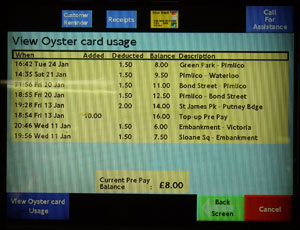
A day or two ago, I was out and about, and had forgotten how much money I had left on my Oyster Card, and saw a machine which looked as if it might tell me, if I put my Oyster Card on the sign, like the one you use when you are passing through a ticket barrier. It duly told me how much cash I had left, and it also gave me the option of learning about my ‘card usage’. I pressed that. And this is what I got (click to get it bigger):
The message is loud and clear. We know where you have been, and when, and we want you to know it. Because, combine all that with surveillance camera info, and they can tell at once who you are.
The times we now live in.
How long before not wanting to buy an Oyster Card is itself regarded as cause for suspicion?
Big selection of essays, some long, some short, about the great composer who was born on this day 250 years ago. Even if you care little for the rather overblown commemorations in Saltzburg and the associated commercial circus, it is hard not to join in the Mozart mania if you are a music fan, as I am.
I particularly enjoyed this essay by Terry Teachout. He asks the question to which there is probably no easy answer: how did such a man churn out such a fantastic and enduring collection of music?
Out of balance, there is also a rather sour piece by Norman Lebrecht . He obviously feels the need to break wind at the party, so to speak.
He was a provider of easy listening, a progenitor of Muzak”
Oh, what a magnificent put-down! After all, great music is supposed to be difficult, not easily understood by the great unwashed (sarcasm alert). But why should ‘easy-listening’ music be inferior to the supposedly hard-listening sort? He also argues that Mozart was not an innovator in the way that J.S. Bach was. Now Bach was a genius, but I am not aware that originality – assuming we take Lebrecht’s argument at its face value – is always the virtue that it is cracked up to be.
Anyway, I think that attempts to define some kind of objective judgement on music is fraught with difficulty, but I do know in my own heart that the Austrian composer has the capacity to speak to me as he does to millions of people, and I rather suspect that is likely to remain the case as long as music is played.
Quick quiz: which of Mozart’s pieces of music do you like the best?
[W]hen we read our newspapers or turn on our TV screens, what we see and hear might well have been “researched” by searching for dirt on the internet. Of course, the mainstream media will never admit it; the pretence that they are above such things is too important to them. They rely on the impression that their reporters are out in the field, fearlessly digging for details on the major issues of the day, not sat in an air-conditioned office with a cup of coffee and an open Google window. But it’s the truth, and for the sake of their own reputations, it might now be time for them to start admitting that they read the blogs just like the rest of us.
– Rob Knight writing at Liberal Review about blog and media reportage of recent Lib Dem scandals
The other night I enjoyed a pleasant meal with a business contact, who works in the property industry and for a large U.S. company. He was talking to a group of people and struck me as a thoroughly charming fellow: articulate, funny, interested in other people, highly intelligent. And then he said something that slightly vexed me in that he started to go on and on about how we must be so appalled by this nutcase rightwinger in the White House, how most Americans were insular and dumb, yadda-yadda. It was so obviously an attempt to deflect what anti-American prejudices potentially might have existed by getting in the blow first. He was, then, slightly surprised me when I said over a drink later that I did not like the way that Americans felt the need to abase themselves this way, or denigrate their home country, or its people. In fact, I told him that, much that I disagreed with many of Bush’s policies, such as his fiscal profiligacy and Big Government leanings, I liked the United States a great deal, not least much of its culture, its vitality and the niceness of most Americans.
So a gentle tip for American travellers from this Brit: don’t slag off your own country when abroad. The locals will see through it and despise you for it. Be proud of what you are as an individual living in Jefferson’s Republic, which for all its faults is the greatest free nation on the planet, and likely to be so for a while to come.
Once upon a time I would have felt awkward about quoting Mark Thomas’s New Statesman column with approval, but we live in interesting times:
In Parliament Square recently, a banner reading “Parliament Square belongs to the people” was deemed a statement of fact and therefore not a protest. Barbara Tucker’s banner, on the other hand, which declared “I am not the serious organised criminal”, was deemed a protest and Tucker faces trial in February. Who knows, had she used the words “I am a flippant chaotic law-abider” the banner may have been legal. In August police arrested Mark Barrett for the crime of having a picnic in Parliament Square. Two weeks later five others were arrested in possession of cakes iced with the slogans such as “Peace ” and “Love” in pink sugary letters. When the state is arresting people with iced cakes, it really is time either to change the law or for ministers to start incorporating khaki uniforms into their daywear.
[If I had a picture of the ever-changing parliamentary fortifications, I would insert it here. But I don’t. And, as Brian found at the dca not so long ago, it would probably be illegal.]
|
Who Are We? The Samizdata people are a bunch of sinister and heavily armed globalist illuminati who seek to infect the entire world with the values of personal liberty and several property. Amongst our many crimes is a sense of humour and the intermittent use of British spelling.
We are also a varied group made up of social individualists, classical liberals, whigs, libertarians, extropians, futurists, ‘Porcupines’, Karl Popper fetishists, recovering neo-conservatives, crazed Ayn Rand worshipers, over-caffeinated Virginia Postrel devotees, witty Frédéric Bastiat wannabes, cypherpunks, minarchists, kritarchists and wild-eyed anarcho-capitalists from Britain, North America, Australia and Europe.
|






Recent Comments