We are developing the social individualist meta-context for the future. From the very serious to the extremely frivolous... lets see what is on the mind of the Samizdata people.
Samizdata, derived from Samizdat /n. - a system of clandestine publication of banned literature in the USSR [Russ.,= self-publishing house]
|
For some weeks Mr. Cameron’s friends in the media (such as the Telegraph group writer and editor of the Specator, Matthew d’Anconia) have been pointing to an upcoming speech that David Cameron was to make. This speech was intended to show what sort of politician Mr Cameron is, to define him – just as the first major foreign policy speech Mrs Thatcher made defined her (earning her the name the ‘Iron Lady’ from the Soviets – what was intended as an insult became a honoured name).
The speech was finally made on September 11th – on the day that the Iron Lady herself stood shoulder to shoulder with the Vice President in the United States (old, betrayed, hit by several strokes, the Lady still stood and walked ramrod straight – held up by courage alone).
Mr Cameron duly denounced anti-Americanism – it was “cowardice”, but then he said Britain must not be “slavish” in any alliance with the United States, and the American leadership was guilty of”‘sound bites”, lacked “humility” and that the American division of things into good and evil was “unrealistic and simplistic” (and so on and so on).
Leaving aside the point that when someone says that they are beyond good and evil, light and dark, (they are more sophisticated than old fashioned ideas of “right” and “wrong”) it tends to mean that they are evil, it was irritating to hear of Mr Cameron first denouncing anti-Americanism and then indulging in exactly that.
Mr Cameron is free to hold any opinion he wishes, even though I might suspect that his Yank bashing was less a matter of principle than an effort to get a favourable editorial in the Daily Mail (on the correct calculation that this newspaper hates the United States even more than it hates him, although some Daily Mail people such as Richard Littlejohn clearly despise what Mr Cameron said yesterday).
However, it is still unclear what Mr Cameron’s opinion actually is – for whilst he attacked the United States he did not say “the Iraq war is wrong”. David Cameron tried to have his cake and eat it as well, and thus playing to both pro and anti war people in his party.
Now being undecided about the Iraq war is not a crime and opposing the Iraq war is not a crime – I myself wrote against the idea of war, although I believed (and still believe) that once the war had started it must be carried on to victory.
I am not attacking Mr Cameron’s right to have an opinion, or his lack of clarity about what his opinion is – it is not even the general patronising tone of his abuse of the leadership of the United States that I object to. It is the date of his speech that is astonishing.
The anniversary of 9/11 is not the time to make this type of speech (far less to bill the speech as some equivalent of the ‘Iron Lady’ speech). If Mr Cameron really does not understand this it shows that just being born into a wealthy family and going to Eton and Oxford do not make a man a gentleman.
With the newly rigorous airport security, that is.
(Thanks to the ever-reliable The Register.)
Whilst travelling down towards the station in Brussels with some friends, one could not help noticing one street full of coffee bars, frequented solely by the male of the species, replicating a corner of Algiers or Tunis. Whilst new to me, this is not an infrequent encounter for the traveller in the Low Countries or France.
As vast portions of the urban geography continue to be recast in the Maghreb mould, and the demographics of immigration and indigenous wind down play out, I asked myself: which European Union Member State is most likely to join the Arab League (perhaps the Maghreb subset) or Organisation of Islamic Conferences in the next few years? Albania, Uganda and Guyana are members of the latter. This would be the predictable ‘next step’ for democratic structures with a large minority Arab electorate.
As did many many countries, Australia prior to the 1980s had a state owned telecommunications monopoly. This company, part of the Post Office until 1976, after that named Telecom Australia and now named Telstra Corporation, charged too much, took several months to connect new telephone lines, and was generally ghastly and bureaucratic. As was also common in those days, the management of this organisation also had a rather grandiose sense of its own importance and its great civilizing and statist mission to bring telecommunications to all of the people of Australia, wherever they might be. Australia’s capital city of Canberra is a fair way inland, a long way from anything else of significance, and is full of large edifices built with taxpayers’ money. In the 1970s, Telecom decided that it needed an edifice of its own in the capital city, and Telecom Tower was built on Black Mountain (actually a not terribly large hill) overlooking Canberra.
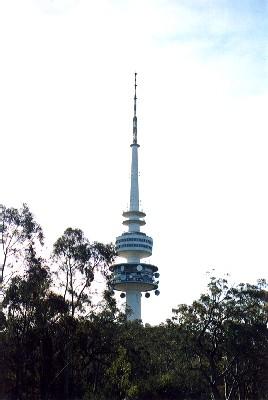 This was ostensibly a communications tower with a viewing gallery (and revolving restaurant) for admiring the view as well, but was actually a large bureaucratic organisation building a monument to its own Ozymandius like belief that it was an organisation of great permanence and importance. I last visited the tower about a decade ago, and even then it seemed a remnant from another age. There were signs talking about when and where it had been built and about the significance of telecommunications, diagrams comparing it to other structures around the world, a plaque stating it was a member of some global organisation of towers, pictures of engineers shaking hands at the groundbreaking, pictures of politicians declaring the tower open, and an extraordinary lack of humour of any kind. The word that the friend I visited it with used to describe it was ‘Soviet’, and it was hard to disagree.
Which was why it was interesting to visit another television tower a couple of weeks ago, the tower in Tallinn in Estonia. This can be seen in the distance from many parts of the city, and of course, rather than the TV tower in Australia that merely seemed Soviet, this tower actually was Soviet, so I had to see it. I knew just looking at it from a distance that this had been built as much as a symbol of Soviet domination and power as for actual telecommunications purposes, and that one way that this would be asserted would be through a viewing gallery and restaurant here, also. As I often do I was carrying a Lonely Planet guidebook. As is expected in such a guidebook, the book mentioned the TV tower by sneering at it, suggesting that the writers and readers of such a book would be much too good and much too authentic travellers to go up something as touristy as a viewing gallery in a TV tower, but we none the less have a duty to mention it in the guidebook.
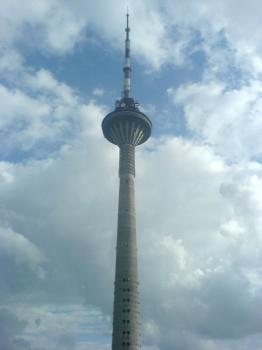 So, I caught a bus to the TV tower. When I got there I found it to be rather run down. There was an attendant at the gate collecting money, but the lift lobby was deserted and I had to push the button to be taken up myself. However, in the lower gallery were the expected signs explaining how “Expert engineers from the Moscow design bureau” had designed the tower, pictures of workers shaking hands at the groundbreaking, pompous looking bureaucrats strutting around at an opening, diagrams comparing the tower to others elsewhere, and that kind of eerily familiar thing.
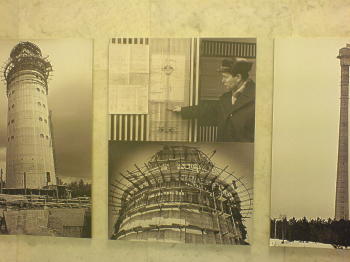 But there was something else, of course. Something much more historically interesting. → Continue reading: On telecommunications, tanks, Soviet housing estates in Estonia, and ethnically complicated shipping containers
The Times newspaper, owned by Rupert Murdoch, has yet to really come out strongly in favour of Tory leader David Cameron, preferring to stick, for the time being, with the Labour Party, or at least maintain a sort of studied neutrality. If you can recall that far back, Blair famously courted Murdoch’s media empire ahead of the 1997 election, convincing Murdoch that a Labour administration would not repeat the mistakes of the past. It worked, and the Times gave Blair and his court a remarkably easy ride for the first few years of Blair’s time in office.
Even so, with Labour in deep trouble, Blair and finance minister Gordon Brown at each others’ throats, the position of the Tories appears to be more promising than for a long time. You might think that Cameron, even though he has shown himself to be trend-follower since becoming leader, might take the odd risk by not trying to creep up to fashionable chattering-class opinion on such issues as Iraq, the Israeli-Hizbollah conflict and the ongoing campaign to crush Islamic fanaticism. Instead, as the Times notes today, what we get is a mixture of truths, half-truths and vacuous sound-bytes on foreign affairs.
Apologists for Cameron – some of whom pop up on the comment threads here – like to use the following, rather damning argument. It goes like this: the public will never vote for a small-government, strongly pro-capitalist, pro-America, pro-liberty Tory Party. The English middle class floating voters, so the argument goes, are not exactly the most intelligent demographic on the surface of the Earth, and are convinced that any tax cuts must come at the expense of the poor, the health service and education. Capitalism is cruel and rather naughty. Saving the planet and forcing people to give up their cars is a Jolly Good Idea (for other people). So Cameron, realising that this is what people think, has to appeal to this mindset. Once he is in power, suddenly, he can give up the “hug-a-mugger” rhetoric, tell the Greenies to go hang, slash taxes and regulations, restore in full the English Common Law, stop nagging us about eating chocolate oranges, etc.
Like many cynics, they are wrong. I would have thought that Cameron, if he has any sense at all, would realise by now that unless he lays down a few markers about what he would actually do in power, then he will face a situation where, once elected, it would be hard to push through a radically pro-market agenda particularly if the Tories get a narrow majority. “Where’s the mandate?”, people would cry. And their cries would have some merit. When Margaret Thatcher won power, the Tory manifesto of 1979 was famously thin. There was little mention of the kind of privatisation and large cuts to tax rates that were to follow. But even so, during the 1975-79 run-up to the elections, Mrs Thatcher, along with colleagues like Sir Keith Joseph, did voice a coherent, and sustained attack on things like Keynesian demand management, out-of-control trade unions, nationalised industries, regulations on business and controls on trade. In short, Mrs Thatcher made it pretty clear what sort of administration hers would be like. She gave herself a bit of room to say to the doubters during the hard years after 1979: “This is my platform and the public voted for it”.
Cameron, if he wants to con his way into power, is, I supposed, welcome to try. Britain’s political history is full of adventurers like Disraeli or chancers like Lloyd George. But when I hear libertarian-leaning Tory voters trying to convince me that Cameron is embarking on the mother-of-all deceptions, it sounds suspiciously close to whistling in the dark to sustain the spirits. I am not convinced.
A few days ago, I was sifting through the intranet noticeboard of the large Australian bank I work for, and I stumbled on an organisation-wide message from our CEO. Anyone who has worked for a large multinational knows the breed – conversational in style, it is usually a somewhat ingenuous effort to create a collegial nexus between upper management and the ungrateful hoardes below. Amongst other rather tedious developments mentioned, the boss noted a recently deceased former customer of the bank who had, “in a rare display of loyalty and reciprocity”, left a substantial portion of his estate to the bank in return for a lifetime of what must have been absolutely brilliant service.
I was, however, disappointed to read that the bank would be donating the bequest to charities in the deceased’s region of abode. This will not do at all – the banks are going all wobbly-kneed and PC on us! What will the shareholders think? I would be tickled pink if our namby-pamby CEO cocked a snook at the “good corporate citizen” brigade and gratefully donated the entirety of the bequest straight to the bank’s bottom line. Better still if he sallied forth proudly stating “that money will be used to refurbish the executive bathroom for the third time this (financial) year.” Steve Edwards suggested he should blow the lot on a nice new tie. Anyone else have any ideas as to how the bequest might be spent? I am looking for the wildest corporate caricatures – the sort that would make Gordon Gekko blush. The funniest wins a degree of transient notoriety.
Today is a day of remembrance and a day to say “Thank you” to those who daily risk their lives for us. It is a day to ponder the guts and determination to save lives which drive fire and police men and women to risk – and sometimes lose – their lives so that others might live. It is a day to remember and thank our military men and women who have made our enemies reap what they have sown.
it is a day to be thankful of the courage which exists within the hearts of very average Americans, a strength of character that caused a small group to fight the first hand to hand battle of World War III in the skies over Pennsylvania.
Above all, it is a day to remember a horror perpetrated against us and to renew our vows to make our enemies pay and pay again for what they did.
There will be much media hype and spin today. Officials will say those sort of things which officials always must say. Personally I prefer the simple direct emotions of people much like myself who needed an outlet to express what they felt: Why We Fight and Have You Forgotten.
If you have not listened to these before (or have but not lately) I recommend you sit back and do so when you have a private moment and are free to shed a tear in remembrance.
Is this really the best way to combat negative stereotyping?
Britain could face the threat of two million home-grown Islamic terrorists, says a senior Muslim leader.
Muhammad Abdul Bari, the secretary-general of the Muslim Council of Britain, fears that continued negative attitudes towards people of his faith could provoke a vast and angry backlash.
“There are a few bad apples in the Muslim community who are doing terrible acts and we want to root them out,” Dr Bari told The Sunday Telegraph.
“But some police officers and sections of the media are demonising Muslims, treating them as if they’re all terrorists — and that encourages other people to do the same.
“If that demonisation continues, then Britain will have to deal with two million Muslim terrorists — 700,000 of them in London,” he said. “If you attack a whole community, it becomes despondent and aggressive.”
So, for those people who think that all Muslims are terrorists, Dr. Bari’s message is: you were right all along. You are not frothing, paranoid Islamophobic bigots but astute judges of character. And by the by, I don’t know what ‘media’ Dr. Bari has been exposed to but if it the same press that I have reading then I think he will find that, when it comes to terrorist atrocities, the members of the British Fourth Estate have been tripping over each other in the headlong dash to blame everyone and anyone except Muslims.
But, quibbles aside, I am inclined to be charitable and assume that Dr. Bari sincerely wishes to repair damaged community relations and foster a mutual spirit of tolerance. However, threatening what is tantamount to civil war is unlikely to achieve such a laudable objective.
Dr. Bari is described as a “senior Muslim leader” so I suppose that makes him a representative. I only hope that he is not representative.
Greer is disgusted by a vulgar fellow like Irwin, just as she has previously been disgusted by Australia’s vulgar choice of prime minister, its lack of culture, its shameful history and so much else Australian that doesn’t meet the standards of her refined intellect (how she must have agonized before accepting the invitation to appear on Celebrity Big Brother).
– Steve Waterson provides a most welcome addendum to Thaddeus’s slapping of fading English (!) intellectual Germaine Greer.
(Via Tim Blair)
This book states what the revisionists have questioned: the fall of the Roman Empire sucked and the Dark Ages really were dark and a regression for civilisation. Looks like a must-read for fans of ancient history.
The other day, my article about the antics of footballers and the shifting balance of power between players and clubs prompted one or two commenters to argue that this shows that market economics and sport do not always mix. The argument, so it goes, is that a sport like football or motor racing needs to operate an almost egalitarian policy when it comes to limiting the power of any participant, because otherwise the most powerful clubs and participants will dominate a sport so much that they destroy the very competition that makes sport enjoyable. Example: the current dominance in the English Premier League of Chelsea, which is now backed by the vast and dubiously-acquired oil wealth of its Russian owner. Another example: Ferrari and its dominance for nearly a decade of Formula One motor sport.
But while such observations have merit, it ignores the fact that sporting institutions like the Football League or Formula 1, the America’s Cup yachting race or whatever are voluntary associations of likeminded people who want to create a set of rules in order for people to have, well, fun. Those voluntary bodies can change their own rules if a participant’s behavioural dominance starts to squeeze the very competition such institutions hold. People effectively choose to submit to rules, just as members of a symphony orchestra voluntarily submit to the dictates of a conductor. In an open society such as ours, we get a profusion of autonomous institutions set up for the purpose of say, staging sports competitions where there are tight rules on behaviour of the participants but where such participants are free to leave.
I personally think that if, say, Chelsea tried to squash all competition beyond a certain point, it could drain interest out of the sport and possibly force the league officials to cap things like the use of foreign players and perhaps even limit the size of a squad that any club can have. And that would be “autocratic” of the league but also no assault on the “freedom” of Chelsea since that club draws is raison d’etre from being a club participating in an intensely rule-bound voluntary association.
Also, if a sport gets bent out of shape and the interest wanes, there are things like “breakaway leagues” or new competitions designed to revive interest. The case of motor sport is instructive: in the last few years, there has been a rising chorus of criticism that F1 motor racing is dull, unglamorous and market-driven (and although no-one will admit this, also very safe). So you get a rise in interest in alternatives, such as rallying, motorcycling, saloon car racing, classic racing, revival meetings, and so forth.
There seems to be a sort of parabola of development in sports. As technical excellence and physical fitness of players increases, some sports can reach a sort of stalemate end-point (Brian Micklethwait made this point about squash and the World Cup soccer tournament recently). But so long as sport remains outside the maw of the state and people can arrange their own events, there is no reason why people who become bored by the spectacle of spoiled-brat soccer stars or processional motor racing cannot do something about it.
Friday night saw yet another party at Samizdata HQ; it has indeed been a busy summer for such gatherings. This one was in honour of Tracy Sheridan, CEO of podcasting company Waxxi. I was fortunate to meet Tracy at the inaugural Techdirt Greenhouse event in Silicon Valley earlier this year, and since then have had the pleasure of her company twice more in the Bay Area. I promised her that if she came to town, we would throw her a party, and – what do you know? – she took me up on it. We are glad she did!
 Yes, it’s a living manga character/Samizdata editor.
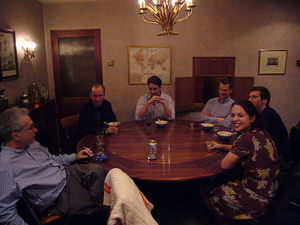 The Algonquin Roundtable crowd had nothing on this bunch.
 Someone had just told me that Ken Livingstone was hanging from a light pole outside; seconds later, the truth emerged and my smile disappeared.
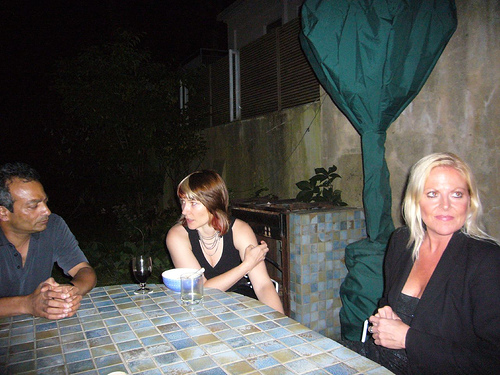
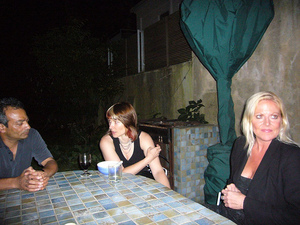 The Three Blogateers: JP Rangaswami, Adriana Lukas, and guest of honour Tracy Sheridan
See more pictures of the festivities on Flickr.
|
Who Are We? The Samizdata people are a bunch of sinister and heavily armed globalist illuminati who seek to infect the entire world with the values of personal liberty and several property. Amongst our many crimes is a sense of humour and the intermittent use of British spelling.
We are also a varied group made up of social individualists, classical liberals, whigs, libertarians, extropians, futurists, ‘Porcupines’, Karl Popper fetishists, recovering neo-conservatives, crazed Ayn Rand worshipers, over-caffeinated Virginia Postrel devotees, witty Frédéric Bastiat wannabes, cypherpunks, minarchists, kritarchists and wild-eyed anarcho-capitalists from Britain, North America, Australia and Europe.
|







Recent Comments