We are developing the social individualist meta-context for the future. From the very serious to the extremely frivolous... lets see what is on the mind of the Samizdata people.
Samizdata, derived from Samizdat /n. - a system of clandestine publication of banned literature in the USSR [Russ.,= self-publishing house]
|
Patrick Crozier of UK Transport looks at Britain and realises we have seen it all before.
It is an essential service. It has been starved of funds. It is in desparate need of modernisation. Of course, this will require some money but the politicians promise us that after they’ve got the new technology working everything will be as right as rain. Is this the National Health Service (NHS) we’re talking about? No, British Rail in the 1950s.
The railway was clapped out just like the NHS. It had been the pride of the nation – just like the NHS It had faced years of re-organisation coupled with fare control, followed by Depression, followed by War, followed by nationalisation. In an age of diesel and electricity, British trains were powered by steam and the industry was losing money fast. So, they called for a Modernisation Plan and a stack of cash was produced. And in the late 1950s British Rail spent it – just like the NHS is about to. And, boy, did they spend it. They spent it on diesel locomotives, electric locomotives, steam locomotives (would you believe it), marshalling yards, DMUs, EMUs, electrification projects. They commissioned something like 20 different types of locomotive – some of which actually worked. Some of which are rattling around the network to this very day.
But by the early 1960s things were looking bleak. British Rail was still shipping cash even though it was supposed to be breaking even. It seems that people had found alternatives to one-size-fits-all railways. They had bought themselves flexible, go-anywhere-anytime cars and lorries and didn’t need boring old trains anymore. Cue Doctor Beeching. Cue the closure of half the network.
As with the railways, so (up to a point) with the NHS. They will spend the money. Some of their IT projects will work. There will be some nice new hospitals. And in 5 years’ time there will be little else to show for it.
The big difference is customers. British Rail wanted customers. The NHS doesn’t. British Rail didn’t get what it wanted and neither will the NHS. British Rail lost out because there was an alternative. The NHS will lose out because there isn’t. The NHS is going to gouge out the private sector for doctors, nurses and beds. In doing so it will force even more people to suffer its tender mercies. And in 5 years’ time a new Doctor Beeching will have to sort out the mess.
Patrick Crozier
Britain’s worst-kept secret is now out in the very public domain. Chancellor Gordon Brown announced his annual budget today and, as widely-expected, has hiked up National Insurance (a type of payroll tax) in order to increase funding of the National Health Service.
This was called the ‘Budget For Health’ by the government. Whose health? Certainly not the health of the economy. The business sector will have to stump up a whopping £3.9 billion a year more in taxes in a desperate attempt by the government to placate its public sector supporters and defer the dark day when the NHS simply collapses.
And it probably will collapse in due course. The NHS is Britain’s version of Yasser Arafat; an odious, Soviet-inspired monstrosity that has caused countless deaths and yet is mysteriously exempt from anything even approaching a critical word. Its status among the British is that of Sacred Cow, nay Red Heiffer. It is the Holy of Holies, the state of which is the barometer by which every government is finally judged. It is hardly a surprise that the press roundly trumpets opinion poll results which overwhelmingly endorse tax rises to improve the NHS when an answer in the negative is probably more outrageous than supporting legalised child-prostitution. The left never miss an opportunity to hector the British public with the admonition that, if they want improved health care, they have to pay for it. I agree, of course. I just think they should cut out the middle-man.
But the cracks have been showing of late. Too many people have been travelling abroad for their health care treatment, forking out for private insurance or watching their elderly relatives expire on trolleys in dank state hospital corridors and you can’t keep that kind of disquiet from spreading. Everybody seems to know or sense that the NHS is crocked and beyond redemption but they are prepared to shut their eyes and wish very, very hard that the government will hose enough money at it to make it all wonderful, gleaming, efficient and keep it free.
It won’t work in the long-term or even the medium-term but the government is gambling that the massive cash boost will tide them over to the next election when they will be able to annouce that they have ‘saved’ the NHS and ensured its future as ‘the best insurance policy in the world’. On the face of it, it is a dangerous gamble. The Labour government was elected on the promise that they had put behind them, for ever, their old ‘tax and spend’ policies and it is at least pragmatic to assume that they will be judged harshly for breaking their promise without delivering.
On the other hand, it might just fool ’em by providing a glimmer of ersatz hope. It is almost impossible to underestimate the sacred status of the NHS. The faith it is has traditionally inspired may prove a strong enough medicine to anaesthetise the public’s critical faculties and enable them to go on believing in the Easter Bunny.
In the meantime, we’re all going to get poorer. Poverty is bad for your health.
Dr. Tim Evans welcomes ‘Red Ken’ to the world of capitalist rationality… sort of
I have long been an advocate of private roads and road pricing. State ownership of public space and its attendant services such as police beat patrols is madness. Indeed, I have long believed that London and all other geographic areas will only get decent integrated roads and transport systems through genuine private ownership and good old free market price signaling.
What I did not expect was that that doyen of the British left and now Mayor of London, Ken Livingstone, would be the man to instigate the transition to such an approach. Let me be clear, Livingstone is planning to introduce road pricing into the capital city early next year. However imperfect his plans will be (and my God, they have some glaring holes at present) and however he seeks to dress this move up with all the usual environmental waffle, the long term affect of his policy of “congestion charging” is going to lead to the commodification of public space. By pricing roads, encouraging an income stream down them and therefore deriving revenue, Livingstone will slowly become addicted to the money.
As he becomes addicted and the approach spreads – already Durham, Cheshire, Milton Keynes, Surrey, Warwickshire, Isle of Wight, Cumbria, South Gloucestershire, Leeds, Hampshire, Derby and at least twenty other areas are already talking to the Department of Transport about introducing road pricing – the incentive for a supply side revolution in roads and public space will mount. For as money pours into the coffers and drivers slip into the psychology of becoming consumers of road space, so there will be ever more pressure to find new ways of generating more income and therefore getting the supply side of public space to meet people’s demands: that is – some semblance of a market approach.
It is with this in mind that the utopian ideas so long espoused by the Libertarian Alliance in such glorious pamphlets as:
LA Economic Notes No. 49, Brian Micklethwait, The Private Ownership of Public Space: The New Age of Rationally Priced Road Use, 1993 *
LA Economic Notes No. 57, Martin Ball, Liberate the Roads! The Benefits that will come from road privatisation, 1994 *
LA Political Notes No. 17, Max More, Private Police and the Free Rider Problem, 1983 *
LA Political Notes No. 40 Chris R. Tame, On the Side of the Angels: A View of Private Policing, 1989 *
LA Political Notes No. 58, Sean Gabb, The Case for Privatising the Police, 1991 *
…will begin to become relevant to everyday experience and discourse. And that in turn could well mean fantastic new private roads and even maintenance work being undertaken with the customer in mind and not the producer interest.
Sure, these new roads might be built underground by private sector companies who put in the latest air purification technology. And yes, the owners of X road might well want to contract with a private security company to breath test one in every 10,000 drivers for excessive alcohol. But hell, that is capitalism. The owners of X road will want to tell customers that this road is the cleanest and safest way to travel.
None of this will happen in the short term. But slowly, step by step, the incentives to engage a market in road provision are mounting. Sod the Queen’s nationalised highway. I want it owned by capitalists. As a driver, I want roads to be appropriately priced and to be served as a customer.
Come to think of it, perhaps that is why those most hard-line privatisers at the Adam Smith Institute had Ken Livingstone visit their offices three times over the last year on the subject of roads?
Come on comrade Ken, scatter those libertarian seeds and take us to the supply side!
Dr. Tim Evans
*= (links requires Adobe Acrobat Reader (or similar pdf reader) which can be downloaded for free)
British government plans for data sharing mentioned earlier in the Libertarian Alliance press release I posted yesterday are a clear indication of the casually authoritarian attitudes of those who would control every aspect of our lives. What I find so infuriating is that the supporters of this giant leap towards the Panopticon State are so arrogant that they are hardly even trying to hide the scope of what they want.
The Orwellian sounding Performance and Innovations Unit (PIU), who are the cutting edge of the leviathan state’s intrusions into every aspect of private life, have had the gall to announce (emphasis added):
Information is processed without people’s knowledge only where necessary for national security, public safety, statistical analysis, the protection of the economy, the prevention of crime, the protection of health, morals, or the rights and freedoms of others
Can anyone out there please tell me ANYTHING that the state does which cannot with the barest minimum of effort be classified under one of these amazingly broad categories?
In short, any functionary of the state with a computer terminal can examine any aspect of your life they wish. They are not even really trying to hide what they are planning.
Government bodies with names like the ‘Performance and Innovations Unit’, a body finding new ways to intermediate the state into every aspect of private life, have always reminded me of the Terry Gilliam movie Brazil , in which the ‘Information Retrieval Unit’ was the name for the agency who extracted information from people by torture. Perhaps it is time for Harry Tuttle to pay the PIU a visit, spanner in hand.

When the state watches you,
dare to stare back
New revelations that Alec Douglas-Home, the foreign secretary under the conservative government of Edward Heath, had planned to try and find a way to hand Gibraltar over to Spain in 1971 against the wishes of its people have been greeted with ‘shock’ and ‘amazement’ by current members of the Tory party.
Well I can only marvel at the credulity of modern Tories. This is the government that did more to undermine the common law basis of British civil liberty than any other in the 20th century by taking us into the European Economic Community (as it then was) under knowingly false pretenses. If they were happy to do this to all of the UK, is it really so surprising that the harbingers of modern super-statism would think twice about selling out a mere 27,000 people in some remote outpost of the Old Empire?
In the print version of The Times T2 supplement today, there was an interesting article by Ann Treneman about attitudes amongst a selection of British Jews living in the heavily Jewish Golders Green area of London. One particular section caught my eye in which Rabbi Pini Dunner remarked about a perceived increase in hostile views towards Israel and jibes about Jews. When asked ‘Like what?’ he replied:
“Like the phrase ‘You people…’ Language we do not expect. Colleagues at work will refer to ‘you people…’ What is that? People think: I am British. I am Jewish. I support the state of Israel. That does not make me ‘you people’. You don’t refer to Conservative supporters as ‘you people’ or black activists as ‘you people.”
Yet he is quite wrong on all counts. I think black people (activists, no less) would be hugely amused to hear they are not referred to as ‘you people’ by some sections of British society. And to hear Conservatives referred to in that manner all you need to do is listen to Prime Minster’s Question Time in Parliament.
Notions of identity are a complex thing in a multi-layered dynamic society like modern Britain. As a friend of mine once said to me, “In Jamaica I feel British and In Britain I feel Jamaican.” For her, feelings of identity bounce off context and her context keeps changing. For Rabbi Dunner, his feelings of ‘dissimulation’ from Britain are, I suspect, more a measure of his own feelings than those of British society around him. All I have to do to become one of ‘you people’ is start loudly espousing libertarian views in Britain or mentioning my Catholic background. My ex-wife once told me she hated it when in London she was referred to as one of ‘you Northerners’ (she came from Newcastle).
The British are a patchwork quilt of a people, not some volk, or Rabbi Dunner would find himself in a very different society indeed, one he would be far more removed from culturally than this one. When we express views that support foreign states or have unusual religions, then we should not be surprised when people notice we are different to them in some ways… but neither should be think it really matters all that much. We are all ‘you people’ to someone. Get over it.
Is ‘Britain’ still a culture rooted in evolved wisdom and contradictions that stretch back more than a millennium? Do those Anglo-Saxon, Norman, Celtic and Nordic roots still run deep?
Or is Britain in 2002 the product of a transcendent collective moment in 1945, just waiting these years since for the uncluttered minds of New Labour to sweep away the last remitments of the Old Empire and cut the even older entangled thread of yeomanry and gentry, producing the longed for value-neutral tabula rasa of ‘Cool Britannia’? Is this Year Zero, in which all cultural values are equally valid… dancing around the maypole, Guy Fawkes night, religious tolerance and snogging behind the bike shed are not more or less a part of a collective multicultural state-society than burqas, clitoradectomy and enforced arranged marriage?
Well the verdict is in… in excess of one million people lined the 24 mile route of the Queen Mother’s progress to St. George’s chapel to cast their vote on the impromptu referendum on just what ‘Britain’ actually means. Millions understand that a hereditary monarchy that reigns over society without ruling the state is less corrupting than democratically sanctified political patronage. These same millions know what it is to be British and stood up to be counted yesterday. They were not there just to see what was but also to show to each other was still is.
Paul Staines finds himself moved by a display of profoundly national sentiment
Have just finished listening to “The Falklands Play”. Looking out from my study, across the Thames over the House of Lords the Union flag is fluttering at half mast in an English spring breeze against a blue sky. A queue of thousands snakes from Westminster hall to pay their respects to the late Queen Mother.
Sometimes even a cynical rational Libertarian-republican-internationalist can cry.
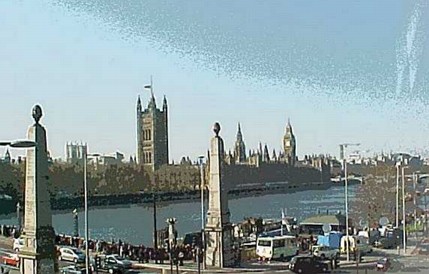 The queue of mourners can seen backed up across Lambeth bridge and around further along the Thames Embankment
Paul Staines
The current worrying increase in crime in Britain, with its spate of shootings, muggings, burglaries, as well as the continued rise in general boorishness and incivility, is one of the main topics of public debate in this country. Predictably, our political masters have reacted to this by proposing such illiberal and largely useless “solutions” as restricting the right to trial by jury, state ID cards, and so forth. So it is encouraging to know that an earlier generation was able to tackle what was by then a relatively unruly society withouth raining all over civil liberties. It has been done before and it can be done again.
I refer to that much misunderstood and maligned period – The Victorian age. They brought about a substantial drop in the crime rate without raining all over civil liberties. And one interesting feature of that period was that the school-leaving age was lower than it is now. Of course this is a complex subject, but I cannot help thinking that some of the current bout of delinquency among youngsters is that many of them are bored out of their minds at school and could be spending their lives more usefully elsewhere.
I found myself nodding in agreement whilst reading this snapshot analysis of the state of politics in Britain by Brian Micklethwait.
What he is really describing is the slow, but seemingly irreversible, public disengagement from politics and its traditional practices. The ever decreasing voter-turnout, not just in Britain but elsewhere, confirms it. People simply don’t want to talk about politics or politicians anymore (except to complain about both). The whole subject is boring; painfully boring. Switch channels, change subjects, let’s talk about Feng Shui instead. Or skiing. Or David Beckham. Or something. Anything. Politics is dull. Politicians are all the same anyway.They’re all useless. They’re all liars. Voting changes nothing.
Good. Disengagement from and disillusion with politicians is precisely what we want and not voting is a libertarian act. But it may not have libertarian consequences.
First of all, voter apathy is not being matched by bureaucratic or managerial apathy. In fact, if anything, the reverse is true. (I do not have any scientific evidence but there may be some correlation here). The less the public engages in political debate the more laws and regulations and policies get churned out. Take the EU (somebody, please). There is no voter engagement at all with the EU commission yet it is a sausage-factory of pointless pettyfogging decrees. It is almost as if, freed from the effort and inconvenience of actually having to argue the merits of their case(s), our political masters are free to do more or less as they please. Added to this is the damage than can be wrought by small but well-organised and energetic lobbyists (coporate and otherwise) who can pressure politicians to get their agenda imposed upon all. Meanwhile, the poor exhausted public simply rolls its eyes, tuts, grumbles and gets on with it, as if they expect this and just have to learn to live with it. There is apathy but widespread obediance and disillusion is a long way from rebellion.
Now some will say that this state of affairs cannot possibly last forever and they would be right. But it can last for an awfully long time and, currently, there is no end in sight.
Secondly, there most certainly is a huge, sucking ideological vacuum out there and nature dictates that it will be filled sooner or later. Certainly liberty is the oxygen that may well fill it but it is just as possible that it may be filled by a re-emergence of communism or (more likely in my view) tribal nationalism. Reason does not always triumph over stupidity and, let’s face it, collectivist philosophies have always had a far more visceral appeal to disenchanted and angry mobs.
Libertarians tend to assume that because we are right we will prevail. Dangerous, very dangerous.
Time for an update about British party politics. When I started Samizdating, I posted a piece about how the British media have finally started laying in to our hitherto untouchable Blair Labour – from now on: Blairbour – government, after about seven years of Blairbour being beyond criticism. However, in my earlier posting I exaggerated how easily the Conservatives might be able to exploit all this. I assumed that they could make clear and rapid strides in the entirely smart direction, and of course being the Conservative Party that’s beyond them. Plus, I keep forgetting how much Normal People hate and despise the Conservatives.
The underlying story here is of a great nationwide coalition for Blairbour between (a) Normal People who want better public services without taxes going up, and (b) Abnormal Socialists who find the Conservatives so appalling that they are prepared to tolerate any other non- or anti-socialist humiliations in order to see the Conservatives go on being humiliated by the Normals. This coalition is starting to crumble.
The Normals want “better public services” and the idea was that by booting out the Conservatives (who supposedly don’t care about public services) and having a Blairbour government that did care about public services (but who wouldn’t put taxes up), they’d get better public services. This was never true. “Public services” don’t work like that. See everything else ever written by libertarians since the dawn of time. Blairbour cannot ever do as well with public services as it has promised. Some public services have patchily improved, at great cost. Others have got worse, also at great cost. Blairbour is starting to mutter about tax increases. The patience of the Normals is wearing thin.
Insofar as it is possible to contrive any “better public services” the only methods that stand any chance – and it is only a chance – are Conservative methods. So now that “we must start actually delivering better public services”, the Abnormals are also starting to be seriously pissed off. Their own methods always fail, and everyone except them knows it. So the methods of the hated Conservatives are being obstinately persisted with by Blairbour, and if anything being beefed up (“we must now actually deliver better public services”). So the patience of the Abnormals is also wearing thin.
(The Abnormals also hate that Blairbour backs the USA against Terrorism. The Abnormals are deeply confused about Terrorism. Some Abnormals are neutral for it. Others Abnormals are neutral against it. None oppose it as keenly as Blairbour or the Americans.)
But the Conservatives remain hated and despised by both Normals and Abnormals. Blairbour is no longer the Best Government available. But Blairbour remains something almost as politically potent, the Least Worst Government. Watch for a huge surge in the polls by the Conservatives, because if that happens I’ll be proved wrong. But my best guess for the next general election is for further significant gains by the Sod-You-All Party, that is to say a further decline in the overall percentage of people eligible to vote actually bothering to vote, for anyone, with the actual number of MPs remaining much as now, except that there’ll be a few more Liberal Democrats. Far more likely than a surge of enthusiasm for the Conservatives – or for anybody else – is a general sense of depression and cynicism about politics as a whole.
Sounds good to me.
Which provokes the question: what of libertarianism? Could there be some kind of British “libertarian political party” cobbled together to fill a small but growing patch of this huge vacuum and snatch some of those idle votes? Maybe. But as usual, the Conservatives are now making just enough libertarian-ish noises (“diversity” – “importance of the market”) to keep all those “libertarians” who are fascinated by British party politics fascinated, still, by the Conservative Party. And the rest of us have better and more amusing things to do with our lives.
Yes, I think that’s what they call it: being ‘ahead of the curve’. In this case, the ‘curve’ that I am ahead of is The Times in an article warning of the dangers of the Proceeds of Crime Bill, the UK government’s grand apparatus in the already-discredited war against ‘money-laundering’.
The writer adopts a more conservative (some might say measured) tone than I did. The piece reeks of unctious solicitude much in the manner of a senior Civil Servant advising a Minister that his decision is ‘courageous’ but it does taper to a fine point:
“The legislation needs to be framed in such a way that it does not deter honest businesses from consulting their professional advisers on grey areas, where they may need clarification of their position in order to be able to rectify it. Otherwise the very professional confidentiality that has created a healthy climate of compliance in the UK will be undermined. This is likely to lead to more criminality, not less.”
Precisely the point I made (among others) nearly a year ago(1).
Still, my natural desire to gloat must be tempered by my satisfaction that some serious people in serious places are starting to get the message and, more importantly, are broadcasting it.
(1)= (link requires Adobe Acrobat Reader which can be downloaded for free)
|
Who Are We? The Samizdata people are a bunch of sinister and heavily armed globalist illuminati who seek to infect the entire world with the values of personal liberty and several property. Amongst our many crimes is a sense of humour and the intermittent use of British spelling.
We are also a varied group made up of social individualists, classical liberals, whigs, libertarians, extropians, futurists, ‘Porcupines’, Karl Popper fetishists, recovering neo-conservatives, crazed Ayn Rand worshipers, over-caffeinated Virginia Postrel devotees, witty Frédéric Bastiat wannabes, cypherpunks, minarchists, kritarchists and wild-eyed anarcho-capitalists from Britain, North America, Australia and Europe.
|




