We are developing the social individualist meta-context for the future. From the very serious to the extremely frivolous... lets see what is on the mind of the Samizdata people.
Samizdata, derived from Samizdat /n. - a system of clandestine publication of banned literature in the USSR [Russ.,= self-publishing house]
|
Four people have been gunned down in a drive-by shooting outside a nightclub in Bradford.
Residents in Manchester have taken to the streets in protest at the rising level of gun violence.
And (just on the TV so no link yet) a man has been shot dead in a pub in the East End of London.
Paul Marks takes a radical view of Britain’s transport system
No one has yet explained to me why the railways could not have been sold as a single unit.
If it had been more efficient to brake up British Rail into regional companies then the new owners would have done just that. Just as if it had been more efficient for the rail to be owned by one company, and have the trains run by other companies this is what would have evolved via the choices of people buying and selling shares (“market forces” are, of course, simply the choices of people engaged in trading). There was certainly no need for the government to engage in complicated schemes – just sell the thing and stand back.
People often talk for the need for subsidies for the railways to compete with the roads (and, to a lesser extent, the airlines) – but whilst I am pleased to accept the fact that the railways and roads do compete for custom (which rather undermines the idea that the railways must be compulsorily broken up to ensure “competition”) I think the whole idea that the railways must fall apart without subsidies is false.
Firstly the roads should not be provided “free” (i.e. free at the point of use) by the state. The problem is not that the government builds motorways late – the problem is that it builds them at all. If people want motorways let them build them and charge people to use them (such things as “road tax” should, of course, be abolished). If people really want to build free motorways let them do so – but I doubt charitable people will put up enough money for this idea.
As for the railways – subsidies should be abolished, but so should regulations. The railways have been attacked by regulations as far back as the 19th century (there were such things as profit controls even then), but in 1906 the government basically declared war on the private railways. Putting trade unions above the law of contract (i.e. outside civil interaction) hit British industry badly – but the railways companies were a specific target of the 1906 Act (the Act was, after all, a direct reaction to the “Taff Vale Judgement” in which the courts declared that a railways company had the right to sue a trade union for organised contract breaking). The “Liberal” government of the day also launched a tidal wave of regulations at the railway companies in the period 1906 to 1914. And then (during the First World War) the railways were taken over by the government, maintenance neglected and the system undermined. We should be very wary of making claims such as the idea that the British railway system was the best in the world in 1919 – such claims are not only rather easy for statists to refute, but (more importantly) undermine the libertarian case that regulations and state control have undermined the railways.
Why the history lesson? Simple – after the returning of the railways to a sort of private ownership history repeated itself. First history repeated itself as farce – in that the government of Mr Major did not intend to harm private railway companies with regulations (but did anyway). And then history repeated itself in a straightforward way with the Labour government’s transport boss (Mr Prescott) setting out to undermine the railway companies as much as he could. A policy continued by his supposedly arch “New Labour” successor as transport boss.
Without the regulations the railways might well be able to compete quite well with the roads without any subsidies at all – even if the roads remained free.
And (of course) a railway system without regulations would be a much safer railway system – as it would be clear who was in charge and who was responsible.
Paul Marks
It will come as no surprise to anyone who habitually reads British newspapers that the state likes the idea of being able to intercept any and all of your communications on the Internet. Well it just so happens that some people are not going to roll over for the government and play ball. Just as the state comes up with new technological ways to spy on its subjects (i.e you), those same subjects are finding ways to prevent them from doing so.
Mathematician Peter Fairbrother simply refuses to just accept the Draconian powers that the state has taken upon itself via the Regulation of Investigative Powers Act and is developing M-O-O-T, an integrated privacy system that you just pop in your PC or Mac at startup. As it uses off-shore key storage, the user can rest safe knowing that the British state cannot get access to your sensitive data at a whim. Bravo!

I must admit that the terms ‘Libertarian’ and ‘Monarchist’ are not one that are effortlessly congruent but neither are they mutually exclusive. So it is without any hesitation that I declare myself to be, in my own quiet and understated way, a Monarchist, at least as far as Britain is concerned.
This being the case, I am only too happy to rise to the challenge of Brendan O’Neill
“..in fact, worst of all is a monarchist who dare not speak his name, who won’t come out in full defence of the royals. So come on then – defend the monarchy.”
I do dare to speak my name, Mr.O’Neill, and defending the monarchy is not just my burden but, I’ll have you know, my pleasure.
If one is to live within the institution called ‘nation’ then it is entirely reasonable (and maybe even essential) to have something or someone to symbolise that nation. Our monarch fulfils that role not just satisfactorily but admirably. It is an institution which is the product of our heritage, culture and history and a reminder that our constitution and civil society was painstakingly built by the craft and toil of ages and has now been largely squandered by the kind of elected representatives you seem to admire so much.
The monarch is a continuum; it is an anchor for the commonwealth of the people and stands not above politics but apart from politics. The monarch has served and continues to serve as a totem for both British sense of community and nationhood; a stubborn reminder that British civil society is not within the gift of Tony Blair or Romano Prodi and will be here long after both of them have turned to dust. Our Queen really does serve, our politicians merely feed at the table.
I might remind you, Mr.O’Neill that it is not the Queen that is bleeding us white with taxes, it is elected politicians. It is not the Queen that is suffocating us with pettyfogging regulations and laws, it is elected politicians. It is not the Queen who has traduced our civil liberties, it is elected politicians. It is not the Queen that has delivered us, bound hand and foot, to the fat Cardinals in Brussels, it is elected politicians. Given the choice between Queen Elizabeth and the gaggle of mendacious, thieving sluts that people like you have in mind to replace her, I know for sure which one I would take up arms for.
So there you have it, Mr.O’Neill. A defence of monarchy. And since I have been bold enough to defend my position, perhaps you will allow me the indulgence of a challenge of my own? It is a challenge for you and all others who believe in ‘democratic’ virtues. Did you take a holiday last year? If so, did you canvass everybody in your constituency beforehand on their opinion as to a) whether you were entitled to a holiday and b) where you should spend it? If not, why not?
Well, it seems hapless former UK transport minister and all-round-twit Stephen Byers learned the hard way of why the once-magnificent British railway system was to prove his downfall. As they say, it could not have happened to a nicer guy.
Meanwhile, Patrick Crozier, at his excellent UK Transport blog, confesses to being totally surprised at the resignation of Byers. I confess to feeling the same way. But of course I am not kidding myself that anything will change in the quality of our transport network as a result of Byers’ departure. The trains will still be late and dirty, the Tube (underground subway) will still be noisy, late and hot; our roads will be jammed, and the cost of motoring will still be extortionate.
Britain is a member of the Group of Seven industrial nations and yet we have an increasingly third world transportation system.

Yesterday at Instapundit, just in case there are any Samizdata readers who read this but not that, there was a link to a story in the Boston Globe about the failure of anti-gun laws to control crime, in Britain. Depressing. The story. And the fact that the story seems only to be being told in America.
Don’t know how to tie your own shoelaces? Just what is the proper way to make a cup of coffee? Should a person sleep standing up or lying down? Having difficulty finding your own arse even though you’re using both hands a map? Don’t know how to barbecue sausages? Well, fret no longer because HM Government is here to help you.
“The Agency’s food hygiene campaign is going alfresco during summer 2002 with a 30-second TV ad spelling out the risks of not cooking barbecue food properly.
This should come as a blessed relief to anyone planning a barbecue this summer. After all, in a country where the mere act of lighting a charcoal briquette is enough to bring on a monsoon, only the hopelessly naive and terminally idiotic can possibly be planning a barbecue in the first place.
‘The Agency’. It sounds so sinister, doesn’t it? That’s because it is. The Food Standards Agency was established in the wake of the BSE crisis to reassure a jittery and highly risk-averse British public that the government was doing its bit to protect them from the evil bugs lurking in their own fridges. Which means, of course, that they do less of their own bit and, thanks to greater dependency and bureaucratic empire-building, today’s patronising message will become tomorrow’s law. I see Sausage Inspectors in our future.
It’s just another brick in the Napoleonic Wall behind which our collective goose is slowly being cooked.
The Sunday Telegraph has commented on the latest and most worrying example of the Labour Goverment’s accumulation of power by controlling information. The good Dr Liam Fox, also the Shadow Health Secretary, alerts us to the fact that last week the Government effectively dismantled the UK system of medical confidentiality. Under new regulations, slipped in using procedural devices to prevent debate in the House of Commons, the Secretary of State will be able to demand that doctors hand over medical records – and fine them if, in order to protect your confidentiality, they refuse to do so. The language of ‘the public interest’ is used to assert the right to demand, and receive, confidential medical information. Boringly, the ‘public interest’ is defined as whatever the Secretary of State says it is….
Having worked as a doctor myself, it horrifies me that doctors will now have to choose between breaching their ethics and breaking the law. To make matters worse, the new law is not restricted to doctors: the behaviour of every health care professional to his or her patients will now be subject to the direct control of politicians. The new law places the administrative convenience of the NHS not only above the bond of trust between doctor and patient, but above the dignity and privacy of patients….the change marks the death of the principle of the patient’s right to give consent before identifiable personal data about them is shared. It is yet another restriction of our liberty – and one we have surrendered to with barely a whimper of protest.
My question is ‘why is this not on the main news but on page 22 in the Comments section….?!’
… Paul Staines does not think so!
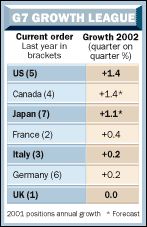
British Chancellor Gordon Brown’s recent splurge on the National Health Service was supposed to be supported by a bouyant economy, but first quarter figures (just released) are terrible.
Manufacturing output tumbled by 1.5 per cent, leaving it 6.5 per cent down on the same time last year ÷ the biggest annual decline since the recession of the early Eighties. A further slump in exports, by nearly 7 per cent, also took a heavy toll.
On the plus side that means mortgage rates are very unlikely to rise near term, but taxes may be more likely to rise as the economy stagnates – unless you think New Labour would actually consider reducing state spending?
As the graphic shows we have slipped from first to last in the G7 growth league – as the other G7 countries voters all shifted rightwards.
Things are going to get more difficult for Brown, sooner rather than later.
Paul Staines
Ever since Tony Blair ushered in the ‘Age of Blandness’, I sense that a lot of people in this country have been seeking a true ‘Voice of Britain’.
Personally speaking, I reject such collectivist concepts both formally and informally. However, if there was such a thing as a ‘Voice of Britain’ then Richard Littlejohn would be it.
Sometimes the story is something that never happened. And what never happened to me is that I neither filled in nor ever sent in my census form, whenever it was. They sent me a census form, so they do know where I live. I kept the form in case things ever turned nasty. I didn’t treat it as pure junk mail and bin it at once, but I never did anything about it. I vaguely remember them sending me a follow up letter saying something like: oh go on, please, if you haven’t … But I still didn’t, and since then: nothing. No threats, no men knocking on the door. My plan was never to actually defy the government and refuse to fill it in. I was never going to send letters to the local paper and insult local magistrates and refuse to pay the fine on principle. It was just to fill it in only when they really made me. “Oh you mean you really wanted me to fill it in? Why didn’t you say? Goodness. Silly me. Sorry, won’t happen again.” That was going to be my line. But it never came to that. Peculiar.
I think what pissed me off about the whole exercise was the slogan at the top, which went: “Count me in!” There was a little child’s hand sticking up, as if I was just begging to be included, and as if the thing was actually a spontaneous exercise in participatory democracy. It was as if the census was really a mass eruption, every ten years, of the popular desire to tell the government how many people one lives with and what one’s religion is, and how much money one earns. ” I can’t help myself, I simply have to tell them! Please, please, give me a form!” For some reason, I didn’t get swept up in this national emotional spasm. Instead, I said to myself: okay if you’re telling me it’s actually voluntary, then that means I don’t have to do it, right? It turns out I didn’t, and it was voluntary.
I don’t know what this proves. I think what it shows is that officially administered British life is now getting fuller and fuller of things that you must do, but which actually you don’t have to do.
I’ve noticed in radio debates recently that quite large swathes of the very law itself are now sliding into this must-do-but-don’t-actually-have-to-do Twilight Zone. Drugs for example. People are adamant that drugs (and you know the ones I mean, I’m not talking about aspirin) shouldn’t be “legalised”. But, on the other hand, they don’t think the police should actually do anything nasty to people who use drugs. It’s just that saying that you are allowed to use drugs would “send the wrong message”, or some such. When someone in a radio yack-in says that drugs should “remain illegal”, I press for clarification. What should happen to you if they catch you doing them? Oh, that’s not the point, the point is they’re very bad, very dangerous, they stick around in your body, blah blah blah. Yes, but should you be arrested, punished, fined, sent to prison? It’s not about that, blah blah blah. Isn’t it? Well no it really isn’t. That actually does now seem to be the law with drugs. Drugs are illegal, and you mustn’t do them. But, on the other hand, actually you can. Like I say, peculiar. This time it’s you-mustn’t-but-actually-you-can, which is the opposite of filling in your census form, but the principle, if you can call it that, is the same.
No links to this. I thought of this story all by myself.
Roger Dorrington, the father about whom I reported on Wednesday following his conviction for beating up the drug dealer who was divvying up heroin with Dorrington’s children in their family home, has been told by Judge David Griffiths that he will not have to pay the drug dealer £250 after all.
However the conviction still stands and he will have to do 100 hours of ‘community service’ for the crime of defending his children against a predatory heroin dealing trespasser. If Judge Griffiths wants him to actually serve his community, I can think of no better way of him spending that 100 hours than for Dorrington to explain, slowly and graphically, to the idiot on the bench what the reality of trying to prevent two teenage children from destroying themselves with heroin is actually like in the real world outside Southampton Crown Court.
Judge Griffiths is just doing what the state expects him to do by demanding that all British subjects be prostrate in the face of any actual threat in which the state does not choose to intermediate itself. Justice for Roger Dorrington and the very survival of his two children does not even enter into that equation. The state is NOT your friend.
|
Who Are We? The Samizdata people are a bunch of sinister and heavily armed globalist illuminati who seek to infect the entire world with the values of personal liberty and several property. Amongst our many crimes is a sense of humour and the intermittent use of British spelling.
We are also a varied group made up of social individualists, classical liberals, whigs, libertarians, extropians, futurists, ‘Porcupines’, Karl Popper fetishists, recovering neo-conservatives, crazed Ayn Rand worshipers, over-caffeinated Virginia Postrel devotees, witty Frédéric Bastiat wannabes, cypherpunks, minarchists, kritarchists and wild-eyed anarcho-capitalists from Britain, North America, Australia and Europe.
|