We are developing the social individualist meta-context for the future. From the very serious to the extremely frivolous... lets see what is on the mind of the Samizdata people.
Samizdata, derived from Samizdat /n. - a system of clandestine publication of banned literature in the USSR [Russ.,= self-publishing house]
|
They are off on a recruitment drive again:
A minister gave a strong hint yesterday that the Government will press ahead with plans to lower the voting age to 16.
David Miliband, the schools minister, told a conference of A-level students that it was illogical to prevent 16-year-olds voting when they were allowed to get married and work at that age.
Do you think he was playing to the gallery at all?
The Electoral Commission is investigating the case for lowering the voting age and several ministers have said they have an open mind…
An ‘open mind’? Is that what they are calling it now? I always thought of it as vast, untamed wilderness situated between their ears, full of tumbleweeds and bleached bones.
The Labour Party has floated the idea in its “Big Conversation” policy document and Lord Falconer, the Lord Chancellor, has called for a debate on this “very important” issue.
Yes, it’s keeping me awake at nights.
The voting age was 21 until it was lowered to 18 as a result of the Representation of the People Act 1969. Most countries have a minimum voting age of 18, although it is 17 in East Timor, Indonesia, North Korea, the Seychelles and the Sudan, 16 in Brazil, Cuba and Nicaragua and 15 in Iran.
North Korea!!? Now there’s a thriving engine of lively democratic values to which we can all aspire. And let us not forget the important contributions to the advance of citizen empowerment being forged in Cuba and Iran. These are the trail-blazers of mankind, Ladies and Gentlemen. Ours is but to give humble thanks for the gifts they have bestowed upon us as we eagerly take up the mantle of their enlightened legacy.
The Electoral Commission will publish its report on the subject towards the end of next month and it is expected that it will support enfranchising 16-year-olds.
Go ahead, make my day because this has got ‘backfire’ written all over it. The teenyboppers will just constitute yet another demographic block that stays away from the voting booths in droves. Either that or they will all earnestly rush to the polls to vote for the BNP. However it pans out, I predict disappointment or disaster or both.
Do you love red squirrels? I love red squirrels. They are very red and they are very squirrely. I love them. There are also some ecologists in England who love them too, almost as much as I do. They just love those big fluffy red tails.
They love them so much they hate anything which may come to lessen their numbers. They particularly hate grey squirrels, with a determined pathological intensity. They hate them so much, that they find great pleasure in killing them, wherever they can find them. Fine action for beardy ecologists, you may think, wiping out one species with murderous fury, to preserve another specially blessed one. But in this case, it’s OK, because the grey squirrels deserve it. Check out the Redsquirrel.org.uk home page, to find out why. Notice the lead phrase:
Sadly, thanks to the invasion of its grey cousin introduced from America, RED SQUIRRELS have been driven out from much of their territory
Invasion. America. Their territory. → Continue reading: Better dead than not red
If it was not so late and if I had not had such a long day, I would launch myself into a rooftop-raising rant about this. But it is late and I am weary and, besides all of that, I am beginning to wonder precisely what good a rant from me (or anybody else for that matter) would do anymore:
Home Secretary David Blunkett wants new anti-terrorism laws to make it easier to convict British terror suspects.
He has discussed lowering the standard of proof required by a court and introducing more pre-emptive action.
Possible plans, revealed on his six-day trip to India and Pakistan, also include keeping sensitive evidence from defendants and secret trials before vetted judges.
Is there any significance to the fact that David ‘Mugabe’ Blunkett elected to unveil his sinister plans on a trip to South Asia? Was he driven into delirium by the heat and the dust? Or maybe a particularly acute case of Delhi-belly left him feeling all bilious and vengeful.
But civil rights groups have condemned the proposals as shameful and an “affront to the rule of law”.
It’s not an ‘affront’, it’s a point-blank dismissal. ‘Lowering the standard of proof’? ‘Pre-emptive action’? ‘Secret trials’? ‘Vetted Judges’? What next? Trial by Ordeal, Ducking stools, Iron Maidens and The Rack?
The truly frustrating thing here is that not only is Big Blunkett unlikely to be opposed to any meaningful degree (the Conservatives are already weighing in on his side) but his ripping up of our last remaining bulwarks of civil liberty is probably going to make him more popular. That is because civil liberties are unpopular. They are merely the boring obsession of pot-smoking hippies and wishy-washy do-gooders; a shielding sanctuary behind which terrorists and child-molestors can hide from justice.
So, go ahead, Mr Blunkett, kick the crap out of them. With a bit of luck nobody will miss them until they have gone (by which time it will be too late).
In today’s Telegraph Charles Moore has an excellent summary of what is wrong with the BBC, its deeply entrenched institutional bias and its undeserved influence:
It seems to me that the BBC today is the enemy of conservative culture in Britain. This is not immediately obvious, because elements of the BBC’s output, particularly on radio, are justly loved by many conservative-minded people. But it is nevertheless the case. The few glorious programmes are used as the camouflage behind which political correctness can advance.
How does the BBC approach subjects such as American power, organised religion, marriage, the EU, the Middle East, the actions of the Armed Forces, the rights of householders to defend their property against burglars, public spending, choice of schools, or any perceived inequality?
Who will be more politely treated – Gerry Adams or Norman Tebbit, a spokesman for Hizbollah or Paul Wolfowitz? If someone appears on a programme described as a “property developer” with someone described as a “green activist”, who will get the rougher ride? If a detective drama features a feisty lesbian and a chilly aristocrat, which is more likely to be the murderer?
And when it comes to a war – it applied both in the Falklands and in Iraq – the BBC takes a pride in being what it calls “even-handed”, which means inventing moral equivalence between the forces of our country and those of aggressive dictatorships.
None of these attitudes is unique to the BBC, but what is unique is the BBC’s power to impose them. In order legally to have a television in your home, you have to pay the BBC £116 a year. This allows it to dominate virtually all forms of broadcast media, many of which have nothing to do with any idea of “public service broadcasting”.
Out of the deference that this power instils, senior BBC executives are paid more than anyone else in the entire British public service. Greg Dyke, the now ex-director-general and editor-in-chief who seems to have been too busy to edit, got £464,000 last year. BBC executives are like the princes of the Church of England before the commutation of the tithes. They are rich and powerful, and no doubt they mean well, but there comes a time when non-conformists get fed up with paying for their sermons and their privileges.
That time is surely near. We must find a way of abolishing or hugely reducing the licence fee while reviving the core of public service broadcasting. How half-witted of Tory Britain to hand this chance to Tony Blair, instead of claiming it for itself.
Apologies for such a long quote but apart from a tiny disagreement about the license fee – it should be scrapped, not just reduced – I have nothing to add.
…is that so many people are astonished that a paragon of the establishment like Lord Hutton should take the view that whatever the government’s ministers say should be presumed to be correct whilst that of mere journalists, even those working for the state owned media, should be assumed to be dissembling.
Did anyone seriously think the outcome would be otherwise?
I realise this is The Story Of The Moment, but simply cannot get that worked up over the difficulties of institutions of which I have such low regard to begin with.
Paul Smith is a man with a profound interest in driving and road safety. As a driver myself I, too, have a vested interest in these matters. Whenever I depart from point A I much prefer it to be overwhelmingly probable that I will reach point B with all my favourite limbs and organs in situ and functioning as nature intended.
The British government and its various agencies claim that they share this interest as well. Moreover, they assure us that the solution to the problem lies with forcing everyone to drive more slowly and punish those drivers who fail to comply. Hence the virus-like proliferation of the ‘GATSO’ or ‘Speed Camera’ which (just by complete coincidence I am sure) has also raised tens of millions of pounds for the public coffers from already over-taxed motorists who infringe blanket and arbitrary speed limits.
In response to the wave of discontent this has caused, the government, the police and the various lobbyists that support them, have doggedly stood their ground and explained that, yes, it is all very regrettable but the point of the GATSO’s is most assuredly not to raise revenue (no, perish the thought!) but merely to save lives. In other words, they are relying on the canard that freedom must be sacrificed in order to achieve safety.
Well, they are wrong and Paul Smith has made it his business to prove, publicly and beyond argument, that they are wrong. His website, Safe Speed, cuts a swathe through the cant and the piety:
We have never seen any credible figures that put road accidents caused by exceeding a speed limit at even 5% of road accidents. We object to speed cameras mainly because they fail to address the causes of at least 95% of road accidents. The Government claims of 1/3rd of accidents being caused by excessive speed are no more than lies according to the Government’s own figures.
I am shocked, SHOCKED I tell you!
Mr Smith has amassed a treasure trove of documentary, audio and video evidence that entirely discredits the myth that Tax Speed Cameras are anything whatsoever to do with either road safety or saving lives. In fact, so confident is Mr Smith in his own research that he throws down this gauntlet:
So here’s the challenge. We promise to publish here (in this box, on the first page of the web site) web links to any serious credible research that implies a strong link between excessive speeds and accidents on UK roads.
So if you are one of those people who thinks that the GATSO is a life-saver, you know exactly what to do.
In the meantime, more power to Paul Smith and his campaign for common sense and reason. When we eventually win this battle, the victory will be due in no small part to the dedication and integrity of people like him.
Cross-posted on White Rose.
At least one member of the ‘great and the good’ seems to think that enterprise is important:
Britain will become a 21st century theme park, unless more is done to create an enterprise culture, a business leader has warned.
George Cox, head of the Institute of Directors, warned the UK was at risk of being reduced to “selling…souvenirs”.
A “can do” mentality must be instilled in young people to benefit business, Mr Cox added.
The comments came ahead of a key government conference on the issue, to be held in London on Monday.
Mr Cox welcomed the talks involving businessmen and women and politicians aimed at boosting enterprise.
Since it is unlikely that an invitation to this event is going to be extended to any members of the Samizdata Team, I expect that the politicians concerned are not going to hear the one thing that they should be told: that the way to ‘boost’ enterprise is to unboost themselves.
If youngsters are being deterred from starting their own businesses then they are hardly to be blamed. Who wants to have to spend most of their time, effort and intellectual energy steering a path through a vast forest of regulations, directives and laws only to watch the taxman take a big, wet, juicy bite out of the little profit you have managed to earn. And, to top it all off, you then switch on the TV or open the morning newspaper only to be told that you are ‘the enemy of the people’.
Contrast this with going for a job in the public sector which will give you a guaranteed income, a job for life and the steadfast loyalty and service of the political classes.
It’s a no-brainer. Life is too short.
Ironic, is it not, that Mr Cox and other business leaders worried about the apparent decline in enterprise are taking their concerns to the very people who are responsible for suppressing it? He will get nowhere.
What he may get for his trouble (apart from a round of champagne cocktails and a plate of canâpes) is a set of ‘Enterprise Regulations’. Mock not, that is very possibly going to be the only tangible outcome and there is no shortage of people either within government or elsewhere who will earnestly see that as a solution.
Mr Cox is to be applauded for at least raising the question. The answer will prove very elusive. How on earth does anybody expect a ‘can do’ spirit to flourish in a political and cultural ethos of ‘should not do’?
The growing examples of Western firms outsourcing or “offshoring” jobs, including hi-tech ones in software, to locations such as India has triggered a certain amount of bleating in parts of the commentariat as well as some excellent responses, such as at the blog Catallarchy. What this does show, however, is that those nations best able to cope with the ever-shifting sands of the global economy are those with the ability to harness skills to best effect.
For some time, we self-deprecating Brits have tended to downplay the extent to which we can still punch our economic weight in such a harshly competitive world economy. Well, this entertaining book, Backroom Boys, by Francis Spufford (never heard of him before, BTW) is a pleasurable, if sometimes maddening account of how the British scientists have pioneered or collaborated in a range of economic fields, such as the early space race of the 1950s and 1960s, computer games, the supersonic jet plane Concorde, and perhaps most significant for our present lives – mobile phones.
What I particularly liked about Spufford’s book is how he got under the skin of how scientists work and co-operate with one another. He nailed home the point that in scientific establishments, both in the public and private sector, what counts for a scientist is not necessarily big money, but the respect of one’s peers. For a scientist, you are respected as much for the ideas you share with your peers as to how many times you get your face on the front of Time magazine. In short, he says scientists operate an intellectual “gift economy” where altruism pays.
The book also shows how British scientific efforts, often “hobbled” by supposed lack of funds, often had to adapt and employ more nimble ways of research while their better-funded American rivals could just bully ahead. The best example, of course, is the contrast between Britain’s puny efforts to launch its own space programme, including the Black Arrow rocket programme, and the various endeavours of NASA. (I wonder how many readers know Britain had this programme? I certainly did not).
The story of how Concorde, a collaborative Anglo-French venture came into being and was supported by the taxpayer before eventually being drawn into the maw of privatised British Airways was instructive. Libertarian purists will, of course, blanche at the idea of such a plane being created with tax funds in the first place. I side with them, but I could not help noticing that Concorde came into its own as part of an overall business package when BA became a private business. There is a lot of interesting description in the book about the “halo” effect, whereby a luxury, loss-making entity like Concorde is kept within a business to make the whole operation more appealing. Spufford also reflects about the nature of luxury goods and how they are priced. It may seem irrational that a Concorde seat costs X times more than that of a seat on a Boeing 747, but making the seat so costly was part of the cachet, like the cost of a Rolex watch or an Aston Martin sports car.
Perhaps in a moment of rare hubris, Spufford ends his book speculating about the now-fated Beagle 2 Mars project. He dreams that a “British suitcase is on Mars”. Oh well, you cannot win ’em all.
Are politicians actually capable of thought and articulation or they merely making noises in return for which they think they are going to get rewards?
Barely two weeks after Michael Howard trumpeted his alleged belief that “the people should be big and the state should be small“, he weighs in on the side of big state and against the little citizen:
A future Conservative government would reverse Labour’s downgrading of cannabis from Class B to Class C, Tory leader Michael Howard has said.
His intervention comes a week ahead of the change to Class C, which will place cannabis alongside anabolic steroids and prescription anti-biotics and mean police will rarely make arrests for possession of small amounts of the drug.
Mr Howard said: “After thinking about this very carefully, we have come to the view that the Government’s decision is misconceived and when we return to office, we will reclassify cannabis back to Class B.”
Mr Blunkett’s changes introduced a “muddle” which would send a signal to young people that cannabis was legal and safe, when it was not, said the Tory leader.
Well, there is a germ of truth here in that HMG is most certainly in a ‘muddle’ but at least it is a muddle which is shambling along, after a fashion, in a sort-of, vaguely right direction. The motives may not be entirely logical or even honourable but I think it’s results that count here.
But am I to believe that Mr Howard has thought about this ‘very carefully’? Cannabis is only illegal because people like Mr Howard demand that it be so and the question of whether or not it is ‘safe’ (whatever that means) is entirely irrelevant. If he genuinely wants to the state to be small then he is hardly likely to achieve that aim by reinforcing the principle rubric behind big government, i.e. that it is necessary in order to manage the citizen’s health and welfare.
So is Mr Howard (a) disingenuous or (b) really not thought this through at all?
I think we have a right to know.
The natives are finally growing restless. Well, some of them are, at any rate and, for just for a change, this is grass-roots agitation of the righteous sort.
Yes, the people behind the Taxpayers Alliance are as mad as hell and they are not going to take it anymore. The strapline says it all:
Campaigning for lower taxes because it’s our money
Right on, brothers and sisters and Amen and, might I just add, about bloody time too. Ever since the mid-90’s, when the producing classes were finally bullied and browbeaten into dolefully accepting that higher taxes would result in better government services, they have stoically maintained their stiffer upper lips while the fiscal thumbscrews have been steadily tightened.
But the government services they thought they cherished have remained as crap as they ever were and now, finally, a few of them have realised that they’ve been took, they’ve been had.
But (and you all knew that there just had to be a ‘but’) as pleased as I am to finally see these few worms turning, they still have some way to go before they address the ‘root causes’ of their problems:
We have already found £50 BILLION of unnecessary government spending to cut (without closing hospitals or schools, or cutting pensions). That is more than enough to abolish Council Tax or take a big slice out of Income Tax.
The objects of their attack are what they see as the ‘waste and inefficiency’ of the government as if those things can somehow be magically eradicated while leaving the public sector largely intact. However, ‘waste and inefficiency’ are not bugs requiring elimination in order for the welfare state to function properly, they are systemic features of the welfare state itself.
For as long as these campaigners continue to accept the fabian argument that services like healthcare and education must be provided by the government, then their otherwise noble campaign will remain fatally flawed. It leaves them wide open to the counter-argument that state and schools and hospitals must have the necessary ‘resources’ and sooner, rather than later I think, they will find themselves running smack into that brick wall.
But, that said, they are still doing the right thing. Or, at least, starting to do the right thing. I hope it is the thin end of a very thick wedge.
[My thanks to reader Gawain Towler who provided the above link via Terence Coyle.]
It is a seldom-recognised fact that the British are world leaders in the art of grumbling. By a long margin, it is our most popular national pastime. In fact, if grumbling was an Olympic sport (or perhaps synchronised grumbling) then it would be British competitors taking gold, silver and bronze. The other nations do not stand a chance.
And I can find no better example of this kind of world-class, cutting-edge grumbling than this article by Philip Johnston:
Do you ever feel like Howard Beale, the character played by Peter Finch in the film Network? He was a news presenter on American TV who became so frustrated at the refusal of anyone to listen to reason that he invited viewers to open their windows and yell into the streets: “I am as mad as hell and I am not going to take it any more.”
Such conspicuous expressions of indignation are more acceptable in America than they are here. When we are as mad as hell, the most forceful manifestation of our emotions tends to be a resigned shrug or a heavy sigh. Understatement is one of our endearing national characteristics; but it also means we can more easily be taken for a ride.
And that is why we lead the world in grumbling. We have the ideal training programme.
Our predisposition to react benignly to developments that would have other people taking to the streets is to be applauded. But this quintessential mildness relies on governments, local councils and others who can interfere in our lives to do so only when it is absolutely necessary, and then in a fair and balanced way. The current Government is no longer able to identify this fulcrum. It brings in legislation because it believes that its very function is to pour forth a cascade of new laws each year, even when there is no demand for them.
Suggest to a minister that he might try to get through the parliamentary session without legislating and he will look at you as if you are crazy. Propose that existing laws should take effect before new ones are introduced and expect a blank stare. After all, what are politicians for if not to bring in laws? “We legislate therefore we are,” should be written on the gates of the Palace of Westminster.
But what else are politicians for? Pray tell, Mr Johnston?
For those fed up with high taxes, street crime, late and dirty trains, inane regulations, the unjustified use of fines and charges, bloody-minded parking restrictions, excessive public sector waste, preposterous European directives, multi-culturalist busybodies, useless and unaccountable council officials and six-hour waits at the local hospital’s A&E centre, a shrug and a sigh are no longer enough.
And so what? What follows from that? If Mr Johnston is proposing that our time-honoured traditions of heavy sighing, eyeball-rolling, muttering and impotent resignation are no longer sufficient grist for the national mill, then so be it, but where do we go from there?
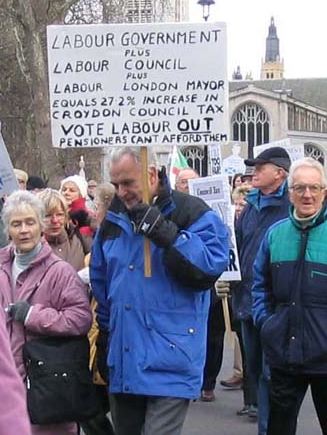
Yesterday afternoon I was out and about walking in London, and just before I got to Parliament Square I encountered a demo. It was not raucous or unpleasant. It was nice. It was old people complaining about their council taxes, which obviously I am all in favour of.
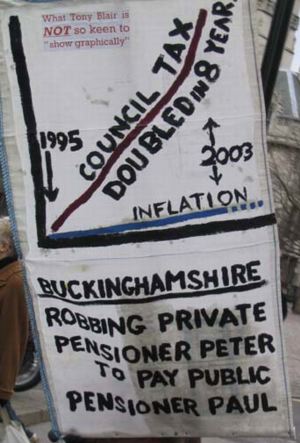
Following the example of supreme Samizdatista Perry de Havilland, I now take my DigiCam with me whenever I go a-wandering, so I was able to start snapping. At first it was just nice old people accompanied by nice policemen, with nice buildings in the background, but only very crude signs to say what it was all about. However patience was rewarded, and some of the signs were highly informative.
27.2%. Ouch! Whatever happened to stealth taxes? (Hey hey LBJ, you killed 27.2% more kids today than yesterday, you bad bad person. Not the same ring to it, somehow.)
And this one takes onlookers into the university lecture theatre.
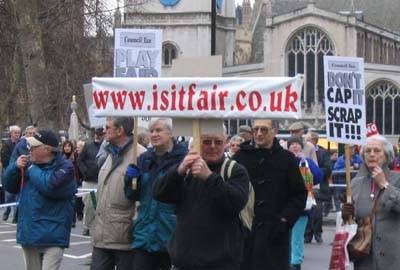
Okay, okay, I’m excited, and I want to know more. How can I follow it up?
Wow, a website. They say, in fact Perry just said it to me in connection with this post, that a picture is worth a thousand words, but I reckon best of all is pictures with words embedded in the pictures, explaining everything. Preferably with an internet link.
|
Who Are We? The Samizdata people are a bunch of sinister and heavily armed globalist illuminati who seek to infect the entire world with the values of personal liberty and several property. Amongst our many crimes is a sense of humour and the intermittent use of British spelling.
We are also a varied group made up of social individualists, classical liberals, whigs, libertarians, extropians, futurists, ‘Porcupines’, Karl Popper fetishists, recovering neo-conservatives, crazed Ayn Rand worshipers, over-caffeinated Virginia Postrel devotees, witty Frédéric Bastiat wannabes, cypherpunks, minarchists, kritarchists and wild-eyed anarcho-capitalists from Britain, North America, Australia and Europe.
|