We are developing the social individualist meta-context for the future. From the very serious to the extremely frivolous... lets see what is on the mind of the Samizdata people.
Samizdata, derived from Samizdat /n. - a system of clandestine publication of banned literature in the USSR [Russ.,= self-publishing house]
|
I carry a Swiss Army Knife around with me on my keyring. I find the blades, scissors, and bottle opener in particular to be very handy. (Some of my friends and I have an ongoing personal joke about whether anyone has ever found a single purpose for the “multi-purpose hook” feature, however. I favour the climber model, and I must have had about five of these over the last fifteen years. I have lost my keys three times that I can think of (always in really stressful situations) and I have also had a Swiss Army Knife confiscated at Heathrow once. None of my knives have ever worn out: they do seem to be very well made. On every occasion I have bought another one of the same model. (I once attempted to buy a blue one instead of a red one, but the shop was sold out). I have had the current knife just over 18 months, I think, and hopefully it will last much longer. But, whenever it happens I need a new one, I may have to consider a different model. That’s right, it’s a USB Swiss Army Knife. What is even more scary than the existence of this is that having a built in USB Flash Drive on my knife is something that I would actually find useful.
 Yes, a scary thought is going through my head. Unlike certain other strange USB devices I genuinely do want one of these.
Link via Slashdot. (Where else, really?)
Surprise surprise:
The renewable energy industry suffered a setback today with the publication of a report showing that electricity from offshore wind farms will cost at least twice as much as that obtained from conventional sources.
According to research carried out by the Royal Academy of Engineering (RAE), the cheapest electricity, costing just 2.3 pence per unit, will be generated from gas turbines and nuclear power stations, compared with 3.7p for onshore wind and 5.5p for offshore. The Academy also emphasised the need to provide backup for wind energy to cover periods when the wind doesn’t blow. The study assumed the need for about 65% backup from conventional sources, adding 1.7p to the cost of wind power, bringing its price up to two and a half times that of gas or nuclear power.
The other alternatives are: coal, which is about to get blamed for frying the planet and to be made illegal, here anyway; and: nuclear power, which is horrid horrid horrid and will never be allowed no matter how sensible they manage to make it.
Accordingly, it won’t be long before we all freeze to death. And since there will not be any electricity, we will not even be able to blog about it.
Prediction: the idiots who between them achieved this will then blame capitalism, for, er, exploiting people’s desire to stay warm, that is to say, not exploiting it enough, er, drivel drivel, shiver shiver, …
Actually, this is not all bad news. The bad news would be if there was no news about it all, and it was just happening. The story here is not merely that environmentalists are driving us all enviro-mental with their idiotically contradictory policies. It is that boring sounding people like the Institution of Civil Engineers are starting to get nervous, and even rather angry.
Nuclear engineers are getting in on the act too. Here is a bit lower down in that Guardian story:
RAE vice-president Philip Ruffles acknowledged that the findings may sound surprising, especially as the cost of nuclear decommissioning had been included in the research.
“The weakness of the government’s energy white paper was that it saw nuclear power as very expensive,” he said. “But modern nuclear stations are far simpler and more streamlined than the old generation and far cheaper to build and run.”
But the mad hippy lunatic scumbag tendency has no time for talk like that:
The British Wind Energy Association, who last year gave full backing to the government’s wind, questioned the reliability of the data which the RAE used: “BWEA assumes that the figures quoted for nuclear power are based upon reactors that are yet to be built and is not aware of any market experience that proves the costs claimed by the Royal Academy of Engineering,” it said.
But the reason there is no market experience of wind farming, surely, is because no one has yet expressed any desire for its product, give what it costs. With talk like that, the more lunatic your entrepreneurial scheme, the more it would be entitled to government money, so that it could acquire ‘market experience’. But maybe I have misunderstood the man.
Be that as it may, the real reason I included that last bit was the presence in it of the glorious phrase (from which a word must surely be missing): “gave full backing to the government’s wind”.
Here at Samizdata, we never give full backing to the government’s wind.
Climate Alarmism Reconsidered
Robert L. Bradley, Jr.
Institute of Economic Affairs, Hobart Paper 146, 2003
This is a rather cautious riposte to the noisy consensus that seems to get all the publicity. Bradley follows Lomborg in pointing out that programs like Kyoto will make so little difference that the money notionally saved might just as well be spent elsewhere – dealing with poverty will do more to clean up the environment that instituting measures that will bear down more on the poor than on anyone else. Since their effect on climate will be minimal anyway, further, even more difficult negotiations must follow.
The free market has done more to solve problems of resource shortages and pollution than the activities of governments; a broad hint that these, defined as statism by Bradley, will be incorrect when applied to climate control. Perhaps unfortunately, he also coins the term stasism, to define the radical environmental position, basically “a wish to return to an idealised stable past” (p. 109).
He sees the current consensus as discounting the benign effects of greater warmth, which occur more in winter than in summer, at night rather than by day and where it is cold rather than hot. Also not taken into account has been the beneficent effect on plant growth of higher levels of carbon dioxide, the optimum for which is 800-1200 ppm, about two to three times what it is now (375) and twice what is forecast for the end of the century (522). He also notes that increased melting of the Antarctic ice sheet at one edge is balanced by thickening at another and by more precipitation onto its land-mass.
His non-polemical language makes it difficult to grasp his most salient arguments, and to some extent I feel that he assumes that the current fuss will die down and that it will become another scare to look back on.
There are three appendices, the first quoting forecasts that, over the years, have been falsified by events, the Ehrlichs being prominent here; the second, positive features half-buried in the latest Report from the Intergovernmental Panel on Climate Change (IPCC), published by the CUP in 2001; the third, extracts from Jevons, the first doomsayer on the subject of resources, in 1865.
I note that Bradley has written a book entitled Julian Simon and the Triumph of Energy Sustainability (2000).
Call me cautious if you will, but I will wait a while before jumping for joy over this potentially wonderful news:
U.S. researchers will soon publish strong evidence of a recipe to generate fusion power with tiny bubbles, which does sound like a modern witch’s brew.
The power source is ultrasonic noise aimed at a clear glass canister whose size would qualify as a grande latte in a coffee house. The sound waves rattle through a liquid solvent in the glass and, as they do, create minute (on the order of a thousandth the width of a human hair) bubbles. Further sound causes the bubbles to expand, compress and then collapse. When they do, some of the hydrogen atoms in the liquid seem to fuse and give off light and energy.
Hmmm… What do our resident gearheads make of this?
Ten years ago I was at Cambridge spending too much time doing stuff on the internet when I was supposed to be working on my Ph.D. thesis. In those days the World Wide Web was fairly new and didn’t contain that much information, and Usenet newsgroups were the normal way that people on the net formed online communities. (These are now archived on Google). Newsgroups were devoted to individual subjects, and although there was a tendency for conversations to become heated and abusive in certain circumstances, civil and intellectually stimulating conversations often occurred. Knowledgeable and interesting people gained reputations, and some of these people are still prominent in internet circles to this day. At the time the net was largely paid for by universities, the Deparment of Defence, the National Science Foundation and various other government organisations, and commercial activity of any kind was frowned upon. (It may seem remarkable today, but when the Hotwired website (then the online arm of Wired Magazine) became the first website to introduce advertising in 1994, many people complained that this was contrary to the spirit of the internet and threatened to boycott the site).
However, on March 5, 1994, ten years ago today, something terrible happened. The first spam was sent. The same message was posted to thousands and thousands of different newsgroups. This came from Canter and Siegel, a two person husband and wife law firm from Arizona, advertising their services providing assistance to people who wished to enter the US Green Card lottery. We had never seen anything like it, and we were outraged. Canter and Siegel were mailbombed, and received immense amounts of abuse. However, nobody was able to stop this practice of massive crossposting, and it soon became very common. This so called “spam” was one of the reasons why Usenet newsgroups became steadily less useful in the following years.
Although there is some disagreement, this post is pretty widely regarded as the first ever piece of spam. The technique was established. Some sort of automated script would be used to send the same message to a vast number of different recipients. Spam soon spread to other applications of the internet. I remember receiving my first piece of e-mail spam a year or so later. It came from an AOL address and I was so outraged that I sent a message to the postmaster at AOL, and received a sympathetic reply saying that they were doing everything they could do to stop this. Sadly, as I now know, they could not.
What I did not expect was that e-mail spamming would grow to such an extent that e-mail would be barely useful as a tool, which is where we are today. The interesting bits of the internet would move from public forums like Usenet to private sites such as blogs, which although not entirely immune from spam, seem to be doing a better job of fighting it than did more public forums such as Usenet. Spam filters would become ferocious, eating plenty of legitimate e-mail as well as spam. Proposals on the table to fight spam involve such suggestions as authenticating all e-mail, only allowing e-mail to be sent via approved servers from big companies, charging for all e-mail, and other such proposals that typically involve a loss of privacy and convenience. Various systems (such as the Turing codes used in the comments system on this blog) are used to determine that messages were sent by real human beings and not programs. Many people now only look carefully at e-mail that comes from known recipients, which eliminates or at least reduces one of the great joys of the internet, that it is possible to be contacted and to contact interesting people all over the world without an introduction and with a general assumption of goodwill. Instead, our e-mail boxes are filled with awful crap from the porn industry and other dubious semi-criminal and indeed fully-criminal organisations.
While somebody else would have no doubt invented spam soon after if the two Arizona lawyers had not, Mr Canter and Ms Siegel have the distinction of being the people who did it. For a brief while they managed to champion themselves in sections of the mass media as brave souls who were bringing capitalism to all the hopelessly utopian hippies on the internet – I even saw them being interviewed on CNN once, and they actually published a book explaining the virtues of spamming to other people. However, it soon became clear that they were a pair of bottom feeders. Laurence Canter and Martha Siegel had been suspended from the Florida bar in 1987 for dishonesty, and in 1988 Canter had resigned permanently from the bar in Florida after being charged with “neglect, misrepresentation, misappropriation of client funds and perjury”, and he didn’t get many CNN interviews after this became widely known. Having moved from Arizona to Tennessee, he was disbarred there in 1997, and his spamming was given as one of the reasons why. He and Siegel were divorced in 1996, and Siegel died in 2000. For the first time since the fourteenth century, a new (tenth) circle of hell was deemed necessary, and Satan created this new form of eternal damnation especially for “spammers”, intially for her. (At least I hope he did). As far as I know, Canter is still alive and living in California. Although there has been speculation on the precise nature of his relationship to Satan, I think that it is relatively simple, and that he will one day join his former wife as a tenant of hell. One can hope.
(Thanks to slashdot for reminding me of the anniversary).
I occasionally buy a magazine called The Week, which contains, or so it claims on its front, “the best of the British and foreign media”. How pleasing to see Britain counting unapologetically for about as much as the rest of the world put together, and as the first of these two equals. Quite right.
Joking aside, on page 26 of the Feb 28 issue, there is this letter:
To: The Guardian
As a scientist of no fixed political position, but deeply involved in climate science and sea-level changes, I agree with Diana Liverman that we must exercise caution with the Earth. Likewise, we must not confuse facts and fiction, nor justify wishes with falsification.
As president of an international commission on sea-level changes and coastal evolution, I launched a Maldives research project. Observational data obtained by our international team of experts shows conclusively that the sea level is not rising, unlike fictions propagated by many who are not specialists.
Nils-Axel Morner, Stockholm University
I have read more grammatically perfect written English than this. I mean, what exactly does it mean to “justify wishes with falsification”? And although the attempted meaning of that final sentence is clear enough, its actual wording is something of a muddle. One expects better English from Scandinavians. Nevertheless, the most important bit, where it says that “the sea level is not rising”, is clear as clear can be.
That international commission would presumably be these people.
Interesting, I think. And good on The Guardian for printing the letter.
Bjørn Lomborg, author of The Skeptical Environmentalist gave a lecture this evening (this was posted after midnight but still that same evening – ed) at the Adam Smith Institute in London. A number of the Samizdatistas were there. Lomborg’s arguments are familiar to those who have read his book, but it was a rapid, powerful, to the point speech in which he demolished many of the arguments of the “The world is facing impending environmental collapse” school of Greenery with ruthless efficiency. His ten minute demolition of the case for the Kyoto accord was particularly impressive.
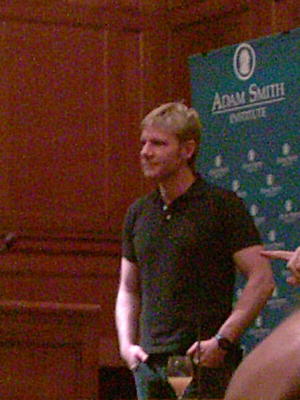
Lomborg walked on stage wearing a pair of jeans and a polo shirt, and looked just like the thirtysomething Greenpeace member and quintissential Nordic person of more traditional environmentalist views he once apparently was. He spoke with a rapid intensity, clearly wanted to get a lot out in the relatively short time he had for the lecture. And perhaps the rapidity of speech was covering up a certain natural shyness, but if so this was mixed in with what was clearly a burning desire to get his message out.
Lomborg told the familiar story of how he found himself in this position. → Continue reading: Bjørn Lomborg at the Adam Smith Institute.
Malaria and the DDT Story
Richard Tren and Roger Bate
Institute of Economic Affairs, 2000
This is a short “Occasional Paper” of about 100 pages, including Introduction and Bibliography, which I read without reviewing when I received it . After reading Robert Ross’s Memoirs, Honigsbaum’s The Fever Trail and Rocco’s The Miraculous Fever Tree, books about cinchona/quinine and Sallares’ Malaria and Rome, I thought I had better re-read it with more attention.
DDT (Dichloro-diphenyl-trichloro-ethane) is the safest, most efficient and cheapest insecticide used to eradicate Anopheles, the mosquito that transmits malaria from person to person. There are three species of malarial parasites in humans, Plasmodium vivax, Plasmodium malariae and Plasmodium falciparum (a pedant would add a very rare fourth), of which falciparum is by far the most deadly and essentially the cause of the problem under discussion. → Continue reading: Not rolling back malaria
According to yesterday’s Observer the HMS Beagle, the ship on which Charles Darwin sailed to the Galapagos Islands and around the world (and which later visited northern Australia, which ultimately led to Australia’s northernmost city being named after one of the greatest of all scientists) has been possibly located at the bottom of a marsh in Essex. There are no records as to where the ship was taken after being sold for scrap in 1870, but some historical detective work by Robert Prescott, a marine archaeologist from St Andrews University, followed by a radar survey appears to have tracked it down.
Given that this is the vessel onboard which one of the greatest of all scientific revolutions began, it would be wonderful if this ship could be raised out of the marsh and put in a museum somewhere, or perhaps it could be turned into a museum. Thematically it would be perfect in the Science Museum in Kensington, but I suspect that the 90 ft brig would be a little big for the building. And while it would presumably be possible to transport it up the Thames on some other vessel, transporting it through Chelsea to Kensington might be a little bit of a nuisance. So perhaps the Maritime Museum in Greenwich would be a better bet.
(Link via slashdot).
Friedrich Blowhard’s latest and pleasingly whimsical posting is called Visual Google. What he was doing was typing in words, albeit words with visual connotations and consequences. Hello “clouds”. Hello “sky”.
Says Friedrich:
It may be an exaggeration to describe a Google search as “found art” but I generally like the results at least as well as a John Cage musical composition.
Indeed.
But now here’s what I thought Friedrich might have been writing about. For some time now I’ve been wondering how you search the net for a picture, when all you have to go on is a bit of picture yourself. Suppose you have a rather blurry or unsatisfactory image, or perhaps a fragment of an image, or maybe a quite good drawing of an image, and you want the Giant Computer in the Sky to tell you what it is, and to show you a far, far better version of it … can you now do that? Are there truly visual search engines out there? And how about a visual description (“cubist woman, with transparent handkerchief in front of her face, crying, lots of yellow, red and blue”) but not the official title? Can search engines now – or will search engines ever be able to – respond intelligently to a query like that?
And how about music? Can you now, or will there ever be a day when you can, go “you know that thing that goes Dah dah de dah dit kabang swoosh …” and get five suggestions for the original track listed for you and ready to roll?
There are some people in this world who do such a good job of discrediting themselves you need hardly bother. I refer you to the public attack on Dr. Glenn Reynolds by a Mr. Mark Modzelewski.
I double checked the impression given by his writing with a physicist friend who runs into him on a regular basis and will for political reasons remain anonymous. “The guy is a PR Flack” and “He knows nothing” were perhaps the kindest remarks I heard, and this is from deep within the ranks of people Mark deals with.
So I’m a Drexlerian by his lights? I find that a label to be proud of.
At least I can pronounce it.
Ever since I struck the chords of some of my libertarian friends with my Libertarian Alliance piece entitled The Fixed Quantity of Wealth Fallacy, I and several of the friends have been on the lookout for new uses for the phrase “fixed quantity of [insert new something whose quantity is not fixed] fallacy”. Well, here is another. See title above.
The beauty of the FQ?F is that all you have to do is state it. Much of the argument is made simply with the phrase. Jobs. Happiness. Travel. Linoleum. Blogging …
The point is that simply altering the price of something massively increases the demand for it. And when economists talk about demand, they are not merely discussing potential consumers standing about with stupid plackards and stamping their feet and getting in a rage – as in political ‘demand’ – they mean actual ‘effective’ demand, demand that counts for something, demand with cash to back it up.
Just to get the linking thing out of the way, I here give thanks to two recent articles which stirred me into saying what follows, one the already much linked-to Wired piece about how Indian programmers are now turning Silicon Valley into a dust bowl, and the other being a piece in today’s New York Times in which you can see the beginnings of the dawning light in the Western Official Mind that this might not all be entirely bad news after all.
So, let us think about this Fixed Quantity of Programming Fallacy. It applies, of course, to the row now raging about the way that those sneaky Indians are stealing all our – I use the words “sneaky”, “stealing” and “our” ironically – computer programming jobs.
Now I do not doubt that there are many computer programmers in the West who will, in the short run and maybe if they can find nothing else to do in the longer run as well, suffer severely. But it is also true that the availability to the West of much cheaper Indian programming power will create massive new economic opportunities in the West, and everywhere else.
Basically, what it means is that Western computer experts will have to stop writing programmes and start, well, demanding them. In less florid language, they will have to switch from writing programmes to writing specifications for programmes, from making programmes to saying what a new programme must do.
At the moment it is simply assumed that ‘writing a computer programme’ is something that only someone very rich can afford to finance. → Continue reading: The fixed quantity of programming fallacy
|
Who Are We? The Samizdata people are a bunch of sinister and heavily armed globalist illuminati who seek to infect the entire world with the values of personal liberty and several property. Amongst our many crimes is a sense of humour and the intermittent use of British spelling.
We are also a varied group made up of social individualists, classical liberals, whigs, libertarians, extropians, futurists, ‘Porcupines’, Karl Popper fetishists, recovering neo-conservatives, crazed Ayn Rand worshipers, over-caffeinated Virginia Postrel devotees, witty Frédéric Bastiat wannabes, cypherpunks, minarchists, kritarchists and wild-eyed anarcho-capitalists from Britain, North America, Australia and Europe.
|








Recent Comments