We are developing the social individualist meta-context for the future. From the very serious to the extremely frivolous... lets see what is on the mind of the Samizdata people.
Samizdata, derived from Samizdat /n. - a system of clandestine publication of banned literature in the USSR [Russ.,= self-publishing house]
|
According to information linked to by Glenn Reynolds, the New World is poised to become the center of gravity for oil production by the end of this decade. There is as much as 2 Trillion Barrels in the US; another 2 trillion in South America and 2.4 Trillion reserves in Canada.
This affects the Middle East but it hits Russia even more. Over the last decade two of their big earners have been oil exports and aerospace. These have been just about the only sources of national power they have. Oil and gas exports have been used as a carrot and stick against the Europeans. The need for Soyuz launches to the International (but mostly US funded) Space Station have softened reactions from the US congress. The Russians know the US can only make noises about sales to Iran and others like them because ISS is and has been essentially hostage to their good graces for years.
SpaceX and American companies like them are about to shift the center of gravity for space systems back to US dominance. This has huge geopolitical implications. Cargo and crew flights to ISS will be fungible. If the Russians threaten a stand down, all that is needed to counter it are extra purchases from an American provider. That assumes we are even still buying Soyuz as the desire for Congressional ‘pork’ will almost certainly be overwhelming. It will result in a ‘buy American’ requirement for all US Government space flight as soon as SpaceX proves they can handle the job. On top of it all, if SpaceX delivers on the low prices it is quoting, and there is no reason to believe they will not, Russia and China and Europe are all going to be priced out of the commercial launch business in short order.
That is why the Russians are not happy about the SpaceX Dragon rendezvous and docking with ISS in December. With that docking and the shift in global energy production the writing is on the wall for Russia. Its days as even a minor world power are numbered. The implications of that are not necessarily good. Russia’s ruling classes have been known to do very bad things when they feel threatened.
Whatever the case, we are going to find out by the end of this decade.
Incoming from Michael Jennings, which started with the link to this Fukushima update piece in The Register (subtitled “Still nothing to get in a flap about”) which at the end says this:
Reaction to our earlier piece praising the actually rather brilliant response of the Fukushima reactors and their operators in the quake’s wake has shown that hoary myths and legends surrounding Chernobyl persist, and that one will still, even after all this time, generally be pilloried for suggesting that Chernobyl – far and away the worst nuclear incident ever which didn’t involve an atomic bomb – was genuinely not that serious.
We here at the Reg attended the launch of this rather excellent recent book, Flat Earth News, in which veteran Guardian investigative journalist Nick Davies dared to include the Chernobyl myths of thousands dead (actually the established figure is 56) alongside other great, baseless modern scares like the Millennium Bug.
Davies said that nothing else he has ever done in his life earned him as much flak as that.
Michael says:
I think most people are unfamiliar with the story of what actually happened at Chernobyl in 1985, beyond “There was a meltdown”. Basically, pretty much every possible fuckup happened one after another (from reactor design, to reactor management, to employee supervision, to safety procedures (there weren’t any, quite seriously) to after the fact disaster recovery. This of course had little to do with problems with nuclear power and quite a bit to do with problems of the Soviet Union. Not that I need to tell you this.
But I do need to pass it on.
Real life spy dramas are interesting but what happens after the Big Denouement?
Russian intelligence sources told local media that the traitor who gave away Anna Chapman and nine others was Colonel Alexander Poteyev who served in the KGB’s elite ‘Zenith’ Special Forces unit during the Soviet occupation of Afghanistan.
A criminal case for ‘state treason’ had been opened against him and he will be tried in absentia like other traitors before him, they said.
Hardly surprising…
Fyodor Yakovlev, a KGB veteran who said he served with Colonel Poteyev in Afghanistan, told the Regnum news agency that he now regarded his former comrade as a “non-person”.
“This non-person will live a lonely life until the end of his days in fear,” he said. “Lonely because his relatives and loved ones will not be by his side. Either his children will have to alter their appearances or else they will be doomed to the same nightmarish existence as their father.”
…so his loved one were left behind in Russia when we was extracted by CIA Operations, eh? Pity that but…
Colonel Poteyev is believed to have fled to the United States in June through his native Belarus days before the ten agents were arrested in America. He was reportedly deputy director of ‘Department S’ inside the SVR, the unit which coordinates the work of illegal agents in the United States.
He is reported to have worked in New York in the first half of the 1990s. It was there that the CIA is said to have recruited him, offering him a financial settlement. His wife later became resident in America and his son and daughter moved there before he fled Russia in June.
…er, hang on, Fyodor… did you not just say his loved one were not by his side?
Sorry but sounds to me like some guy called Hank Smith from Chickasaw Falls, plus his wife Wilma, son Hank Jr and daughter Natasha… er, I mean Britney… are living Happily Ever After and spending that hearty ‘financial settlement’ from Uncle Sam in a suburban strip mall looking forwards to Christmas somewhere with a fuck load better weather than Moscow.
“We are building socialism … and as long as we are building socialism but have not yet built it, we will also have homeless children.”
– Anne Applebaum quotes Nadezhda Krupskaya in this review of Children of the Gulag
I commend this fascinating article to those who have not yet come across it – A Hidden History of Evil:
Why Doesn’t Anyone Care About the Unread Soviet Archives?
The archives contain “unpublished, untranslated, top-secret Kremlin documents, mostly dating from the close of the Cold War”, yet their guardian “can’t get anyone to house them in a reputable library, publish them, or fund their translation.” Amongst numerous other tidbits, there is some very interesting stuff about Soviet dealings with François Mitterrand, Neil Kinnock, and several past and present “European Project”/EU bigwigs.
(From the excellent Michael Totten, who’s doing a fine job of holding the fort over at Instapundit)
And guess who the new owner of this leftist newspaper is? I wonder how Robert “my brain hurts” Fisk, columnist at that paper, is taking the news.
James Delingpole delivers the goods on the latest blow against AGW alarmism. It has come from Russia. The story is not quite so “John Le Carre” as the theory put up recently by Sean Gabb, however.
Happy Christmas!
As far as I know, it was my very good friend Sean Gabb who first posited a theory about who may be responsible for the hacking of the CRU e-mails that have now formed the basis of ‘Climategate’:
In short, I believe the Russians are behind this. It may be that all those megabytes of data were stolen by a computer hacker. There may be any number of people who are up to such hacking in the technical sense. But this seems to have been an integrated operation. Having the technical skills to get access to a computer archive is not the same as knowing where to look in that archive and what to look for. Nor is it the same as knowing what to do with it.
But the Russians had means and opportunity to do the job. Perhaps their security services are no longer as efficient and as well-funded as in Soviet times. But they are still there. Their mission is no longer to win the Cold War. But making life easier for Mr Putin and his friends is a large mission in itself.
I have no idea whether or not there is any truth in this. Certainly the Russian state has plenty of motivation but then so do a host of others. Sean offers very little in the way of evidence because there is very little in the way of evidence.
But, interestingly, there are some tufts of corroboration emerging:
Suspicions were growing last night that Russian security services were behind the leaking of the notorious British ‘Climategate’ emails which threaten to undermine tomorrow’s Copenhagen global warming summit.
An investigation by The Mail on Sunday has discovered that the explosive hacked emails from the University of East Anglia were leaked via a small web server in the formerly closed city of Tomsk in Siberia.
Have they merely read and then embellished Sean’s article I wonder? Or is there some flickering fire to accompany this smoke? The evidence is, at best, circumstantial.
But what if it does turn out to have been the former KGB? Would it not be an irony of historic proportions that an organisation formerly devoted to establishing a global tyrrany has thrown a big hammer-and-sickle into the works of their would-be successors? And, not just ironic, but also just.
Because if the warm-mongers get their way, then it is not the powerful and the well-connected that need fear their zealotry. The Al Gores and Zac Goldsmiths of the world can afford to bask in the green glow of personal glory, safe in the knowledge that their opulent lifestyles will not be compromised by so much a sterling silver napkin ring. They will soar (both literally and metaphorically) above it all. No, it is the Average Joe/Jane who will be forced to endure the austerity that their new overlords will demand. It is those who struggle to make ends meet who will be told that the planet can no longer afford their humble family saloon or their two weeks a year in the Algarve. It is the little people who will be stepped upon because they can be stepped upon.
Maybe, one day, we will know the true identity of the e-mail hackers. Or maybe we will never know. But I do sort of hope that it does turn out to be some guy called Yvgeny, acting on orders from the Kremlin, tapping away in a windowless room in a drab building on a military base in Krasnoyarsk because then, we will be able to say: congratulations, tovarisch! You have, at long last, established yourself as a Hero of the Proletariat.
Take a look at this short video featuring Bill Browder, founder of the investment firm Hermitage, who several years ago was suddenly denied entry into the former Soviet Union for the “crime” of asking awkward questions about various Russian firms he had invested in. As I say, this sudden refusal of entry came to light a few years ago, but for some reason the video got made recently, and has stirred up fresh controversy about Mr Browder, and his treatment. I hope he has got decent security and takes care of himself.
To be honest, whenever I have an off-the-record chat with any private banker strategist, hedge fund manager etc., they tell me the same thing: avoid Russia if you do not want the risk of having your wallet lifted, or worse. It is that bad now.
But then I consider how the bond-holders in the US auto industry got the shaft during the recent bailout of said as orchestrated by Mr Obama and his pro-union political allies. The abuse of property rights knows no national boundaries.
Okay, be honest now… this time last week, how many of you had heard of Georgian blogger Cyxymu? Hello? Anyone? No, I suspected as much. Me neither.
So… imagine you are some Russian nationalist jackanapes hoping to silence a critic of Russian foreign policy and you get a bright idea:
“Hey Boris! Lets unleash the bots of war and do a massive world wide takedown of Twitter, facebook and Livejournal so that no one will read those nasty things mean old Cyxymu is saying about Mother Russia!”
Pure genius. Now, does anyone who reads the tech press (or indeed the mainstream media) not now know who Cyxymu is?
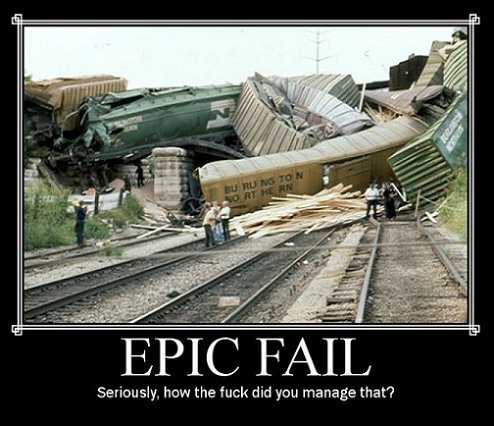
Although Russia abounds with fascistic nationalists who could have done this off their own initiative, in truth an epic fail of this magnitude anywhere in the world generally implies government involvement.
Russia continues its steely eyed march into hilarious self-parody and irrelevance (unless you happen to be a tiny powerless neighbour)…
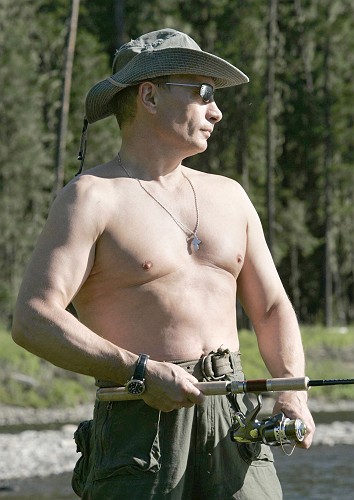
… get yer pecs out Obama, your soul mates want to play.
Nicolas Bourbaki presents a very interesting insider’s view of the how things are developing in Russia. Several of the article’s links require registration at the linked site.
The summer of 2007 was a busy year for the Russian oil and gas business. In April of that year, the state-run energy company Gazprom finally exerted enough pressure on the Sakhalin II consortium to wrest control of the giant project in Russia’s Far East from Shell, who had hitherto been the majority owner and manager of the development. In return for a cash payment of $7.45bn, at the time seen as a knock-down price, Gazprom acquired a 50% plus one share stake in the project. The deal was struck after months of the Russian environmental regulator exerting pressure on the consortium, Sakhalin Energy, resulting in works being delayed, stopped, and threats being made to withdraw the license to continue the development altogether. Despite there being genuine concerns regarding environmental damage incurred by the development, not to mention the doubling of project costs to $22bn, few believed that the governmental pressure exerted on Sakhalin Energy was anything other than a naked attempt by the Russian government to gain control over the project, its resources, and its revenues by force. Sure enough, within weeks of Gazprom taking the keys to Sakhalin II, the environmental regulator cheerily announced that all concerns had been resolved to its satisfaction and not a peep has been heard from them since. The outcome at Sakhalin II was presented by the Russian government, and accepted by many Russians, as a significant victory of the resurgent Russian state in reversing their exploitation at the hands of foreign powers when they were weak, and regaining control over Russia’s strategic resources, its wealth, and its independence.
Buoyed with confidence from their coup on Sakhalin, the month of June saw the Kremlin use alleged breaches of license obligations to ‘persuade’ BP to sell its 62.85% stake in Siberia’s Kovykta development to Gazprom for $900m in cash, a figure many people thought better than what was feared, i.e. nothing. Two months later, in August 2007, the Russian government moved to deny the Exxon-led Sakhalin I consortium the right to export gas from its development in an attempt to force the sale of the gas to Gazprom at artificially low domestic prices, after which Gazprom would be free to export it via pipeline or LNG carrier at international prices.
Now that Russia’s foreign-run developments were back under government control or suitably compliant, the government ensured that all future developments would remain similarly tied to the Kremlin with limited foreign influence. In April 2008, the Russian parliament approved a new law which effectively handed monopoly rights for all future developments of the Russian continental shelf to just two companies: Gazprom and state-owned Rosneft. By now, the bulk of Russia’s enormous hydrocarbon wealth both present and future was firmly in government hands, a situation which was looked on with gleeful satisfaction by Russians and allowed them to wield considerable influence beyond their borders. Soon followed grand plans for Gazprom to build a pipeline across the Sahara desert, buy all of Libya’s gas, and build LNG plants in Nigeria. Energy nationalism at home and the loudly announced forays abroad as personified by Vladimir Putin helped ensure the Russian population returned approval ratings of over 80% for their then president, now prime minister. Russia had picked itself up off its knees, Russia was strong once more, Russia could once again command respect from others. Russia was back. → Continue reading: Russia’s descent into reality
|
Who Are We? The Samizdata people are a bunch of sinister and heavily armed globalist illuminati who seek to infect the entire world with the values of personal liberty and several property. Amongst our many crimes is a sense of humour and the intermittent use of British spelling.
We are also a varied group made up of social individualists, classical liberals, whigs, libertarians, extropians, futurists, ‘Porcupines’, Karl Popper fetishists, recovering neo-conservatives, crazed Ayn Rand worshipers, over-caffeinated Virginia Postrel devotees, witty Frédéric Bastiat wannabes, cypherpunks, minarchists, kritarchists and wild-eyed anarcho-capitalists from Britain, North America, Australia and Europe.
|