I’ll pay my share of the Thatcher funeral cost and that of two objectors if they’ll pay my share of government spending I don’t like.
Any takers?
UPDATE: At least Mr Cameron is being as consistent as I would have expected.
|
|||||
|
I’ll pay my share of the Thatcher funeral cost and that of two objectors if they’ll pay my share of government spending I don’t like. Any takers? UPDATE: At least Mr Cameron is being as consistent as I would have expected. April 28th, 2013 | 22 comments - (Comments are closed)
 Taking offence cannot be equated to being criminally victimised. – “Cannot” as in: “should not”. Sadly, they just did. That’s Richard Carey, writing at Libertarian Home about the disappearance of the blog and twitter feed of Old Holborn, and other twitter accounts, for the crime of being “inappropriate and offensive”. April 23rd, 2013 | 15 comments - (Comments are closed)
Today I received one of those collective emails with a big list of recipients at the top. It was from Tim Evans to the Essex University Liberty League, and copied to the rest of us, suggesting all the copyees as potential speakers to the Essex University Liberty League. I was pleased to be even suggested, because I was a very happy student at Essex University in the early 1970s. Fingers crossed, hint hint. But much more importantly, following a little googling for the Essex University Liberty League, I found my way to this, which I had not noticed before and which is a video of a talk given by the noted libertarian historian Stephen Davies to … the Essex University Liberty League. Having both hugely enjoyed and been hugely impressed by the talk that Stephen Davies gave to the Liberty League Freedom Forum in London just under a fortnight ago, on the subject of healthcare, I cranked up this video about the history of British libertarianism and had a listen. Brilliant. The time, nearly fifty minutes of it, just flew by. Davies really is a master communicating a large body of ideas and information, seemingly with effortless ease, in what is (given the sheer volume of all those ideas and all that information) an amazingly short period of time, although in other hands the same chunk of time would feel like an eternity. Thank goodness cheap videoing arrived in time for Davies to be extensively captured on it, for two reasons. First, it would be very hard to take notes that would do justice to a Stephen Davies talk, and it would be impossible to remember it all. There is, every time, just too much good stuff there. You want to be able to hear it all again, with a pause button available. Second, I get the distinct impression that Davies knows a great deal more about the present and the past of the world, and of the people trying to make the world more liberty-loving, than he has so far managed to get down on paper. Indeed, I sense that Davies’s recent IEA job, stimulating Britain’s student libertarian network, is a calculated trade-off on his part, between one important job, namely that, and the other important thing that Davies ought to be doing, namely writing down many more of his brilliant thoughts and discoveries and opinions and historical wisdoms than he has so far managed to write down. Although, now would be a good time to flag up a piece Davies wrote for the Libertarian Alliance entitled Libertarian Feminism in Britain, 1860-1910, which is about the kind of thing his talk is about. The point being that most feminists then were libertarians, in contrast to the collectivists that most feminists are now. So, Davies has written some of his wisdoms down, just not as much as he might have. However, meanwhile, and as a natural consequence of all the student networking that he has lately been doing, Davies does often give a talk, and sometimes someone records it. Like I say, thank goodness for video. And congratulations to whoever did video this particular Davies talk to the Essex University libertarians. Richard Carey, who did the short blog posting where I found the video, does not say who did this. Presumably an Essex libertarian. As I say, kudos to whoever it was. Sadly, the Stephen Davies talk to LLFF2013 about healthcare was not videoed. April 19th, 2013 | 6 comments - (Comments are closed)
Reading the excellent blog The Last Ditch, there was an article about the Liberty League Freedom Forum 2013, written back on April 06th. And in the article, the author describes the views of Sam Bowman, of the Adam Smith Institute (and I am a great fan of the ASI) thus:
Views like Sam Bowman’s are why I am so in favour of the private ownership of firearms. When he (theoretically) points his (theoretical) gun at me to force me to risk my life to save another, I would say “Yes sir… oh and do you also want me to rescue that burning baby over there?” And when he turns to look, I would (theoretically) produce my (theoretical) handgun and put two (theoretical) 40 cal rounds in the fucker’s chest and then one in his (theoretical) head. And then I might actually go rescue the (theoretically) drowning baby and thereby have done two good things in a single day. April 19th, 2013 | 54 comments - (Comments are closed)
I have been interested in Frank Turner, who is a popular singer, ever since he performed at the London Olympics opening ceremony, and a Labour MP got angry about that:
Oh dear. Not allowed. Can’t be a popular pop singer and even think things like that, let alone say them. And just now, things on the Frank Turner front are getting rather interesting. NME have done an intereview with him. The NME website reports:
If that had been the only Frank Turner quote in this report worth requoting, that would have been today’s SQotD. But there is more. Turner also spoke about that Guardian piece (here‘s the link again):
Today, I intend to be doing exactly that. April 18th, 2013 | 21 comments - (Comments are closed)
The ever alert Mick Hartley links to this story:
Now I know what you’re thinking. Well, I know what I’m thinking. Who gives an expletive deleted about some ridiculous wall of worship that collapses, when people in North Korea are starving in their hundreds of thousands, and probably millions? The answer, of course, is: the rulers of North Korea. A key moment in the history of a tyranny comes when the tyrannical system in question no long works even by its own tyrannical standards, and instead starts making the tyrants themselves appear ridiculous, even to themselves. I therefore consider this a significant story. Not the least significant thing about the story being that it got out:
By the sound of it, it already has become “political”. April 18th, 2013 | 16 comments - (Comments are closed)
Just about now, I had hoped to be writing in some detail about some of the many interesting things said at the Liberty League Freedom Forum 2013, which happened last weekend. I still hope to. Meanwhile, I have already done a quick posting at my personal blog, with lots of photos, about how good, in general, this event was. And here is another posting about LLFF2013 to say, again, that it was very good. As I said at my own blog, the best thing about this gathering, excellent though the line-up of speakers was, was the audience that it succeeded in attracting. This audience was big, around two hundred strong. It was mostly young, mostly students. And it was very smart. As you will observe if you take a look at my crowd shots, most of the audience, besides being young, was male. But not all of it was. And the young males looked like they are the types to be going places in the future. A good way to get across the quality of this whole event is to quote from the comment that Michael Jennings added to what I put at my blog, in connection with the two talks that Randy Barnett gave:
Indeed. At the obvious risk of insulting others who contributed importantly, I singled out for particular praise for their organisational efforts: the IEA’s Stephen Davies and Christiana Hambro, and the Liberty League’s own Anton Howes, not just for their work on this LLFF but for previous iterations of it, in London and elsewhere in the UK. Time was when there was a sprinkling of libertarians and free marketeers in London, but when similarly inclined people outside London hardly knew of each other’s existence. People like Davies, Hambro and Howes, and others of course, are now changing all that. There is now a big and growing pro-liberty network among Britain’s student population, with pro-liberty student groups getting started in university after university. When I spoke with Davies about all this, his main worry seemed to be in finding places to fit everyone in. The answer seemed to be: smaller events, but more of them, in more places. Sounds good. Sounds very good. I have long had the impression that the organisation which has lead the way in earlier years in building a pro-liberty student network in the UK was the Adam Smith Institute, as I mentioned towards the end of this earlier posting here, about the history of the ASI so far. Now, under Mark Littlewood‘s leadership, the IEA is piling in also. In general, the amount of inter-organisational co-operation that you now see going on (it always has gone on but now especially), between the various UK pro-liberty groups and think tanks, is most admirable. If I have got it a bit wrong concerning who exactly deserves a pat on the back for all this pro-liberty activity, well, that is but a symptom of the fact that, as has been said before, it is amazing what you can accomplish in life if you do not care who gets the credit. April 10th, 2013 | 5 comments - (Comments are closed)
From the Daily Mail website:
The article, which chronicles the outbreaks of violence and antics of – mostly – young people following the death of Margaret Thatcher, does not inform us as to whether Mr Styles has been permanently out of work since 1984, a period of 29 years. It may be that he has worked for periods, no doubt adding his magnificent skills, charm and knowledge to the global economy. On the other hand, I suppose it is possible that this individual has spent the last, entire 29-year period living off the benefits provided by fellow taxpayers. I hope he has managed to cope. He sounds as if he certainly will be able to drown his sorrows with plenty of drink. Forgive my sarcastic tone, but while I certainly do sympathise with anyone made redundant – I have been through that experience and I know what it feels like – it seems to be stretching one’s natural compassion to the limit to feel much sympathy for a person who might have been out of work, or at least some form of productive activity, for almost three decades, even while remaining an able-bodied citizen. (The article does not say if he is disabled.) Among the many things that the late Margaret Thatcher strived against was what she thought of as an “entitlement mentality”: the idea that we are, simply by virtue of being alive, entitled to coerce our fellow man into providing us with things or services. The assertion of such “rights” is impossible without stipulating that others have some duty to provide these things. But how much of a right does one have? To one job? To a permanent job? A highly paid one? A moderately paid one? In your home town? Globally? To pose such questions is to cut to the heart of the incoherence and contradictory nature of such bogus “rights”. A right is, by definition, an assertion that one has a personal space that cannot be invaded, which is why property rights are an essential component of the idea, and why socialist “rights” are a hopeless muddle. I suppose all this philosophy might be a bit of a stretch for this ex-coal miner and his fellows, but it might be nice to think that in contemplating some of the sentiments of recent days, one might also reflect on the principles that are highlighted by Margaret Thatcher’s 11 momentous years in power. April 10th, 2013 | 15 comments - (Comments are closed)
The latest wave of communicational cleverness has made face-to-face meetings to spread good ideas both easier to organise, and more necessary to organise. Easier, obviously. More necessary because it now takes much clever thinking and cooperative enterprise to get good ideas heard and acted upon in this new media hubbub, just as it used to when the media were dominated by a few megaliths. There was, I now realise, a joyous interlude when good ideas had the run of the blogosphere and those who might have been using the blogosphere to spread bad ideas instead mostly just waited for the good ideas to go away. But now the bad ideas are back with a vengeance, never having gone away – just having been temporarily heckled a bit, and now different skills and energies are needed to get the good stuff said and done, and in much the same considerable quantities as two decades ago. There are now so many meetings, just in London, of the kind I am inclined to be attending, that I myself have taken to sending out reminders when my own last-Friday-of-the-month meetings are imminent, and I greatly appreciate it when others do the same. Nobody has yet complained to me about my reminders. Several have said thanks. (My speaker this month, by the way, will be Samizdata’s own Rob Fisher, who will talk about the impact that open source software is having on the world.) So it was that I was very glad to receive this, this morning:
More here, and what I earlier said about this event here: here. Another meeting I will soon be attending is this evening, organised by Libertarian Home at the Rose and Crown in Southwark, and addressed by our own Adriana Lukas. Details here. Get there Reminding people about your meeting involves the same kind of humility that is involved in repeating good ideas. People don’t necessarily hear things the first time you say them, and if they do they often forget them, especially when they now have so many other things to be attending to. And even when they have told you that they will definitely be attending your meeting, your meeting is not likely to be the biggest thing in their lives, and they are entirely liable to forget all about it until several days later. Unless they get a reminder. April 4th, 2013 | 2 comments - (Comments are closed)
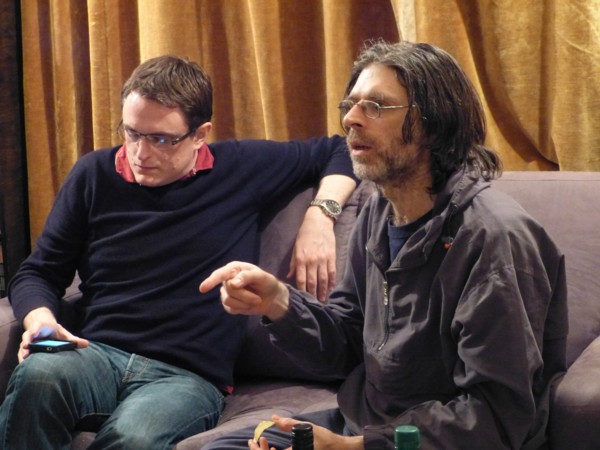
Last night being the last Friday of March, there was a meeting at my place, as already flagged up here. But it was also Good Friday, so I did a bit of extra hustling and emailing around beforehand to ensure some kind of turnout. It worked. Great talk, and there were nine libertarian-inclined Londoners present in the form of: two Americans, a German, a Frenchman, a Spaniard, a New Zealander and three Englishmen. I neglected photography at the January meeting, which I already regret, and did hardly any better at the end of February. This time I tried harder, this being one is my favourite snaps from last night:
Those are two of the three Englishmen who were present, the other being me. On the right there is speaker for the evening Richard Carey, and on the left Simon Gibbs, both of Libertarian Home fame. Gibbs was not rudely ignoring the conversation and catching up on his emails; he was looking up names and titles that were being mentioned in the conversation. I particularly like the potato crisp in Carey’s left hand at the very bottom of the picture. The talk was everything that I personally was hoping for. There was lots of biographical detail of who the key early Austrians were (Menger, Böhm-Bawerk, Wieser) and what kind of intellectual context they were operating in and what they said. And then the same for the later figures of note (von Mises, Rothbard). Other twentieth century figures were mentioned. Given how admiringly Carey spoke about him, I was particularly intrigued by Frank Fetter, only a name to me until now. Carey made no attempt to disguise the fact that he is a recent arrival to the task of getting his head round Austrian Economics, which for me was a feature rather than a bug, just as I thought it would be. And he made no attempt to suggest that he understood more than he actually did about the subject. His talk entirely lacked that sub-agenda that you so often sense with some speakers, that half the point of telling the story is to tell the story, but the other half of the point is to prove how very clever and well informed the speaker is, more so than he actually is. That Carey had no time for such nonsense only made me admire his intellect all the more. I had been expecting that the abstract theorising about what it all meant, what the intellectual guts of it all consisted of, would come at the end. The economic way of getting stuff versus the political way, trade versus stealing, individualism versus collectivism, the subjectivity of value, and so forth. Actually that bit came, at some length, at the beginning, so much so that I at first feared that all that biographical detail that I had been so looking forward to would be somewhat skated over. But all ended well, and I learned a great deal. I did not record this talk in any way. However, Simon Gibbs, the man on the left in the picture above, has already invited Richard Carey to do a repeat performance of this talk for Libertarian Home, and a video camera will presumably then be running. Meanwhile, I am very happy for Carey to have given this talk a first outing in friendly surroundings, and for him to get some early feedback on it. I find that I am making a point of getting speakers to speak about things they’ve not spoken about before, but will undoubtedly be speaking about again, for just these sorts of reasons. Two books were mentioned in the course of the discussion afterwards that I intend to investigate further. Christian Michel mentioned this collection of lectures by Michel Foucault, in one of which he apparently said something embarrassingly (given the kind of people who were listening) nice about the free market as the only place where freedom actually happens, or some such surprising thing. I’ve already emailed Christian asking for chapter and verse of the quote in question. And second, Aiden Gregg (who is an academic psychologist and who has already been fixed to speak at a later one of these meetings) mentioned the writings of somebody called Larken Rose, a new name to me, and in particular this book, which appears to cover similar ground, albeit in a somewhat different style, to that discussed in Michael Huemer’s The Problem of Political Authority, which has been written about here recently. Evenings like this don’t have any immediate world-changing impact, but every little helps. March 30th, 2013 | 4 comments - (Comments are closed)
“I want a “leave me alone” society — one where Christian schools can turn people away for rejecting their doctrine, just as gay rights groups can reject those who don’t share their beliefs. I don’t want us all to get along — not because I’m misanthropic (well, not just because I’m misanthropic), but because I know that “consensus” is usually a fancy word for muting minority viewpoints. I want us all to be free to be annoyed with each other from our separate corners. Is that too much to ask?” He’s writing about Michael Bloomberg, who is up there with Hugh Grant and George Galloway in my current “rogues’ gallery”. Competition for membership of the gallery is proving quite competitive at the moment.
March 27th, 2013 | 31 comments - (Comments are closed)
The speaker at my next Last Friday of the Month meeting will be Richard Carey of Libertarian Home, and the title of his talk is: Austrian Economics: What It Is and How It Relates To Libertarianism. And yes, Friday March 29th is not any old Friday. It is Good Friday, which may thin out the ranks of attenders somewhat. Not too much, I hope. About what he will be saying, Richard Carey says this:
Here is some video of Richard Carey talking on another subject, about doing libertarian politics. And here is the list of his recent bloggings for Libertarian Home. I have a very selfish motive in getting Richard Carey to talk about Austrian Economics, which is that I personally find it rather hard to get to grips with this subject, and with subjects like this. What I mean by “subjects like this” is subjects which consist of a lot of logically interconnecting concepts, each of which you have to understand, and the interconnections between which you likewise have to understand, in order to make sense of it all. What makes me want to make sense of Austrian Economics is that I have become entirely convinced, as have millions of others in recent years and decades (years especially), that Austrian Economics doesn’t just supply the best explanation of what has been going on in the financial world lately (and for that matter for the last several decades and even several centuries); it supplies the only explanation. All else in the way of economics is statistically disguised, fumbling, blundering nonsense, enlivened with many amusing details and incidental truths, but nevertheless, underneath it all, when it comes to the most important questions of all, just plain wrong. I already feel about Austrianism (as I like to abbreviate it) in the way many self-declared Marxists felt about Marxism when the Great Crash and then the Great Depression were unfolding. They didn’t really understand Marxism, but they had heard enough to be utterly convinced that This Is It, as in: This is the place to keep looking to work out what the hell is happening, and what the hell to do about it. The difference being that whereas the Marxists were all deluded and stuck up an intellectual and political blind alley, the Austrianists, and I, are not. My problem is that I find the great Austrian School writings very hard to actually read, and I typically find your average spoken exposition of Austrianism, by someone long steeped in the subject, very hard to follow. Part of this is that I am a slow and easily distracted reader, slow partly because so easily distracted, but also just slow. And when listening to a talk, I likewise get easily distracted (for example with trying to get my head around the previous interconnected concept but one, even as the latest one is being expounded), and if the talk is the kind of talk with a logical thread to it (as it so often is when the subject is Austrian Economics), any distraction guarantees that I lose that thread. But I have another problem, which is that a great deal of Austrian School writing consists of belabouring the obvious. March 26th, 2013 | 20 comments - (Comments are closed)
|
|||||

All content on this website (including text, photographs, audio files, and any other original works), unless otherwise noted, is licensed under a Creative Commons License. |
|||||