We are developing the social individualist meta-context for the future. From the very serious to the extremely frivolous... lets see what is on the mind of the Samizdata people.
Samizdata, derived from Samizdat /n. - a system of clandestine publication of banned literature in the USSR [Russ.,= self-publishing house]
|
I agree with Mr Quotulatiousness that this, from a posting at the Coyote Blog from July 7th of last year, deserves to be made much of:
One of the factors in the financial crisis of 2007-2009 that is mentioned too infrequently is the role of banking capital sufficiency standards and exactly how they were written. Folks have said that capital requirements were somehow deregulated or reduced. But in fact the intention had been to tighten them with the Basle II standards and US equivalents. The problem was not some notional deregulation, but in exactly how the regulation was written.
In effect, capital sufficiency standards declared that mortgage-backed securities and government bonds were “risk-free” in the sense that they were counted 100% of their book value in assessing capital sufficiency. Most other sorts of financial instruments and assets had to be discounted in making these calculations. This created a land rush by banks for mortgage-backed securities, since they tended to have better returns than government bonds and still counted as 100% safe.
Without the regulation, one might imagine banks to have a risk-reward tradeoff in a portfolio of more and less risky assets. But the capital standards created a new decision rule: find the highest returning assets that could still count for 100%. They also helped create what in biology we might call a mono-culture. One might expect banks to have varied investment choices and favorites, such that a problem in one class of asset would affect some but not all banks. Regulations helped create a mono-culture where all banks had essentially the same portfolio stuffed with the same one or two types of assets. When just one class of asset sank, the whole industry went into the tank.
Well, we found out that mortgage-backed securities were not in fact risk-free, and many banks and other financial institutions found they had a huge hole blown in their capital.
I remember having all this explained to me at the time, although I do not now recall who by. I do recall the word “Basel” coming up a lot.
My title above is in the past tense, but I presume problems like this have since got worse rather than better. What will be the dates of the next financial crisis, I wonder?
In the comments for this article, someone said:
“Minimum wage laws make sense to me”
Quite so, the least productive elements of society are better off on state welfare, essentially making them perpetual wards of the state by removing the only basis upon which they are employable: low cost. It is foolish to think otherwise.
Likewise there is much to be said for government incentivisation, via minimum wages and other regulatory measures that increase the cost of labour, for the development of fully automated fast food and janitorial jobs, given that this is now increasingly plausible technologically.
These sorts of things also have the added value of adding to the pool of citizens with a vested interest in maintaining the welfare system, without risking perverse incentivisation that productive economic activity sometimes causes, which may lead to socially inappropriate activities, such as increased carbon footprint or voting for incorrect political parties 😀
If Capaldo’s claims were right, Europe should have economically disintegrated as a result of its trade integration with any other part of the world. The Capaldo reasoning suggests that Europe’s trade integration with China, for instance, would have fractured EU economic integration. In fact, European economic integration deepened considerably even though import competition from the Asia-Pacific increased significantly over the past two decades.
According to the Capaldo reasoning, economic integration within the European Single Market should have triggered a tremendous fall in wages and employment due to the greater exposure of EU economies to trade and the proclaimed negative impact on income and aggregate demand. None of this has happened.
– Fredrik Erixon & Matthias Bauer, from “Splendid Isolation” as Trade Policy: Mercantilism and Crude Keynesianism in “the Capaldo Study” of TTIP
The story of rent controls has been the same everywhere they have been tried. Until they were abandoned, rent controls in Seventies Britain led to a catastrophic fall in the number of rented properties available, and they did nothing to stop unscrupulous Rachmanite landlords. Rent controls accelerated the woeful degradation of much of New York’s housing stock, and in so far as there has been a boom in New York property, it has taken place in housing not subject to rent controls.The Swedish economist Assar Lindbeck has said that rent control is “the most effective technique presently known to destroy a city – except for bombing”; and the reason he has come to that conclusion is that experience has shown that it is an idiotic way to tackle the problem of high rents.
– Boris Johnson, Mayor of London, and newspaper columnist.
I should add that one of the things I notice about Ed Miliband, the Labour leader – and many others who share Miliband’s views – is not so much ignorance of economics, as hostility to the idea that humans act as they do. The assumption seems to be that to bring about desirable objective X, one should pass a law to ensure X happens, and if it doesn’t, then evil intent has caused it. So, if you want to raise pay, you pass a minimum wage law decreeing that employers must pay staff so much money; if you want to hold down the cost of rentals, you pass a law banning landlords from pushing up rents above that level, and so on. And the fact that landlords and employees might alter their behaviour as a result or that unemployment and crap rental housing might ensue is the fault of evil people, not the forseeable result of interfering in the market. And on housing prices, as Boris mentions, the main problem is that supply in the UK is artificially suppressed by planning laws. (It should be noted that people of all political persuasions favour these, either for aesthetic or more narrowly self interested reasons.) But to admit that is, for the Miliband mindset, unthinkable: the State cannot have caused a shortage of something, surely! It must be because bad, uncaring people have somehow failed to provide enough housing!
To put it even more simply, with the Milibands of this world, we are dealing with the mentality of a child. Now, I don’t care whether Miliband looks or sounds odd, or is a tosser who knifed his brother in the back, so to speak, although I suppose these things do matter. What, at root, terrifies me about the idea of this fuckwit taking power is that he is a fuckwit, and alas, insufficiently self aware of his fuckwittery and inability to deal with reality. Or perhaps another way of seeing this is that he is an example of a mindset that goes back to JJ Rousseau and further back: the idea that what matters is that one is sincere, one cares, rather than reflect on the actual results of what one does.
Is this not rather predictable?
HSBC will look into upping sticks and moving its headquarters out of London once the regulatory environment becomes clearer, its chairman said today.
“We are beginning to see the final shape of regulation, the final shape of structural reform and as soon as that mist lifts sufficiently we will once again start to look at where the best place for HSBC is,” Douglas Flint said.
He was speaking at an informal shareholder meeting in Hong Kong. This comes as a recent hike in the special tax levied on banks in the UK makes it increasingly costly to do business, people familiar with the situation told Reuters.
And this under an supposedly ‘conservative’ Prime Minister 😀 The Stupid Party indeed. If Labour wins, I imagine this will become a stampede as businesses bolt for the exit.
I am not familiar with Paul Lindley but an article he wrote set my alarm bells jangling:
Business is changing. The predominance of companies for which profit is everything – and everything else is nothing – is waning, and a new wave of entrepreneurs and socially-minded individuals is on the rise. If I could give one piece of advice to the next government, it would be this: don’t just do what’s best for business, also do what’s best for those people – the stakeholders – involved in business. (…) Consumers are becoming more morally aware. They have an increasing amount of data available at their fingertips – from the ingredients in the products they buy to the supply chains of companies – and they are demanding more from their favourite brands. A new type of company has arisen to meet this demand, already popular in the US and elsewhere abroad. Benefit corporations – or “B-corps” – are companies which include a positive impact on society and the environment, in addition to profit, as their legally defined goals.
Well if I could give one piece of advice to the next government, it would be this: don’t do anything for anyone, just stay the hell out of the way and let markets do what they do.
I suspect my idea of what “social responsibility” means is probably not the same as what Paul Lindley means, so I really do not want the state deciding which of those views is the official approved version. Anyone asking the state to facilitate their objectives is almost always looking to have them stick their thumb on the scale and protect someone’s business model against someone else’s business model.
As I said I am not familiar with Paul Lindley but I am parsing his remark “companies which include a positive impact on society” to mean he thinks a supermarket, garage or clothing store, simply by virtue of offering things people want to buy at prices they want to buy them at, does not constitute a “positive impact on society”… and he wants the state to have policies that ensure straightforward commercial enterprises which do not market themselves according to an approved list of other added-on “social benefits”, are made less competitive vis a vis those who do. As he is fairly vague on precisely what policies he wants I cannot be sure, but that is what I am getting from this article.
In the late 1970s, the top rate of income tax in the UK was over 80 per cent and the top one per cent of income tax payers paid just 11 per cent of the total. Rates are dramatically lower today, and the one per cent paid 27.7 per cent of the 2011/12 total. The idea you get more money out of the rich by putting the screws on runs counter to the facts.
– Marc Sidwell
The Labour Party has stirred up the usually rather complacent wealth management sector in the UK by vowing to end the so-called “non-dom” system under which a foreigner who wants to spend some time in the country can avoid paying tax on all his/her worldwide income and capitals gains so long as this money is kept outside the UK. If such a non-dom has lived in the country for seven years, they must pay an annual levy and depending on the duration, that annual levy is as high as £90,000. A study by University College, London, published in 2013, concluded that the system brought in more revenue for the UK than was being lost by the absence of such a system.
At face value, the non-dom system might look like a great deal for a person who is worth tens of billions of pounds, dollars or whatever and who “only” pays several thousands per year to live in the UK. But if such a person’s wealth has been largely generated outside the country and is kept outside it, what is unfair about this position? If Mr Stinking Rich brought those billions to the UK, he would have to pay a thudding great tax bill. Ed Miliband, leader of the Labour Party, must know that, or if he doesn’t, he is being reckless. The whole idea that a person should pay tax to the country of his/her birth regardless of having not lived there for a period – as is the case with the odious worldwide US tax regime – cuts against the idea that one should pay taxes that focus on where you actually live.
Matthew Sinclair has a good piece here on the issue.
From a point of narrow party politics, I suppose Ed Miliband and his colleagues think they are being clever at playing the class war card and hope to trap opponents by having to defend the non-dom system. I notice that whenever a weapons-grade knob such as Miliband makes such a crowd-pleasing proposal, it is seen as a “trap” and that therefore the other side are told that it isn’t wise to oppose it. But this sort of cowardice-as-a-tactic approach merely favours the bully. A braver, and ultimately better, argument is to state that it is in the UK’s interest to encourage internationally-minded investors and entrepreneurs (so long as they are not criminals and jihadi nutcases) to come to the UK and enrich themselves and everyone else. To pander to the zero-sum, dog-in-the-manger mindset of Miliband and others is also foolish.
There is also a broader point to be made here: such attacks represent, at the margins, part of a rollback of globalisation, of the free movement of capital and people, a process from which London, as a global financial centre, has been a mighty beneficiary.
Far too many people in the banking and financial markets more broadly have fought shy of voicing their concerns about the demented nature of so much “banker-bashing” and attacks on inequality recently. Consider the respect granted to Thomas Piketty’s fatally flawed claims about inequality and his call for draconian taxes on capital. It is sometimes stated – I heard such a statement recently at a gathering – that “neo-liberals” (ie, classical liberals) have “won” the argument and that we now need to move on. How complacent that is. The arguments for freedom and capitalism are being lost in the UK, or at the very least, they aren’t being made very effectively.
“America is the world’s most successful economy because it is a democracy”, sayeth Iain Martin. I am not convinced.
It is not a coincidence that the United States is such a success and a democracy. It is such a success because it is a democracy. Indeed, the American impulse is rooted in the rejection of tyranny and scepticism of excessive government power. That commitment to free competition – sometimes imperfect, often producing uneven results – is what drives innovation.
It is a point made brilliantly by Guy Sorman in his latest piece for CapX, published this week. As he says, if you want meaningful innovation, the lifeblood of technological improvement, rather than copying and refining existing technology, then you need that clash of ideas that happens in a free society in which those in charge can be kicked out or established players can be outflanked by upstarts.
But it is liberty, not democracy, that brings these things. It is constitutionally separated powers and limited government, which is to say limiting the scope for democratically impelled politics, that enables people to challenge established business models.
And those limits on what government can do are in precipitous decline in the USA (and elsewhere) regardless of ‘democracy’… and often because of it. A great many people are quite happy to vote for excessive government power and more ‘free stuff’ that other people will have to pay for.
The downside of zero inflation is that it does nothing to erode the value of debt, much of which is denominated in money terms. If your mortgage is £100,000 and the price level doubles, its real value has fallen to only £50,000. The world is still burdened with excessive debt, which is a worry for policy-makers. But a low inflation world forces them to confront this issue honestly, and not try to evade it by using the subterfuge of inflation.
– Paul Ormerod
Of course it is only a ‘downside’ if you are in debt, it is an upside if you are a saver and lender.
… and in order to fit in better with the people around you, feel the need to blast off about ten IQ points, you are in luck! Just watch this from our good chums over at the BBC. It is an experience a bit like holding a live piranha to the side of your head.
This was tweeted by Dominic Frisby earlier today:
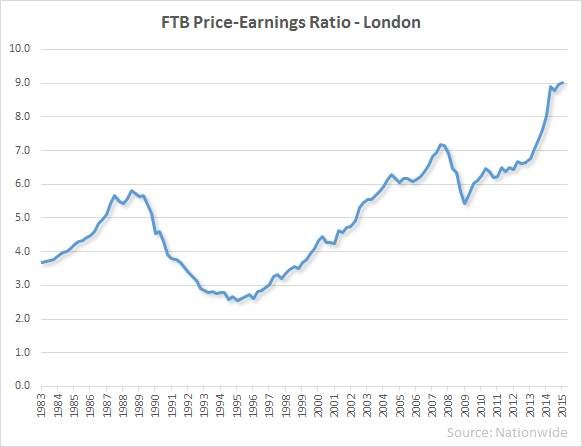
As he says: “1st-time-buyer earnings-to-house-price ratio in London. Gulp. And London 1st-time-buyers are old too … ”
The moment interest rates go up, even slightly, there is going to be an almighty collapse.
|
Who Are We? The Samizdata people are a bunch of sinister and heavily armed globalist illuminati who seek to infect the entire world with the values of personal liberty and several property. Amongst our many crimes is a sense of humour and the intermittent use of British spelling.
We are also a varied group made up of social individualists, classical liberals, whigs, libertarians, extropians, futurists, ‘Porcupines’, Karl Popper fetishists, recovering neo-conservatives, crazed Ayn Rand worshipers, over-caffeinated Virginia Postrel devotees, witty Frédéric Bastiat wannabes, cypherpunks, minarchists, kritarchists and wild-eyed anarcho-capitalists from Britain, North America, Australia and Europe.
|





Recent Comments