We are developing the social individualist meta-context for the future. From the very serious to the extremely frivolous... lets see what is on the mind of the Samizdata people.
Samizdata, derived from Samizdat /n. - a system of clandestine publication of banned literature in the USSR [Russ.,= self-publishing house]
|
I’m sure Netflix is more popular than any politician
So says “Kilroy”, commenting on a DSL Reports post about Netflix being charged a 9% amusement tax by the City of Chicago. He suggests that Netflix should just stop selling services to people in Chicago and instead direct them to their local lawmakers. If it happened it would be a fine example of a company refusing to cave in, but it is unlikely. According to The Verge, “Netflix says it’s already making arrangements to add the tax to the cost charged to its Chicago customers.”
According to Ars Technica, what might stop this are conflicting federal telecommunications laws.
On Reddit someone pointed out that this is rather in conflict with the idea of net neutrality.
A side discussion on Reddit is about the extent to which companies can shop around for cities with favourable laws. Someone said, “see Detroit“. Did business move out of Detroit because of unfavourable laws and taxes?
Bitcoin offers a glimpse into the future of money a purely digital form of money that is individual, private, global, and free (free as in speech, not as in beer). Bitcoin is often compared with the existing banking system, juxtaposing its futuristic capabilities with the slow, antiquated, and cumbersome world of wire transfers, checks, “banking hours,” and restrictions. But the future will not be a choice between “old money” and cryptocurrency. Instead, it will be a choice between two competing visions of digital money: one based on freedom and choice, the other based on control and surveillance, a dystopian totalitarian system of control from which no one can escape.
We are now at the crossroads, and we must choose the future of currency wisely.
– Andreas Antonopoulos
I am often disappointed when a company apologises or pulls an ad campaign after receiving complaints. Paul Marks recently called this “corporate cowardice”. According to Martin Daubney on Breitbart London, things might be about to change. Fighting back against such criticism seems to be good for business. This story has everything: capitalism, SJW-trolling and even girls in bikinis. Via Eric Raymond’s Google Plus feed.
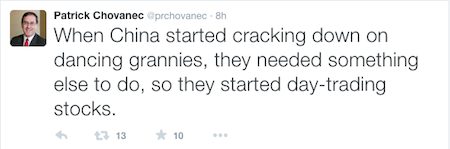
…here’s a theory:

I apologise for the non-Twitterish look of this but it seems Samizdata’s all-knowing editing software doesn’t like scripts and I don’t have the patience to select, save and edit each tweet individually.
Update
It occurs to me there’s a bit missing from the tale. And just to prove that this really was on Twitter:
Apple’s removal of a American Civil War game from its app store due to it showing a Confederate flag (yeah I know 😀 ) prompted such widespread derision across the internet from such a wide range of the political spectrum that lo and behold, the app has been reinstated. One might assume a multi-gazillion dollar company would have sufficient checks and balances to stop Le Grand Fromage from making a complete pilchard of himself and his company in the first place, but at least common sense has eventually prevailed.
And as for a certain flag maker declining to manufacture Confederate flags any more, well one company’s boycott is another company’s business opportunity.
Bill Clinton continues to push for an end to capitalism, such as it is, and the fuller implementation of a system in which only nominal ownership of the means of production is permitted, and company ‘owners’ are free do do what they want, just as long as it is in accordance with the state’s political objectives.
For some reason the twits who run the City of London gave this philandering scumbag a venue in which to speak.
Nice to see the ‘conservative’ government’s attempts to drive the financial industry out of UK is continuing apace.
Bonuses could be clawed back for as long as a decade under new rules published by City regulators today. The Prudential Regulation Authority (PRA) and Financial Conduct Authority (FCA) confirmed they were pushing ahead with rules for a wider seven-year claw-back period but that an added three years is being considered for senior managers.
if HSBC and others do not make good on their threat to leave the UK then they must be out of their bloody minds. Just move to Hong Kong or Zurich. And if you get a bonus in the UK, plan on leaving the UK and working somewhere else at the first sign of trouble in your company, taking your dosh out of the country with you of course, because otherwise some regulator looking to justify their existence might want to take a bite out of your account.
Tim Worstall pointed me in the direction of this article by Mark Herbert of the British Council, the 3,934,561st in a series of 79,804,227 about the dire state of foreign language teaching in British schools. Tim Worstall’s post is followed many entertaining comments from people who have learned, taught and forgotten foreign tongues. But I liked my own comment enough to bring it round here, chop it up and add stuffing until it became a post in its own right.
The trouble with Mr Herbert’s article is that, like 95% of articles about the state of foreign language learning in Anglophone countries, it’s saying things that are just not true. He writes, “We need far more of our young people to learn languages in order to boost their own job prospects and to ensure the UK stays competitive on the world stage.”
In real life the job and salary prospects of most native English speaking pupils are almost unaffected by having studied a foreign language. Of course there are exceptions – one of my children is one – but for the vast majority of students a language qualification simply adds to your UCAS points total or local equivalent. A language qualification has some extra value as an unfakeable subject, but no more than a STEM qualification does. As for the objective of ensuring the UK “stays competitive on the world stage”, (a) who gives a damn about UK competitiveness in their personal choices? (b) if bureaucrats do care, that objective is vastly better advanced by getting the brats to study some subject related to an area in which the UK has a comparative advantage. Which, famously, ain’t languages.
A later comment by MyBurningEars describes the major reason for the decline in the study of languages by English speakers succinctly:
“The costs and benefits of learning languages are very asymmetric – it is clearly worthwhile for many Danes to learn English, often to a high level, yet this renders it almost completely futile (from a professional standpoint) for a Brit to learn Danish. London has hundreds of bilingual speakers of every major language, and many minor ones to boot. What would the point be for me to learn Urdu or Mandarin, an exercise which (to reach worthwhile levels at a professional level) would take years of solid study – far higher than GCSE or A level?”
Exactly. The decline that Mr Herbert laments is not happening because Brits and Yanks are becoming more arrogant or more stupid. It is happening because they are consistently making a rational judgement of a changing situation regarding the likely benefits to them, as individuals, of language study. Or as the famously well-travelled Michael Jennings put it in a comment to this post by Brian Micklethwait on the triumph of English,
“What is new, is that lingua francas other than English are in most places dying as lingua francas. In most places on earth, where two people from different cultural groups needs to communicate, they now do this in English.”
Some lingua francas (linguae francae?) other than English are still gaining ground regionally, such as Swahili. But this trend is only likely to continue while East Africa remains relatively isolated from the world economy. Globally, the rise of English has reached and passed a tipping point. English will now be the first world lingua franca, something humanity has never had before. Nothing human lasts forever, but it won’t be easily dislodged from that position, certainly not by a change as minor as China becoming economically dominant. The retooling costs are too great, particularly if Chinese sticks with its current beautiful but impractical writing system. English already gets you the world and there are no more worlds to conquer. What might dislodge it? Worldwide economic collapse, worldwide tyranny, or machine translation (both written and spoken) much better than we have now.
My feelings about the triumph of English are not particularly triumphant. Yes, if there is to be a world language I would prefer it to be mine. That does not mean I rejoice to see the slow strangulation of rival languages. Perhaps I had better pray for translation software – or brain augmentation – to get so good that all this, the rise and fall of “Empires of the Word”, ceases to be a zero-sum game.
Meanwhile, back in the real world, the choice of what subject to spend several years of your finite supply of life studying is fairly close to a zero-sum game and the choice between languages even closer to one. It is not entirely a zero-sum game; it is reasonable to suppose that study of all kinds exercises the brain, and learning one foreign language certainly makes learning others easier. But the fact remains: to learn a new language is hard. Most people only do it because they have to. English speakers don’t have to. The monetary return on investment of learning another language is not that great for English speakers. Promises to the contrary are not true. People should stop making them.
I am vastly more sympathetic to apparently airy-fairy justifications for learning foreign languages, like “you will gain an insight into other ways of thinking”, or “you will enjoy your time abroad”, or “when you meet attractive foreign persons your suit will be more likely to prosper”. These promises are quite likely to be true if you apply yourself. The “you will have proved to yourself and others that you can learn something difficult” factor can also be honestly promised.
The G7 has agreed that the Chinese yuan should be part of an international basket of reference currencies. Does this technically make the Yuan a basket case? 😉
Yeah I know, slow day.
U.S. Senator Bernie Sanders, who is not the only socialist currently running for the U.S. Presidency, but who is the only candidate honest enough to openly say that he’s a socialist, has recently gotten a bunch of buzz in some circles for saying this:
You can’t just continue growth for the sake of growth in a world in which we are struggling with climate change and all kinds of environmental problems. All right? You don’t necessarily need a choice of 23 underarm spray deodorants or of 18 different pairs of sneakers when children are hungry in this country. I don’t think the media appreciates the kind of stress that ordinary Americans are working on.
Kevin Williamson has written a brilliant summary of what is wrong with Senator Sanders and his ideology. It is well worth reading even if you already know the topic well.
Here’s a link: Bernie Sanders’s Dark Age Economics
I have heard one friend refer to the essay as “Economics in One Article” and there’s some truth to that. It’s very well written, very general, and filled with amazing quotes, such as this one:
Markets adapt to political changes, and the hierarchy of values that distinguishes between an hour’s worth of warehouse management, an hour’s worth of composing poetry, an hour’s worth of brain surgery, and an hour’s worth of singing pop songs is not going to change because a politician says so, or because a group of politicians says so, or because 50 percent + 1 of the voters say so, or for any other reason. To think otherwise is the equivalent of flat-earth cosmology. In the long term, people’s needs and desires are what they are; in the short term, you can cause a great deal of chaos in the economy and you can give employers additional reasons to automate rote work. But you cannot make a fry-guy’s labor as valuable as a patent lawyer’s by simply passing a law.
Do give it a read. You may be linking to it for years to come.
EDITED TO ADD: A friend pointed out this important message from the Bernie Sanders Save The Children Fund:
[youtube http://www.youtube.com/watch?v=fspZiT8TdBE&w=560&h=315]
Presented for your consideration, two quotations and a hyperlink:
“I am convinced that the path to a new, better and possible world is not capitalism, the path is socialism.”
-Hugo Chávez
“I have said it already, I am convinced that the way to build a new and better world is not capitalism. Capitalism leads us straight to hell.”
-Hugo Chávez
Venezuelan Bolivar now worth more as toilet paper than as money.
I would have had this as today’s Samizdata quote of the day if I hadn’t already done one earlier:
It is fashionable for the left to say we need big government to deal with big business. The opposite is true. Only big business can survive big government.
I plan on using that.
It is from an interview with Carly Fiorina by Jennifer Rubin, for the Washington Post. The rest of it is well worth a read also.
I have no idea what chance Carly Fiorina has of being the next President of the USA, but the nearer she gets to it, the happier I will be. Vice President maybe? Or would that be to underestimate her?
|
Who Are We? The Samizdata people are a bunch of sinister and heavily armed globalist illuminati who seek to infect the entire world with the values of personal liberty and several property. Amongst our many crimes is a sense of humour and the intermittent use of British spelling.
We are also a varied group made up of social individualists, classical liberals, whigs, libertarians, extropians, futurists, ‘Porcupines’, Karl Popper fetishists, recovering neo-conservatives, crazed Ayn Rand worshipers, over-caffeinated Virginia Postrel devotees, witty Frédéric Bastiat wannabes, cypherpunks, minarchists, kritarchists and wild-eyed anarcho-capitalists from Britain, North America, Australia and Europe.
|





Recent Comments