We are developing the social individualist meta-context for the future. From the very serious to the extremely frivolous... lets see what is on the mind of the Samizdata people.
Samizdata, derived from Samizdat /n. - a system of clandestine publication of banned literature in the USSR [Russ.,= self-publishing house]
|
I really must try to set aside some time to further develop an idea I have for a ‘Lefty Street Demo Reality Conversion Chart’. I have in mind a handy reference source can be used to translate ludicrously inflated attendance figures for lefty protests into actual numbers that the rest of us would recognise. For example, whenever you read of ‘hundreds of people’ at some lefty demo, simply look up the this figure on your handy conversion chart which will give the real figure of ’50’. Similarly, ‘thousands of people’ converts as ‘150’, ‘tens of thousands’ means ‘500’ and so on.
I better get a move on with this project in order to answer the urgent market need because the buggers have been at it again this weekend:
Thousands of campaigners across the UK are taking part in a marathon lobby of MPs and a series of protests this weekend to call for a shake-up of global trade rules.
The mass demonstration Scale Up for Justice is calling on the government to put pressure on the World Trade Organisation to rewrite its laws in favour of poor countries.
Any idea what they mean, precisely? Well, the organisation behind this latest round of muddle-headed, sandalista squawking is something called the Trade Justice Movement and, if their website is anything to go by, they appear to be long on rhetoric but remarkably short on details.
According to the TJM:
Together, we are campaigning for trade justice – not free trade – with the rules weighted to benefit poor people and the environment.
No mention of what constitutes ‘justice’ nor what ‘rules’ they have in mind. → Continue reading: Send in the clowns
When reading about the many and disparate anti-globalisation activists who protest against international trade, one often gets the impression that the writers discussing their antics think that what motivates these folks is a relatively new phenomenon.
Not so. The desire to replace free trade with politically controlled and above all, domestic trade has long been a central aspect of collectivism of all flavours.
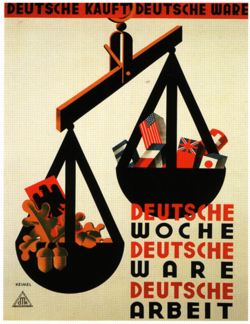
Adolf did not much care for global trade either
At its root, all forms of collectivism have more in common than its supporters might be comfortable admitting.
Johnathan Pierce did a piece on Tuesday about this book by Tyler Cowen. And if you follow that link to amazon.co.uk you find that paragraph one of review number one goes like this:
A Frenchman rents a Hollywood movie. A Thai schoolgirl mimics Madonna. Saddam Hussein chooses Frank Sinatra’s “My Way” as the theme song for his fifty-fourth birthday. It is a commonplace that globalization is subverting local culture. But is it helping as much as it hurts? In this strikingly original treatment of a fiercely debated issue, Tyler Cowen makes a bold new case for a more sympathetic understanding of cross-cultural trade. Creative Destruction brings not stale suppositions but an economist’s eye to bear on an age-old question: Are market exchange and aesthetic quality friends or foes? On the whole, argues Cowen in clear and vigorous prose, they are friends. Cultural “destruction” breeds not artistic demise but diversity.
So globalisation is good, culturally as well as economically. But the Saddam Hussein reference does rather make me want to rethink my attitude to My Way. This song may indeed be a hymn of praise to individualism and individual liberty, but Saddam Hussein wasn’t (and still isn’t?) averse to individualism and individual liberty – he was/is after all an extremely liberated individual – provided that it’s his individualism and individual liberty he’s singing about rather then anyone else’s. The “My Way” critics would appear to be vindicated.
But although bad news for anyone who thinks that only Hayekian liberals sing this song, this is not exactly good news for collectivists either, for when someone like Saddam sings this song, he is ramming home the lesson that collectivism, rather than installing any sort of collective virtue into power, merely ensures the triumph of all the vices of one vicious individual, who ends up doing everyone in, and doing it “my way”. You have to admit that the world’s nastiest despotisms devise their own uniquely ghastly ways of killing and torturing people.
And now, the end is near;
And so I face the final curtain. …
Concerning Saddam, let’s hope so.
Most defences of globalisation, as far as I have seen, have focussed on the essentially economic benefits of free trade, the free movement of goods, services and people. To date – and I may have missed something – there has not been much in the way of a cultural defence of globalisation. So I was delighted to come across this book a while back by noted culture and economics writer Tyler Cowen
He makes the important point that far from crushing local cultures and imposing a blanket of bland pap on us all, globalisation has often spawned a great deal of what we would think of as “traditional” culture. Using examples as varied as Navajo textiles to Caribbean music, Cowen nails the idea once and for all that globalisation means that the entire planet is going to turn into a MacDonalds fast-food joint.
What I particularly liked about this book was its positive, thoughtful tone. He spared us any tiresome ideological hominems about capitalism and the market. Instead, he shows how trade stirs up cultures worldwide, often producing marvellous and dazzling results.
A key theme also emerging from Cowen’s study is that globalisation has in some ways vastly increased, not reduced, the diversity of cultural forms on this planet. When anti-globalistas like John Gray, for example, berate it, what I suspect they want is for the status quo to be preserved in the ways they like. They are often not all that interested in diverse cultures, more in a form of nationalism. What Cowen does is show the enormous benefits of modern fast communications, technology and speed of human contact.
I recommend this book very highly.
Amid the recent revival of the spectre of large tax increases, a simply splendid post by David Farrer pointing out exactly why the political classes need them:
The truth is that the welfare state is bankrupt and almost no one, not the Scotsman editorial writer and certainly not the Tories, is willing to say that the Emperor has no clothes.
And not just the British welfare state either. For all the robust free market rhetoric that frightens the piss out of European lefties, the American welfare state is in just as parlous a condition:
Are we really broke? The answer is clearly, YES, but living on borrowed time and money. A recent study was done by Jagadeesh Gokhale and Kent Smetters which measures our government’s current debts and projected debts based on the proposed federal budget and revenues for 2004. By extending the numbers in constant 2003 dollars, they have come to the conclusion that the Federal government is officially insolvent to the tune of $44 trillion.
According to Financial Sense Online (from whence the above quote is lifted) both Medicare and Social Security will be bankrupt by 2010 or 2011.
This is really the big, global, dirty, open secret: the 20th century welfare state constructs are lurching, creaking and on the verge of collapse. Yet, in polite circles, this looming disaster cannot even be discussed, let alone addressed. Such is the taboo status of the welfare state that most Western politicians would rather be seen to publicly champion child molestation than any serious reform agenda.
It is for this reason that the reactionaries are trying to float various methods for the state to plunder everything and anything they can in the desperate, febrile, frantic hope that they can put off the Day of Reckoning for just a few more precious years.
Andy Duncan has heard the voice of Metatron Peter Hain and he is pretty sure it may have been Hain’s lips that were moving but it was Tony Blair’s voice we were hearing
On the BBC Today program this morning, Labour Party Leader of the House of Commons, and Secretary of State for Wales, Peter Hain floated the idea of increased income taxes. As he’s the semi-official Voice on Earth, for the internal workings of Prime Minister Tony Blair’s mind, his attempt to start this ‘debate’ can be assumed to have been cleared by Downing Street.
Is this the last desperate throw, by an increasingly desperate Prime Minister?
In the interview, the BBC Radio 4 Presenter, John Humphrys, tried to press Mr Hain on this ‘debate’, but didn’t get the minister further than saying the rich would be ‘asked’ to contribute more, for the common good of the public services.
Mr Hain refused to define what is ‘rich’, and refused to define how much income tax would be going up by, except to say it wouldn’t be “punitive”.
Mr Humphrys put forward the figures of £50,000 pounds a year as being the Labour Party’s definition of rich, and 60% per cent income tax, as being a ‘fair’ contribution. Mr Hain did not refute these figures, merely avoided answering the questions in his self-styled ‘debate’.
Given that Tony Blair hinted at more tax increases, earlier in the week in his Fabian Society speech, it seems he is ready to formally break his 1997 ‘pledge’ to not increase income tax.
But does this really signal it’s time up for Tony Blair?
Andy Duncan
The sharp eyed and attentive amongst you may have spotted the funky monkey that has appeared in the ‘free market’ section of our sidebar… we have acquired a sponsor!
But not just any sponsor.
The Gold Casino is an off-shore internet casino (obviously) in the most literal sense of the term. It is located on a server in the Principality of Sealand, a fully independent micro-state off the shore of Great Britain. Don’t like the state? Go set up your own.
No I am not joking!
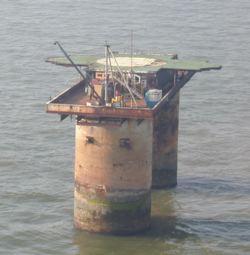
Well I did say micro-state, didn’t I?
So take a peak at what our sponsor is offering by poking the funky monkey and check out their message via the link underneath the sidebar graphic. I assure you it is far more interesting that the usual marketing blather one is usually confronted with… you will see why we find them so ideologically agreeable!
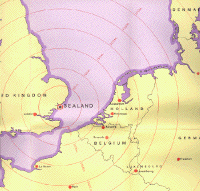
It adds a whole new nuance to the term ‘off-shore business’
I did a posting here a few days ago about how political debates are, at any rate in Europe, and most especially here in Britain and in England, becoming more about who we are, and not just about who is right. It was the one about the Renault TV car advert.
There were many commenters, one of whom said that in the USA, things were different. Who we are, he said, is not an issue in the USA, because we know who we are. And in the sense that in the USA, unlike here, or for that matter here, there is no debate about what country they should be, what continent they should be a part of, and so on, that’s true.
But now take a read of this bit, from a Sunday Times article by Andrew Sullivan, on the subject of Hillary Clinton. Hillary C, says Sullivan, is the most divisive US politician since Nixon, and she doesn’t just divide at the level of opinion, she divides at the level of “identity”. (Equals: who we are.) → Continue reading: Andrew Sullivan on Hillary Clinton – and me on the globalisation of the “who we are” question
A new EU directive, that goes into effect on July 1, will require all Internet firms to account for value added tax, or VAT, on “digital sales.” Computerworld reports how overseas Internet retailers may see their European profit push derailed by one of the oldest drags on business: tax.
The effect of the law will be an additional 15 to 25 percent levy on Internet transactions such as software and music downloads, monthly subscriptions to an Internet service provider and on any product purchased through an online auction anywhere in the EU.
The VAT tax is not new burden for European dot-coms that have been charging customers VAT since their inception. Their overseas rivals though have been exempt, making foreign firms an obvious choice for the bargain-hunting consumer. David Melville, general counsel of UK ISP Freeserve, a division of French ISP Wanadoo, rejoices:
It’s a massive competitive disadvantage. It’s good to see at last it being eroded.
Freeserve has lobbied furiously for the past two years to get the loophole closed, saying its chief rival AOL UK, the Internet unit of AOL Time Warner, saved 150 million pounds ($249.7 million) in tax payments over the years.
Shock, horror! How about lobbying the EU comissariat to abolish the internet sales VAT in the EU instead?! I thought not.
For example, on eBay, a UK seller will pay six pounds to list an automobile and 35 pounds for real estate, both 20 percent increases that include the UK’s 17.5 percent VAT charge. Some analysts predict that the new tax will decreases sales in the short term, which will hurt American dot-coms such as eBay and Amazon, given their expectations of higher growth in their overseas business.
But European firms feel justice have been done.:
The old way certainly gave non-EU companies a leg up during a very crucial stage in the development of the market.
Please note the assumption that it is acceptable for governments to meddle with competitive markets and ‘equalise the race’. The EU businesses behave in a way that is not surprising, they are happy to see their overseas competitors weakened, however, I fear their victory is rather Pyrrhic.

Last year I was annoyed when the government of Switzerland broke the last link between the Swiss Franc and gold.
I was annoyed as it was yet another defeat for tradition and decency in the world. Decay and collapse may be a process we have to go through to get to a position where people can rebuild – but that does not mean I have to like the process. But I thought the broken link would have little practical importance – as the Swiss Franc was (like all other currencies) basically a fiat (government command – token money) currency already.
It seems that I was quite wrong. The Swiss money supply (whether one measures narrow money or broad money) has been expanding like mad.
Not only are the Swiss powers-that-be expanding the money supply faster than the American powers are, but they are doing so faster than the British or even the European Union authorities. I have been watching the progress of the various money supply expansions via the back pages of The Economist for quite some time.
I wonder if the Swiss authorities are trying to get some temporary economic growth (via the standard credit bubble) in order to influence the elections in October?
Looking at reality (even the imperfectly measured expansion of money supplies) does make watching political debate quite a strange experience. For example, in Britain, virtually everyone talks of how the European Union Central Bank is following too ‘tight’ a policy – whereas in reality it is inflating the money supply more than the Americans or even the British are doing.
Both pro and anti Euro forces in this country are deeply ignorant of even the most basic facts.
I was just watching a report on early morning TV which was in itself a rather mundane piece about how the authorities in Britain are clamping (immobilising) cars which are stopped on the road and found to have unpaid vehicle tax. Yeah yeah, whatever.
But then came a remark which astonished me…
“Unpaid annual Vehicle Excise Duty costs the British economy millions of pounds per year”
Now without getting into the rights and wrongs of vehicle ownership taxes (as opposed to road use taxes), the implication is clear: money not paid to the state for the privilege of owning your own several property does not create wealth… only when that money is safely in the hands of the state does the British economy benefit. Note, the words use are not “costs the British state millions…” but rather “costs the British economy millions…”
And with that tax money taken out of private hands, the state creates a net gain in wealth how exactly? Hiring more wealth destroying bureaucrats? And of course that money you selfish tax dodgers have not paid to the state is going to be flushed down the toilet rather than being used for some alternative economic activity, right? Likewise immobilising people’s transport because they have not paid an annual ownership tax, and thereby preventing those people making deliveries or getting to work, that does not British economy a penny, right?
Arrogance and ignorance in equal measure. The state is not your friend.
Although I am unlikely to be in a rush to join either of these organisations, today is a day a day I can say I am for once in agreement with their current campaigns.
Amnesty is campaigning against Castro’s crackdown on dissidents. OK he might not change his ways just because you send a letter of complaint, but Amnesty also, rightly, reckons the US government embargo needs to go. More contact will weaken, not strengthen Castro. And anyway, if I want to go to Cuba, what business is it of the US government?
Oxfam has also been making some helpful noises on Trade for Africa, on CNBC in Evian one of their spokespeople rightly said aid did not matter any where as near as much as trade. The best thing for Africa would be an end to subsidies for American and European farmers. Their latest paper on the G8 summit has the usual nonsense about how poor taxpayers in the West should subsidise rich kleptocratic dictators in Africa through government-to-government aid, but also calls on G8 governments to…
Address the enourmous harm being done by the subsidies rich Western Countries pay their farm sectors to produce a glut of cheap food which is dumped on world markets, undercutting African farmers and robbing their livelihoods. To fight a war on unfair trade rules, the G8 countries should: Immediately stop using subsidies and export credits that cause over-production and dumping of surpluses in developing countries. Open their own markets to all products from Africa and other low-income countries.
Looks like the message is semi-seeping through to NGOs.
As for Bono and Oxfam’s “Drop the debt” campaign, even a greedy capitalist like myself recognises that debts derived from old Cold War era geo-political bribes should not burden Africa’s children. Time for a market-solution to the debt. Let the failed-states go bankrupt. Alternative, better, delivery mechanisms for education and healthcare can be created. Africa doesn’t need corrupt governments and armies, it needs teachers and nurses.
Paul Staines

|
Who Are We? The Samizdata people are a bunch of sinister and heavily armed globalist illuminati who seek to infect the entire world with the values of personal liberty and several property. Amongst our many crimes is a sense of humour and the intermittent use of British spelling.
We are also a varied group made up of social individualists, classical liberals, whigs, libertarians, extropians, futurists, ‘Porcupines’, Karl Popper fetishists, recovering neo-conservatives, crazed Ayn Rand worshipers, over-caffeinated Virginia Postrel devotees, witty Frédéric Bastiat wannabes, cypherpunks, minarchists, kritarchists and wild-eyed anarcho-capitalists from Britain, North America, Australia and Europe.
|

