We are developing the social individualist meta-context for the future. From the very serious to the extremely frivolous... lets see what is on the mind of the Samizdata people.
Samizdata, derived from Samizdat /n. - a system of clandestine publication of banned literature in the USSR [Russ.,= self-publishing house]
|
The other thing that really got me thinking was seeing the sort of people that would appear on television, proselyting about the coming tragedy that it would imminently become too late to prevent. Whether from charities, pressure groups or the UN, I knew I had heard their strident and political use of language, and their determination to be part of the Great Crusade to Save the World before. These were the CND campaigners, class war agitators and useful fools for communism in a new guise. I suddenly realised that after the end of the Cold War, rather than slinking off in embarrassed fashion to do something useful, they had latched onto a new cause. The suggested remedies I heard them espouse were always socialist in approach, requiring the installation of supra-national bodies, always taking a top-down approach and furiously spending other peoples’ money. They were clearly eager participants in an endless bureaucratic jamboree.
Now don’t get me wrong: a scientific theory is correct or not regardless of who supports it. But recognising the most vocal proponents of CAGW for what they were set alarm bells ringing, and made me want to investigate further…
– Jonathan Abbott writes on WUWT about his personal path to C(atastrophic) A(nthropogenic) G(lobal) W(arming) skepticism.
Aside from the slightly odd word “proselyting” … snap.
A few commenters here have expressed boredom about this whole climate thing, and a lot of people certainly are very bored indeed with the climate alarmists. But when you consider how much power and money are still being diverted into arrangements based on climate alarmism being true, by people for whom the science still seems to be settled like it was 1999, it would surely be a big mistake to stop discussing these matters now. This would be the equivalent, during the Cold War (an earlier huge argument to which Abbott rightly compares the climate debate), of reading someone like Von Mises explaining in about 1950 that communism is economically irrational and hence in the long run doomed, and saying, right, we can forget about that then. Communism still had many decades of damage to do. And it didn’t just fall. It was also pushed. Climate alarmism is the same now. The damage it will do has, arguably, only just begun. Just how much damage climate alarmism ends up doing depends on how much it continues to be challenged.
Earlier this year, we here in the UK had a spring that felt more like winter. Now we are enduring the frightful ordeal of a summer that is exactly like a summer, only more so. I don’t know about other UK-based Samizdatistas, but this current burst of local warming saps my will to blog. When it is this warm, my idea of fun is not sitting next to a typing machine that happens also to be a fan heater. But I will give it a go anyway, and in a way that doesn’t change the subject from the weather.
Last week, there was a publicity stunt by some lady mountaineers, who climbed up the Shard, to protest against oil and gas drilling by Shell in the Arctic. Measured with a tape measure and a stop watch, media reactions to this escapade say that it was a big success.
Nevertheless, the mainstream media angle on all this may have somewhat disappointed the lady mountaineers. It was: Does This Kind Of Thing Work? Does a bunch of women showing off their shapely bottoms on nationwide television by clambering up a rather irrelevant but shapely new London tower really do much to change opinion on such matters as Arctic oil and gas drilling? That was the BBC’s original slant on this, and I heard the same thing on the Channel 5 TV news in the evening. Maybe I am reading too much into this, but such questions suggest to me a slight pulling back from this argument on the part of the media people, a feeling that a whole generation of broadcasters is detaching itself from a previously definite point of view, the obvious truth of which would have been their starting point only a few years ago, but which they now regard as just another of those arguments that people have, which it is now their job to report rather than to take sides in.
The pessimistic line on this, from the anti-alarmist point of view, is that all that the media people were really asking was: How Can We Best Make Everyone Into Climate Alarmists? Will this stunt accomplish this, or do we need to try other methods? We. They are still all on side with the climate alarmists, but some of the climate alarmists, especially those in the media, are now starting seriously to fret about tactics. But even if there was a big whiff of that about the coverage of this stunt, does not the suggestion that these lady climbers might not actually have been persuading anyone to think differently at least suggest that maybe their team in this argument might be wrong about matters of far greater substance, such as – whisper it ever so quietly – the alleged scientific fact of forthcoming climate catastrophe?
What is not deniable, if you will pardon the expression, is that a libertarian, Simon Gibbs of Libertarian Home, was asked to join in the coverage and say what he thought about it all,. You can listen to what Simon said here, and read Simon’s further thoughts on all this here. It was an email from Simon Gibbs that alerted me to this story. He knows that I am fond of the Shard.
→ Continue reading: Extreme weather – and some thoughts about what publicity stunts do and do not accomplish
When we learned how to make carbon our slave instead of other people, we started to learn how to become a civilised people. Thorium has a million times the energy density of a carbon-hydrogen bond. What does that mean for human civilisation? Because we’re not going to run out of this stuff. We will never run out.
So says Kirk Sorensen in a 5-minute YouTube video summarising the benefits. See also his company Flibe Energy and the Energy From Thorium Foundation. Between this and fracking there really is no need to worry about energy. That whole debate is simply between those who are for and those who are against civilisation.
Mongolian neo-Nazis rebrand themselves as environmentalists.
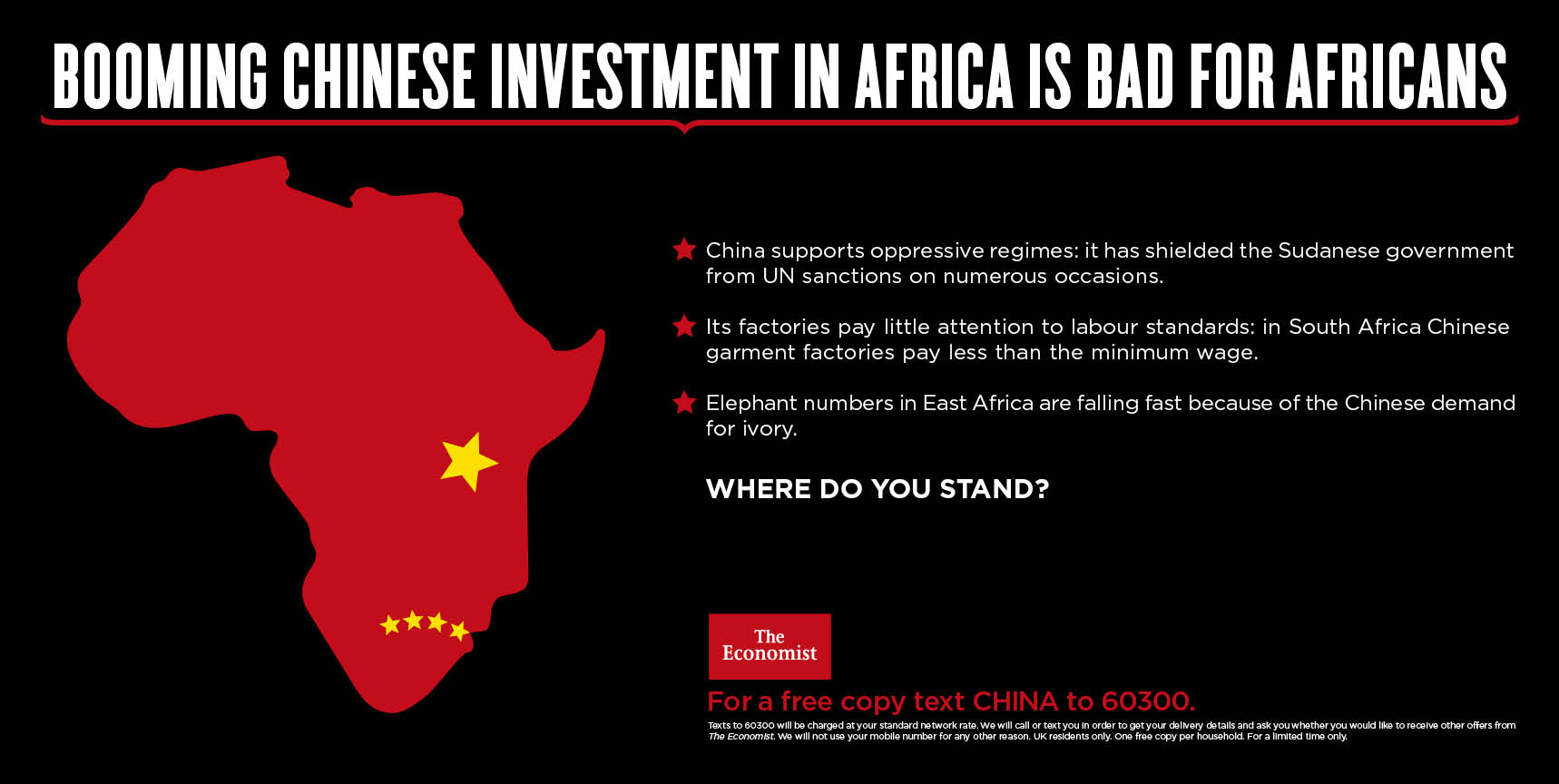
Yesterday, I encountered this Economist advert (one of this set), in the tube, which included the following argument that booming Chinese investment in Africa is bad for Africans:
Elephant numbers in Africa are falling fast because of the Chinese demand for ivory.
My immediate reaction was that elephants should maybe be farmed. That would soon get the elephant numbers up again, and it would also be good for Africans, because it would provide them with lots of legal jobs. If you google “elephant farming”, you soon learn that an argument along these lines already rages.
People much like Doug Bandow (and like me) say: Why not farm elephants? And people like Azzedine Downes, as and when they encounter this elephant farming idea, are enraged:
These days, it seems like any idea casually dropped in a coffee break conversation can be, if repeated often enough, and forcibly enough, taken seriously by those not really interested in finding solutions. They are looking for sound bites and this one was a doozy! I have seen these arguments take on a life of their own and so struggled to overcome my own vision of elephants in iron pens being kept until they could be killed for their teeth.
“First of all”, I started. “No-one needs ivory.” “Secondly, your proposal raises so many ethical questions that I don’t really know where to start.”
“Don’t get upset”, he said. “I was just wondering. You are right, it is an awful idea.”
I hope I never hear that idea coming up again and, if I do, I hope it will be just as easy to convince the next misguided soul that it is an awful idea.
I’m afraid that Azzedine Downes is going to hear this notion, seriously argued, again and again, unless he covers his ears.
I think I get where he is coming from. Killing elephants, for any reason, is just wrong, like killing people. Downes doesn’t spell it out, because he is not in a spelling things out mood. (“I don’t really know where to start.”) But it seems to me that what we have here is the beginnings of the idea that certain particularly appealing and endangered and human-like animals should have something like a right not to be killed, just as you and I have such a right. If someone kills us, the government will, depending on its mood, go looking for who did it and maybe, if it catches the miscreant in question, punish them in some way or another. Killing elephants, says Downes, is likewise: murder. See also: whales.
Farming a bunch of humans for their bodily organs would also be murder. A kidney farmer pointing out that he was raising his clutch (herd? pack? flock?) of humans not just for the serial killer hell of it, but in order to profit from selling their kidneys, would make things worse for himself, legally speaking, because this would provide the jury with a rational motive. Motive is not justification. Motive gets you punished, not acquitted.
In the matter of elephants, pointing out that farming elephants for their tusks might, given the facts on the ground in Africa, be the difference between African elephants as a species surviving, and African elephants being entirely wiped out by ivory poachers (for as numbers diminish, so prices will rise and rise), or perhaps entirely replaced by a newly evolved species of tuskless elephants, is, for Azzedine Downes, entirely beside the point. Farmers killing the elephants for their tusks doesn’t solve the problem, any more than the slave trade solved the problem of slavery. The problem of slavery was slavery, and the problem here is people killing elephants, which they would do even more of if they farmed them for their tusks. This is absolutely not just about the mere survival of a species. It is about not doing something morally repugnant. The elephants must be saved. They must not be murdered. End of discussion.
Thoughts anyone? How about the Azzedine Downes tendency proving their love of elephants by buying lots of elephants, and large elephant habitats, and then spending more money protecting the elephants from ivory poachers, but without farming them or otherwise exploiting them, other than as objects of photographic devotion by tourists. Presumably this is sort of what they are already doing, even as the idea of people owning elephants sticks in their throats, just as does the idea of people owning people.
Here’s another thought. How would Azzedine Downes feel about elephants having their tusks removed and sold on to Chinese ivory carvers when the elephants die but not before they die? Die of natural causes, I mean. As a matter of fact, are the tusks of elderly elephants, just deceased, still worth enough for that to be any sort of economically viable compromise? And as a matter ethics, would the Downes tendency tolerate even that?
Elephant tusk donor cards? Well, not really, because how would you know, in this new world of elephant rights, how the elephant or elephants actually felt about such a scheme? In this connection, the recent proposal that humans should be presumed willing to part with any or all of their useful-to-others organs when (as above) they die but not before they die, unless they explicitly say otherwise by carrying a non-donor card, is surely relevant.
Another thought: Will it soon be possible to make something a lot like ivory with 3-D printing? Or with some sort of magical bio-engineering process? Perhaps, but if so, that would presumably take much of the fun out of ivory. But then again, so might ivory farming, if it got too efficient.
Perusing the Samizdata postings category list reminds me that maybe similar considerations apply, or soon will apply, to hippos.
Time for me to stop and for any commenters, who want to, to take over.
Who knew that China was being funded by the Koch brothers?
– WUWT? commenter Alphaeus responds to the news that the Heartland Institute’s anti-climate-alarmist publication Climate Change Reconsidered has been published, in Chinese, by the Chinese Academy of Sciences.
Over the years in which climate change has been discussed in the media, there have been continual suggestions that it will be of benefit to gardeners – allowing us to grow fruit and vegetable crops that enjoy the continental climate, but fail to thrive in a traditional British summer. As those warm summer days have failed to materialise, and look increasing unlikely, I am eyeing up my new allotment with a view to planting crops that will enjoy our cool climate.
– The opening paragraph of a piece by Emma Cooper entitled Crops for a cool climate, quoted by the ever alert Bishop Hill.
The truth about Global Warming (that there has not been any lately) is starting seriously to circulate.
Eventually, when enough of it has been laid end to end, weather is climate.
At around midday today I caught Ed Davey MP babbling away on the telly about how 97 percent of climate scientists agree with him about the need to wreck the British economy and treble our fuel bills by making carbon illegal, or whatever. The BBC person present complained that Davey wasn’t doing nearly as much to wreck the British economy and treble our fuel bills as he should have been doing, and that what he was saying was merely bluster to comfort greeny true believers. It would certainly be nice to think so.
Peter Lilley MP, also present, had plenty to say about these absurd claims, but the word – just the one word – that he used that I remember most fondly was: Tosh.
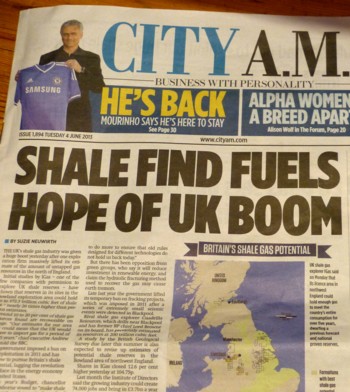
Later in the day, on a tube train, I learned of better British economy and energy bill news, in the form of this City A.M. front page:
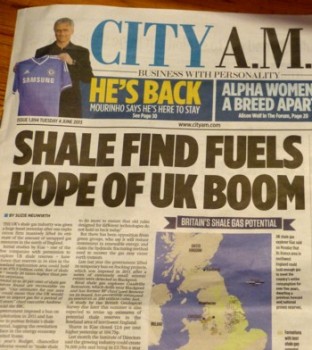
Here is the front page story.
Quote:
THE UK’s shale gas industry was given a huge boost yesterday after one exploration firm massively lifted its estimate of the amount of untapped gas resources in the north of England.
Initial studies by IGas – one of the few companies with permission to explore UK shale reserves – have shown that reserves in its sites in the Bowland exploration area could hold up to 172.3 trillion cubic feet of shale gas – nearly 20 times higher than previous estimates.
My favourite paragraph of this story is this one:
But there has been opposition from green groups, who say it will reduce investment in renewable energy, and claim the hydraulic fracturing method used to recover the gas may cause earth tremors.
Anything that reduces invetment in “renewable” energy, which is the stupid kind, is all to the good. As for those earth tremors, bring them on.
City A.M. Editor Allister Heath starts what he has to say about Britain’s shale bonanza with this question:
What are we waiting for?
Waiting, presumably, for the likes of Ed Davey MP to be dumped into the dustbin of history where they belong.
The British government wants to “eradicate undernutrition globally”. It has a department for it. This can not be good. There is also a committee of MPs who have released a report.
There is an argument in the report that since the population is expected, by Benny Dembitzer as far as I can tell, to increase to 9.3 billion people by 2050, and since consumption of meat is increasing, that there is going to be a general food shortage. Meat is singled out for being an inefficient use of resources. From the report:
Simply urging the Western world to stop consuming meat is neither feasible nor desirable. Moreover, nor is it necessary: meat production based on pasture-fed systems (e.g. pasture-fed cattle), as opposed to the mass production of grain-fed livestock, is markedly less problematic.(69) The Food Ethics Council therefore suggests a ‘less but better’ approach, with meat promoted as a occasional product rather than an everyday staple.(70)
Note that the Food Ethics Council is funded mostly by the Joseph Rowntree and Esmee Fairbairn charitable trusts. Even private organisations can be wrong.
So why is pasture livestock “less problematic” than grain-fed? Note 69 points to question 62, part of a series of testimonials which seem to make up most of the evidence used to make the report. I’ll highlight the most fun bits.
Q62 Fiona O’Donnell [committee member]: Finally, as carnivores, can we keep consuming meat in the way that we are? It is probably a rhetorical question.
Tim Lang [Professor of Food Policy, City University, London]: Is the “we” here? Do you mean us?
Fiona O’Donnell: Yes.
Tim Lang: The rich world, no. Let me be very hard, and I will speak now as a public health man. The case or reducing meat consumption in the West from our astronomic levels is overwhelming; it is a public health gain if you reduce it. The report that I led and that Oxford University and others fed into, on food security and sustainability and on sustainable diets, showed that there is a win-win for the environment and for public health if you reduce our meat consumption. It is not meat qua meat; it is processed meat. The evidence there is getting stronger and stronger.
Camilla Toulmin [Director, International Institute for Environment and Development]: It is also intensive livestock production.
Tim Lang: Exactly. You will get agreement from us. In our world, the three of us and the previous panel, we are worried about this assumption that 50% of grain or 40% of grain to the world must be diverted down the throats of animals to then give us meat. There are cases when that can be useful, depending on the climate. To factor in a meat engine, which is like a juggernaut driving our definition of what a good food system is, is crazy. It is a crazy use of resources, it is crazy economics and it is crazy public health.
Andrew Dorward [Professor of Development Economics, School of Oriental and African Studies]: Can I just add two things to that? Firstly, I would broaden it to livestock production. For example, butter is not very good for us either and eating too much cheese makes for the same sorts of problems. In terms of livestock production, it is basically the consumption of grains in intensive systems that is bad. Where you have more extensive systems, where you have pastoral systems and where you have more extensive upland systems in the UK, it is a different argument. For the intensive grain systems, the health and the environment, the food security and the water demand arguments are really overwhelming.
It is mostly incoherent ranting. Are they arguing for less intensive farming of animals to solve the problem of too much meat consumption, or something else? I’ll see how far I can get by assuming that this is about using resources in the most efficient way.
It seems to me that if people are hungry they will start to bid up the price of grain and stop buying meat anyway and that the problem will solve itself. I am not sure why pasture livestock is preferable. I suspect it is even less efficient than grain livestock, assuming all land is equal. It may be that grain for humans is always more efficient than grain for animals, however since there is land that is not suitable for grain that might as well, in that case, be used for livestock. There is also a hint here that grain production needs more water. But all this is a non-problem in a free market. In a free market the land is always used in the most efficient way and whatever shortages of grain or water come about will move the prices and hence the demand automatically.
This seems to be a big problem with the concept of “sustainability”. If you think that current levels of meat production are unsustainable, then if you are right they will not be sustained. If you are right, it doesn’t matter what anyone does. Coming up with innovative policies to reduce the consumption of meat seems to be a bit pointless unless what you really want is to reduce the consumption of meat even if you are wrong about its sustainability, or you are concerned about being blamed by the voters for its un-sustainability. I rather think that it is sustainable and we will end up eating less meat anyway to please these sustainability “experts”.
If some fundamental resource shortage does increase the price of food, an interesting question is at what point does food become so expensive that it takes more than one person’s labour to produce enough food for one person? I expect with 9 billion people (some of them rather more clever than the assembled committee members and witnesses at making food production more efficient) we are still a way off mass malnutrition caused by resource shortages. At some point hydroponics and 3D farming become cost effective.
Still, the rest of the conversation is a fascinating insight into the minds of the elite:
Q63 Fiona O’Donnell: Do you think the market price will choke off demand for meat? There is only so much horse meat you can put into a burger.
Tim Lang: You are back to a mass psychological problem. Meat has, historically, been associated with progress and feast days. The problem is that feast days are every day. Wearing different hats, let us just move to horse-burger land. Look at what is exposed there. You have got a culture that is now centred around plentiful meat and meat as the centre of the plate. These are deeply rooted—in different ways in different countries—cultural goals.
Camilla Toulmin: You are right that meat is too cheap. Meat production does not, in fact, cover the full costs of production. Until it does that, we are going to see too much of it around.
Q64 Fiona O’Donnell: We would almost be heading towards a vegan diet then for a lot of people, especially poorer people, in order to be healthier. Are we doing enough work to look at how we then should have a nutritious balance and how we produce it?
Tim Lang: The short answer is: no. I referred very early on to this issue of sustainable diets. There is a bubbling debate. I could spend my whole week, like Camilla, in the air going to meetings—they are cropping up everywhere. Last week I was in a one-day meeting, though I was only there for half a day, where experts from all over the country were brought in. I will quote, without naming, a leading nutritionist, who said, “Look, veganism can deliver a sustainable diet and can deliver a healthier diet, but the issue is culture and choice.” Without a shadow of a doubt, the ubiquity and cheapness of meat and meat products, as a goal for progress for Western agriculture, let alone developing world agriculture, is one we have to seriously question now for reasons of climate change, emissions, ecosystems and local reasons. Many of us in this debate referred to the Steinfeld et al./FAO’s Livestock’s Long Shadow report. This month, the new version of that report is going to come out, so I strongly recommend the committee has a look at that. I am not allowed to say what is in it.
Do these people listen to themselves? Meat is cheap and ubiquitous therefore we need to eat less of it. Climate change!
Andrew Dorward: This is something we all personally need to take very seriously, because it starts with us, not with telling policymakers what to do.
Fiona O’Donnell: I will take that away, if nothing else, from today.
Camilla Toulmin: In 20 years’ time we will look back at it in the same way as we now look back at smoking as it was 20 years ago.
Do not underestimate the power of these people. They may seem like idiots and professors talking nonsense among themselves but look what they have done with smoking. In 1999 I had to change seats on an aeroplane because there was too much smoke. Now people are cast out of society for lighting up at the far end of the empty railway platform. And it started like this.
Lots of conversations like that, then the report, now the news articles. Say the headlines: “Families should only eat meat as an occasional treat because the surge in global demand is unsustainable, according to a committee of MPs.” They are making the idea seem normal.
The committee also urged the Government to redouble its efforts to slash the amount of discarded produce – estimated to be around 30% globally… The committee wants ministers to set producers and retailers targets for food waste reduction, with sanctions imposed when they are not met.
The thing about food waste is that there is no such thing. There is a rational economic decision to choose excess food production to optimise for something else instead. In my house I sometimes buy or cook more food than I need because the computing resources needed to calculate exactly the correct amount are more expensive than the food that is thrown away. Everyone else is making similar choices. If the government invents innovative new policies to reduce “waste” X they necessarily make Y more expensive and thereby allocate resources less efficiently than before.
If existing policies are found to cause market distortions that cause food to be thrown away that would not be absent the policy, then these should of course be abandoned. But this should be applied generally to all policies that distort markets.
And it called on the UK to look at whether nations should stockpile food to protect themselves from price spikes.
Don’t we have market solutions to this already? Speculators?
They also warned that some biofuels are driving up prices and making them more volatile and, in some cases, could be even more damaging to the environment than fossil fuels.
Good thinking. Don’t stop there. Let me help you along. What do biofuel targets have in common with food waste targets and meat production targets?
The above is a lesson in how the ideas of certain classes of people – academics; politicians; journalists; social scientists – become law. These are the early stages, but something is afoot.
I recommend this report by Danny Weston (guest writing at Bishop Hill) of a talk at the London School of Economics given by NASA’s James Hansen. Hansen is a manic climate alarmist, and the audience was almost entirely other manic climate alarmists. But Weston himself managed to get a question in edgeways.
To echo many of the Bishop Hill commenters, congratulations to Danny Weston for attending this event, for spoiling the party by actually expressing doubts out loud about what Hansen said, and above all for writing his report of the event, for an influential climate skeptic blog.
Opponents, however manic, need to be listened to, and argued against. The point is often made here by commenters that arguing against such people as Hansen and this LSE audience is a waste of time and effort, and there is a definite and entirely understandable trace of this feeling in Weston’s own report. Wrong, wrong, wrong. In among that audience were other doubters besides Weston, a few of whom identified themselves to Weston afterwards sotto voce, congratulating him for what he said. Genuine undecideds, and even some of the majority who flatly disagreed with Weston, may also have been impressed by Weston’s sheer guts, as well as by his arguments. And by writing it all up, Weston greatly reinforces this silent bystander effect.
Weston ends his report with these words:
All in all a thoroughly depressing experience.
I hope that responses like this, and like the many other positive comments at Bishop Hill likewise full of congratulation and admiration, will have cheered Weston up a bit, and maybe even a lot.
Plebs is a sitcom set in ancient Rome. They showed the sixth and last of (the first?) six episodes of it last night on ITV2 TV, and they’ll be showing this again tonight.
I’ve been recording Plebs. In the opening scene of this latest episode, the three leading characters, Marcus (who wants to be more successful while still being nice about it, the voice of concerned normality), Stylax (more of a Jack the Lad type), and Grumio (their slave), are out and about in the town, watching the ancient Roman version of the media, i.e. people orating and/or selling in the market place.
Mad Soothsayer Woman: “The seas will rise up and drown the people living in the lowlands …”
Doughnut Salesman: “Doughnuts!”
Mad Soothsayer Woman: “… and the sun shall beat down and burn all those people living in the hills!”
Doughnut Salesman: “Doughnuts!”
Mad Soothsayer Woman: “And those people living on the lands that are neither high nor low will also die through a combination of burning and drowning! None of you are safe! The end is nigh!!!”
Doughnut Salesman: “Come get your doughnuts!”
Stylax: “So, when’s the world ending?”
Grumio: “I dunno, I were listening to that doughnut guy.”
Marcus: “Nigh, apparently.”
Stylax: “Alright, nigh. Hang on, doesn’t that mean soon?”
Marcus: “To the people that say it, it means soon. To everyone else it means you’re a nutter, talking shit.”
Grumio: “I’m going to get a doughnut just in case.”
Sam Leifer and Tom Basden, the two man team who wrote, produced and directed Plebs, are either climate non-alarmists themselves, or at the very least they reckon that a lot of us now are, and that we’re ready for comedy which takes the piss out of our mad soothsayer tendency.
My original title for this was: “Are the plebs starting to see sense about climate alarmism?”, but I reckon our plebs have been sussing this out for quite a while now. Britain’s telly comedians are following public opinion on this rather than shaping it. Until a couple of years ago or so, they were constantly going on about how stupid climate non-alarmists were. Then they went quiet on the subject. Are they beginning seriously to see sense?
Mankind will never enjoy the full social, economic and psychological perfection of the Inuit hunting group, as portrayed by First Peoples — but then real Inuit hunting groups don’t enjoy that either.
– Martin Hutchinson
|
Who Are We? The Samizdata people are a bunch of sinister and heavily armed globalist illuminati who seek to infect the entire world with the values of personal liberty and several property. Amongst our many crimes is a sense of humour and the intermittent use of British spelling.
We are also a varied group made up of social individualists, classical liberals, whigs, libertarians, extropians, futurists, ‘Porcupines’, Karl Popper fetishists, recovering neo-conservatives, crazed Ayn Rand worshipers, over-caffeinated Virginia Postrel devotees, witty Frédéric Bastiat wannabes, cypherpunks, minarchists, kritarchists and wild-eyed anarcho-capitalists from Britain, North America, Australia and Europe.
|





Recent Comments