We are developing the social individualist meta-context for the future. From the very serious to the extremely frivolous... lets see what is on the mind of the Samizdata people.
Samizdata, derived from Samizdat /n. - a system of clandestine publication of banned literature in the USSR [Russ.,= self-publishing house]
|
I was going to just point out a splendid article in the UK edition of Esquire magazine by the dependably excellent Karen Krizanovich about ‘the murky world of the dominatrix’ and how context really matters:
Let’s say that one evening your girlfriend starts having a go at you for not doing the washing-up. “You are so lazy!” she screams, slapping a teatowel against her firm thigh. Her breasts quiver as she gestures at you. “I should put you across my knee and spank you!” she shrieks, her pupils dilating with anger. She’s red in the face now, and you are the helpless target of all her built-up rage and resentment. She steps forward, towel in hand, to take her revenge…
Whoa! Stop right there. Maybe this isn’t the perfect evening for you. But picture this scene in the bedroom with both of you naked. Maybe now you get the point.
Yes indeed I do!
But the fact is that quite apart from this howlingly wonderful Karen Krizanovich piece, this is one of the best issues of Esquire I have read in ages. There is a great article about the race car driver and supremely cool French Resistance hero Robert Benoist, a fascinating piece on the Falklands War, a hilarious ‘Ali G’ interview, new iMacs, why the sex, sadism and hard drinking in Ian Fleming’s James Bond books make the 007 movies look pallid, and an excellent list of Britain’s 40 most eligible women. Under the entry for supermodel Kate Moss:
Money: You know your annual salary? She wouldn’t get out of bed for that.
Personality: Like shouting at an alien bartender through a wall of ice 6ft thick while juggling two cats and a monkey
Run, do not walk, to your nearest news agent and purchase a copy of the April UK edition of Esquire
A few days ago I reviewed John Keyes’ new play and mentioned it would soon be going on the road. I rang him t’other day for details so our London readers can drop in to see this excellent bit of theatre.
John will be performing his two act play at the Wimbledon Studio Theatre from Sunday February 24th to Tuesday February 26th.
Enjoy!
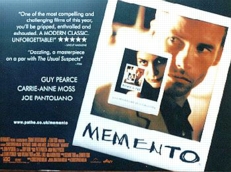
I must say that the most egregious omission from the Oscar line up for best flick is director Chris Nolan‘s highly unconventional Memento. Unlike the linked review I think it quite possibly does make it to “favorite-of-all-time status” rather than just pretty damn good.
Guy Pearce turns in his best performance yet, sympathetic without being sentimental and Carrie-Ann Moss proves there is more to her than just ‘Trinity’ from The Matrix with her alluring, pitiable and in the end utterly detestable character. Joe Pantoliano is of course as dependable as ever. The structure of this work is pretty much in a class of its own: we see a scene and we think we understand what is going on, but a few minutes later we see the exact same scene but the context has changed, and we realise what we thought had happened before was not the case at all. This happens several times throughout the film, which in effect starts at the end and works not so much backwards as backwards, forwards, backwards again, hop to the middle, jump back again…
This little non-linear gem is certainly in my top 5 movies of all time. Hey Oscar, we wuz robbed!
Dale Amon, from Belfast, reports on the daft new regulation to limit decibels to 83db. Are the EU mad? Who is really going to enforce this? I can imagine the first time some little dweeb from the EU directorate goes into a death metal gig in Sweden. The venue is full of leathered, iron spiked and generally cranky death-metal fans. Is the EU bloke going to ask these nutters to turn down their music, and expect to live? Just look through the pages of Brave Words and Bloody Knuckles or Terrorizer to find examples of death metal types. Never mind the fact that most death metal fans I meet are huge, well built hard men who look like they could be vikings. Is it a co-incidence that extreme/death/doom/speed metal is very popular in Scandinavia and Germany? I don’t think so. Sorry to tell you Dale but punk rockers are wimps compared to these guys.
May I suggest we send Chris Patten to Wacken or maybe the Inferno festival? Someone needs to convince him to announce from the stage at about 10pm what his intentions are. “Excuse me fellow Europeans, I am here to inform you that this venue must turn down the music to an EU-approved 83db. The EU is only concerned for your hearing and well-being.”
Well good thing about this new db rule, it will turn anyone who likes loud and heavy music against the EU in an instant. What I would love to see is an army of leather clad insensed metal-heads decending on Brussels for a huge protest.
Oh yes and Dale, there have been several songs written about the EU. One, whose name I forget, mentions the great line: “another doomed utopian ideal…” You are also mistakened if you think all musicians are socialists. The loud-mouthed ones might be, but there are many a band whose lyrics speak to a libertarian mind-set (especially in the heavy metal/hard rock genres). Of course, I know of major bands who are Tory voting, all of whom think their being ‘outed’ would hurt/kill their careers.
Lagwolf
Rockers Outraged At Regulation (R.O.A.R.) arise against fascist EU state!
Yes, you can find some really great electric blues here. Not to sound like an agent for the Northern Ireland Tourist Board or anything… although a women friend of mine does work there. Rab McCullough’s band is simply on a level with the best you will find anywhere. He can compete with the best in the USA, and in fact has. He took 3rd in an international blues competition in Memphis a couple years ago. I stopped in to their gig at the Empire after the play since I’d not seen Rab in a couple months, and I’d just gotten an SMS message from a mutual former bass player of ours. Which is not at all to put myself in the same league as the unnamed bass player…
This is not a huge city, nor is Northern Ireland altogether very large. But the place has more talent per square meter than any place I’ve ever been. And that includes Manhattan. I’ve lived in the Village too, and I agree there are more fine acts there than in Belfast. But then, there are 10,000,000 people in New York City… and 500,000 in Belfast.
We’ve got you on per capita talent, no ifs ands or buts about it.
One of the perks of the arts community is that you get invited to things without having to pay. Arts people take care of their friends because like themselves, their friends are always broke.
Tonight I went to the night after opening night of a one man show by John Keyes, a marvelous actor. One of the top actors in Ireland actually. It was a very small crowd in a small venue… this is the trial run, the warmup before he takes it to London.
John is the agent for a close friend of mine, and although I knew he was a top actor, I only knew him in a social environment and had not actually seen him doing his professional thing.
I was awed.
He wrote the play and performed the two acts. Solo. One man show. He didn’t need anyone else. From the first word to the last I was rivited.
Well, almost. To digress… I used to do a great deal of theatre myself. Mostly tech, although I used to do work in musicals. I knew I was a mediocre actor. I pushed choreographers to new levels as they strove to find moves for three left feet… I got the parts because I could belt, pure and simple. Nonetheless, I decided that I was better off doing tech… and then someone talked me into producing a play. It’s that demon rum, something like that. Devil made me do it and it was a bad idea. I can only say that I did *not* commit homicide upon the director; I even went so far as to stop the cast from stringing him up from House One… and I never did theatre again. I was already losing pleasure in theatre because instead of watching the show, I saw the detail. I’d note the light cues, catch the flaws in the fields, nod my head at the use of a particular fresnel… in other words, the magic was gone.
So to come back to our story… I was watching John in the midst of a brilliant monologue and caught myself analyzing the reflections of the straw gelled PAR reflecting off the grand piano strategically placed as a distant backdrop behind him… and caught myself before it was too late.
That was my only slip of the night.
I won’t give you a lot of detail, but the show is about Michael Mac Liammoir, originally from London, who was a founder of the Irish theatrical tradition. A man whose passport was signed by De Valera himself.
The monologues and acting are brilliant. When John hits London, look for it.
I’ve read the posts on the recent EU regulation that nowhere in Europe should a workplace exceed 83db and did not think a great deal about it until tonight when I was standing up near the stage at an electric blues gig. There is a section of the bar near the speakers that is “musician country”. Everyone there is either a head or part of the family. It struck me somewhere arount the 3rd or 4th pint that the decibal level where I was standing was a bit beyond 83. Well, let’s face it. it passed 83 when the first chord was struck and went up from there. For myself, I’d hardly noticed it. If I’m due for hearing loss, the damage was done and finished with over 20 years ago standing in front of a speaker stack with my Hagstrom III cranked up to eleven. 83db? Is for wimps!
Which got me thinking. Where is the EU going to find someone with the pure balls to walk up to a rock band and tell them they are playing too loud for EU law? Thinking back to my own self in a younger and wilder format, I know exactly what would happen. I’d have stopped playing long enough to beat the crap out of him. Jail? Who cares? For most young musicians trying to make it jail would be warmer, cleaner and have better food that they can afford. Artists live on the fringe. Many bloggers comment on artists who have “made it” and that they are socialist. That might be true when they’ve got the gig with real dosh… but for most artists politics is just words. The enemy is whoever threatens your art.
Would you like to imagine what songs will be written if the EU starts trying to shut down punk rock bands?
And can you imagine what the regulation enforcers will look like walking out of a gig with a drum stick rammed up their arse?
Although I make my living (sometimes and poorly) doing internet infrastructure, my true home is in the art’s scene. It may be hard for those who have not live the life of the artist to understand the world of the actor, the musician, the fine artist… but no matter how long or how well I program machines, that is my true home.
The entry into the arts world is not an easy one, and not one for those who are weak of heart or who do not truly love their art for its’ own sake. I’ve paid my dues over decades and it lets me move freely in the arts world, and most particularly in that global brotherhood of musicians. There is an assurance in knowing you could be dropped anywhere in the world and inside of an evening get yourself sorted for a place to crash and pointers to where the craic is.
I’ve been out on such a night and have decided I should compose several short stories rather than write one long and disjointed article.
Due to the format, you are reading the introduction last… so just pretend you started here.
I oppose Gun Control and I oppose Porn Control. In the War on Drugs, I am confident that the side I back (Drugs) will eventually be declared the winner. But what I actually like is classical music, and about a week ago I visited Mr CD in Soho, which is my second-favourite second-hand CD shop in London, to get another fix. Just now, some of the CDs there are particularly fine bargains.
Two purchases from Mr CD have given me special joy, namely two double albums of violin concertos by Vivaldi, at £2 (~$3) per album, i.e. £1 per CD.
I have a love hate relationship with the music of Vivaldi. I love it when it is played as I love it to be played, and I hate it when it is played as I hate it to be played. And I hate it when Vivaldi is played in the “authentic” style, on “original instruments”, by musicians who also fancy themselves as scholars. What this means in practice is coming down on the first beat of every bar with a great bulge of over-emphasis. What I like is best described by the Italian word “legato”, a steady line of melody in which the volume doesn’t come and go within each note. And of all the famous composers, I find that the gap between how good it can sound and how bad it can sound is greatest with Vivaldi. Good Vivaldi is heartbreakingly lovely. “Authentic” Vivaldi is boringly, relentlessly pointless, like the worst sort of ‘elevator music’.
The most detestably authentic musicians I’ve ever heard are some people called “Musica Antiqua Köln“, who are misdirected by a man called Reinhard Goebel. I have a CD by these people, which I have only kept so that I could one day denounce them to the entire world without miss-spelling their names. They shouldn’t all be taken out and shot by a firing squad which specialises in using original weapons, because that would be wrong. As a libertarian I defend the right of people to express themselves in any way that does not aggress against the rights of others, no matter how horribly they avail themselves of this right. But you get my point.
But ah joy, the Vivaldi CDs I came upon in Mr CD were played by the Chamber Orchestra of the Vienna State Opera, in other words by real musicians. I think this orchestra may be a slimmed-down version of the Vienna Philharmonic Orchestra itself, no less, a suspicion strengthened by the fact that one of the solo violinists in the Opus 3 Concertos (“L’Estro Armonico”) is the great Willi Boskovsky, the VPO’s long time leader. The recording was made in 1964, long before authenticity struck, but just recently enough for the sound quality of the recording to be okay. Viennese opera musicians wouldn’t be allowed anywhere near a baroque recording project these days.
I played the CDs eagerly as soon as I got home, and all the joy I used to get in my youth from listening to Vivaldi came flooding rapturously back.
The difference between this sort of music making and Musica Antiqua Köln is the difference between making lingeringly rapturous love, and merely humping up and down, trying and failing to force on an orgasm.
On the same expedition I also acquired the latest recording in the LSO Live series, a beautiful performance of Elgar’s First Symphony conducted by Sir Colin Davis, brand new this time, for a mere £5. This is my favorite LSO Live CD so far. (You can find out more about this and the other excellent and keenly priced CDs in this series, and about how to purchase them, by going to the London Symphony Orchestra website.)
The impression usually left in the mind of the listener by this wonderful symphony is of great dignity and great splendour, the main tune of the first movement being especially dignified and splendid (it’s marked “nobilmente”). But in this performance it was the quieter and subtler orchestral details that most caught my attention. Sir Colin Davis is quoted in the sleeve notes thus:
“If I am conscious of being older now I think my feelings must have changed too! Like a lot of older people, I am looking for space. There is more space between the bar-lines than people understand. There is more time for musicians to gauge the rise and fall of a phrase. There is no virtue in driving things just for the sake of it, which is a temptation of youth. But of course if one did not do that when one was young one would not enjoy not doing it when one was older!”
For once, the artist’s sleeve note claim and the artist’s actual artistic achievement correspond perfectly.
People who say that money can’t buy happiness are just no good at shopping.
The music industry is a wonderful example of how established players in any market often feel they have a vested interest in stasis rather than dynamic change. Rather than see new technical innovations as potential boons, the industry has spent a fortune trying to use the state to defend its existing business models with an army of lobbyists and lawyers, attempting to un-invent the technologies that they (rightly) see as shattering the current structure of its multi-billion dollar industry. Steven Den Beste has a good article on the subject and makes an excellent point regarding the self-defeating culture in the boardrooms of the music industry majors:
As long as the industry doesn’t see it from that point of view, they will continue to try to fight the future. No industry can ultimately survive if it thinks of its customers as enemies; ultimately the industry has to adopt the point of view of its customers and cater to their desires. You cannot sell someone what you want them to have. You have to sell them what they want to buy.
A classic case of this syndrome of ‘customer-as-enemy’ was provided by Steve Heckler a VP from Sony Pictures Entertainment in August 2000 who said:
The [music] industry will take whatever steps it needs to protect itself and protect its revenue streams,” Heckler said. “It will not lose that revenue stream, no matter what. […] Sony is going to take aggressive steps to stop this. We will develop technology that transcends the individual user. We will firewall Napster at source – we will block it at your cable company, we will block it at your phone company, we will block it at your [ISP]. We will firewall it at your PC.
Although Sony tried to apply some damage limitation spin to Heckler’s remarks soon afterwards, this is clearly delusions of grandeur on a spectacular scale and is exactly the mentality to which Den Beste has alluded. The major players think they can translate their wealth into political muscle and use the state to crush would-be new entrants that seek to undermine their businesses. taking out Napster has only encouraged this flawed thinking. Additionally yet more money is being spent on technological fixes which are also doomed to fail due to the ‘Swiss Watch Effect’ (it is cheaper and easier to smash a Swiss Watch than it is to make one): they spend millions on copy protection that will be broken within months or weeks by the worldwide army of Internet linked 15 year old crackers who work for free.
Another indication of the scale of ‘wrong-think’ going on in boardrooms is that they do not seem to realise that many people’s CD player is their computer. I might have purchase the new Natalie Imbruglia CD White Lilies Island but I have read that most computers gag on some of the tracks due to copy protection and I do tend to play a CD in my computer whilst I surf the Net. As a result I have not bought the CD. Well I suppose if the company strategy is to make it hard for me to rip any tracks into MP3s, one way of doing that is to discourage me from buying their products all together. Somehow I don’t think that was quite the effect they were hoping for but that is the one they have got.
[Update: article amended with Steve Heckler of Sony’s exact remarks thanks to the excellent input of readers Tino D’Amico and Joachim Klehe]
Patrick Crozier is happy to see the old lags of British terrestrial television being given a run for their money
UK Channel 5 has been dismissed by the elite as being a non-stop orgy of sex and violence. Such statements in themselves lay bare the warped priorities of our ‘leaders’ but there is one other problem: it isn’t true. Channel 5 is simply the most dynamic and innovative British terrestrial channel around.
It has the best reality TV programme: The Mole
It has the best two animations: The Powerpuff Girls and Tintin
And it has some of the best history documentaries around. My favourite has to be Hitler’s Henchmen. Not least because an inspired piece of scheduling led to biographies of Hermann Goering and Heinrich Himmler being interspersed with shows covering the life and works of John Prescott and Pete Waterman.
In fact, Channel 5’s documentaries seem to be giving BBC2 and Channel 4 something of a headache. For many years these stuck up elito-vision channels have been pumping out nothing but revisionist pap. You know, ‘Churchill was a drunken child molestor’, that sort of thing. But then Channel 5 started broadcasting things like “British Heroes of World War 2” (the title says it all). And then “Secrets of World War 2”. In the hands of the elite this would have been all about how Churchill contributed to the slaughter of Russians on the Eastern Front but from Channel 5 it a set of stories about the daring exploits of our ancestors.
I do not know if Channel 5’s documentaries are particularly popular. But the reaction (especially from Channel 4) has been revealing. To “Secrets of WW2” Channel 4 countered with “Battle Stations”. To “Heroes” they countered with “Commando”. And to a fine 3-parter on the Falklands they dusted off a 10-year old documentary of their own and put it out as a spoiler.
But the really interesting thing about this is the way the content has changed. Quite simply, Channel 4 has sobered up, smelt the coffee and dumped the revisionism. Commando was an hour long show but contained little more than half an hour’s actual information. Could it be that the missing half an hour was the revisionism they had to axe to get the ratings?
Patrick Crozier
Our very own Tom Burroughs has long complained to me about the consistently venal and ugly way in which businessfolk are portrayed in TV drama. His highly meritorious complaint is picked up and expanded upon by Rand Simberg
Having spent a few years of my life as a jobbing scriptwriter, I have moved amongst these people and, from my experience, the anti-capitalist theme of much of their writing is no surprise given their almost universal woolly socialist outlook. I know that, in Britain at least, this is so overwhelmingly the prevailing paradigm that it is, to all intents and purposes, a hegemony
I have tried to examine the reasons for this and the one that I find most compelling is that their socialism is a reflection of their life experience.
Most of those who spend their lives pursuing artistic success will do so fruitlessly. Very, very few make it and, even those that do, have spent years in struggle and poverty. The cliche of the artist starving in a garrett is a cliche because it is largely true. The simple, seemingly eternal, truth is that there are way too many people wanting to earn their living from artistic endeavour than the market can viably support and possessing talent guarantees nothing
Yet, there is no paucity of effort on their part. A writer may spend years of his or her life pouring their heart and soul into a magnum opus that nobody wants to publish or buy. Nor are they lacking in cognitive faculties. Most writers are highly learned and articulate and many feel that, for that alone, they should be rewarded in some way but are not. It is easy to imagine just how rudely offensive they find it when a monosyllabic, uncouth market trader can go off to the City of London to ply his share-dealing skills and earn more money in a month than most artists will earn in any decade of their lives
That is what they find so wrong about capitalism: its indifference. It cares not a jot for sincerity and effort and craft and endows its riches upon those who fulfil the often flimsy and evanescent wishes of consumers. The dedicated artist whose fingers have bled in learning to play Shostakovich on his cello, but can’t afford to give up his day job, knows that something needs changing when Gerri ‘Spice Girl’ Halliwell (who gave consumers what they want, what they really, really want) builds another palatial home on the Cote D’Azur. It’s all so unfair
Just how much more attractive to any writer or artist is the warm embrace of socialism with it labour theory of value, its promise to support and succour artists regardless of their output, to banish harsh wordly concerns of homelessness and unemployment and build a society based on status rather than contract
There are, of course, exceptions. There are always exceptions but they are the exceptions that prove the rule. And, for sure, there may be other factors involved, most notably good, old fashioned peer pressure. Success as a writer depends upon acceptance by the notoriously cliquey world of the Literatti and either you lockstep or step out (I stepped out)
But it is my view that, lying behind all of it, is the almost unchallengeable belief that Mistress Capitalism is cruel, capricious and immoral and so are those who feed at her breast
|
Who Are We? The Samizdata people are a bunch of sinister and heavily armed globalist illuminati who seek to infect the entire world with the values of personal liberty and several property. Amongst our many crimes is a sense of humour and the intermittent use of British spelling.
We are also a varied group made up of social individualists, classical liberals, whigs, libertarians, extropians, futurists, ‘Porcupines’, Karl Popper fetishists, recovering neo-conservatives, crazed Ayn Rand worshipers, over-caffeinated Virginia Postrel devotees, witty Frédéric Bastiat wannabes, cypherpunks, minarchists, kritarchists and wild-eyed anarcho-capitalists from Britain, North America, Australia and Europe.
|






Recent Comments