We are developing the social individualist meta-context for the future. From the very serious to the extremely frivolous... lets see what is on the mind of the Samizdata people.
Samizdata, derived from Samizdat /n. - a system of clandestine publication of banned literature in the USSR [Russ.,= self-publishing house]
|
This is an article about a movie that I rather like, but it is also about how not to write a film review.
I am werewolf, hear me roar… No, I am sure I remember that name of that daft Helen Reddy song all wrong, but that does seem to be the message of a review of Underworld in the Sierra Times by the colourfully named RadioFree Rocky D… this movie is just a pinko feminist tract.
To which I say… nonsense.

Underworld, the film in question, is in essence a version of Romeo and Juliette, but set against the backdrop of a war between not Montagues and Capulettes, but a clan of werewolves and a clan of vampires! This has everything for the trash movie aficionado: monsters, perpetual gloomy atmospherics, high tech weapons, chick-in-latex-with-guns (the breathtaking Kate Beckinsale)… need I say more? As an extra added bonus, it even has a decent and fairly complex storyline!
The review on the worthy Sierra Times dislikes this movie because it was being ‘politically correct’:
Women and men are physical equals. Anything a man can do, a woman can also do. Anyone who points out that men are physically stronger than women should be forced to undergo government-sponsored sensitivity training. Worse yet, telling the truth just may be sexual harassment. I know this, because Hollyweird tells me so.
I’m guessing that Beckinsale weighs in at a whopping 115 pounds – including her bootiliscious leather getup and her ho’ boots. I warm up with more weight than that. Be-otch come near me, and I’ll squish her. Good thing for her she carries twin Glocks.
Well for a start Selene, Beckinsale’s character, does not go mano-a-mano with the werewolves when she can avoid it… in fact she runs like hell to put some distance between them so she can shoot the hell out of them with silver bullets. And for another, she is not a 115 pound woman, she is a 115 pound immortal vampire, so why the hell should she be constrained by the limitations of a normal woman? I am sure that mighty jock RadioFree Rocky D could kick Kate Beckinsale’s delectable behind, but I doubt he is bulletproof regardless of how much weight he warms up with, so who cares?

The fact she casually steps off a ledge 20 floors up is a
fair indication the movie does not expect you to see
Selene as a feminist representation of ‘everywoman’
But then the review gets really weird:
More PC oozes out when someone wonders aloud, “Who started this war …?” This is Hollyweird’s way of saying that all wars are stupid and meaningless. Nothing could be further from the truth. Tell any veteran the war he fought in was for nothing, and you’ll get a face full of knuckles – and you’ll deserve it. Hollyweird has its hate-America-first panties in a bunch over the fact that President Dubya was the man at the helm when our troops totally stomped Saddam’s jackbooted civilian-killers into the sand. Where were the liberal’s objections when Weak Willie was Presidunce and sent troops to Bosnia, Somalia, Rwanda and Haiti? Where were the socialist street protests then?
Huh? Now I quite like the Sierra Times and no doubt RadioFree Rocky D and I would probably agree on a great many issues (I was an outspoken supporter of the armed overthrow of Ba’athism in Iraq for example), but this review is what happens when one’s ideology starts to distort everything one sees. That paragraph seems to suggest that to question the legitimacy and sanity of any war makes you some pabulum puking whining pinko. I guess RadioFree Rocky D must have thought any Russian who questioned the wisdom of the Soviet invasion of Afghanistan was some sort of weak kneed girly-boy.
And from this position he takes the view that questioning the wisdom of a war between vampires and werewolves is somehow criticism of the US/UK invasion of Iraq. Funny but I must have missed the ‘No Blood For Oil’ speech coming from one of the vampires (vampires… blood… get it? Oh never mind).

Use GUNS when fighting werewolves!
Anyway, this review tells us a lot about the author who rejoices in the name of ‘RadioFree Rocky D’ but tells us jack shit about the movie called Underworld… which happens to rock big time.

The ayes eyes have it!
Alex Singleton over on the Adam Smith Institute blog does not think much of the cinematic renditions of Lord of the Rings and asks:
Is the Lord of the Rings the most boring series of films ever? I sat through the second in the trilogy, The Two Towers, and just wanted to go to sleep. The pointless dialogue, endless battle scenes and lack of a story made this quite possibly the worst film I have ever watched at the cinema.
Well it takes all tastes but I for one enjoyed both Fellowship of the Ring and The Two Towers thoroughly and disagree with almost every word of Alex’s critique. The dialogue was true to the story, the battles gripping and best of all for me, the characters were almost exactly what I had in my head for over 30 years since I first read the books. In fact I think the films cut out a lot of the ‘flabby bits’ in Tolkein’s epic (such as editing out the completely superfluous Tom Bomberdil interlude) without doing a great violence to the substance of it.
Although as you may have gathered, I have long been a great fan of Tolkein’s works, the Lord of the Rings has always held deeper meanings for me and the big screen versions have just reinforced my views as to what it all really means.
I eagerly await the third part later this year.

Art criticism is something about which I only rarely touch on when something particularly interests me. But in today’s Sunday Telegraph (print version only), Ian Hislop has written an interesting piece called Now I’ll be labelled a pervert on how playwright Andrew Lloyd Webber has been scorned and derided by the British ArtCrit set because he has the temerity to not just collect Victorian and Pre-Raphaelite paintings, but to actually exhibit them to the public.
Having consented to display his collection at the Royal Academy last week, Webber was duly given a good kicking by the critics, who lined up rubbish both the pictures and their owner. The pieces ranged from the hysterical, in the case of Brian Sewell1, to the merely critical, in the case of the critic of this newspaper.
[…]
What appears to really annoy a lot of the critics is the literalism of the paintings: the idea that there is a story or a message, or even something as vulgar as a moral in the artwork, rather than just an impression or a mood or an emotion. Brian Sewell says that Webber has “a literal eye” and that this “has nothing to do with Art”. Nothing at all? This seems rather harsh
1= free registration required
And for me, therein lies the rub. Most art critics hate literal art because literal art can be understood by anyone who takes the time to learn a bit about the context within which the art was created. Now I am not someone who thinks ‘modern art’ is an oxymoron but it is true than much of what passes for art these days is so obscure that it requires an ArtCrit, such as Sewell or Saatchi, to give it some meaning. I guess what I am really saying is that much of what the likes of Tracy Emin does is so devoid of intrinsic meaning that only a professional arbiter of artistic values and taste can tell us poor muggles what the hell it means. No wonder art critics love ‘cutting edge’ modern art!
And now for some art you might be able to figure out for yourself…



The movie moguls and their sidekicks in the film industry are being urged to tone down their campaigning to win the forthcoming Oscars.
Presumably the heads of the film industry in the U.S. and elsewhere are concerned that an unseemly rush by actors, actresses and others to plug their films is already annoying the public. I honestly don’t know if people really are all that concerned if, say, Cameron Diaz or Russell Crowe are on the stump advocating the merits of their films. (If Ms Diaz wants me to interview her about her work, she is only too welcome).
The film industry, both in the States as well as elsewhere, has become so large in its financial strength that it is hard to see how much can, or should be done to restrain artists from doing their all to grab one of the golden statues. It may be crass, but what can you do, apart from ask for polite restraint? Personally, I nurse a slight antipathy to the Oscars, which usually provide an opportunity for blowhards like hard-left progagandist Michael Moore to harangue the audience with his paranoid views at the reward ceremonies, or else give the back-scratchers in the business a chance to do what they know best.
But really, in the big scheme of things, it is hard to get too upset. The Oscars have become a circus and they look set to remain that way, barring a catastrophic drop in the movie industry’s fortunes. Michael Jennings of this parish had some good things to say in this vein in his superb piece here a few days ago.
Of course the surreal nature of lobbying for Oscar slots gets even more Daliesque when juxtaposed next to the recall election in California. Here’s a poser for you – which is more out of touch with reality, the Oscars, or California’s politicians? Discuss.
It is the end of August, and the Labor Day holiday weekend is here. This is considered by the film industry to be the end of the summer movie season. Since Steven Spielberg invented the modern blockbuster when he made Jaws in 1975 (and due to the near-coincidental arrival of air-conditioning in most movie theatres), this has been the most important season for the Hollywood film studios. I am going to be mildly self-indulgent and give the readers of Samizdata a lengthy overview of what I think happened to Hollywood this summer, largely from a business point of view, but also from a creative point of view. This is going to be much longer than a normal Samizdata article, but I am assuming that my editors will indulge me just this once. Or maybe I shall receive what is known in Samizdata speak as an “editorial spanking”. We shall see. However, I think most of the following is quite interesting.
One sad fact is that I am in Britain, and films are usually released in this country anything from the same day as in the US to a couple of months after they are released in the US. Sometimes though it can be longer. What this means is that there are one or two big summer releases I haven’t seen. The most important of these is Finding Nemo, which is being held over until the holiday season here in the UK, despite being the highest grossing film of the summer in the US.
However, in order to explain why certain films are hits and some are not, an overview of recent year Hollywood economics is necessary. So, a little digression first.
→ Continue reading: Thoughts on Hollywood’s lousy summer
Ever since Instapundit pointed out, during all that faking of stories scandal, that the NYT may be politically all over the place on pages one, two, etc., but that on page n as n tends to infinity it has great technology coverage, I’ve been making a point of looking at that, and he’s right.
This, for example, from the New York Times today, sounds really interesting:
Standing on four metal legs, under two banks of fluorescent lights, was what appeared to be a modest-size billboard, measuring about 9 feet wide by 4 feet in height. Across its face, which looks like paper under glass, was a full-color advertisement for a soft drink maker. A few moments later the ad disappeared and was digitally replaced with a different one, and then another, like a screensaver cycling through images on a laptop computer screen.
But the surface of this billboard is not a liquid crystal diode screen – the energy-hungry display common to laptops and increasingly to cellphones, digital cameras, digital organizers and flat-screen computer monitors and television sets. Neither does this billboard share the light-emitting-diode technology that makes million-dollar-plus video screens light up the night in Times Square, Las Vegas and sports arenas around the world.
What makes the electronic billboard in Jersey City possible (and those installed for trials in London, Tokyo, Toronto and Panama City, among other locations) is an innovation by a New York-based display technology company whose name, Magink, is a combination of the words magic and ink. Its approach to imaging departs from the way most text, graphics and images are electronically presented, including the way expensive plasma screens work, as well as cathode-ray tubes, the old workhorses still found in most television sets and desktop computer monitors.
By creating a paste made of tiny helix-shaped particles that can be minutely manipulated with electric charges to reflect light in highly specific ways, Magink can produce surfaces that look like paper but behave like electronic screens, rendering high-resolution, full-color images without ink – or, as Magink executives like to refer to the process, with digital ink.
Ran Poliakine, chief executive of Magink, said the idea was to create visually compelling ads that could be replaced frequently – perhaps hourly, based on consumer response – and could be controlled remotely, all with far less energy and at a far lower cost than a video billboard.
It looks like paper. It’s cheaper than the usual screens, and easier to update. “Digital ink.” Wow.
I’m not any sort of techno-buff, but it sounds as if this technology differs radically from the usual screen technology in that it starts out being pretty big, but is rather hard to make small enough to fit on my desk. But they’ll get there, surely.
I don’t know about you, but when I am faced with a twenty page article on the internet, I do a print-out. Paper is just so much nicer than that screen shining so brightly at you. It’s the difference between reading something on the surface of a torch, and reading something on a surface. This stuff doesn’t shine light at you in an exhausting glare. It just reflects it, the way paper does.
It often happens that advertising cleans out the tubes of a new way of presenting messages, if only because novelty itself is the lifeblood of advertising – it gets your attention even if it does look cranky, because it looks cranky. Ten years later, it isn’t so cranky anymore and the advertisers are losing interest. But the R&D has had a big early contribution and Western Civilisation marches onwards. Just one more reason to love advertising.
Because what this really sounds like to me is the future of … reading!
Ah, the free market. Don’t you love it? When offered a Two Towers DVD at Victoria station by WH Smiths, on Friday, for £18.99, three days ahead of the supposed release date, I had to turn it down for three reasons:
- My mother-in-law, whom I was visiting in Worthing, has no DVD player.
- I didn’t want to have to go back to Victoria to change it, if it was scratched.
- I knew those nice people at Tescos would have a better deal, and I would be driving right past the Tescos in Henley on Monday, on the way back from Worthing.
And lo, the Two Towers two-disk set was mine, as I’d predicted, for a mere £11-99, provided I spent fifty quid on other Tesco items. Oh please, I never get out of there for less than a full ton (£100) these days, what with nappies, slim-line tonics, and Atkins’ diet steaks. So laughing all the way to the till, with a trolley load including two small steaks valued at my saving of seven pounds, I inwardly praised Adam Smith and the mysterious workings of the free market, before I bore the precious item home. → Continue reading: Lord of the DVDs: Thank God for Tescos
If you like your music with a positive, pro-technology and pro-future outlook, ZIA is the band for you.
ZIA has gigged successfully in the competitive New York City scene for nearly a decade. They have had their Rite of Passage: a review by The Village Voice. They developed a following and produced a number of excellent recordings. You can download a bunch of tracks from their web site and order any of the discography.
ZIA is 1990’s music, full of sythesizers and strange instruments. If you aren’t a cultural “old fart”, you’ll love it. Even if you are, you may still love the subject matter. They talk about settling Mars, going back to the Moon, winning the X-Prize and about the simple yearning of all us spacers… to get off this frigging planet. True, ‘filkers’ cover some of the same ground, but they and their material are not suitable for a Lower East music venue. Kids who haven’t even looked up at the seven or so stars in the nightime sky of Manhattan can drink and party to ZIA.
Full disclosure: I’m not exactly unbiased since I know the writer, Elaine Walker, and work with her in the National Space Society. Remember her name. Someday she’ll be running an industrial conglomerate in space.
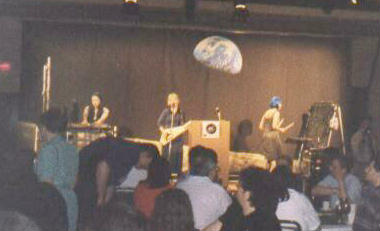 ZIA performance at 1999 International Space Development Conference
Photo: D. Amon, all rights reserved
PS: I understand Elaine is moving out of NYC, so I don’t know what is happening with the band. Watch their web site. I’m sure the information will show up there.
Are you ready, DVD Sports fans? Are you ready for Lord of the Rings, Part II?
It’s no good, I should’ve been a film star. Ok, so when I was seventeen I was spotty, overweight, and without any acting talent whatsoever, but I should’ve still been a film star. Under a socialist society I would’ve been spotted by now, for being an immense actor of charisma, talent, and conviction, but unfortunately, with society being still unprepared for my raw presence, under the evil rule of Mr Tony Blair, a hammish actor with only a scintilla of my ability to project compassion, emotion, and downright plain falsity, I was doomed to have to work for a living, to pay his bleedin’ wages. Damn!
Should’ve been a politician. → Continue reading: Lord of the DVDs
The most absurd intellectual property rights claim ever?
With their earthy tones and lizard motifs, Prince Harry’s paintings won admiration at home and last week earned him a grade B at A-level. But his work has stirred anger in Western Australia, where he is accused of stealing Aboriginal themes.
The moral pygmies claiming ‘ownership’ of the images drawn by artists who died hundreds of years ago must be the world’s biggest losers. Inacapable of artistic expression themselves, they demand the unearned greatness of their remote ancestors.
How sad that genuine aboriginal achievements are drowned out by the moochers!
The first foreign cricket team to visit England (in 1868) was comprised entirely of aboriginal players. Subsequently, Australian cricket authorities tried to forget about this as more than a century passed without a non-white player. Are they excluded from clubs, does the welfare system turn an entire race into a dependent underclass?
I don’t suppose that the professional racial-awareness poverty pimps are demanding that aborigines stop getting welfare and solve their problems by economic means.
For the record, one of my French ancestors wore the Crusaders’ red cross on white background in Palestine. Does this mean I should sue England soccer supporters for ‘violating’ my heritage, after all their king only went on the Third Crusade?
Kevin Connors talks about a certain British civil servant with a licence to kill, er, drive
Bond purists know that there are only two ‘proper’ cars for 007 to drive, an Aston or a Bentley. But for many years, while the British auto industry decayed, neither Aston or Bentley produced anything James would be caught dead in (book readers might recall Gardner gave him a Mulsanne Turbo in 1984). But over the last decade, the British Car business has been undergoing a renaissance, riding a wave of American and German capital and technology. The fruits of this are really starting to come now. Two years ago, Aston Martin (now owned by Ford) introduced their beautiful V12 Vanquish, seen in last year’s Die Another Day. But still, relative to the breathtaking Ferrari 575M Maranello, it’s only real competition, most automotive commentators declared it an also-ran. (While the comparison is far closer than that of the classic DB5, introduced in Goldfinger, and the 1964 Ferrari 500 Superfast, to say nothing of the incomparable 250GTO. Even the Lamborghini 350GT and Maserati 3500 GT, would likely have cleaned the DB5’s clock.)
Now, all that is behind us. After many teases, Bentley Motor Cars, (now owned by Volkswagen) is finally releasing their latest masterpiece, the Bentley Continental GT:

It has no competition.
This 4 passenger, 5000lb, W-12, AWD monster does 0-60 in 4.7 seconds, the same as a Porsche Carrera. It tops out at 198 mph, faster than all but a handful of 2 seat super-exotics. All this while coddling the passengers in the lap of luxury.
With plenty of room for Q to hide toys, this is a car Commander Bond would love. Of course, the next car 007 actually drives will be determined by the real world consideration of how much the manufacturers are willing to pony up in product placement money. And, although the producers know the fans want to see Bond in a British car (and not a plastic toy Lotus, even if it does go underwater), If Toyota forked over enough, James might be driving the new Supra.
BUT WAIT!
There’s a new player on the scene
I didn’t consider this at first, because of the leading name on the moniker. However, on further consideration, there’s likely more actual British engineering and manufacturing content in this than the Bentley. Ladies and gentleman, coming in about six months, I give you the revolutionary Mercedes-Benz SLR McLaren:

As opposed to the Bentley’s porcine two and a half ton mass, carbon composite construction helps keep the SLR to a svelte one and three-quarters. This, along with slightly greater horsepower (580, not 605 as stated on spec. sheet), shave a full second off the Bentley’s 0-60 time. Top speed is 211 mph. A handful of currently available automobiles are in the performance league with the SLR: the Lamborghini Murcielago (also VW, btw), the Pagani Zonda C12-S 7.2, the Ferrari Enzo, and the Saleen S7. But all these are, to one degree or another, racing cars for the street. The SLR promises to be the first super-exotic that’s also a viable daily driver.
Of course, the SLR costs (before Q-izing) two or three times the price of the Bentley. But, to Her Majesty’s Government, it’s just chump change seeing as they have all those taxpayers to call on.
With Mr Schwarzenegger throwing his hat into the ring of the California Governorship, I thought it was my aspiring libertarian duty to the spirit of freedom, to take in the Austrian candidate’s latest mega-movie, Terminator 3, Rise of the Machines. So I beat a warm and humid trail from a jet-engine air-conditioned hotel in the salubrious Euston area of London, to the fragrant Leicester Square, home to a million and one interesting smells emanating from the great hoi polloi of old London Town.
I managed to scramble about the last ticket sold, for the early evening performance at the Odeon cinema, and only managed to sit down and switch off my mobile phone ten seconds before the opening credits began.
So, first impressions? If there’s a Terminator 4, I’ll be back. (Come on, we’ve got to get these things out of the way when reviewing Arnie films. I’ll try to get all the others in as soon as I can, to ease the pain.)
Second impressions? To hell with what the literati London critics said about this film. I’m a lowbrow and I need regular jolts of science-fiction-style entertainment to get me through this rollercoaster we know as life. And Arnie films almost always do the trick (except for Twins, of course.)
In Terminator 3, Arnold once again delivers the goods. Can he really be 56 years old? I hope I have pectorals like that when I’m 56. Hell, I wish I’d had pectorals like that when I was 23. → Continue reading: Terminator 3, Rise of the Machines
|
Who Are We? The Samizdata people are a bunch of sinister and heavily armed globalist illuminati who seek to infect the entire world with the values of personal liberty and several property. Amongst our many crimes is a sense of humour and the intermittent use of British spelling.
We are also a varied group made up of social individualists, classical liberals, whigs, libertarians, extropians, futurists, ‘Porcupines’, Karl Popper fetishists, recovering neo-conservatives, crazed Ayn Rand worshipers, over-caffeinated Virginia Postrel devotees, witty Frédéric Bastiat wannabes, cypherpunks, minarchists, kritarchists and wild-eyed anarcho-capitalists from Britain, North America, Australia and Europe.
|





Recent Comments