We are developing the social individualist meta-context for the future. From the very serious to the extremely frivolous... lets see what is on the mind of the Samizdata people.
Samizdata, derived from Samizdat /n. - a system of clandestine publication of banned literature in the USSR [Russ.,= self-publishing house]
|
Here is proof that Jeremy Clarkson and his fellow petrolheads have definitely got under some green skins, if you get my meaning:
Environmental campaigners have called for the BBC’s Top Gear programme to be scrapped as they claim it promotes irresponsible driving. But how fair is this criticism?
For many motoring enthusiasts it is among the highlights of the television week.
But, with its irreverent style and penchant for high-speed stunts, Top Gear attracts fans and critics in equal measure.
Now the BBC Two programme has come under fire from the Transport 2000 pressure group, which has called for it to be taken off the air and replaced with a show that promotes “sensible driving in sensible vehicles”.
Yes, that will pack them in.
Greenies: try to understand. Most drivers spend their lives driving sensibly in sensible vehicles, except when you lunatics have stuck bumps in the road, in which case they are obliged to drive senselessly, accelerating and decelerating and generally spoiling the air and the neighbourhood. The idea that TV’s premier driving show should surrender its position as TV’s premier driving show by doing nothing but reflect this dreary reality is crazy, and cruel. Kill Top Gear, and you will have alienated yet another big brick in the human wall that is Middle England.
Transport 2000, which is committed to reducing the environmental and social effects of transport, argues that Top Gear falls short in its responsibility to educate viewers and acknowledge the interests of women drivers.
Personally, I am in favour of the “social effects” of transport, the main ones being that because we are able to travel, we can get to see interesting places and appealing people, and get and do far better jobs than would otherwise be possible. And as for the environmental effects of transport, I know what they mean, but once again, I think transport makes the environment far more congenial, not least because we can travel about in it and see what it all consists of.
Obviously the most environmentally friendly thing, in the sense these people mean, that humans could do would be to drop dead en masse. But most of us, thank goodness, are not these people. For most of us, life is for living, and life would be very lifeless if we were to do away entirely with exciting cars, and drove only sensible ones, and worse, if we were not even allowed to watch crazy cars being driven crazily on TV.
Michael Blowhard’s latest posting is one of his link fests, to video clips this time. He says he now prefers internet video bits to regular Hollywood movies.
It saddens this longtime film buff to say it, but I’m having a better time these days browsing video clips on the Web than I am watching most new movies.
I know the feeling. I do not indulge in internet video clips, but I am finding the movies duller and duller as the years go by. But I do not think this is because the movies are necessarily any worse. It is just that I have learned all I want to from the movies, and I have seen all the stories. I know the formulae. I now actually tend to prefer clever movies from Europe with subtitles, because I do not know how they are going to end, and because the people in them now seem more interesting and more real. Time was when it was the subtitled movies that were dull and the Hollywood stuff that was exciting. So has Hollywood changed? I doubt it. Have I changed? That seems far more likely.
Friedrich, the other Blowhard, has a similarly low opinion of current Hollywood mainstream fare, and reckons it may be something to do with the fact that the big studios now make their real money not in the cinemas, but from DVDs, and other spin-off products such as video games. But a launch platform, to do that job well, still has to be good, does it not? If so many other kinds of business rest on these platforms, all the more reason to do them well, surely.
I tried a few of Michael’s links to video clips, although I fear that investigating the porny ones too enthusiastically would be to invite all kinds of nasty Dark Side forces to encamp themselves on my hard disc.
My favourite one was the first one linked to, which features a most unusual species of octopus:
When walking, these octopuses use the outer halves of their two back arms like tank treads, alternately laying down a sucker edge and rolling it along the ground. In Indonesia, for example, the coconut octopus looks like a coconut tiptoeing along the ocean bottom, six of its arms wrapped tightly around its body.
Apparently, this is a fairly recent discovery:
“This behavior is very exciting,” said Huffard, who first noted it five years ago in the coconut octopus but only recently was able to capture both types of octopuses on film. “This is the first underwater bipedal locomotion I know of, and the first example of hydrostatic bipedal movement.”
Although, I have to say that one of the best things about this item was how little time it took to enjoy it, unlike a Hollywood movie like Miss Congeniality 2, which is the one that Friedrich Blowhard was especially complaining about.
I really liked Miss Congeniality 1. If Miss Congeniality 2 is boring tripe, no more amusing than being told the same joke all over again, this should be no particular surprise. The surprise is when Whatever It Is 2 is really good, like with Godfather 2 or Terminator 2, or with James Bond number 2. Why? Because making a film good enough to have a sequel is very hard, and for the follow-up to be as good or better is a huge coincidence. I reckon Friedrich B was just particularly angry about MC2 and blamed all of Hollywood, instead of just the people who made MC2.
Relax, mate. Pour yourself a drink and have a look at the walking octopus.
Kamal Aboukhater, producer of the independent film Blowing Smoke (full disclosure: he is a tBBC client), has put an invitation out to readers of the movie’s blog to come to a special screening of the film on April 21 in Los Angeles.
I think this is a first of its kind invitation from a film producer via movie blog – very exciting stuff. Blowing Smoke is a provocative film – the New York Post’s Richard Johnson called it “the most politically incorrect movie ever made” – and well worth checking out. Definitely not for the easily offended or faint of heart, though.
I have just got back from a trip to the Tate Britain art gallery at which such wonders as the works of Turner, Monet and Whistler were on display. The Turner pictures of Venice, London and the Seine Valley of northern France bowled me over, as they do every time. One stray observation: many of the pictures brought out the effect on light of heavy air pollution. Monet was a master at this, particularly in his paintings of the Houses of Parliament. Some of the Monets and Whistlers were painted in the late 19th century when London’s smog levels were notoriously bad. As an adopted Londoner I am of course delighted that the chronic air pollution which once ravaged the lungs of our forbears has been reduced. I wish our modern artists could produce something as great as Turner, though.
Saturday night’s American Cinema Foundation panel at the American Film Institute in LA, moderated by media critic Cathy Seipp, was fascinating on several levels.
The theme of the event was “Mass market, smart content,” and featured four TV writers/producers/directors: Paul Feig (creator and executive producer: “Freaks & Geeks;” director: “Arrested Development;” director and writer, the feature film “I Am David;” author: “Kick Me: Adventures In Adolescence” and the upcoming “Superstud: How I Became a 24-Year-Old Virgin”), Scott Kaufer (executive producer: “Boston Legal;” writer: “Gilmore Girls,” “Chris Isaak Show,” “Murphy Brown”), Rob Long (co-creator and excecutive producer: “Men, Women & Dogs,” “Love & Money,” “George & Leo;” executive producer: “Cheers”) and Tim Minear (executive produer: “The Inside,” “Wonderfalls,” “Angel,” “Firefly”). Together, they tackled the issue of how successful television writers manage to keep their distinct viewpoints when writing for the mass market.
I believe wholeheartedly that there is no such thing as ‘the mainstream,’ and that the mass market is dead, and being replaced by a mass of niches. I also believe that the mass media is not being destroyed, merely altered radically, and individuals are being liberated from the mass by the unprecedented choice of personal relevance that (thanks to things like blogs, mp3s, TV on DVD, podcasting, and TiVo) they have today – and that choice of personal relevance is increasing exponentially at a rapid rate. So the topic of the panel was extremely appealing to me as a total geek on the social ramifications of emergent technology tip.
I guess I forgot that these guys write some funny stuff, and that they were going to make me laugh – which they did, in a big way. Some of my favourite exchanges and lines:
CATHY SEIPP: How do you react to people who say they never watch TV?
TIM MINEAR: I run them over with my Mercedes.
SCOTT KAUFER: After seeing [the movie] JFK, I thought, “Why don’t I make a movie called Oliver Stone, and just invent shit?
ROB LONG: What would you have to invent?!
PAUL FEIG: That he’s nice, he’s respectful of women…
TIM MINEAR (on not being allowed to have a serial killer character use the word retard): The network thought the serial killer was being awfully insensitive.
I did not want to hit the guys over the head with the beliefs I laid out above, so I asked them if they thought that TV series on DVD (which they all seemed to agree was the best thing to happen to TV in a long time, even if the lack of leadership in the Writers’ Guild means that they get screwed out of decent earnings, receiving only 2 or 4 pennies per DVD sale), TiVo, and that greater choice of personal relevance is going to affect what they do in any significant way. Every panel member had something to say about that, but the most interesting answer came from Paul Feig, who said that the bottom line is that the show that draws the most advertising revenue wins, and it will always be that way.
Except I am sure that it will not always be that way, and that the advances in emergent technologies and the rebirth of niche will bring about that dramatic shift a lot sooner than we may think. The business model of broadcast must change if it is not to die (and with only 12 per cent of US viewers getting their TV via antenna these days anyway, ripping it down is not a bad idea). As viewers (read: customers) get used to having that personal choice of relevance, they will throw their attention (read: value) to the places where they can get it: cable, satellite, and the internet. And if you think advertisers will not pick up on that and move their ad spend accordingly, I have some stock in broadcast that I would just love to sell you.
The kicker being, I do not believe that advertising revenue is going to be the bread and butter of TV on cable, satellite, and the internet. Sure, there will be ads in the world as long as there are lazy, clueless companies who believe in “just in case” marketing. But the costs of that kind of marketing are rising, the effectiveness declining, and profits down as a result.
Which brings us to my point: This drive to niche dovetails very nicely with the need of companies to put customers at the beginning of the value chain instead of at the end of it. The increasing emphasis on the individual also means a move from push marketing to engagement marketing. So instead of wasting a great deal of money on a TV ad, a company can spend a fraction of that on, say, developing great blogs to provide value and engage the niche they are targetting. (They can throw some podcasts up there while they are at it.)
So here is the question I really wish I had asked the panel: Ten years from now, who exactly is going to be spending the kind of money on network TV ads that they need to maintain this broken system? And if that money isn’t there, will you be running over non-TV-watching freaks with your Kia instead of your Mercedes?
I watched the beginning of Dirty Harry on the telly (before remembering that I already have it on DVD), and have just heard Clint Eastwood deliver the first version of the do I feel lucky? speech. And I just want to say something that I have long felt, which is that he delivers the line, at least on that first occasion, very badly. They should have done a retake. The actual “do I feel lucky?” bit is gabbled, and you can hardly hear it. There should have been a slight pause between “you’ve got to ask yourself a question” and “do I feel lucky?”, but there is no pause. The sentences just before are fine, but this particular bit sounds like an uncomprehending read-through, not a performance at all. I realise they did not want to upstage the rerun of the same lines later in the movie, when the real Bad Guy is asked the same question, but I reckon they downplayed it too much.
Not that I blame Clint Eastwood. Or, I blame him only if he was the one who chose this particular take. But I presume that this was the director, or maybe the producer. Actors are usually helpless in circumstances like these. Time and again, they get called bad actors, when it was really bad directing and bad editing.
Otherwise, excellent movie entertainment, full of good sense about the deterrent value of chasing and punishing criminals and the pointlessness of worrying too much about what makes them become criminals. The important thing is to hunt them down and lock them up, or worse. (One of the biggest reasons why they become criminals being that they do not expect this to happen.) This is a lesson which the USA’s rulers now seem to be learning fast but which our rulers here in the UK (see the comments on Tuesday’s murder posting) are still only groping towards.
Most of the mere people in both countries have of course always known this.
Thank goodness for the movies. On this particular issue, insofar as they have argued anything at all, they have mostly argued very sensibly.
And let no one kid you that movies like Dirty Harry are just “mindless” entertainment. When people call a movie mindless, it generally means that it is actually rather mindful, but that the mindfulness involved is something that the complainer would rather not face. So, he claims that there is nothing to be faced. It was the same with the (ridiculously titled) Death Wish series. Those movies are crammed full of ideas.
And mostly very good ones. When Bronson chalked up his first kill in the first of these movies, cinemas everywhere erupted with spontaneous cheering.
Since I am already on the subject of Mars… the X-Plane flight simulator now includes a number of Mars ports at which you can land your SpaceShipOne. Here is a recent announcement of the Mars extensions to the X-Plane product:
Trans-global flight on the planet Mars is now available to X-Plane
pilots. If you don’t have the Mars Data CD set….go to x-plane.com and buy it!
Over 70 ‘marsports’ have been constructed, several with ILS and GS, to provide the Mars enthusiast (like myself) an opportunity to explore the future home of human beings…today!
X-Plane users may either download the complete Mars X-perience package, or simply the apt.dat and nav.dat files. The MXP .zip file contains Custom Scenery, maps, and the “Cydonia Station” shuttlecraft. The SS1MARS is a modified version of SpaceShipOne engineered to tackle the thin Martian atmosphere (original X-Plane flight model created by Curt Boyll).
This data has not been tested on XP-8, but Robin Peel has indicated he will be giving it a run very soon.
You can find out more about it here.
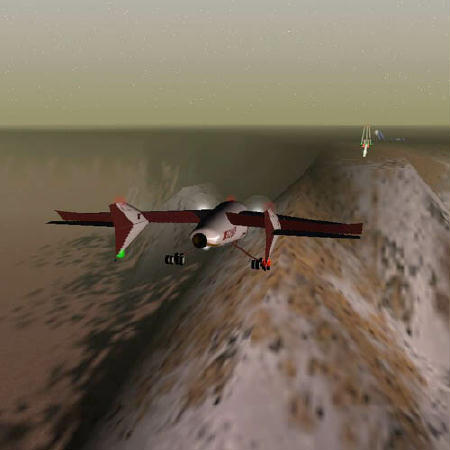 Credit: Dreamsenses Credit: DreamsensesI wish I could afford the hardware upgrade so I could play too!
Jim Plaxco of the National Space Society tried some creative processing of Mars image data with artistic rather than scientific goals in mind. Some of the results are quite to my taste; others are more for lovers of the abstract.
I cannot help but imagine art such as this in the lobby of some Martian corporate headquarters or perhaps in the Marsport Bigelow reception area.
Jim has a website for his artistic renderings. This is a web site under-construction and at present contains only a fraction of his work. I recommend you check back every few weeks.
 With permission of the artist, Jim Plaxco With permission of the artist, Jim Plaxco
Mark Holland is, as Instapundit would say, on a roll just now. I wonder if some things that were said at that Friday meeting I seem to want to keep mentioning has something to do with this. Mark was there, and seemed genuinely surprised by the high esteem in which his blog is held by all those of us present who are familiar with it. Maybe that encouraged him. It would be good to think so. If so, this nicely illustrates the value of old fashioned face-to-face contact. “I really like your blog” is not the kind of message that carries quite as much conviction if you cannot see the whites of your admirer’s eyes.
Mark writes about (and/or links to) many things (crappy old British sex comedies, the sport of bicycling, politics in Slovakia) but he told me something rather intriguing that I do not recall reading about at his blog, although this could just be me.
Mark and some friends attended a Bruce Springsteen concert some years ago, in a Manchester football stadium. He and his mates arrived early for the thing, and took their seats way up high in the stands, about a quarter of a mile from where the performance was going to be given. Then, a Big Person approached them. They were unnerved. But no. The Big Person guided them from way back and way high up, right to the very front of the assembly, into Bruce Springsteen Heaven. And they duly watched it all, feet away from The Man. (Sorry, Boss. Sorry.)
Thinking about this some more, I reckon that it makes sense, is probably often done, and is therefore not news to those readers and writers of Samizdata who are also regular attenders at rock gigs. But I am not such, and if you are not this either, allow me to reinvent the wheel for you.
What do you absolutely not want in the front few rows of the crowd at a major pop gig? Two things, I suggest. One: Uncool People (old, ugly, dressed in corduroy jackets, etc.). And worse, two: empty seats. Such horrors would completely spoil any video footage of the event. When everyone is standing in a scrum, this is no big problem. (Presumably uncool people can simply be dragged backwards from the front, and cool people dragged forwards.) But in an all-seater stadium, such as this was, with individual seats booked, there is the real threat of horrors in those vital front few rows.
So how do you prevent these? Answer, you do not sell the front few rows, but instead handpick the people at the front from the early arrivals, like a night club queue minder picking out cool people for a club. Mark, being cool and several degrees cooler back then, I dare say, was, together with his (I assume) comparably cool mates, selected for the front.
You might at this point be expecting one of those blue MORE things, after which the significance of this is explained in more detail and its relevance to lowering income tax etc. is all gone into with proper thoroughness. But, that is all.
I bought a DVD of Nabucco the other day. It’s the usual story: boy meets girl; girl’s father attacks Jerusalem; Hebrews carted off to Babylon. “Sack, burn the temple,” says the King of the Babylonians. “This cursed race shall be wiped from the earth.” But first, let’s all have a sing-song.
I saw it in Hong Kong a couple of years ago. It was the Latvian National Opera, so I was watching Latvians, in China, pretending to be Jews in Babylon, and singing in Italian. Well that’s all right. I can take a joke.
– Harry Hutton last Friday. More about Nabucco here.
I am watching the BBC’s Culture Show, and they are telling a sad little story. Apparently, the regional theatre companies of Britain have, during the last five years or so, enjoyed a bonanza of government money. There has apparently been a mini theatrical renaissance in the provinces. Hurrah!
But now, the horrid government is imposing a pay freeze, and this “great achievement” is in jeopardy. For the sake of a few more million quid, this great achievement could all collapse. Woe!
I could have told them. Never, I would have said to them (had they thought of asking me), depend upon government money and the promises of politicians. Never get addicted to the contents of the public purse, for they can be snatched away from you without warning. Renaissances funded only by politicians have a way of dying very prematurely. Getting money from mere customers may be harder in the short run, but once you learn the trick, you have a foundation you can build on more confidently.
Probably all this is just the political machine doing what it does. It spends. It cuts back on its spending. Occam’s Razor says that this is what is happening here. But, although it was not discussed on the show, I wonder if the end of the romance (that is to a Times on Line piece, which may be a problem for some, but it tells this story better than any other I could find) between New Labour and the Luvvies – caused by such things as New Labour going to war in Iraq, and the Luvvies going to war against the war in Iraq – might have something to do with this story of theatrical feast and threatened theatrical famine.
Last night I started to get into the mood for the Capitalist Ball (that being a link to David’s piece about it last year), which will take place in Brussels this evening, by playing waltzes by Johann Strauss II, on my medium- to lo-fi hi-fi machine.
And what lovely music it is! I remember reading that when Herbert von Karajan got hired to conduct the New Year’s Day concert in Vienna, in 1987, he experienced a sense of both musical and personal renewal. This makes perfect sense to me.
With these waltzes, marches and dances, the symphony orchestra had its one great age of pop superstardom. Before then, pop music was played in taverns and in the open air, and classical music was for the aristocracy. As the audience for orchestral music widened, and as the symphony orchestra widened with it, composers like Brahms and Dvorak, in among grander works like piano and cello concertos, and symphonies of course, also wrote dances for the orchestra. But there was about these pieces an air of down-market music being ever-so-slightly elevated by these grandees of the concert hall. The music of the Strauss family was the genuine, popular article, the purest example of orchestral popular dance music ever created.
In Italy, opera was enjoying a similar period of genuine popularity, where high art and popular art were similarly united.
With arrival of the twentieth century, and the age of electronic recording, and then of electronically enhanced instruments, pop music and classical music again went their separate ways. While the classical musicians concentrated on recording what would now be called their back catalogue, the popsters switched back to more raucous sounds, more suited to the limitations of early recording, and then more attuned to their new audiences, no longer beholden to the musical conventions of an earlier epoch. And opera also divided, the torch of popularity being handed on, via operetta, to the stage ‘musical’.
Meanwhile, the once imperial city of Vienna has been dining out on the music of the Strauss family just about ever since, first for real as it were, and then – and now, still – in reaction to the very different and disappointing reality by which it was increasingly engulfed, and to which it made its own baleful contribution, in the form of the influence and perverse inspiration it supplied to the young Adolf Hitler. No wonder the Viennese still prefer the Beautiful Blue Danube version of their past to more recent horrors. (The moment of transition, when what had been a joyous reality was sliding into history, was memorably captured by that other Strauss, Richard, no relation, in the waltzes he wrote for his opera, Der Rosenkavalier.)
But the music of the original Strausses still plays on. As the centuries pass, it seems all too possible that, horrifying though they were, the wars and massacres of the twentieth century may eventually be topped by later and greater horrors as yet unimaginable. The slaughters that now seem to us so uniquely evil may in due course seem only banal, like the murders and feuds of the Italian Renaissance, which we now think of as the mere backdrop to all those wondrous paintings. But those waltzes, dances and marches of the century before the one just concluded – the waltzes especially – will never be bettered.
At the Capitalist Ball, one of the organisers has just told me, there will be a French swing band in action. A different and later style of dance music, but one I am greatly looking forward to hearing.
|
Who Are We? The Samizdata people are a bunch of sinister and heavily armed globalist illuminati who seek to infect the entire world with the values of personal liberty and several property. Amongst our many crimes is a sense of humour and the intermittent use of British spelling.
We are also a varied group made up of social individualists, classical liberals, whigs, libertarians, extropians, futurists, ‘Porcupines’, Karl Popper fetishists, recovering neo-conservatives, crazed Ayn Rand worshipers, over-caffeinated Virginia Postrel devotees, witty Frédéric Bastiat wannabes, cypherpunks, minarchists, kritarchists and wild-eyed anarcho-capitalists from Britain, North America, Australia and Europe.
|





Recent Comments