We are developing the social individualist meta-context for the future. From the very serious to the extremely frivolous... lets see what is on the mind of the Samizdata people.
Samizdata, derived from Samizdat /n. - a system of clandestine publication of banned literature in the USSR [Russ.,= self-publishing house]
|
Hundreds of thousands of tourists and New Yorkers headed for the extravaganza riverside fireworks display last night. I was not one of them. I have done it before and did not tonight feel a herring-like desire to join the tightly packed school of fellow hominids on the riverine Manhattan coast. What I did have a desire for was a quiet pint of well-pulled Guinness and some good music. I knew exactly where to find it on a Monday night: Mona’s.
Mona’s is a small pub in the Lower East Side. It is a local in every sense of the word. There is no big flashing “Monas” sign outside. There is, in fact, no sign at all. Just a window through which you can see a very dark pub that is decidedly not ferns and chrome. No wimpy idiotic ‘theme’. Just a place that has grown organically around its central purpose of beer, music and pool for a neighborhood clientele. When I first lifted a pint here some eight years ago, it was in a neighborhood which had transitioned from broken glass and junkies in the doorways to one which was merely for the adventurous, a hangout for musicians and a hodgepodge of starving artists, writers, actresses, bikers and Irish expats. Since then the neighborhood has changed. It seems like almost the whole of Avenue B has gone way upscale. The tide of new bars has not yet reached 14th Street and the clientele is still neighborhood… but you are now more likely to run into a med student outside than a junkie.
The session at Mona’s is a very informal and relaxed affair. There is usually a core of fine musicians, but anyone who loves the music can join in. Some of the better musicians take time over a long break to show newcomers a few tunes and techniques.
As you can see, it is a very homey session:
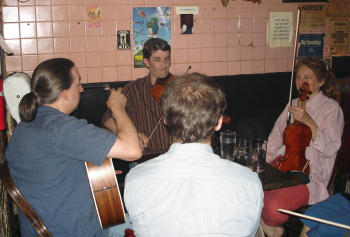
A very traditional session at Mona’s Photo: D.Amon, all rights reserved.
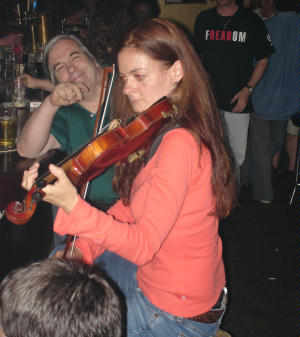
Traditional music attracts classy fiddle players Photo: D.Amon, all rights reserved.
The New York traditional music scene has been a home away from home for me for almost a decade. My familiarization with it began when I toured with a band and sang here in 1994; it expanded greatly when I worked on a series of internet webcasts and spent a good chunk of 1998 living in the East Village. During that hot summer of 1998 I had a weekly pub schedule to follow. The crowd of musicians I got to know so well floated in an eternal circuit from the Monday Session through to the Sunday Session. Many of the same people are still to be found on the same weekly rounds and only one of the Sessions has died off over the last seven years.
So… Sunday night. That’s the Doc Watson’s night. For the hardcore musicans, the Sunday drinking actually starts in the afternoon at the Thady Con’s Session, but I had engineering notes to prepare.
Doc Watsons is in the Upper East side and not the easiest place to get to from where I am staying in the Upper West. This business trip has been going well so I splurged on a taxi rather than the usual long A train and crosstown bus trip. The first taxi to stop was from a Car Service, not one of the metered Yellow ones. I have been around the city long enough to know to dicker the price before one goes anywhere. The ride is nicer but you could be in for a surprise if you have not got the price set first. If you are a stranger to the city you won’t know whether a price is reasonable or not so I would probably not recommend it without the advice of a local friend. The Yellow ones are safer for tourists.
I have sung at Doc Watson’s myself, although not in many years. I have been too busy surviving as a consultant to keep any material up to what I would consider professional performance standards. Since I have been there and done that, I have more to lose making a complete fool of myself on stage than most. One never knows: perhaps the day will fall when I must survive at it. It is best I not leave bar owners and public with memories of blue notes and effed lyrics to replace older,better memories of mostly competent performance. Instead, I competently hold up the bar and drink Guinness.
The pub has a Sunday anchor band that is usually John Redmond and Peter Rufli, fellows I know from years past. This Sunday John was not present and Peter had several other fine musicians with him.
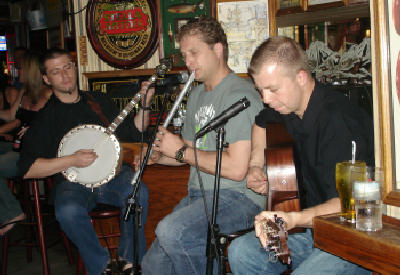
Right to left: Davie Ryan, Banjo; Peter Rufli, flute & whistle;
Dominic Cromie, guitar and vocals Photo: D.Amon, all rights reserved.
In addition to the craic of old acquaintances, Doc Watson’s has very good food and pulls a decent Guinness. I particularly like their Buffalo Wings platter.
If you have not spent time in New York, you are missing the real meaning of cross-cultural fertilization. The following photos show how Chinese culture has improved upon traditions long a part of the Irish music scene:
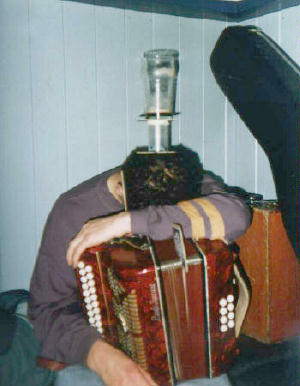
Traditional Irish beer balancing technique Photo: D.Amon, all rights reserved.
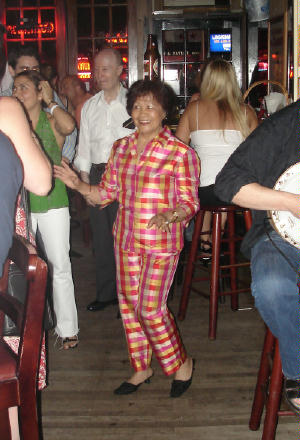
Chinese improvement Photo: D.Amon, all rights reserved.
Yesterday I visited Hampstead Heath, to renew my acquaintance with the magnificent view of London that you can see from there, and also to see this rather entertaining sculpture, installation, visual pun, prank, call it what you will. Basically, it is a giant table and chair. It is called “The Writer”, because your average writer uses a table and a chair when writing. Hampstead Heath was chosen by The Writer’s creator, Giancarlo Neri, because of Hampstead’s literary associations. It will be on the Heath until October.
Click on these squares to get bigger pictures:
You cannot please everybody when it comes to public sculpture. Personally, I reckon just about anything is better than the kind of meaningless lumps that used to disfigure London – in fact more or less everywhere – in the sixties and seventies, until the fashion for sculpture that is of something came roaring back. The meaningless lumps were ugly as sin, and took themselves about as seriously as a religious cult, which they were. Neri’s installations, on the other hand, have a bit of wit and fun about them, like most public sculpture these days. And if you hate it, relax. It will soon be gone. I have my photos and I am happy. You can forget about it.
I particularly like where The Writer has been put. It nestles modestly at the bottom end of Parliament Hill Fields rather than strutting its stuff at the top of Parliament Hill. From Parliament Hill you can see the top of the table (top left) the way you cannot when you are closer to it (top right).
The view through it and back up towards Parliament Hill, with all those even smaller figures on the horizon (bottom left) is a particularly nice one, I think.
The Writer makes good use of the people who flock to gaze at it. It then looks much more amusing than it would be if there were no people under or around it. The joke of how big the table and the chair are only comes alive when there are normal sized people around to dramatise it.
Inevitably, because these are the times we live in, there is a website (bottom right), although I found this BBC report more helpful.
The first choice to be faced when making a Batman film (or any other superhero film) is to whether it should be played for laughs or played straight. This Batman film tries to play it straight and I think that is the right choice. It is harder to play a superhero film straight but that is the spirit in which the stories were written and enjoyed.
Critics will not tend to like a straight superhero film (for example they hated the Bruce Willis film Unbreakable, which I would argue is a very fine film indeed), but it is the way to go, and the Spiderman films showed that critics and public can accept it (sometimes). The character of Batman is less difficult to present in one way, in that he is a superhero with no superpowers.
So one is left (in the comics) with a man of great inherited wealth, who is man of practical invention, physical action and great public spirit. Well John Walton (who died a few days ago) was a man of great inherited wealth who choose to join the army and served (as a medic) with U.S. Army Special Forces in Vietnam, he was also an inventor (no sneering about how he died in an aircraft he built himself – his stuff was good quality), and a man who administered the Walton family charitable activities. Of course John Walton did not go out and fight crime, in the big city, in an armoured suit shaped to scare the criminals (for a start he did not like big cities), but the rest of his life story shows that the Bruce Wayne character idea is certainly not “unbelievable”
Batman Begins decides that all of the above is too much for one man and so has Mr Wayne helped by a scientist in his company – but again that is hardly an absurd position. Where the film does stain belief is that Mr Wayne owns his company and in these days of inheritance tax and capital gains tax, having a man inherit control and keep it even after a determined effort to “take the company public” (i.e. hand over ownership to the pension funds and other financial institutions) by the hired manager… that strains belief. → Continue reading: Pondering Batman Begins
Bob ‘give-us-yer-fokken-money’ Geldof must be losing his touch:
Berlin’s planned Live8 concert next week threatens to turn into a fiasco because it has failed to attract the support of politicians or business sponsors, the event’s German organiser has admitted.
Marek Lieberberg, a friend of Bob Geldof contracted to run the Live8 concert in Berlin, said the lack of support meant the rock bands appearing at the event risked having to pay for the €1m (£663,000) show themselves.
A risk? Surely not a ‘risk’ but a heaven-sent opportunity for the socially-conscious cream of the rockeratti to put their own money where their big ‘fokken’ mouths are.
The BBC are now bingeing on Beethoven, which is fine by me. (And yes, I quite agree that if you do not care for Beethoven, you should not have to pay for it, blah blah. Let us take that as a given, shall we?)
On Saturday night BBC4 TV showed three videos of the first three symphonies, conducted by Sir Roger Norrington in One (which I missed), the late Otto Klemperer in Two (in 1960s black and white), and Rattle doing the Eroica with his old City of Birmingham Symphony Orchestra in 1995. Rattle’s Eroica was, for me, as gloriously invigorating as Klemperer’s Second was cloddish and over-solemn. Watching a very obviously heart attacked, slack-jawed Klemperer sitting like someone in a hospital waiting room waving one finger vaguely in the air while the New Philharmonia tried to divine some musical sense out of these wobbly gestures suddenly did not seem funny any more, although on another night I might have been entranced.
But Rattle’s Eroica was fabulous. All his calculatedly wide-eyed astonishment and arm-waving, armpit-flaunting drama-queening made perfect sense, given that he was conducting what is probably the single most astonishing and dramatic piece of music ever written. This is amazing, said Rattle’s every look and gesture, and it was. → Continue reading: Eroica
The Turner Prize competition has become a byword for everything that is, in the opinion of some, trashy, superficial, capricious, and utterly vacuous in today’s art world. Amazingly, it is considered a news event that an artist working in the representational tradition has actually been shortlisted to win the prize named after one of the greatest, if not the greatest, painter that Britain has ever produced.
In the meantime, for those that wonder about what has gone wrong in the art world, may I recommend this fine book about art and the theories thereon by the late Ayn Rand. I highly recommend it even to those who are not Rand fans like yours truly.
Of course, I would love it if this man won the Turner Prize, but I guess he probably does not care a hoot anyway.
The artistic version of the Labour Theory of Value is restated, at its natural home, here:
One song hails from an album that took years to craft and perfect, the delays in its conception seriously denting profits for EMI as fans across the world awaited its release. The other was obviously whipped up in a matter of minutes by a dodgy German dance act with an 80s record collection and a sampler.
Nevertheless, following the cliche that there is no accounting for taste, the Crazy Frog ringtone appears to be jumping over Coldplay’s Speed of Sound towards this week’s number one spot.
And appearances did not deceive. Yes, this was the big Frog head-to-head over the last few days. An electronic rehash of the dominant tune of Beverly Hills Cop: would it get to number one? Yes? Or no.
The samizdata.net meta-context is sometimes a bit hard to work out and apply, but in this contest, I think we all know where our sympathies lie. Do we vote for the oh-so-late album of a bunch of dreary navel-gazing complaint rockers, aimed at dreary ageing complainers (a big market, I do agree), or for a spirited up-beat can-do problems-are-there-to-be-solved need-for-speed aquatic cartoon creation? I think we know the answer to that one, don’t we girls?
Normally, I would not myself be so partial to the Crazy Frog, if only because I also quite like his deadly rival Sweety. But the Frog does seem to get up all the right noses, so all power to his legs.
Next stop for the goggled one, Korea.
I just saw Revenge of the Sith with a group of chums and I must say it was interesting to see how varied the reactions were. For me, anyone looking for profound meaning in a George Lucas movie is well and truly in the wrong place. With that in mind I went expecting breathless fights, awe inspiring battles between vast starships and Padmé Amidala (Natalie Portman) wearing interesting outfits. And that is exactly what was delivered.
Lucas is at his best when the battlecruiser starships are blowing the crap out of each other whilst the heroes weave their nimble fighters in and out with guns blazing in cheerful disregard of the laws of physics. He also knows a thing or two about choreographing some pretty nifty lightsabre duels. The Yoda vs. Palpatine showdown is a particular eye-popper… who would have thought a 2 foot high gremlin could actually look plausible in a swordfight!
But, and you knew there was going to be a ‘but’, when it really comes down to it, George Lucas is just not that skilled a director. He does fine until it requires people to actually interact other than when they are trying to slice each other in two. At which point he proves that he can produce weak performances even from a splendid actress like Natalie Portman (who was from good to great in everything else I have ever seen her in) and Ewan McGregor (who is debatably my favourite actor). The ‘doomed romance’ between Natalie Portman (Padmé) and Hayden Christensen (Anakin Skywalker) is central to the whole story of the creation of Darth Vader and yet I could not escape the impression that neither of them really cared for each other, for which I mostly blame Lucas’ leaden hand more than the actor and actress in question. Ewan McGregor is a splendid Obi Wan Kenobi when it comes to laying waste to the bad guys with his lightsabre but again, when it comes to his relationship with Anakin, it all seemed a bit unengaged. Only Ian McDiarmid (Palpatine) really managed to transcend the stilted feeling of much of the dialogue and sound like he really meant when he said.
And although I said one does not go to a George Lucas movie to seek profundities, there was one rather splendid line uttered by Padmé whilst in the senate chamber listening to the delegate enthusing whilst Palpatine seizes power to ensure ‘justice and security’:
“This is how freedom dies. To thunderous applause.”
Pity the rest of the movie did not have more such memorable lines. 7.5 out of 10, mostly for the sheer spectacle.
I share the general enthusiasm for the so-called London Eye (I prefer to think of it as The Wheel), and so I hope that this little spat fizzles out quickly:
The London Eye could close down after being served an eviction notice after a £1m rent demand – an increase of more than 1500%.
Its landlords, the South Bank Centre (SBC), said they are not getting enough rent from the land that holds part of the wheel’s supporting structure.
If the rent is not paid they say the Eye will have to be removed in a month.
None of the parties wished to comment but said negotiations are taking place in the hope of reaching a settlement.
According to a document seen by Kate Hoey, MP for Vauxhall, SBC sent out the eviction notice after issuing a demand for the increased rent.
She told BBC London on Thursday: “I find it quite outrageous that the South Bank Centre has now turned around and is trying to be like a greedy developer.
“It will not go down very well with people in my area and Londoners and the country as a whole.”
Oh well, there you go, that’s politics for you. And it must be politics because an MP is involved, and the South Bank Centre is being accused by that MP of trying to be like a greedy developer, which would never have been said if it was a real developer.
I have no idea of the details of the agreement between whoever now runs the Wheel and the South Bank, but personally I think that the Wheel is by far the most beautiful object on the South Bank, and that anything calling itself the South Bank Centre ought to be thoroughly ashamed of itself for even pretending to threaten to get rid of it. Presumably it is strapped for cash, for some reason associated with all the other abominable structures on its patch.
Come to think of it, it occurs to me that there is a big plan in motion to try to rescue the now grotesque acoustics of the Royal Festival Hall. As this Guardian piece says:
They’re awful. Simon Rattle once said that playing there “saps the will to live”. Even the RFH’s resident orchestras, who have historically been defensive about their home, now openly admit it “leaves a lot to be desired” (that’s David Whelton, who runs the Philharmonia).
I once heard Rattle conduct Mahler’s mighty Resurrection Symphony in the RFH. It sounded like a very bad recording.
Anyway, has this wild attempt to gouge more money out of the Wheel got anything to do with this RFH plan? The attempt to turn the RFH into a proper concert hall will apparently be costing quite a lot.
The Royal Festival Hall (RFH) in London will close after its last performance on 26 June to undergo a GBP71m, 18-month refurbishment. The work is part of a wider GBP91m development of the South Bank Centre on the River Thames.
GBP71m? GB91m? Yes. I do believe there might be a connection there.
Globalisation does funny things:
Former Baywatch star David Hasselhoff has been named international star of the year at the Bollywood movie awards in Atlantic City in the US.
He received the award because his shows, including Knight Rider, are among the most popular on Indian TV.
That is the BBC story. I also recommend this Reuters report on the event, which packs a lot of information into a small space. Such as, that:
Rani Mukherjee won the best actress award for her role “Hum Tum.”
What does Hum Tum mean? Is it a medical condition? Or is that the name of Rani Mukherjee’s character?
And I did not know that they have Bollywood awards in Atlantic City. What is that about?
Says Reuters:
The event was held in the old U.S. East Coast gambling resort of Atlantic City as part of Bollywood’s bid to be a global force in cinema.
Interesting. And I did not know this either:
Bollywood churns out around 1,000 movies a year but despite a fan base that extends to the Middle East, Europe and Asia, few movies make money and the industry is under financial pressure. Bollywood films have not had much commercial success in America.
But Shammi Kapoor, who was given a lifetime achievement award, said better technology was leading to more and better films. “They’re getting to be more topical,” he added. “They aren’t the happy, happy movies of yesteryear.”
Indians will soon be complaining that Bollywood is becoming a fifth column Frankenstein’s laboratory Trojan Horse turncoat snakepit of anti-Indianism that panders to the global market and apes its worst excesses.
Ooooh..I am so excited! It will not be long now before I will be able to gorge myself on yet another body of incoherent babbling:
When the website huffingtonpost.com launches on May 9, it will eventually see contributions from Norman Mailer, David Mamet, Warren Beatty, Diane Keaton, Harold Evans, Tina Brown, Gwyneth Paltrow, and the woman who played Elaine in Seinfeld. They will offer a “round the clock commentary on our life and times”…
I don’t know about you, gentle reader, but I am positively aquiver with anticipation to discover what Diane Keaton has to say about my life and times. Yet, my enthusiasm is perhaps somewhat tempered by the inexplicable absence (thus far at any rate) of the great Professor Streisand.
I submit that huffingtonpost.com will prove to be a one-stop, on-line resource for all serious students of thespianomics (advanced module). For everyone else it should be a ‘target-rich environment’.
Enjoy!
|
Who Are We? The Samizdata people are a bunch of sinister and heavily armed globalist illuminati who seek to infect the entire world with the values of personal liberty and several property. Amongst our many crimes is a sense of humour and the intermittent use of British spelling.
We are also a varied group made up of social individualists, classical liberals, whigs, libertarians, extropians, futurists, ‘Porcupines’, Karl Popper fetishists, recovering neo-conservatives, crazed Ayn Rand worshipers, over-caffeinated Virginia Postrel devotees, witty Frédéric Bastiat wannabes, cypherpunks, minarchists, kritarchists and wild-eyed anarcho-capitalists from Britain, North America, Australia and Europe.
|









Recent Comments