We are developing the social individualist meta-context for the future. From the very serious to the extremely frivolous... lets see what is on the mind of the Samizdata people.
Samizdata, derived from Samizdat /n. - a system of clandestine publication of banned literature in the USSR [Russ.,= self-publishing house]
|
Okay, it is very late on Thursday evening and I thought I would pose this question to our commenters for a bit of a Friday quiz before I go to bed:
What is the worst film you have ever seen?
(This thought was inspired by seeing a short trailer for a movie starring Jennifer Lopez).
Not much time to blog today… blame AnorakLight, Lynch Rider Lulu and Victoria Hume live at the Troubadour. Well recommended.
If you love innovative photography, particularly of landscapes and modern, soaring buildings at day and night, go and have a look at this. Wow. (Hat-tip, Andrew Sullivan).
I don’t find taking my clothes off difficult, it’s the acting that’s really hard!
– so said Elena, who is a thespian, last night after dinner at Samizdata HQ
I must admit my heart sank when I heard that a remake of the classic, and creepy UK film, The Wicker Man, was coming out. We seem to have a lot of remakes at the moment, prompting thoughts that Hollywood has run dry on creative ideas. I sympathise up to a point with this. The remake of the old Michael Caine/Noel Coward caper, the Italian Job, was an amusing piece of film but not a patch on the original. Flight of the Phoenix was good, but not as good as the original, etc. And yet and yet….the Thomas Crown Affair, starring Pierce Brosnan and Rene Russo and Denis Leary, was excellent, in fact an improvement in certain ways on the original, which starred the great Steve McQueen.
I suspect the problem is that when we first see a film, or read a novel, we intend to invest a certain amount emotionally in the experience if is a good one. I can imagine the howls of outrage if someone tries to remake Casablanca, or the African Queen, say. One of the problems of course is that remakes can remove elements deemed politically incorrect. The original Italian Job, for example, took a poke at the older incarnation of the EU, known at the time as the Common Market; it also made fun of Italian crooks and security services, while it also celebrated a sort of camp Britishness and had the wonderful character, Professer Peach, as played by Benny Hill (his character had a penchant for very large women).
Even so, I resist the urge if I can to get snooty about remakes. Peter Jackson, the maestro behind Lord of the Rings, is planning to bring out a new version of the classic war movie, The Dambusters, using modern computer technology to portray how 617 Squadron breached a number of German dams during the war. Jackson is no PC bore and seems determined to pay his respects to the heroisim of the RAF. I am definitely looking forward to the film when it comes out.
In the original movie, the RAF leader Guy Gibson has a black labrador, called Nigger. I will be interested to know if that rather un-PC fact is airbrushed out. Also, it being the 1940s, most of the aircrew should smoke cigarettes like chimneys. Will they be forced to stub out the habit to preserve the sensibilities of 21st Century viewers?
Well shall see.
In the past I have lambasted famous actors, singers and sporting ‘heroes’ who have allowed the (frankly remote) threat of terrorism involved in a long distance flight to cause them to change their travel plans. You do not have to be a great warrior to do something to help defeat Islamic terrorism… you just have to refuse to let yourself be terrorised.
And so it is nice to see a Hollywood A-lister made of sterner stuff than some that could be mentioned. The precarious state of things in the Middle East has not stopped Natalie Portman going to Israel to visit friends and family. Bravo, Ms. Portman, good for you.

Tougher than Schwartzenegger, harder than Willis, only a little larger than a well-fed wombat
I have never been to the Edinburgh Festival, which has been, over the years, a launchpad for standup comedians and musicians such as Denis Leary. James Glassman, who went to the event this year, observes that Jew-bashing and “gags” about the Holocaust is going down a storm. Quite what that says about the organisers and the clientele, heaven only knows. Being an ardent defender of free speech, Glassman rightly points out that the way to deal with jerks like the “comedian” mentioned its contempt. I hope a fair amount of contempt is indeed delivered.
A while ago I briefly referred to a book by Simon Winder about Britain in the decades immediately following the Second World War. The book takes the idiosyncratic approach of looking at post-war Britain through the prism of Ian Fleming’s James Bond adventures. I cursorily flicked through the pages and it appeared to be an amusing and quite cleverly-done piece of work. Winder seems to have added something fresh to what is already a crowded cottage history of Bond studies. Winder’s book, at first glance, looked like a zany and rather affectionate recollection of what it was like to grow up as a young English middle class boy in the era of Meccano toys, WW2 comics and James Bond film premieres.I can identify with some of Winder’s own upbringing and views. So I bought the book and sat down to read it to pass away a few hours. What I read was in fact rather different, more serious and more annoying than what I had expected.
Winder makes a lot of astute points about post-war British history but a lot of his book is spoiled by an insistent, splenetic hatred of the English upper classes and Britain’s colonial history. He is determined to lay it on a bit thick, in the manner of a rather earnest sixth-former trying to creep up to his leftwing history master.
In fairness, he does grasp how Britain, victorious in the war but materially and financially shattered, rapidly lost its global position, overtaken not just by the already-mighty USA but also by France, West Germany and Japan. While Konrad Adenauer was helping to turn the devastated western half of Germany into an economic dynamo – with a little help from Hayek-influenced economics minister Ludwig Erhard – Britain built its ‘New Jerusalem’ of a welfare state, nationalised industries, crushingly-high income taxes, currency controls and a still-heavy military spending burden. Winder gives an easy pass to the Labour government after 1945 and is savage to the Tories under the elderly Churchill and his deputy, Anthony Eden. For Winder, the Tories are a bunch of old pin-stripped duffers more used to shooting grouse in the Scottish highlands than wrestling with Britain’s supposedly rightful position as a meek European power. His attacks on the Tories seem to be more about their accents and backgrounds than on what they actually did or did not, do. He misses the chance to make what I think is the really serious charge against the Tories of the time, as made for example by historian Andrew Roberts in Eminent Churchillians: these men failed to even make the slightest dent in the Attlee socialist creation. They accepted, for example, the trade union legal privileges and regulations that helped pave the way for the economic near-collapse in the 1970s and early 1980s. It is a harsh charge, but Winder does not make it as it would not, I think, occur to him to do so if my judgement of his political views is accurate. → Continue reading: An entertaining but infuriating book about British post-war history
I’m sorry to say that the latest on carrying hand-baggage on flights to/from Britain is that violins appear to be a no-no.
– Jessica Duchen writing today about the difficulties now being faced by itinerant classical musicians
It seems that Beyoncé Knowles is as timid as she is talented. She has pulled out of a promotional tour of the UK because of the “continued threat to people flying across the Atlantic”. Never mind that large numbers of lesser mortals are making the trip across the puddle daily or that security has now been officially elevated to ‘Insane’.
Welcome to the Chickenshit Files, Beyoncé! You may be beautiful and talented but admirable? Not really.

It’s like deja vu all over again!
The film Miami Vice has been panned by the critics here in Britain, but I thought it was OK. The critics said the dialogue was hard to follow and it is true that the actors (like so many Hollywood folk today) forget the basic rule of “project, dear boy, project”.
However, modern films tend to be designed for a young audience (they are the people who buy most of the tickets)not for middle aged people like me (or most critics). The young simply have better hearing, and (much though it hurts to admit it) pick up things faster, they will have worked out what is going on in a scene seconds before someone my age will.
So if you are middle aged and decide to go and see this film you are going to have to concentrate (or be confused like the critics) – even though the young person next to you can watch the film without concentrating and still know what is going on. There are plot holes in the film, but it is still an effective (and quite intelligent) action movie.
However, the little touches of political correctness in the film did irritate me.
For example, a white racist group is shown. One of the characters actually asks why they would be involved in a major international drug enterprise – and it never is explained why the major drug players have got these people involved (white racists do indeed deal drugs – but they are small players, major players would not cross the street to piss on them). It was just an excuse for the standard Hollywood “look, evil white racists” bit.
Also it is mentioned, at one point, that some of the drugs come from the “right wing AUC in Colombia”, the AUC does indeed supply drugs (one of the founders of the AUC was tortured to death only last year for objecting to this) – but the (Marxist) FARC supplies far more drugs – why were they not mentioned?
Then one of the characters (who is pretending to be a drug transporter) says that he should not visit Cuba because “the Cubans do not like my business”… as if the Castro family had not been massive players in the drug trade for several decades.
In the credits at the end of the film I noted that one company was called “Che Guevara” pictures (or something). I suppose “Che” might have been amused by people choosing to name a private company after him (although he would still have killed of them of course). But is not about time the Hollywood crowd grew up?
Roy Bacon has spotted a shocking and indecent source of ‘child pornography’ that our political masters seem to have left us completely unprotected from
The criminal law has apparently caught up with thoughtcrimes associated with digital manipulation of imagery; but if the legislators want real headlines, and more celebrated scalps, perhaps they should look at more traditional means of picture-making.
Today I visited a central London venue in which were publicly displayed dozens – perhaps hundreds – of indecent images of children, ranging in age from a few days old to puberty. One child in particular seemed to have a voyeuristic cult formed around him, frequently appearing with his breast-flaunting unmarried mother in the company of older men and (in the most barbarous scenes) farmyard animals.
Most of the perpetrators of these images were, at least to judge from their surnames, foreign (Angelo, Velazquez, Rubens, etc.), and the vast majority are long dead and presumably burning in hell for their perversions. However, the guardian and curator of this squalid collection is alive and well and living under British jurisdiction. He is, of course, Charles Saumarez Smith, the Director of the National Gallery.
Who is going to inform the authorities?
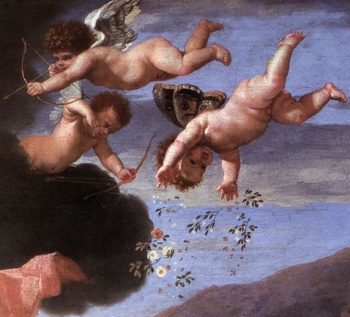
Try painting this today and see how long you stay out of jail
|
Who Are We? The Samizdata people are a bunch of sinister and heavily armed globalist illuminati who seek to infect the entire world with the values of personal liberty and several property. Amongst our many crimes is a sense of humour and the intermittent use of British spelling.
We are also a varied group made up of social individualists, classical liberals, whigs, libertarians, extropians, futurists, ‘Porcupines’, Karl Popper fetishists, recovering neo-conservatives, crazed Ayn Rand worshipers, over-caffeinated Virginia Postrel devotees, witty Frédéric Bastiat wannabes, cypherpunks, minarchists, kritarchists and wild-eyed anarcho-capitalists from Britain, North America, Australia and Europe.
|






Recent Comments