We are developing the social individualist meta-context for the future. From the very serious to the extremely frivolous... lets see what is on the mind of the Samizdata people.
Samizdata, derived from Samizdat /n. - a system of clandestine publication of banned literature in the USSR [Russ.,= self-publishing house]
|
Danny Finkelstein has noticed something highly dubious about the coverage of the Zimbabwe catastrophe by BBC veteran foreign correspondent, John Simpson.
To put it bluntly, Simpson is an over-rated arse who seems to bend over backwards to present Mugabe’s actions in a favourable, or at least not unfavourable, light. I have found that too much of his coverage, while affecting the “Our brave correspondent in Godforsaken Country etc” often glides over serious problems and issues. He is often wheeled out by the Great and The Good as the example of the impartial British journalist, so much better than all those simplistic Americans with their strange ideas about right and wrong. Sorry, I am not buying it. For sure, unlike some people, I do not regard the BBC’s foreign coverage as an unmitigated evil, but stuff like this does not exactly help.
Thanks for Stephen Pollard for the tip.
There seems, finally, to be a concerted effort going on to rid Zimbabwe of its appalling President, Robert Mugabe. The disgust felt by the entire civilised world at from the farce of the recent Zimbabwean election, won in the first round by the opposition but now about to be scrubbed out by pure force, was too much even for President Mbeki of South Africa to resist. Today Nelson Mandela made a short speech giving voice, finally, to his disgust at Mugabe’s behaviour. And now that Mandela has spoken, Britain has felt able to chip in by forbidding a Zimbawe cricket visit to Britain next year, and by stripping Mugabe of a knighthood of a particularly grand and vacuous variety that was conferred upon him some years ago. As the Tesco adverts say, every little helps.
But Mugabe will never go merely because of trivial indignities such as those. He has no better nature to be appealed to, no shame. It is being said that if South Africa pulls the plug in some way on the Mugabe regime, that will finish it. I hope that some time during the next few days or weeks, we will all get the chance to see if that’s true. When the lights don’t work inside Mugabe’s palaces, when the electric fences guarding him stop hurting anyone, when his bodyguards don’t know where their next meal is to come from, then that will indeed be the end of him, and this can’t come too soon for the wretched people of the country he has ruined. It’s all very Shakespearian.
I don’t know if Mr Brown will deserve any particular credit for such an outcome, if and when it finally materialises. I recall Mr Brown lining himself up some weeks ago with all this anti-Mugabe activity, speaking out against this grotesque man at the UN or some such place. But I suspect that this was only done then so noisily and so newsworthily because this was about the only uncontroversially respectable policy that Mr Brown still had on his desk at that time, which was, you will recall, a time of impending elections. I remember at around that same time speculating that Mugabe would outlast Brown. I hope that this turns out to be wrong, or, if right, that this is because Mr Brown succumbs to mysterious medical problems brought on by Labour Party fundraising difficulties, some time during the next few days.
We will know that South Africa does not have the stomach to support freedom and democracy for this vulnerable country. Zimbabweans must now exercise their Lockean right of self preservation to exterminate this kleptocratic elite who deny them consent and rob them of their property.
Good luck to them!
But not green television the way you think. South African blogger 6000 is “not sure where this came from originally or if it’s true”, but he adds: “But you know, this is SA and people are nothing if not resourceful. It’s a cool story – I choose to believe.” Me too.
Spending fever has reached all walks of South African life. Here’s a fellow who lives in a squatter camp beyond Somerset West in Western Cape who now wants a television set – a new one, mind, not that second-hand thing in the pawn-shop window – so he buys one from the High Street furniture retailer.
But he’s back next day, saying the things keeps switching off just at the crucial moment. The shop checks it out and can find nothing wrong, but soon enough he’s back with the same complaint.
This time the shop sends out a technician to pop round to see what the problem is. When the technician gets there, he discovers our guy’s shack draws its electricity from a nearby traffic light, and that the TV only works when the light is green.
Good to know that almost everybody down there can afford to have “spending fever”, even if some prefer to economise on their electricity bills. 6000 has this as a mere scanned image of a newspaper report. I think it deserves the .html treatment.
Perry de Havilland of this parish just loves these creatures. Here’s a great story to brighten up a rather dull, grey day in London.
I really must go on safari one day.
Glenn Reynolds links to an interesting-sounding book about South Africa’s poor whites, a group completely obscured – globally, by the international perception of the apartheid society and locally, by post-apartheid positive discrimination efforts to raise the country’s recently oppressed blacks out of poverty. It made me recall a piece I saw some time ago on the Australian Broadcasting Corporation’s international current affairs programme, Foreign Correspondent, that also examined the lot of disadvantaged white South Africans. It contained a very interesting interview of the ANC government minister Essop Pahad. I have reproduced the business end of the discussion below (the emphasis in bold is my own):
→ Continue reading: The new face of South Africa
Of the mainstream development charities, Oxfam is one of the better. Yes, it remains wedded to failed notions of ‘development aid’, but it is less shrill that many of the others. Its Oxfam Unwrapped initiative, where members of the public buy a Christmas present which goes to people in poor countries, strikes me as quite a good idea. Aid sent this way is certainly more likely to get to ‘real people’, rather than be sqandered by political elites like so much development aid.
But good intentions are not enough. Oxfam takes a perfectly good idea then ruins it by encouraging the gifting of goats. Goats are profoundly destructive to economic progress. They are the animal version of Robert Mugabe, destroying wealth and ripping up property rights, by destroying neighbours’ crops. They wreck agricultural land, turning fertile land into dust. As Lord Eden of Winton has said in the House of Lords:
Where there are large populations of goats, there is invariably poverty. Where there is poverty, there are invariably large populations of goats. Goats are marauding and indiscriminately destructive creatures. In his typically trenchant piece in last week’s Spectator, Matthew Parris described them as, “rank-smelling weapons of mass destruction”.
They destroy all vegetation, they kill reafforestation, they promote erosion and, in the long term, help to perpetuate poverty.
So why is Oxfam encouraging us to buy them for poor countries?
The left may have fun with Ian Smith, the former Prime Minister of Rhodesia, having died on November 20th – the same day as Franco in 1975, and Primo de Rivera back in 1936.
There was a BBC Radio Four discussion on Mr Smith today, but I do not know whether any mention was made of the date of his death – I turned the show off after it became clear that all the participants in the discussion hated Ian Smith and, more importantly, had no interest in truth.
The obituary of Ian Smith in today’s Economist did not make any joke about the date of his death, it just contented itself with accusing him of ‘tyranny’ and saying the government he headed, and the whole of the Rhodesian effort, was “rather squalid”.
However, both the BBC show and the Economist obituary said that Ian Smith had delayed black majority rule for “fifteen years” (1965 to 1980) – this is false.
Some background:
Under the 1923 Constitution of Southern Rhodesia there were educational and property qualifications on voting – which meant that the vast majority of voters (although not all of them) were white. Even under the Constitution drawn up under Ian Smith in 1969 only eight of the members of House of Assembly were to be directly elected by blacks who do not meet the educational and property qualifications (although another eight were to be chosen by tribal chiefs) – whereas the mainly white voters who did meet the qualifications got to elect fifty members. It is true that the Senate was more balanced – with a minimum of ten Senators (out of 23) being elected by the tribal chiefs. But the Senate only had delaying powers.
However, Ian Smith accepted the 1971 deal proposed by the British government headed by Edward Heath – a deal that would have speeded up the process by which more blacks got the vote on an equal basis with whites. But after widespread protests about how it was wrong to link voting with property ownership at all (oh silly Aristotle for thinking that majority rule can only work when the majority are property owners) this proposal was withdrawn – which Mr Smith regarded as a betrayal (one of many). Ian Smith said many times that he would never accept “majority rule” if this meant the rule of non property owners, i.e. the tribal masses, but in the end he did accept it – and his acceptance was not in 1980…so the “fifteen years” is false.
In March 1978 Ian Smith accepted majority rule in a deal with some of the black leaders, including Ndabaningi Sithole, the founder of African nationalism in Rhodesia, and Bishop Abel Muzorewa – who had played a leading role in sinking the 1971 deal. It is true that under the 1978 deal the new ‘Zimbabwe Rhodesia’ would reserve a third of the seats in Parliament for the mainly white property owners, and it is also true that there were other constitutional protections.
Ian Smith also hoped to be Minister of Defence under a black Prime Minister, but after the elections of 1979 he had to make do with being Minister without Portfolio – a white Defence Minister yes – but not old burnt face, seems to have been the position of the new government.
However, the British government, in spite of the Conservatives having said during the British elections of May 1979 that they would support the internal settlement) undermined the deal and demanded, at the Lancaster House talks, that Prime Minister Muzorewa and the whole government be removed and the country be placed under British control for new elections. Thus Bishop Muzorewa was humiliated in the eyes of his tribe, who made up the majority of the population, and with the British in charge there was nothing to prevent intimidation winning the elections for the most radical elements – as Ian Smith predicted would happen.
So the new Prime Minister in 1980 was the Marxist terrorist Comrade Bob – on the grounds that he was from the majority tribe, unlike the rival terrorist leader, and had the best organized intimidation.
Both the BBC and the Economist choose to date majority rule from this date.
As for the picture presented of Ian Smith as being unwilling to compromise and as having learnt nothing from his experiences in World War II, the Economist obituary makes the latter claim, I do not know whether the BBC show claimed it as well – I do not know for the reason I explained above, well I think what I have already explained casts doubt on this picture.
The Economist posted an article about Zimbabwe this week reporting that Zimbabwe is ‘at the end of its tether’, with the news that the vile regime of Robert Mugabe has introduced price fixing as a means of legislating away the rampant inflation that has left Zimbabwe banknotes worth less then toilet paper.
Instead the president, who famously despises “bookish economics”, has decided to outlaw inflation. Price freezes have only been enforced through the arrest of scores of businessmen who are accused of profiteering. The result: shops are bare of basic goods, as businesses refuse to sell more than a minimum of flour, sugar, maize and other items at a crippling loss. There has been panic buying all over the country. In Harare, the capital, crowds wait outside supermarkets ready to rush in and grab whatever they can. Where basics such as cooking oil are available they are rationed by shopkeepers. Fuel is in short supply, with long queues of cars reappearing outside Harare’s petrol stations. As factories prepare to close operations their owners, in turn, are being arrested and forced to keep operating.
Some have expressed the hope that the oncoming economic collapse might presage a political upheaval that will remove Mugabe and restore a democratic government in Zimbabwe. There is no doubt that there is a great upswelling of discontent in the country. It has few friends internationally and those are of dubious repute.
But there is faint hope to expect the end of the regime as long as Mugabe has the strength to kill his domestic enemies and hang on to power. There is the dreadful example of Communist Kampuchea as an example of how low a country can go before it becomes extinct. Things in Zimbabwe are going to get much, much worse.
Is Blairism infectious? Our glorious leader (former) waltzed around Tripoli with his grin and imparted wisdom to the monarch of that realm. For we live in an age of usurpers, where dynasties conform to the current demand for popular sovereignty, and sons succeed fathers as Presidents.
Once Gadaffi had talked to the maestro, his own ambitions knew no limits.
Colonel Gaddafi yesterday called for the creation of a United States of Africa, and appeared to be positioning himself to be its first leader.
Flanked by his usual coterie of female bodyguards and wearing a shirt covered in images of African presidents, he said: My vision is to wake up the African leaders to unify our continent. Long live the United States of Africa. Long live African unity.
I fear that he lacks his idol’s penchant for suits, ties and hairdressers. But, perhaps his authentic look of the tyrant as scruff and the Byronic hair will open doors that remain closed to the Emissary.
Seen on a street in Addis Ababa, near the interesting Entoto market
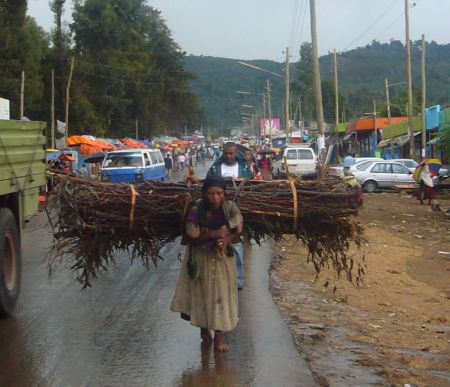
So you reckon your job sucks, eh?
I will be travelling (with another esteemed Samizdata editor) to Addis Ababa this weekend and stay in Ethiopia for about a week. I have read many fascinating things about the country but I have no idea what to expect. So tips and suggestions are welcome.
I plan to travel outside the capital – it was a toss up between Axum and Lalibela. In the end the latter won as the rock-hewn churches are amazing. Also it is a shorter flight, which given time constraints is preferable.
Thanks to Graham of Noodlepie I have learnt about the vibrant Ethiopian political blogosphere. Any Ethiopian bloggers worthy of note?
|
Who Are We? The Samizdata people are a bunch of sinister and heavily armed globalist illuminati who seek to infect the entire world with the values of personal liberty and several property. Amongst our many crimes is a sense of humour and the intermittent use of British spelling.
We are also a varied group made up of social individualists, classical liberals, whigs, libertarians, extropians, futurists, ‘Porcupines’, Karl Popper fetishists, recovering neo-conservatives, crazed Ayn Rand worshipers, over-caffeinated Virginia Postrel devotees, witty Frédéric Bastiat wannabes, cypherpunks, minarchists, kritarchists and wild-eyed anarcho-capitalists from Britain, North America, Australia and Europe.
|




