We are developing the social individualist meta-context for the future. From the very serious to the extremely frivolous... lets see what is on the mind of the Samizdata people.
Samizdata, derived from Samizdat /n. - a system of clandestine publication of banned literature in the USSR [Russ.,= self-publishing house]
|
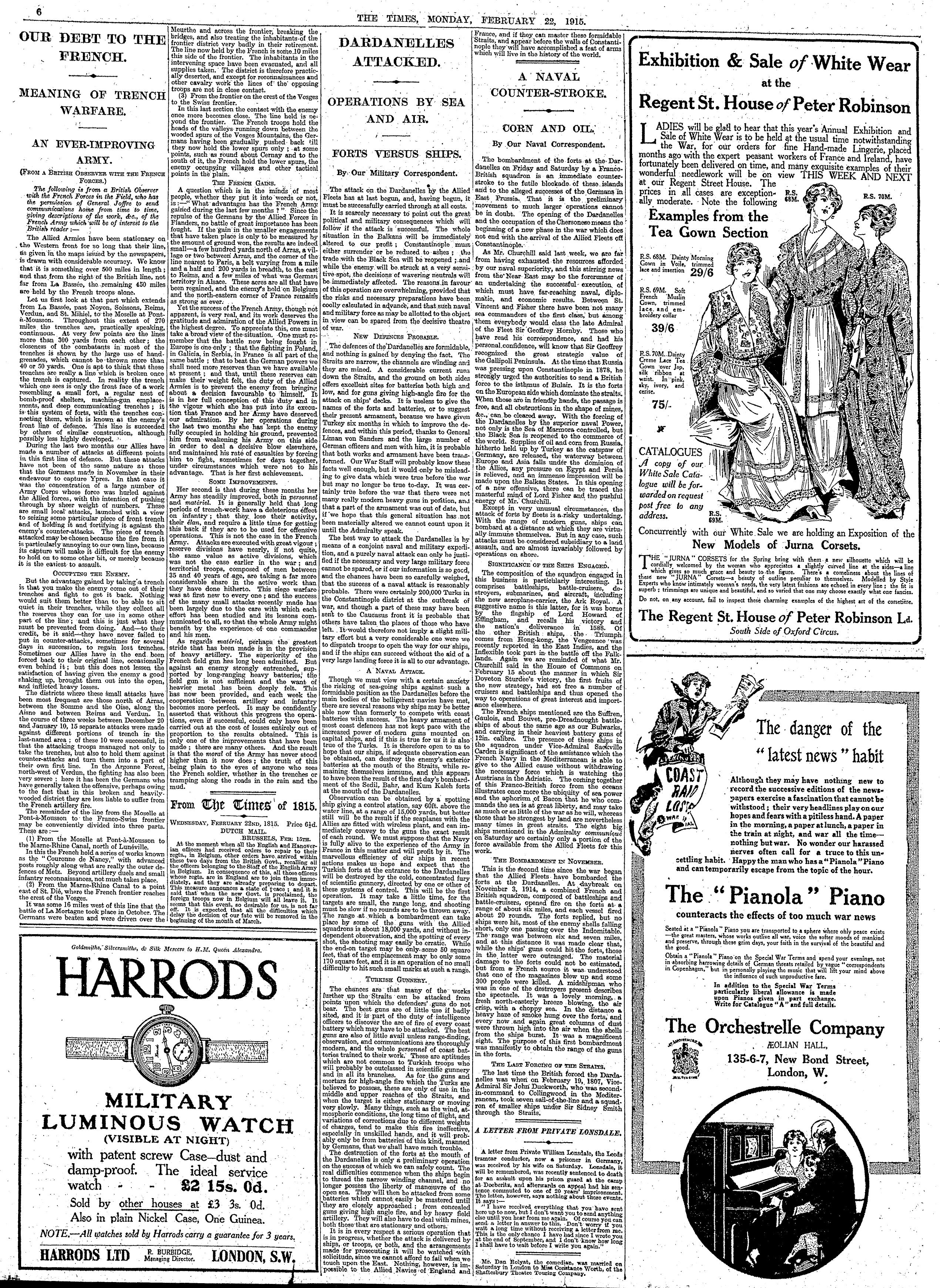
What is a military correspondent to do when in the course of wartime his government is doing something sensible? Why, support it of course. But what if that government is doing something very, very stupid like launching the Gallipoli campaign? The answer, of course, is to support that too – in wartime loyalty trumps honesty – but point out the difficulties.
Which is precisely what Charles à Court Repington, Military Correspondent of The Times, does. In some detail.
The reasons in favour of this operation are overwhelming, provided that the risks and necessary preparations have been coolly calculated in advance, and such naval and military force as may be allotted to the object in view can be spared from the decisive theatre of war.
Note the use of the word “decisive”. The meaning is clear: the Western Front is decisive, this isn’t.
The defences of the Dardanelles are formidable, and nothing is gained by denying the fact. The Straits are narrow, the channels are winding and they are mined. A considerable current runs down the Straits, and the ground on both sides offers excellent sites for batteries both high and low, and for guns giving high-angle fire for the attack on ships’ decks.
The best way to attack the Dardanelles is by means of a conjoint naval and military expedition,…
Which they’re not doing… yet. By the way, I was once told that strictly speaking the word “military” refers exclusively to land-based warfare. I think this is how the word is being used here.
… and a purely naval attack can only be justified if the necessary and very large military force cannot be spared,…
Which it can’t, not least because it doesn’t exist.
… or if our information is so good,
Which it isn’t.
…and the chances have been so carefully weighed, that the success of a naval attack is reasonably probable.
But hey…
…if they can master these formidable Straits, and appear before the walls of Constantinople they will have accomplished a feat of arms which will live in the history of the world.
He’s not kidding.
And whose bright idea is this campaign? Why, Winston Churchill, of course. If you want a way of thinking about Churchill prior to “We’ll fight them on the beaches” and all that, think Tigger from the Winnie-the-Pooh books – loud, abrasive, energetic, enthusiastic, convinced of his genius and indispensability, hare-brained. Such an attitude has already caused problems but now it will cause the sort of problems that cannot be ignored. Ultimately, it will lead to Churchill’s removal from government and a stint in the trenches. It is not something that will ever be entirely forgotten. Indeed one wonders if Churchill timed his death in January 1965 to avoid the 50th anniversary of Gallipoli in the February.
About the best that can be said for Gallipoli is what would they have said had it never been tried? There would doubtless have been people claiming that here was a scheme that would have won the war much more quickly at far less cost and it was only a lack of imagination and institutional stubbornness that prevented it being pursued.
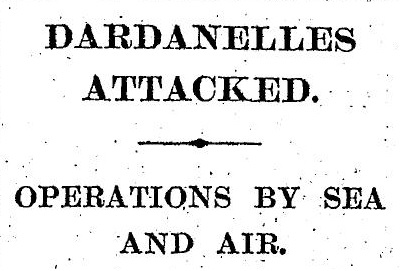 The Times 22 February 1915 p6
Many of you will have noticed that I haven’t been blogging from a hundred years ago as much as I used to. This is mainly because my source material, The Times, isn’t what it used to be. It is much shorter – 16 pages instead of 24 – and much less accurate. In wartime you do not and often cannot know what is going on.
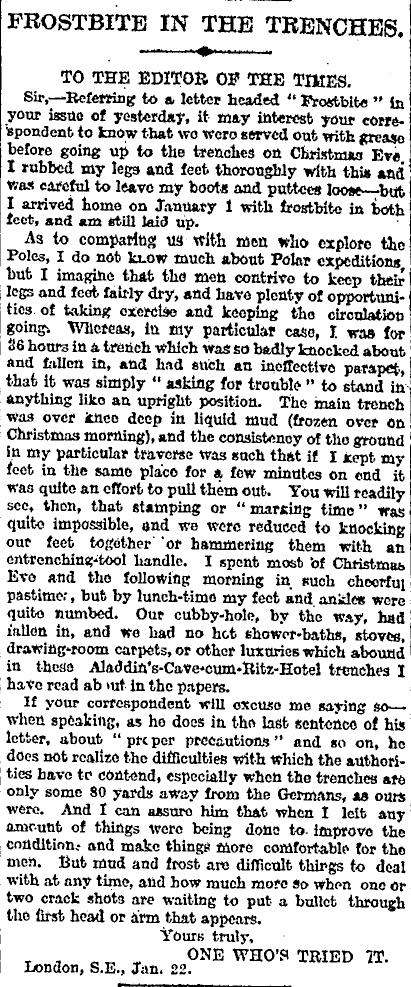
Here, however, we do have an accurate report, from the front line no less:
…it may interest your correspondent to know that we were served out with grease before going up to the trenches on Christmas Eve. I rubbed my legs and feet thoroughly with this and was careful to leave my boots and puttees loose – but I arrived home on January 1 with frostbite in both feet, and am still laid up.
He goes on:
…I was for 36 hours in a trench which was so badly knocked about and fallen in, and had such an ineffective parapet, that it was simply “asking for trouble” to stand in anything like an upright position. The main trench was over knee deep in liquid mud.
Before getting indulging in some light sarcasm:
Our cubby-hole, by the way, had fallen in, and we had no hot shower-baths, stoves, drawing room carpets, or other luxuries which abound in these Aladdin’s-Cave-cum-Ritz-Hotel trenches I have read about in the papers.
The thing that really strikes me about this letter is that it pulls no punches. I have often heard it said that the people at home had no idea what life was like at the front. But if letters like this were getting published on a daily basis I wonder if that’s really true.
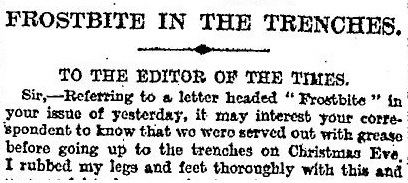 The Times 25 January 1915 p9
UKIP have just issued 100 days till the election, 100 reasons to vote UKIP. Some of it is good:
1. Get Britain out of the European Union
6. Cutting £9bn from our foreign aid budget
20. Scrapping the poorly planned HS2 project, saving up to £50bn
31. Withdrawing from the European Court of Human Rights
34. No votes for prisoners
42. Opposing plain packs for cigarettes, which has had no impact where trialled
55. Scrapping the arbitrary 50% target for university attendance
68. Stopping the sale of patient data to big business
78. Repealing the Climate Change Act 2008 which costs the economy £18n per year
82. Leaving the Common Agricultural Policy
Some of it is bad:
2. Get control of immigration with an Australian-style, points-based immigration system
3. £3bn more, annually, into our NHS which desperately needs it
4. Scrap tuition fees for students studying Science, Tech, Engineering, Maths, or Medical degrees
21. Opposing tolls on public roads – we’ve already paid for them
25. Protecting our green belt
87. Scrapping the Bedroom Tax
Some of it is “meh”:
11. Ending PFI privatisation of the NHS, proliferated by Labour and the Tories
13. Establishing a Veteran’s Administration to look after those who looked after us
49. Reoccupying our seat at the World Trade Organisation
58. Guaranteeing a job in the police, prison, or border forces for anyone who has served 12 years in the Armed Forces
95. Emphasising the immediate need to utilise forgotten British infrastructure like Manston Airport
And some it I shouldn’t like but do:
7. Give the people the ability to “recall” their MPs, without parliamentary or MP approval
10. Allowing existing schools to become grammar schools
15. Overcoming the unfairness of MPs from devolved nations voting on English laws
Disturbingly there is nothing on the debt, deficit, money or gold. But at least some of it is good. Can you say the same for any of the other parties? Come to think of it, I think the Greens would still re-legalise cannabis.
Ever since I have been aware of something called military history I have also been aware of someone called Basil Liddell Hart. He is usually described with great reverence as the man who invented the Blitzkrieg.
This is not really true. Yes, he was an advocate of an independent tank arm. Yes, he saw that it could achieve a tactical breakthrough. And, yes, he saw that it needed close support from the air. But that is not the full story. Firstly, he wasn’t original – that accolade goes to Major-General J F C Fuller. Secondly, while he saw the need for penetration the Blitzkrieg took it much further. Thirdly, there is no direct link between what he wrote and what the German armies did.
It gets worse. As Jonathan Mearsheimer points out in Liddell Hart and the weight of history there’s more to him than that. Or perhaps, depending on your point of view, less. For while Liddell Hart had indeed come up with some far-sighted ideas on tactics, by the 1930s he had more-or-less abandoned them.
In their place he argued that Britain’s generals were irredeemably incompetent and Britain should never again get involved in a continental war. He even found himself arguing that the tank was in fact far more useful in defence than attack.
These were dangerous ideas. Should the advocate of such ideas be in an influential position it would be likely that the British army would be starved of resources. This would mean that it would be in no state to fight a continental war and certainly be in no position to go on the offensive. That would mean that Britain would have no ability to deter an aggressor. As I said, if the advocate was in an influential position. Unfortunately, Liddell Hart, as Times military correspondent and confidante of Leslie Hore-Belisha, the Minister of War, was in just such a position – to the extent he was sometimes known as the unofficial Chief of the Imperial General Staff – and the British army in 1940 was indeed in no state to fight a continental war. Surveying its parlous state Field Marshal Montgomery Massingberd was in no mood to be generous:
He accuses Earl Haig and the British generals of losing lives in the last war, but I wonder how many lives are going to be lost in this war because of the teaching of that man and of people like him.
It took Liddell Hart a long time to realise he was wrong. He continued to argue that defence was stronger than attack. After the German annexation of the rump of Czechoslovakia he continued to argue against a continental commitment. And when the Germans broke through at Sedan he argued that it was only a matter of time before they were stopped.
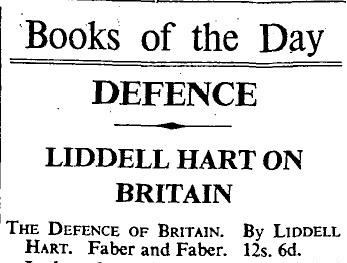 The Times 18 July 1939 page 9 After the Fall of France and the evacuation from Dunkirk Liddell Hart found himself (rightly) ignored. But you can never keep a bad man down and in the 1950s with the help of skint German ex-generals he managed to rebuild his reputation. He did such a good job of it that by the 1960s he was being lauded as the “Captain who teaches generals.” Such was his influence that it was almost impossible to make a career as a military historian without his help. The only exception to this was John Terraine: chief script writer of the Great War series part of which was recently repeated on BBC4 (amongst other things). When Terraine published a generally positive biography of Haig, Liddell Hart secretly organised a campaign against it.
On 27 October 1914 HMS Audacious, one of the Royal Navy’s newer battleships hit a mine and sank. The government censored the story and the loss wasn’t officially admitted until after the war had ended. This is about as close as readers of the Times got to hearing about it officially: 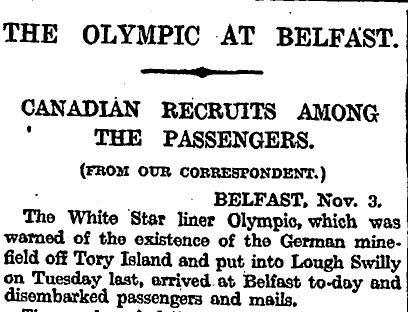 The Times 6 November 1914 p4 The point being that the Olympic (sister ship of the Titanic) helped in the rescue operation. Many of its passengers were Americans and some even took photographs. As there was no censorship in America news of the sinking slowly filtered across the Atlantic. There’s a good discussion about the sinking here:
So, why the secrecy? Partly this was because of where the Audacious sank. The fleet was supposed to be in Scapa Flow in the Orkneys guarding the North Sea. However, due to the state of the submarine defences there it was thought prudent to move it to Lough Swilly off the northern coast of Ireland. The navy did not want the idea to get out that the North Sea was an open house. 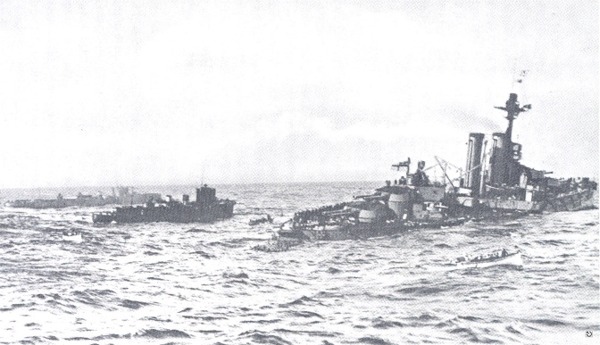 HMS Audacious sinking But there may have been another reason. The early months of the war had been a disaster for the Royal Navy. The German battlecruiser, Goeben, had evaded the British in the Mediterranean and went on to play a large part in bringing Turkey into the war. Three cruisers, the Hogue, Aboukir and Cressy had managed to get themselves sunk by the same submarine in the Channel in the space of an hour and a half. At the battle of Coronel a British cruiser squadron had attacked a superior German force with disastrous results. In the southern oceans the commerce raider Emden was making fools of its pursuers, seemingly able to pop up out of nowhere to shell ports and destroy wireless stations. There may have been a desire not to admit just how badly things were going.
In situations like this questions are bound to be asked about the man at the top – or the First Lord of the Admiralty to give him his grand, official title – but it would take another year and more disasters before he would finally be sacked. The chap’s name? Oh yes, Winston Churchill.
This is how in 1918 Times readers first found out about Spanish flu:
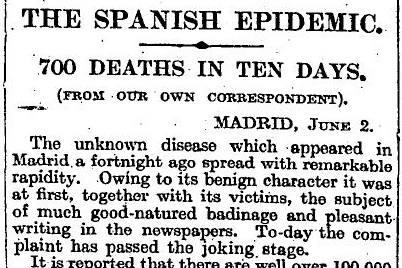 The Times 3 June 1918 p5
You can say that again. It ended up killing 40 million people.
Incidentally the Wikipedia page on the subject is an appalling mess. At one point it claims that it began on the Allied side of the front, at another that it began on the Central Powers’ side. At one point it claims that it was particularly lethal to those with strong immune systems and at another to those with weak immune systems.
Having said that I love the suggestion that it was called Spanish flu because that was the origin of the first reports of the disease. It was the origin of the reports not because it was the first place to get the disease but because wartime censors did not want to encourage the enemy by admitting its presence.
So, it’s possible that this was not how Times readers first found out about it.
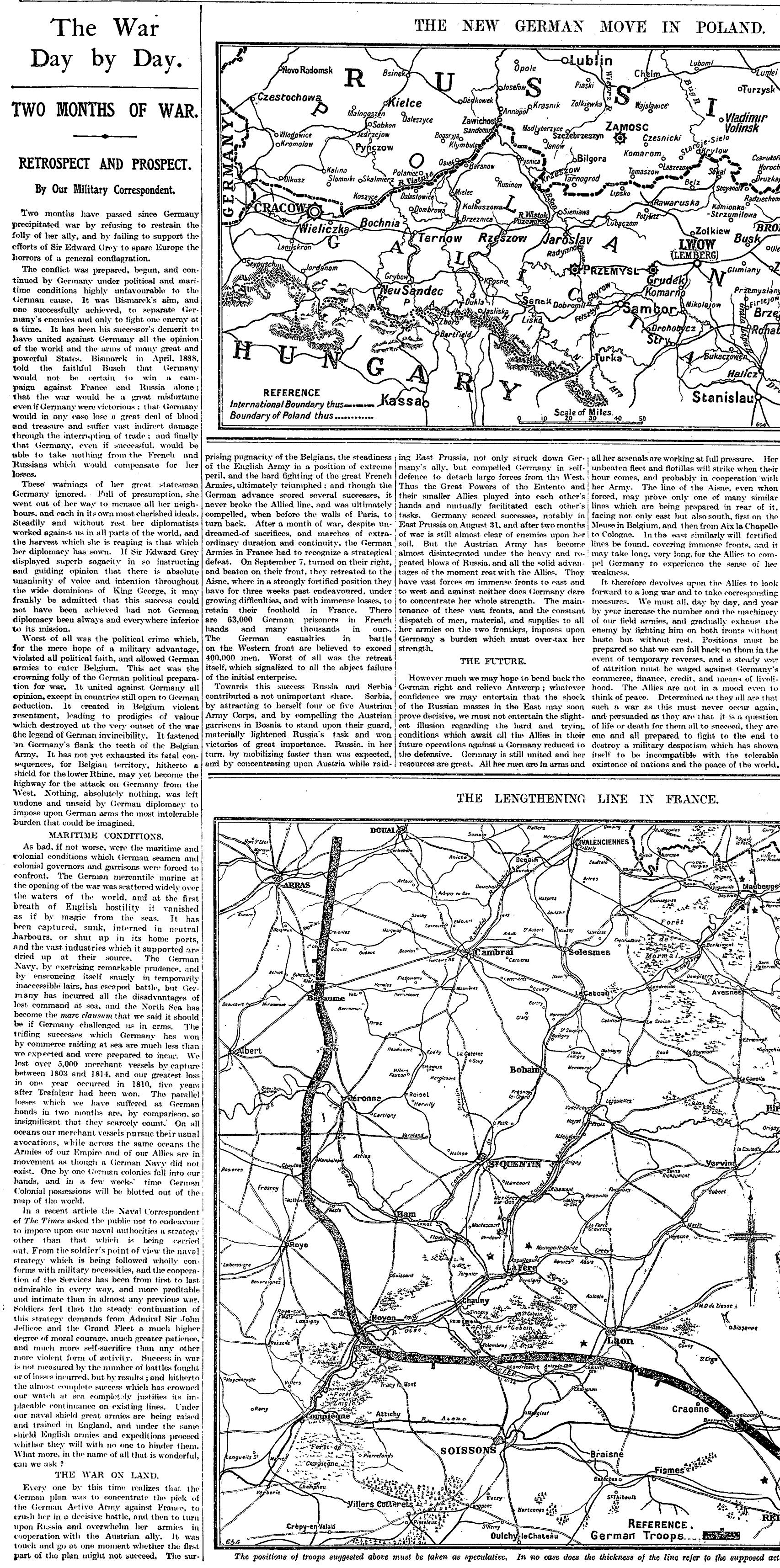
The story of the First World War so far: Germany pushed the bulk of its army through Belgium. The French, along with the tiny British army were unable to hold them and retreated. At the Marne the Germans were stopped and themselves began to retreat. At the Aisne they stopped retreating, dug in and trench warfare began. People are beginning to realise it’s going to be a long war.
However much we may hope to bend back the German right and relieve Antwerp [they didn’t]; whatever confidence we may entertain that the shock of the Russian masses in the East may soon prove decisive [it didn’t], we must not entertain the slightest illusion regarding the hard and trying conditions which await all the Allies in their future operations against a Germany reduced to the defensive. Germany is still united and her resources are great. All her men are in arms and all her arsenals are working at full presssure. Her unbeaten fleet and flotillas will strike when their hour comes, and probably in cooperation with her Army. The line of the Aisne, even when forced, may prove only one of many similar lines which are being prepared to the rear of it… and it may take long, very long, for the Allies to compel Germany to experience the sense of her weakness.
In other words, it’s not going to be all over by Christmas. [Not that I have actually come across that phrase in the pages of The Times.]
The writer, himself is worth a mention. He is The Times’s Military Correspondent, a chap by the name of Charles à Court Repington. A talented officer with a bright future, he was chucked out of the army for conducting an affair with a married woman. The army’s loss was The Times’s gain. While no one can predict the future with perfect clarity, Repington did a pretty good job of it as he does above. In 1913, he predicted that Germany’s main thrust would come through Belgium. The French high command did not work that out until late August 1914 when it was almost too late.
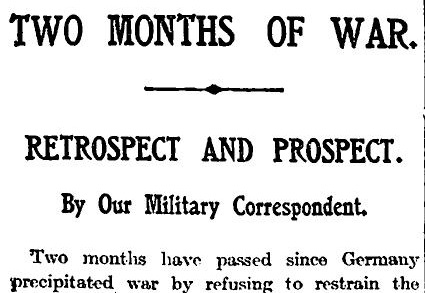 The Times 3 October 1914 p5
Here’s how:
1. There is a crash in the stock market this autumn (there has already been a large fall).
2. A recession starts. Businesses start to close, others start to lay off workers. Either way there is a large increase in unemployment and the fear of unemployment.
3. The public see that as far as Cameron and Osborne are concerned the emperor has no clothes. The mirage of economic recovery they have concocted over the last four years is seen for what it is: a mirage.
4. As the Conservatives start to fall in the polls, UKIP and Labour start to rise. Eurosceptic Conservative MPs realise they have nothing to lose by defecting to UKIP. A hundred do so.
5. The defection of such a large number of Conservative MPs makes UKIP seem a lot more credible as a party of government.
6. In the election, Labour get a plurality but not a majority. UKIP are only a few seats behind. The leader of the Conservative Party, now with 30 seats becomes known as Kim Cameron.
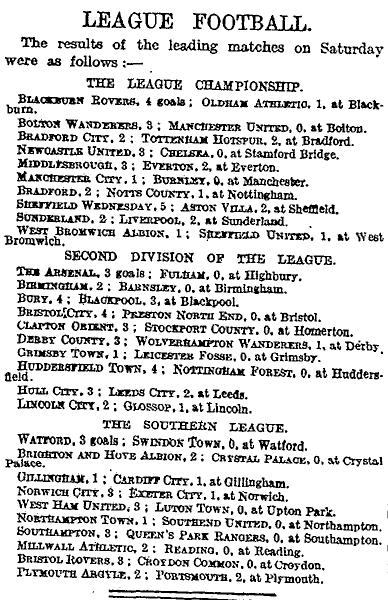
The British Army might be involved in a desperate struggle in northern France but that doesn’t mean that life should come to a standstill at home:
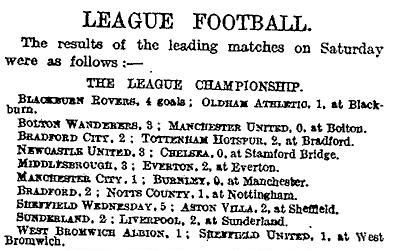 The Times, 14 September 1914 p2 I jest, the Football Association has asked for guidance. This is what the Army Council had to say:
The question whether the playing of matches should be entirely stopped is more a matter for the discretion of the Association, but the Council quite realise the difficulties involved in taking such an extreme step, and they would deprecate anything being done which does not appear to be called for by the present situation.
One of the problems – a problem that will haunt the British Army until 1917 – is that it is a small army with a small supply industry. There simply is no great stockpile of uniforms, weapons and ammunition and no easy way of producing more. Sure, the Army may have recrutied 100,000 men (or is it 500,000?) by this stage of the war but there’s precious little they can do with them. So football might as well continue, as indeed it did until the end of the season in 1915.
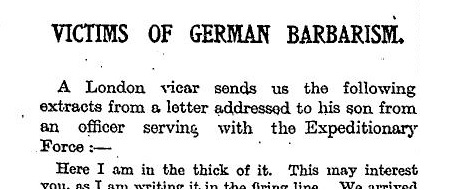
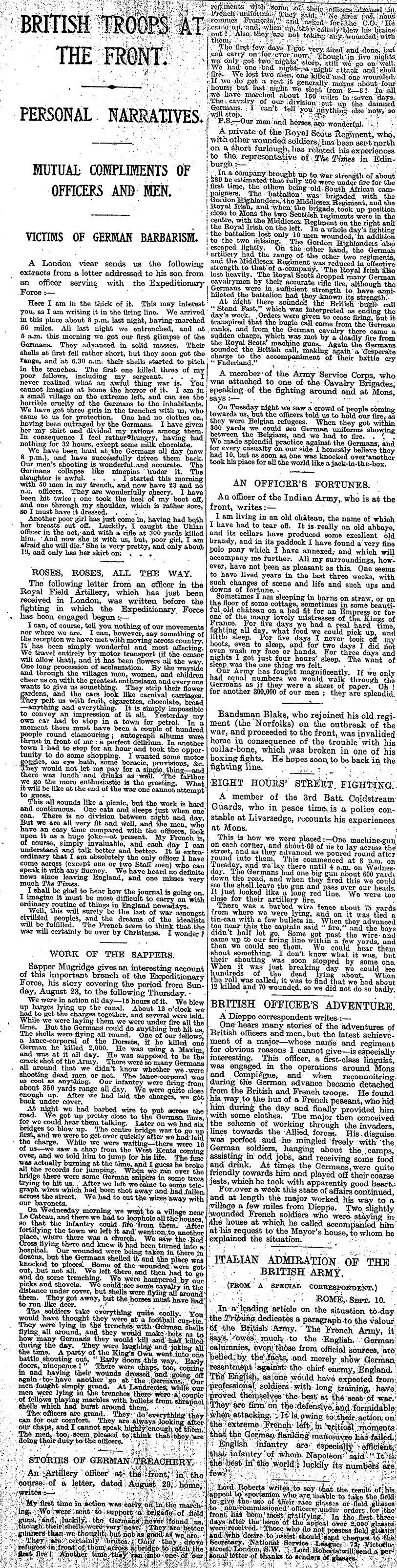
The Times from 12 September 1914. A vicar passes on a letter from his son, an officer in the British Expeditionary Force:
Another poor girl has just come in, having had both her breasts cut off. Luckily, I caught the Uhlan [German cavalryman] in the act, and with rifle at 300 yards killed him. And now whe is with us, but, poor girl, I am afraid she will die. She is very pretty, and only about 19, and only has her skirt on.
The article continues in a similar vein with this and other letters from the front telling tales of rape, the use of civilians as human shields and other forms of German treachery.
But what is one to think? I suppose the first question is, is it true? And then, was it intentional (on the part of the Uhlan)? Are there any mitigating factors? And are the British any better?
On that last one I am inclined to think yes, simply because they are amongst friends.
And on the first one, I see little reason why an officer or a vicar would make it up. But someone else might. And The Times which backs the war effort might not be that keen on checking up. Or maybe the officer was suffering hallucinations through lack of sleep.
But on the other hand, the Kaiser’s men did raze Louvain to the ground, and massacre civilians at Dinant and use the ones they hadn’t massacred as human shields.
Ultimately, I am inclined to believe this. And I am shocked. And if I am shocked a hundred years later it is not difficult to imagine what people must have been thinking at the time.
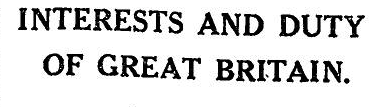
The “July Crisis” of 1914 may have come as a shock to the British but that does mean they were not able to weigh their options. I was surprised by the excellence of a couple of articles I came across in The Times. One of them appeared on the editorial pages, did not have a byline but didn’t appear to be an editorial either. It was still good though. This is the key passage:
France does not threaten our security. A German victory over France would threaten it irremediably. Even should the German Navy remain inactive, the occupation of Belgium and Northern France by German troops would strike a crushing blow at British security. We should then be obliged, alone and without allies, to bear the burden of keeping up a Fleet superior to that of Germany and of an Army proportionately strong. This burden would be ruinous.
That is the best explanation from Britain’s decision to go to war I ever heard. Peace is perilous.
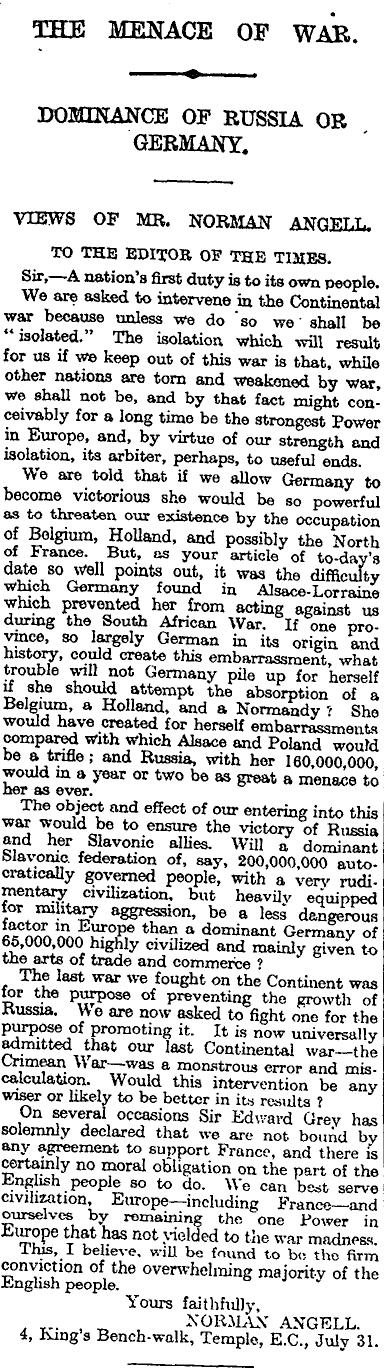
The other was a letter from Norman Angell, author of The Great Illusion:
We are told that if we allow Germany to become victorious she would be so powerful as to threaten our existence by the occupation of Belgium, Holland, and possibly the North of France. But, as your article of to-day’s date so well points out, it was the difficulty which Germany found in Alsace-Lorraine which prevented her from acting against us in the South African War. If one province, so largely German in its origin and history, could create this embarrassment, what trouble will not Germany pile up for herself is she should attempt the absorption of a Belgium, a Holland, and a Normandy?
Rather depends on how civilised she plans on being. He goes on:
The object and effect of our entering into this war would be to ensure the victory of Russia and her Slavonic allies. Will a dominant Slavonic federation of, say, 200,000,000 autocratically governed people, with a very rudimentary civilisation, but heavily equipped for military aggression, be a less dangerous factor in Europe than a dominant Germany of 65,000,000 highly civilised and mainly given to the arts of trade and commerce?
A prediction, of course, that manages to be both very wrong and, ultimately, very right.
|
Who Are We? The Samizdata people are a bunch of sinister and heavily armed globalist illuminati who seek to infect the entire world with the values of personal liberty and several property. Amongst our many crimes is a sense of humour and the intermittent use of British spelling.
We are also a varied group made up of social individualists, classical liberals, whigs, libertarians, extropians, futurists, ‘Porcupines’, Karl Popper fetishists, recovering neo-conservatives, crazed Ayn Rand worshipers, over-caffeinated Virginia Postrel devotees, witty Frédéric Bastiat wannabes, cypherpunks, minarchists, kritarchists and wild-eyed anarcho-capitalists from Britain, North America, Australia and Europe.
|









Recent Comments