We are developing the social individualist meta-context for the future. From the very serious to the extremely frivolous... lets see what is on the mind of the Samizdata people.
Samizdata, derived from Samizdat /n. - a system of clandestine publication of banned literature in the USSR [Russ.,= self-publishing house]
|
The Oracle of Delphi was the flip side of the ancient Greek culture that brought us the underpinning genius of modern western thought. The Oracle was the voice of superstition and irrationality. As a result I have always thought it appropriate that the name of the company founded by supporter of the Panopticon surveillance state Larry Ellison was ‘Oracle’.
Over on Matt Welch‘s blog, he reports the inane comments of my pet hate Ellison who, it turns out, is a great fan of Napoleon. Hold on to your tricorn hat for a trip into the history à la Larry:
Napoleon codified the laws for the first time in Europe. He was constantly limiting kings and other tyrants.
Quite right Larry. He constantly limited other tyrants as he insisted on being the only tyrant allowed. Military dictators generally don’t like political competition.
He opened the ghettos and stopped religious discrimination. He was an extraordinary man who wrote a lot of laws himself.
Indeed he did. He used the French Army to impose his own will on most of Europe. I wonder if Larry thinks when this was tried again in 1939, it was necessarily a bad thing?
He was incredibly polite, generous almost to a fault, a remarkable person who was vilified. By whom? The kings that he deposed. The kings of England, and the old king of France, and the kings of Prussia, and the Czar of Russia were all threatened by this man who was bringing democracy. […]
I see. So EMPEROR Napoleon, self-crowned military dictator of the French EMPIRE, conquered much of Europe and caused several million deaths during the Napoleonic Wars because he wanted to bring democracy to everyone? Including democratic Britain (that’s ‘England’ to you Larry)?
He was a liberator, a law-giver, and a man of incredible gifts. He never considered himself a soldier, he considered himself a politician, though he was probably the greatest soldier — the greatest general –perhaps in all history.
For a man who never considered himself a soldier that was quite some military career. Particularly the bits where he went to military school, joined the French army, gave some folks a ‘whiff of grapeshot’, hijacked the French Revolution and then led the French army on a war of aggression against most of Europe. My guess is that Larry Ellison has probably never considered himself a poorly educated jackass either. Other than the fact unlike Mussolini, Napoleon was indeed a great general and he had a more extravagant tailor, there is actually little to differentiate him from any number of brutal collectivist military despots. Today he would have been called a fascist. Of course as many of the political causes Larry Ellison backs are indeed aimed at turning nations into police surveillance states I am hardly surprised he admires Napoleon-the-lawbringer, albeit from the perspective of a historical ignoramus.
I can certainly understand admiring Napoleon-the-General, but to praise him for authoring the world’s first truly global war in order to impose his will, his Code Napoleon on everyone at bayonet point? It is rather like admiring Heinz Guderian not because he was a brilliant general but because he was a Nazi.
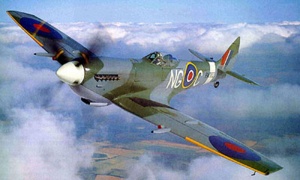
Steven Den Beste has replied to my remarks about World War Two aircraft. Tally ho!
Perry’s British sensibilities do not need to be defensive about that, because the British contributed nearly as much to the success of the Mustang as did the Americans.
It has nothing to do with my ‘British sensibilities’ but I do know a thing or two about aerocraft of the era.
As a Brit, it was inevitable that Perry should be nostalgic about the Spitfire. In 1940 there was no better air defense fighter in existence, and the UK damned well needed it. Twice as many Hurricanes fought in the Battle of Britain than Spitfires, but it was the Spitfires which made the difference because the Hurricanes were not really able to stand up to the 109’s. That said, it has to be recognized that as an all-around fighter, the Spitfire had major weaknesses, especially compared to later designs. Its airframe wasn’t as rugged as those the Americans built, and for most of the war it was undergunned (because it relied on .30 caliber machine guns). And its biggest weakness all through the war was short legs; it simply could not carry enough fuel for anything except defense.
I will try not to get too irked that Steven seems to imply that my presumed nationality somehow skews my historical judgement. He also should have read my article more carefully. I said I was talking about mid-to-late war piston engined fighters (the P-51 was not around in the early war period), and what Steven is describing is a 1940 Battle of Britain era Spitfire I. By 1941 all (non-PR) Spitfires, from the Spit V onwards, were armed with two 20mm cannon as well as (usually) four .303 machine guns. It is the lack of cannon armament in the P-51 to which I was referring. More importantly all the Luftwaffe fighters which the USAAF were facing were cannon armed aerocraft. Of course it was not a decisive flaw because the six 50 cal HMGs favoured by the USAAF were good enough.
When most aficionados of WWII aircraft speak of “the best”, it mainly becomes a question of sending 8 of each into the air to duke it out and see how many of each come back. On that basis, the Spitfire would not have rated against the Mustang because of the Spit’s final drawback: it wasn’t as fast. In combat, speed is life. Which doesn’t take anything away from the Spitfire’s designers; North American designed the Mustang six years later and had learned much.
Quite incorrect. Stephen seem to be again comparing the 1940 Spitfire I with the 1943+ Mustangs, rather than the Spits that were flying at the same time as the various marks of Mustang (such as the Spit IX or the formidable Spit XIV or Spit XIX). In fact, there was never really anything to choose between the two fighters in terms of speed because as the newer versions of Mustang came out, so did the newer versions of Spitfire. There were many versions of the P-51 and even more of the Spitfire and the Spits in particular had many sub-variants optimised for certain altitudes making the comparisions even harder. In fact the late war Griffon engined Spitfires were generally both faster, better armed and more heavily armoured than the directly contemporary Mustang versions. But this also goes to show the fallacy of comparing them at all: the Mustang was fighting most of its battles at very high altitude over Germany, for which it was optimised and handled beautifully, whilst the Spitfires were fighting at low to medium altitude over the battlefront or defensively over Britain, neither of which required long range. Certainly Spitfire LF variants would be able to outfly a Mustang of equal era at low altitude by a significant margin, but that is not really what Mustangs were for, even if they were occasionally used that way, so is it even a useful comparison?
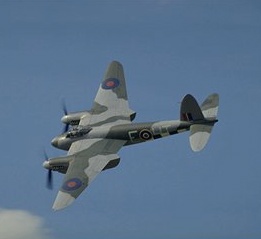
Perry brings up night-fighters. They were important (especially to the RAF, which did most of its bombing at night) but most people don’t consider them to be the same kind of thing. Night fighters had to be larger because they had to carry radar. There was much less emphasis on maneuver because night fighters didn’t tangle with each other, so most of the emphasis was on simple ability to carry weight. The Mosquito made a decent night fighter, but it could never have competed during the day. (It is noteworthy that the ME-110 was meat on the table during the day but ended up being a pretty decent night fighter.)
The fact is RAF nightfighters did indeed operate against Luftwaffe nightfighters. For much of the war, hunting German nightfighters was the primary RAF nightfighter mission, both as escorts to the RAF night bomber streams and as night counter-air intruders over German airfields. If you want to know more about that I strongly recommend History of the German Night Fighter Force by Gebhard Aders. It is written from the German point of view and is a superb book, pretty much the definitive work on the subject of the night air war in WW2.
Also to compare a Mosquito (of any mark) with an Bf.110 is like comparing a Ferrari with a Pinto. Mosquitos did indeed operate against single engined day fighters in a way that would have been suicide for a Bf.110. There are a host of books on the history of the Mosquito, but I would recommend Mosquito by C. Martin Sharp & Michael J. F. Bowyer, if you want to see a very broad range of information and statistics of all versions. By day, what it could not outfight it could outrun (until the jets arrived of course). Mosquito day fighter-bombers (mostly the FBVI version) regularly clashed with high performance single seat fighters like the formidable Fw. 190 and were quite capable of holding their own. For some excellent accounts of Mosquito tactical day and night operations, I recommend 2 Group RAF: a compete history. 1936-1945 by Michael J. F. Bowyer, which I have just finished re-reading.
[…] If one really wants to open up all the stops and say what the best fighter of the war, anyplace, anytime was on the basis of “send 8 up and see how many come back” then there is no question of the choice: it would be the pure fighter version of the ME-262. With a hundred mph edge in speed and a decent weapons load, it was deadly. It is fortunate for us that Hitler had his head wedged and ordered the majority of ME-262’s to be equipped as fighter-bombers.
Maybe, maybe not. There are many historians who disagree with that widely held view and contend it was production problems, not the so called ‘bomber directive’ that was actually the reason so few Me-262’s ever became operational.
Update: As a couple people have asked me to recommend some sources regarding my remarks about the Mosquito, I have edited the article to include two in the text above.
Steven Den Beste treads where 100,000 aeropundits have gone before
Ultimately, they switched to the Mustang, which was the prestige fighter of the European theater; beautiful, fast, deadly and long ranged: it was the best fighter the Allies had in Europe, and for bomber escort they needed every bit of it, especially after the Germans began to fly the Me-262.
Best fighter is truly meaningless unless it is stated what specific role it was best for. The P-51 Mustang was without doubt the most effective long range piston engined daylight escort fighter of World War II. Of the mid-to-late war piston engined fighters, it was not the best defensive fighter (Fw.190-D or Spitfire 19) or nightfighter (He.219 or Mosquito, various) or day/night intruder (perhaps Mosquito FBVI) or multi-role fighter (no clear winner).
Comparing fighters with different roles is pointless and thus there was no single ‘best fighter’, just ‘best fighter in some role’. The P-51 had good all round performance, very good cockpit visibility and most importantly had the range to carry out the strategic escort mission that other even higher performance piston engined fighters did not have. But as all combat aerocraft do, it also had its weak points and like all USAAF fighters of the time was certainly under-armed by 1943-1945 standards and had GC issues at some weights. How about “The P-51 Mustang was the most important USAAF daylight fighter of the European Theatre in mid-to-late World War II period”. A much safer contention.
The dependably interesting John Weidner at Random Jottings has a wonderful article on the daddy of all bloggers.
[He] was a lousy writer. At least when he wrote books and articles. His books are cranky hotch-potches; formless and almost unreadable. He was very combative; he was at his best in the quick give-and-take of argument, and was very successful as a lawyer. But he rarely took the time to organize his (often excellent) ideas into reasoned discourses.
However, unknown to the world, he spent much effort writing in a different style. He owned the best library in North America, and the books he read most often were those whose arguments he hated! He would fill the margins of those books with comments and refutations. He would tear them apart line by line. Does this sound familiar?
If you want to know who this mystery proto-blogger was, you will just have to go take a look at John’s article.
But certainly not a site for the weak! The curiously named Rantburg is a tightly focused geopolitical warblog with a robustly anti-idiotarian view of things. I do not always agree with Fred Pruitt’s particular spin, though I frequently do, but it is nevertheless a good and and often quite detailed read. He has a fine grasp of the regional players about which he writes (unlike a few blogs I could mention) and he understand real-world political dynamics (unlike a few other blogs I could mention).
Visit daily.
An article in the Sierra Times describes a Canada sharply at variance with what I had thought existed.
Gordon Campbell and the Liberal government swept to power last year (winning 77 of a possible 79 seats in the BC Legislature) on a mandate to set British Columbia back on the road to prosperity. Prosperity – as the Liberals promised – would be built on a platform dedicated to freeing the private sector from crushing taxes and burdensome regulation. Indeed, this last move by the Liberals to help cut 1.9 billion dollars from the budget by 2004 is just one thing in a list of many that has some wondering if the Liberals are actually Libertarians in disguise.
Well that certainly is one hell of a majority! But call me cynical if you like: talk is cheap… except for political talk, which is usually very expensive indeed. But then when I read what the BC Liberals have actually started doing, I almost fell off my chair! Way to go! Read the Scott Carpenter article and be amazed yourself. Methinks I shall be visiting the Sierra Times and the various Canadian blog sites more often to see what is in the air over there.

I have always felt second to none in my detestation of former NY mayor Ed Koch, who was for me the unalloyed stereotype of pragmatic municipal amorality. And yet, I found the following Ed Koch quote on the sublimely named Communist Vampires Newswire regarding the WTC twin towers:
I think we should rebuild them exactly the same way that they were. They are the symbol of New York. In a way, we crush the terrorists by rebuilding them. They thought they had destroyed us. I think this shows we are crushing them.
– Ed Koch, former New York mayor (1978 – 1989)
Absolutely true. Even better would be to build the largest building(s) in the world. To keep the site as some maudlin garden of remembrance would be a colossal mistake. We must indeed remember the fallen but let us also remember that they fell engaged in World Trade and in doing so made the world a better place more than any ten NGO’s you might care to mention.
Over on National Review On-line, sometimes inspired and sometimes confused Jonah Goldberg describes the new NRO blog Corner for those unfamiliar with the format:
For those of you who don’t “get it,” here’s what it’s about. Various NR editors and members of our extended family get to comment on anything we like, including each other’s comments. We try to keep the posts short and the most recent appear on top.
There are no editors, no rules, and no master plan. Yes, as many, many, many readers have pointed out, it’s very much like a blog along the lines of AndrewSullivan.com or Instapundit.com. The difference, however, is significant. Those guys run one-man operations. If you can’t see the distinction, look at it this way. Sex with one person is very different than sex with more than one.
Someone needs to spank that boy with a rolled up copy of National Review and set him straight on a few things: Firstly “Corner” is not “very much like a blog”… it is a blog. Secondly, it is bad form not to link to Andrew Sullivan and Instapundit if you are going to mention them. We are not competitors, Jonah, we are actually a resource for each other and “Corner” is no different. Unlike dead tree media, which is chasing the same dollar, cross links actually feed readers at the people we comment on and visa versa. In fact, the more of us there are and the more cross links there are, the more readers we all get by virtue of the increased content and broader catchment… people who might not be seen dead with a copy of NR or ever think of typing www.nationalreview.com (i.e. quite a few libertarians) might nevertheless follow a link they find here to NRO just to see what we are talking about, which is surely what NRO would want.
Bitching aside, “Corner” is actually quite a fun blog. We are glad they liked our multi-contributor format so much that they copied it. It is even nicer to know that when Jonah thinks about blogs, he thinks about sex. I’d like to think we can take credit for that too.
We are of course well aware that the cognoscenti like Jonah only come to Samizdata for Natalija’s “go for the throat” articles.
Pakistan has a very large expatriate community scattered across the world, particularly in the UK and the USA. The peoples of the sub-continent also have a deeply engrained and entirely laudable distrust of governments poking around in their affairs, which is why the hawala system of moving money around globally is so popular with people from that part of the world.
In recent weeks there has been a huge inflow of capital from the Pakistani diaspora back to Pakistan due to the scrutiny of US investigators looking ostensibly for Al Qaeda funds. Of course there is widespread and quite justified belief amongst Pakistani businessmen that where the anti-terrorist investigators tread, the IRS will not be far behind looking to see what they can confiscate. Sub-continent businessmen have been on the receiving end of shakedowns like that from potentates, princes and nations for centuries and have well honed cultural reflexes in such matters. The simple solution: move your money where the US authorities cannot see it, by bank transfer if possible or via the invisible hawala system if not.
Networked distributed capitalist systems like this are extraordinarily resilient and are fueled by deep seated and entirely admirable non-deference to state authority. Just as the justified fight against Al Qaeda is also being used to fulfil an unjustified a wish list of civil liberties abridgements, so too are the statist enemies of free trade on both left and right using it to move against the sort of small scale (though large in aggregate) trans-border capitalism at which people from the Indian sub-continent so excel. It is for reasons of control that Big Capitalism and The State get on so well: bureaucrats can meet with a few hundred CEOs of vast companies and reach understandings to their ‘mutual benefit’ (though not to anyone else’s). Hundreds of thousands of small scale truly capitalist ventures with trans-border cash flows however are impossible to even monitor, let alone control: which is of course why they are such a good thing.
Continuing in the same spirit of the last few posts, a tip of the space helmet to Samizdata reader Neil Eden for providing us with two excellent essays located on The Proceedings of the Friesian School website:
The Fascist Ideology of Star Trek: Militarism, Collectivism, & Atheism
Star Wars: Episode I, The Phantom Menace, A Response to Critics
I had forgotten how popular critiques of science fiction are, but reader responses via e-mail have just reminded me of that fact following my less than flattering remarks about the politics of Star Trek! Here are some earlier articles on the same subject that produced much the same response:
The trouble with the Federation
Star Trek: the Post-Christian Generation!
More on Star Trek: An amuzing/alarming suggestion
Star Wimps
I am a great fan of both pugnacious blogger Ken Layne and Sci-Fi afficionado King Abdullah of Jordan, as both are anti-idiotarians who have excellent taste in women by all accounts. However both the worthy King and Ken seem to have a misplaced affection for Star Trek.
It’s like Star Trek — and notice that the Star Trek universe is multiracial and multicultural and the whole deal is based on getting it together, exploiting science, taking the good stuff from every culture and leaving behind the stupid, racist, sexist, totalitarian nonsense. (No Saudi science officers in Star Fleet).
Roddenbery’s ‘utopian’ United Federation of Planets is a vision of the future in which society is starkly homogenised, with para-military governance and a total state allocated command economy the likes of which have thankfully never yet come to pass (even the Soviet Union did not completely abolish money as a medium for low level allocation of resources). How many gay characters crop up in Star Trek’s Federation? How many non-conformist extroverts? Any sign of a counter-culture? How often is an internal voice of political dissent heard in the Federation? The only dissidents shown, the Maquis, were forced into armed conflict with the Federation when it betrays them to the fascist Cardassians. The only attempts at political change shown were a couple failed attempts at a coup d’état by elements of the Federation’s own military, neither of which had liberty as their objectives. The Star Trek Federation is a dystopian nightmare: smiley face totalitarianism with a California “liberal” vibe, complete with attractive telepathic political officers (‘councellors’).
A similar vision of a fascist future existed in Babylon 5, but unlike Star Trek, they were the bad guys (and had much cooler uniforms)!
Oh, and Ken is also totally wrong about Spanish food.
|
Who Are We? The Samizdata people are a bunch of sinister and heavily armed globalist illuminati who seek to infect the entire world with the values of personal liberty and several property. Amongst our many crimes is a sense of humour and the intermittent use of British spelling.
We are also a varied group made up of social individualists, classical liberals, whigs, libertarians, extropians, futurists, ‘Porcupines’, Karl Popper fetishists, recovering neo-conservatives, crazed Ayn Rand worshipers, over-caffeinated Virginia Postrel devotees, witty Frédéric Bastiat wannabes, cypherpunks, minarchists, kritarchists and wild-eyed anarcho-capitalists from Britain, North America, Australia and Europe.
|