We are developing the social individualist meta-context for the future. From the very serious to the extremely frivolous... lets see what is on the mind of the Samizdata people.
Samizdata, derived from Samizdat /n. - a system of clandestine publication of banned literature in the USSR [Russ.,= self-publishing house]
|
When Hong Kong was handed over to Communist China by the British state, to much joy and acclamation by credulous Chinese and Gweilos alike, the totalitarian gerontocracy in Peking pronounced soothingly that Hong Hong would retain its relatively liberal order under a doctrine ‘One nation, two systems’.
Tens of thousands of people have marched in protest at a planned anti-subversion law aimed at an EU style ‘harmonizing’ of Hong Kong law with that of the rest of Communist China. One nation, one system it would seem.
…the government is pushing through the national-security legislation, known as the “Article 23” measures, too quickly, and without enough public debate. The proposal is in many ways an attempt to bring Hong Kong’s laws regarding subversion, treason, sedition and the theft of “state secrets” in line with China’s.
Well it comes as no surprise to me that these patent lies only took six years to be revealed. I look forward to hearing the people who rejoiced at the surrender of Hong Kong’s people to China recanting their folly. I am not holding my breath however.

The Chinese way of dealing with effective protests
(WSJ link via Combustable Boy)
When Hong Kong was handed over to Communist China by the British state, to much joy and acclamation by credulous Chinese and Gweilos alike, the totalitarian gerontocracy in Peking pronounced soothingly that Hong Hong would retain its relatively liberal order under a doctrine ‘One nation, two systems’.
Tens of thousands of people have marched in protest at a planned anti-subversion law aimed at an EU style ‘harmonizing’ of Hong Kong law with that of the rest of Communist China. One nation, one system it would seem.
…the government is pushing through the national-security legislation, known as the “Article 23” measures, too quickly, and without enough public debate. The proposal is in many ways an attempt to bring Hong Kong’s laws regarding subversion, treason, sedition and the theft of “state secrets” in line with China’s.
Well it comes as no surprise to me that these patent lies only took six years to be revealed. I look forward to hearing the people who rejoiced at the surrender of Hong Kong’s people to China recanting their folly. I am not holding my breath however.
The Chinese way of dealing with effective protests
(WSJ link via Combustable Boy)
We got a mention in The Times (link may not work if you are outside the UK) today in an article about blogging by Michael Gove. Excellent.
And they go our URL completely wrong. Bugger.
I called up The Times this morning and asked them to at least correct the URL for the on-line edition. And did they? Nope. It seems the wheels grind extremely slowly at The Times.
Oh, and Michael… I ready don’t think our antipathy to statist solutions to most things makes us ‘right wing’ as social conservatives we ain’t.
lib·er·ty n. pl. lib·er·ties
- a. The condition of being free from restriction or control.
b. The right and power to act, believe, or express oneself in a manner of one’s own choosing.
c. The condition of being physically and legally free from confinement, servitude, or forced labor. See Synonyms at freedom.
- Freedom from unjust or undue governmental control.
- A right or immunity to engage in certain actions without control or interference: the liberties protected by the Bill of Rights.
Like some undead zombie in B-grade horror movie, we have pumped the hideous thing full of lead from our rifles and shotguns… it falls riddled with logical holes and yet somehow the creature staggers to its feet again with bits falling off, lurching forward once more.
Gauche is clinging remorselessly to the term ‘Libertarian Socialism’
But I’m still an enthusiast for egalitarian self-managed market socialism; and I still want the state to leave us all alone as much as possible. My big difference with libertarians of the right is that my ideal minimal state concentrates not on maintenance of property rights and defence of the realm but on redistribution of incomes and wealth to provide basic needs to everyone as of right (citizen’s income and free healthcare, education and housing) so we can all get on with whatever we want. And OK, I know that’s utopian. But so what?
Well on one point I am in complete agreement with Gauche… his view is utopian. In fact, the notion that a state which redistributes wealth by force and provides ‘education’ to its citizens can be a minimal state is more than just utopian, it is fantastical. Wage control? Nationalised healthcare? Nationalised education? Nationalised housing? And how, exactly, would this be different to the non-libertarian modern socialist (i.e. social democratic) states found all over the western world?
The answer is it is exactly the same thing. The only liberty in Gauche’s libertarianism is the liberty to take the money of others by force without prior consent and to run the economy on political, rather than social, interaction.
Sure, there is a long history of people calling themselves libertarians. But so what? Liberty means not having one’s life under the force backed direction of others… socialism means using force backed politics to direct people’s life in accordance with socialist political ends. The two are antithetical.

Arrrggg… I’m a…libertarian…too!
As Gabriel Syme wrote earlier today, the objective on this blog is to argue for a ‘broad front’ push to regain some ground lost to successive governments in the struggle for individual civil liberties. But as a hard core free market individualist who opposes collectivism in all its left and right flavours, it would fair to say that when I write for Samizdata.net, I tend not to make many friends amongst socialists, social democrats or statist conservatives.
And yet… on White Rose I try to leave some of my narrow political views at the door as the aim here is about forming a much broader front in the resistance to the diminution of individual liberty. Gabriel was right to point out the excellent article by Stephen Robinson in the Telegraph in praising left winger John Wadham for his stewardship of the human rights group Liberty.
I have recently been taken to task by libertarians and conservatives for praising George Orwell, because he was a socialist. Yet it would be hard to overestimate the importance of 1984 and Animal Farm in estabishing a popularised meta-context in which the true nature of tyranny could be understood by millions of people across the world. It is my desire that people reach the conclusion that the state is over-mighty and that its actions pose a clear and present danger to individual liberty… I am far less concerned how they reach that conclusion. If Orwell felt his socialist collectivism could be squared with an abhorance for tyranny, well fine. I may not see it that way but Orwell made many of the right arguments nevertheless. We must take our friends where we find them.
The need to resist the tide of the regulatory state’s smothering of individual rights has appeal far beyond the narrow confines of libertarianism or any particular -ism, and if we are to ever roll back the trend towards a panoptic micro-regulated ‘society’, to quote Benjamin Franklin, we must hang together, or surely we will hang separately.
When reading about the many and disparate anti-globalisation activists who protest against international trade, one often gets the impression that the writers discussing their antics think that what motivates these folks is a relatively new phenomenon.
Not so. The desire to replace free trade with politically controlled and above all, domestic trade has long been a central aspect of collectivism of all flavours.

Adolf did not much care for global trade either
At its root, all forms of collectivism have more in common than its supporters might be comfortable admitting.
Simon Davies of Privacy International organised an event this evening here in London in order to honour George Orwell and hoist a drink or three to one of England’s greatest writers on the occasion of his birthday.

Now I know a lot of you have read Orwell’s sundry works… 1984… Animal Farm… etc… but how many of you have drunk a ‘Black and Tan’ at Orwell’s favorite pub, the Newman Arms on 23 Rathbone Street…
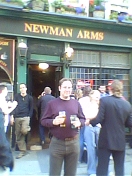
…followed by walk to the Elysee Restaurant, around the corner at 13 Percy Street, which was one of Orwell’s favorite eating places? The default dish here has to be Moussaka, as Orwell ate it on nearly every occasion that he visited this place.
A splendid evening was had by Gabriel Syme and myself (the wicked and iniquitous Johnathan Pearce was a no-show) amidst an impressive collection of privacy and civil liberties activists from across a .. ahem… wide range of the political spectrum.
Cross-posted from Samizdata.net
Simon Davies of Privacy International organised an event this evening here in London in order to honour George Orwell and hoist a drink or three to one of England’s greatest writers on the occasion of his birthday.
Now I know a lot of you have read Orwell’s sundry works… 1984… Animal Farm… etc… but how many of you have drunk a ‘Black and Tan’ at Orwell’s favorite pub, the Newman Arms on 23 Rathbone Street…
…followed by walk to the Elysee Restaurant, around the corner at 13 Percy Street, which was one of Orwell’s favorite eating places? The default dish here has to be Moussaka, as Orwell ate it on nearly every occasion that he visited this place.
A splendid evening was had by Gabriel Syme and myself (the wicked and iniquitous Johnathan Pearce was a no-show) amidst an impressive collection of privacy and civil liberties activists from across a .. ahem… wide range of the political spectrum.
The telescreen received and transmitted simultaneously. Any sound that Winston made, above the level of a very low whisper, would be picked up by it; moreover, so long as he remained within the field of vision which the metal plaque commanded, he could be seen as well as heard. There was of course no way of knowing whether you were being watched at any given moment. How often, or on what system, the Thought Police plugged in on any individual wire was guesswork. It was even conceivable that they watched everybody all the time. But at any rate they could plug in your wire whenever they wanted to. You had to live – did live, from habit that became instinct – in the assumption that every sound you made was overheard, and except in darkness, every movement scrutinised.
– George Orwell, from 1984
Today is George Orwell’s birthday. Happy birthday George, you were right… just a few years too early. And now we have thermal imagers which means even darkness is no shield from the Panopticon State.

Nah! You must be paranoid! It’ll never happen here!
The telescreen received and transmitted simultaneously. Any sound that Winston made, above the level of a very low whisper, would be picked up by it; moreover, so long as he remained within the field of vision which the metal plaque commanded, he could be seen as well as heard. There was of course no way of knowing whether you were being watched at any given moment. How often, or on what system, the Thought Police plugged in on any individual wire was guesswork. It was even conceivable that they watched everybody all the time. But at any rate they could plug in your wire whenever they wanted to. You had to live – did live, from habit that became instinct – in the assumption that every sound you made was overheard, and except in darkness, every movement scrutinised.
– George Orwell, from 1984
Today is George Orwell’s birthday. Happy birthday George, you were right… just a few years too early. And now we have thermal imagers which means even darkness is no shield from the Panopticon State.
Nah! You must be paranoid! It’ll never happen here!
To be honest I have never understood what the fascination people have with so-call ‘reality TV’ programmes like Big Brother. I have forced myself to watch a couple times and ended up despairing for the future of western civilization. Suddenly my taste for explosion filled action movies and lycra clad starlets with guns does not seem so low-brow after all.

Oooo! Very exciting!
No doubt some of our faithful commenters will put me right on this area of complete disconnection between me and this baffling area of popular culture.
But maybe this Disneyfication of the entirely unfunny term ‘Big Brother’ that George Orwell coined will soon be coming to an end.
Then maybe we can start getting more people frowning with concern rather than smiling vacuously at the sound of the words ‘Big Brother’. Why bother watching the TV to see a bunch of self-absorbed cretins in a room back-stabbing each other when you can be in your very own rolling endless episode of ‘Big Brother’ by just walking down almost any CCTV filled high street in Britain?
Here is some real reality TV, staring… you.
 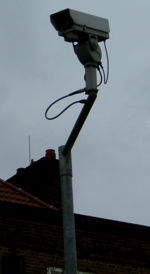

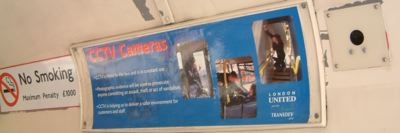
Cross posted from: Samizdata.net
A new speed camera installed at the urging of Robert Marshall, a Conservative on South Staffordshire district council has caught its first few victims, one of whom was… Robert Marshall.
The Tory speed demon was nailed doing a whopping 43mph in a 30mph limit.
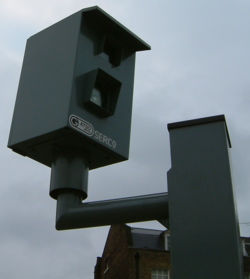
Gotcha, you Tory bastard!!!
Cross posted from: Samizdata.net
|
Who Are We? The Samizdata people are a bunch of sinister and heavily armed globalist illuminati who seek to infect the entire world with the values of personal liberty and several property. Amongst our many crimes is a sense of humour and the intermittent use of British spelling.
We are also a varied group made up of social individualists, classical liberals, whigs, libertarians, extropians, futurists, ‘Porcupines’, Karl Popper fetishists, recovering neo-conservatives, crazed Ayn Rand worshipers, over-caffeinated Virginia Postrel devotees, witty Frédéric Bastiat wannabes, cypherpunks, minarchists, kritarchists and wild-eyed anarcho-capitalists from Britain, North America, Australia and Europe.
|




